
The pressure gauge on a new packaging suite told the story before anyone did. The room was built to hold a steady cascade against the corridor, but each time the boundary door closed, the reading sagged and took minutes to return. The HVAC contractor added makeup air twice. The real problem sat in the frame: a galvanized roller shutter, the model the warehouse runs happily, had been installed at the edge of an ISO 8 zone.
A clean room door and an industrial door can look similar on a quote, and both may carry a CE mark. They are engineered for different jobs, and the price gap buys three invisible things: airtightness under a pressure cascade, surfaces that survive daily disinfection, and evidence that survives an audit. The clean room door vs industrial door comparison below works through seven dimensions side by side, then closes with decision lines.
Category choice is the first split, operation mode the second; the manual or automatic cleanroom door decision guide compares cost, traffic, hygiene, maintenance and compliance for each opening.
Category choice is the first split, operation mode the second; the manual or automatic cleanroom door decision guide compares cost, traffic, hygiene, maintenance and compliance for each opening.
Clean Room Doors and Industrial Doors Side by Side
The fastest way to see the split is a dimension-by-dimension table. Ratings describe typical practice; the first-party rows come from our own line, where we build both families.
| Dimension | Clean Room Door | Industrial Door |
|---|---|---|
| Design goal | Hold a controlled environment | Move goods and people securely |
| Contamination control | Low particle release, non-shedding surfaces | Not a design objective |
| Airtightness | Hermetic seals, gasket compression, interlocks | Weather sealing at most |
| Surface and frame | Flush, ledge-free, cleanable on both faces | Exposed frames, tracks and fasteners |
| Materials | SS304/SS316, HPL, PU-cored panels | Galvanized or aluminum slats 0.8–1.5 mm |
| Certification axis | ISO 14644 classes and GMP design evidence | EN 13241 / EN 12453 safety |
| Cost profile | Controlled-environment asset, higher upfront | Volume durability purchase |
Each row below unpacks one line.
Contamination Control: Two Different Jobs
An industrial door earns its keep by opening reliably forklift after forklift and standing up to impacts. Nothing in its specification asks what the door sheds. A clean room door starts from the opposite question: whatever it adds to the air must stay near zero, because filtration pays for every particle it must not remove.
That inverted goal changes hardware throughout the leaf. Bearings run in cleanroom-grade grease, vision panels sit flush, and interlocked models tie two leaves together so the doors never open together. Our best door for a clean room guide ranks the common options by classification.

Airtightness and the Pressure Cascade Duty
Controlled facilities live on pressure. Guidance around ISO 14644-4 commonly works with 5 to 20 pascals between rooms, and EU GMP discussions use roughly 10 pascals as a cascade step. A boundary door with leak paths turns that cascade into a sawtooth, bleeding the gradient at each closure.
Hermetic models answer with compression gaskets that clamp the leaf against the frame, and some add air lock behavior so the doorway re-establishes pressure as it closes. Door family matters here too: supplier guidance notes manual sliding doors leak noticeably more air than swing doors. A standard industrial shutter does not enter this contest, which is why rooms that cannot hold differential end up replacing it. Our cleanroom high speed doors vs standard industrial doors comparison covers that failure path.

Surfaces and Materials Built for Cleaning
GMP-style expectations describe the door plainly: a seamless surface and frame that gives bacteria nowhere to lodge and does not warp under washdowns. That favors flush leaves set into the wall line, frames without ledges, and fasteners recessed or gone. An exposed industrial track is the opposite geometry, collecting residue where a mop cannot follow.
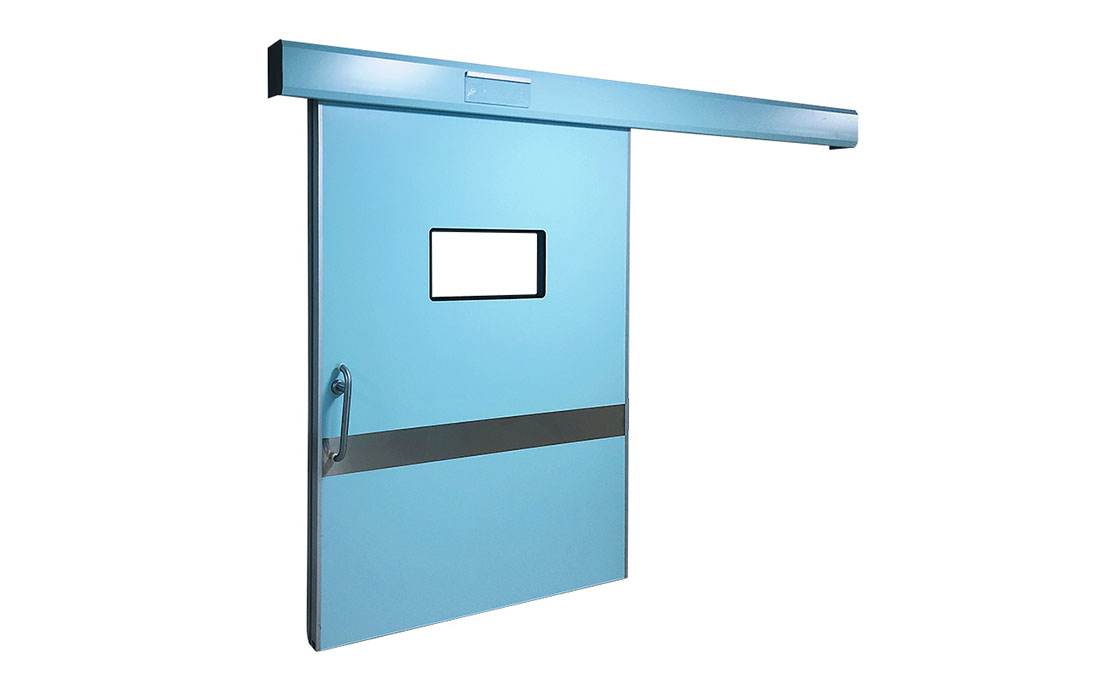
Materials follow the same logic. Our clean room line works in SS304 or SS316, HPL and PU-cored panels chosen to tolerate the disinfectant rotation. Controlled-suite leaves commonly run 60 millimeters thick or more, against the 0.8 to 1.5 millimeter slats of a galvanized roller shutter. To see those builds as a set, the clean room doors range lists airtight, stainless and interlocked models with full surface options.
Compliance and Certification Go Different Ways
The two families certify against different questions. Industrial doors document mechanical safety: our range carries CE under EN 13241 with EN 12453 covering the operator, proving the door will not hurt people passing through. A clean room door is documented against ISO 14644 classes and GMP design expectations, proving it will not hurt the product made there.
Those evidence axes do not substitute for each other, and auditors read them separately. A safety certificate says nothing about particle release or seal performance, and a cleanliness dossier says nothing about force limits at the leading edge. Specify both whenever a doorway sits at the edge of a classified zone.
What the Price Gap Actually Buys
Clean room doors cost more, and the premium is easier to defend once itemized. Stainless construction raises the purchase price, and operators accept it because a shutdown in a regulated suite costs more than the door; stainless cleanroom door suppliers make exactly that argument. Automation is a second lever: guidance commonly quotes manual units 30 to 50 percent below automatic.
The gap runs the other way too. Fitting a cleanroom-grade door on a general warehouse bay buys performance nobody audits, so the disciplined question is which room you are buying for. Price the door to its duty.

Which One Should You Choose
A clean room door vs industrial door decision settles most projects along four lines. First, any room with an ISO class or an audit calendar gets a clean room door, full stop. Second, general storage, docks and machine halls stay with industrial doors, which are cheaper, tougher and certified for that duty.
Third, the transitional spaces between them, airlocks, gowning and buffer rooms, take hermetic or interlocked models so the cascade survives the traffic. Fourth, when pallet traffic must cross a classified boundary at speed, a cleanroom-rated high speed door is its own topic. Our overview of what a cleanroom high speed door is starts there.
Put those four lines over your floor plan and nearly every doorway sorts itself. The ambiguous handful, usually shared logistics corridors, deserve a pressure calculation before the purchase order, not after a failed balance reading.
Before acceptance day, bundle the paperwork to match the door. The industrial bay hands over its safety file under EN 13241 and EN 12453; the clean side hands over its cleanliness and sealing dossier. An auditor will not reconcile the two regimes for you, and the facility that keeps the evidence sets separate passes.
Clean Room Door vs Industrial Door Questions
Can a standard industrial door work inside a clean room?
Not as the boundary door. It is built for durability and security, not particle control, sealing or cleanable surfaces, and it cannot hold a pressure cascade. Controlled zones specify clean room doors instead.
What pressure differential do clean room doors hold?
Guidance around ISO 14644-4 commonly works with 5 to 20 pascals between rooms, and EU GMP discussions use about 10 pascals as a cascade step. The door and its seals hold those figures as part of the envelope.
Why do clean room doors cost more than industrial doors?
Non-porous cleanable materials, hermetic sealing hardware, and documentation that survives audits. Stainless units also cut shutdown risk in regulated rooms, offsetting the higher purchase price over the room’s life.
Are sliding cleanroom doors as airtight as swing doors?
No. Supplier guidance notes manually operated sliding doors leak noticeably more air than swing doors and age faster. Where pressure duty is high, swing or hermetic models with compression seals are safer.
Does a CE mark make a door cleanroom ready?
No. CE under EN 13241 covers mechanical safety. Cleanroom readiness is documented against ISO 14644 classes and GMP design expectations, a different evidence axis a safety certificate cannot substitute.
The comparison above stays at the hardware level. The regulatory side, why cGMP facilities ban standard industrial doors altogether, is its own argument.