Between 30 and 50 percent of what you pay for an insulated commercial roll-up door goes to installation labor, not to the door itself. That single share explains most quote shock on industrial projects. Two buyers can hold quotes for the same door size and still see totals that differ by thousands. The gap is rarely the panel; it is the lines you cannot see.
We build these doors in a factory that ships them without installation crews, so we sit on the supply side of that divide. That position has taught us what a complete quote looks like and what a cheap one quietly removes. Here is the full industrial door cost, line by line. The features that fill those pools are the same ones that define the category, which we itemize in our guide to what features make an industrial door.
What You Are Actually Paying For
Spread any installed quote on the table and it separates into four pools: the door leaf, the drive, the hardware, and the labor that puts them to work. An Australian cost survey splits an installed industrial roller shutter the same way, and the proportions hold across markets. The door itself is only the largest line, never the whole bill.
| Quote Line | What It Covers | Verified Range | Market Context |
|---|---|---|---|
| Door leaf and hardware | Curtain, tracks, springs, seals | AUD $1,700–$6,095 | Installed Australian quotes |
| Opener and controls | Motor, drive, safety edge | AUD $750–$1,000 | Same market, per door |
| Installation labor | Crew, lifting gear, commissioning | AUD $300–$600 | Same market, per door |
| Insulated panel upgrade | PU core instead of single skin | AUD $280–$380 vs $220 per m² | Supply price, ex-works |
US wholesale price lists read differently because they exclude the fitter. Basic commercial overhead doors list at $600 to $1,200, insulated versions at $900 to $2,500, and motorized systems from $1,200 to $3,500. European warehouse figures land near €2,000 to €6,000 installed. Keep the currencies and markets apart; a blended “global range” is a number nobody can buy against.
Installation and Building Work Costs
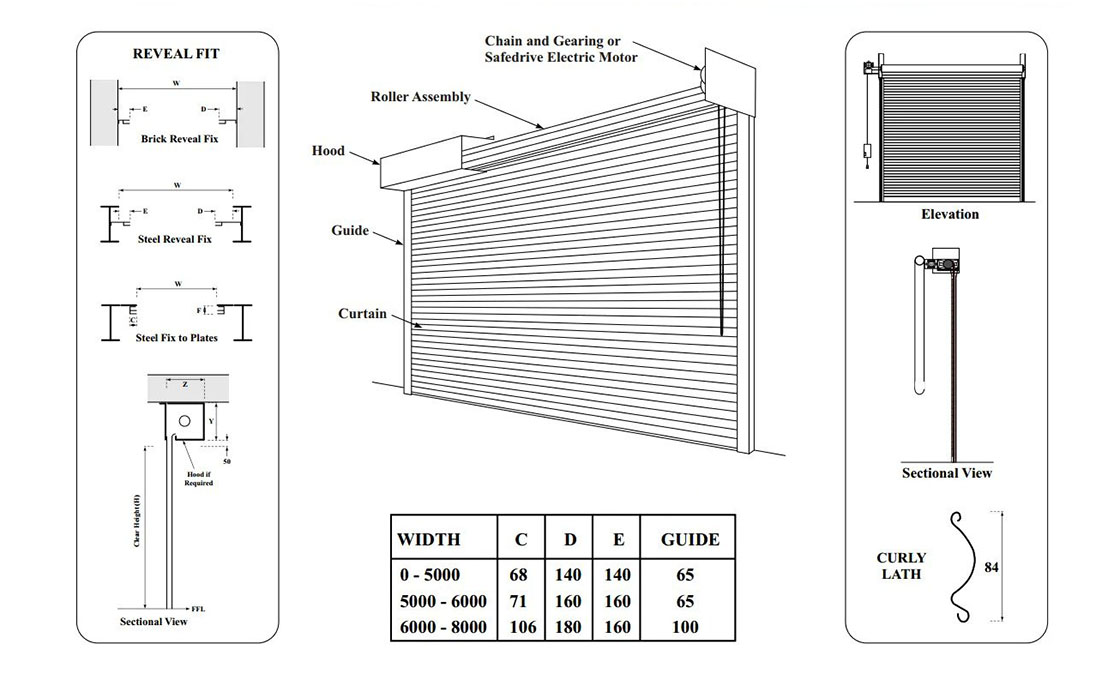
Labor deserves its own budget line, because at 30 to 50 percent of project cost it outranks most hardware upgrades. Crews charge for lifting equipment, site time, and commissioning, and those inputs vary with the opening, not with the door. A dock door set in a clean steel frame is a morning’s work. The same door over a rough masonry opening with a skewed lintel can take two days.
A supply-only quote is like buying an engine without a gearbox. The engine has an honest price tag, but nothing moves until someone prices the driveline, the mounts, and the fitting. Most manufacturers outside your border, us included, quote this way: the door ships with drawings and manuals, and your local contractor prices the works. Before comparing quotes, check that every bidder drew the same boundary, because each will price installation, connection, and first-cycle testing differently if you let them.
Building work is the line buyers forget to write down. Headroom and side room may need steelwork, the lintel may need shimming, and the operator needs a power point within reach.
None of that appears on a factory invoice. We have seen a door reach port while its opening was still bare blockwork and the lifting crew already demobilized. the UK HSE framework assigns installation and maintenance duties explicitly between the supplier and the operator of work equipment. Decide in writing who carries which duty before the door ships.
The Hidden Costs After Installation
The purchase price is a down payment on roughly 15 to 25 years of ownership. Three running pools follow the door through that life: energy, downtime, and parts. None of them shows up on day one, and all of them show up on the same invoice you signed.
Energy Follows the Open Time
An uninsulated single-skin curtain in a heated bay leaks money in two directions: conduction through the panel and air exchange while the door stands open. Insulated sectional panels at 40 to 50 mm with a U-value near 0.33 W/m²K cut the conduction term to a fraction. Fast doors rated at 0.8 to 2.5 m/s attack the second term by shrinking every open-close cycle. You do not need a consultant to see your own number; a split-meter reading across one week of shifts will rank your openings by loss.
Downtime Is the Line Nobody Prices
A jammed door does not bill you, yet a blocked bay stops trucks, shifts, and sometimes the cold chain behind it. This is why we tell buyers to weight spare-part response above almost any other after-sale term. Our own policy ships warranty parts by DHL or FedEx within 5 to 7 days. A part that arrives in three weeks converts a minor fault into a lost contract. Price that risk into the comparison, even roughly, and cheap quotes start looking expensive.
Warning: energy and downtime costs differ by site, so no honest writer can print a universal figure. Measure your own openings for one representative week and compare doors on your data, not on a brochure average.
How to Read a Quote Like an Auditor
Auditors do not read totals; they read rows. Treat every quote as a claim about scope and verify each row the way you would verify an invoice. The method takes an hour and routinely moves the ranking of three bids.
Line Items Cheap Quotes Leave Out
Springs are the classic hiding place. Standard torsion springs are rated near 20,000 cycles while heavy-duty sets reach 50,000. On a busy dock the cheaper set is a mid-life purchase you simply make early. Panel thickness moves the same way, with 40 mm and 50 mm PU cores priced apart for a reason.
Track gauge, window cuts, and wind locks each carry cost, and a row that names no specification is a row the bidder plans to value-engineer later. Certification is the last silent line: ask whether CE EN 13241 and EN 12453 documentation, factory test reports, and CAD installation drawings come with the door. Sourcing them afterwards costs more than getting them at the works.
Making Three Quotes Comparable
Normalize before you rank. Fix one specification, same opening size, same spring cycle rating, same insulation grade, same control package, then ask each bidder to reprice that single sheet. Special door types deserve the same discipline. A fire rated industrial steel door carries a genuine premium over a non-rated leaf because of the core, the hardware, and the test evidence behind it. Judge each premium against the requirement, not against the cheapest unrelated door.
This is where the real industrial door cost debate settles: not on who quoted lowest, but on who quoted the same thing.
A Ten Year Total Cost View
Stretch the ledger to a decade and the pools rebalance. A door is a 15-to-25-year asset, so the purchase price amortizes into a modest annual figure while energy, maintenance, and parts accumulate every shift.
Insulation is the clearest case. The upgrade from a single skin to a PU core adds real money per square meter at purchase. It pays back in every heated or chilled month after. Cycle rating works identically, since a 50,000-cycle spring on a high-traffic opening simply removes one planned mid-life replacement.
Material choice changes the same ledger from another direction, and we cover that trade-off in detail in our guide to why aluminium roller shutters carry a higher price. The honest summary is that no single line wins on its own. Total cost of ownership rewards the buyer who matches each premium to traffic, climate, and duty, and who refuses to compare across mismatched scopes. When you are ready to rank openings and door types together, our selection guide for industrial doors walks that decision in full.
Every factor on that ownership list starts with a purchase price, and the seven factors that move an industrial door quote are broken down line by line in what drives the price of an industrial door.
Frequently Asked Questions
How much does an industrial door cost installed?
Installed ranges run from AUD $2,850 to $12,000 for roller shutters in Australia, €2,000 to €6,000 in Europe, and $600 to $3,500 at US wholesale before fitting. Size, insulation, and automation move every figure.
How much does installation add to the price?
Published industry figures put installation labor at 30 to 50 percent of total project cost for insulated roll-up doors. Complex openings, steelwork, and site access push crews toward the upper end of that band.
Why do quotes for the same door differ so much?
Bidders draw different scope boundaries. One price includes lifting gear, commissioning, and steelwork while another lists only the door. Normalize every bid to one specification sheet before comparing totals.
Does motorization change the industrial door cost much?
Published add-on pricing for motorization runs about $200 to $1,300 depending on duty class and controls. Heavy-cycle operators sit at the top of that band, and the wiring is usually a separate local trade.
How long should an industrial door last?
Insulated roll-up doors are typically credited with 15 to 25 years of service life. Spring cycle ratings, duty frequency, and maintenance discipline decide where any individual door lands in that range.