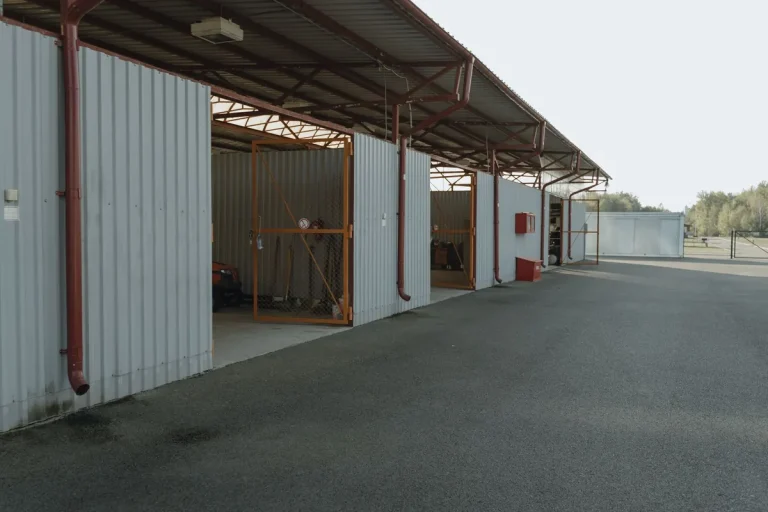
A cold-store buffer door opens a thousand times a shift, and every opening trades chilled air for warm outside air. High-speed rigid rolling doors exist to close that trade. They use solid insulated panels instead of a flexible curtain, so the open-door time and the leakage at the edges both shrink. For storage operators, that difference shows up on the power bill and on the forklift clock.
The choice is not automatic. High-speed rigid rolling doors cost more up front, and they top out faster than a flexible PVC curtain. The useful question is which storage bays justify the premium, and where a lower-cost curtain still fits.
Where Flexible PVC Doors Start to Fail
Most storage buildings begin with flexible PVC doors, because they are inexpensive and quick to install. Volume then grows, and the same door starts to fail in three separate ways. None of the three shows up on the purchase order.
When a cold buffer door cannot close fast enough, the compressor pays for the gap every hour the plant runs.
Cold is the first problem. A PVC curtain stiffens as the temperature drops, and its edges warp against the frame. The closed-position seal weakens season by season, so a door that sealed acceptably at handover leaks air a year later.
Traffic is the second problem. A slow door queues forklifts at the threshold. One extra second per pass is trivial; a few hundred passes a shift is not. Throughput quietly caps out at the speed of the slowest door on the route.
Wind is the third problem. An exterior curtain catches the breeze and billows, which lifts the edge seal and can stall the door mid-cycle. On an exposed loading bay, that is a reliability risk rather than a comfort issue.
How Rigid Rolling Doors Actually Work
A high-speed rigid rolling door replaces the curtain with solid insulated panels. Those panels run inside a spiral track and coil above the opening. Because the panels never drag against the guides, the door can cycle fast without shredding its edges.
The components are simple, and each one earns its place.
- Rigid panel
- Double-layer aluminium around a polyurethane core, typically about 40 mm thick.
- Spiral track
- A curved guide that rolls the panels into a compact coil above the opening.
- Anti-wind wheels
- Rollers spaced about 220 mm apart in published spiral designs, holding the panel against lateral wind pressure.
- Thermal break
- An insulating separator that stops heat from conducting straight through the metal frame.
Panel alloys matter more than the brochure suggests. A 6063-T5 or 6063-T6 extrusion holds its shape under repeated flexing, which is why it outlasts thin sheet metal on a busy bay.
Speed is the payoff. Our high-speed rigid rolling doors open and close between 0.8 and 2.5 m/s, so a cold buffer closes before the cold air clears the threshold. For shallow headrooms, a telescopic high-speed rigid door folds the same panel stack into less overhead space.

Rigid Rolling Doors vs Flexible PVC Roll-Up Doors
Comparing high-speed rigid rolling doors with flexible PVC curtains comes down to five measurable differences: panel structure, insulation, wind class, opening speed and where each door belongs. The table below sets typical supplier-published ranges side by side, not one tested unit.
| Feature | Rigid rolling door | Flexible PVC door |
|---|---|---|
| Panel structure | Double-layer aluminium with PU core, about 40 mm | Single flexible PVC curtain |
| Insulation | 0.5 to 1.2 W/m²K | 3.5 to 5.5 W/m²K |
| Wind class | Up to Level 12 | Level 3 to 6 |
| Opening speed | 0.8 to 2.5 m/s | 0.6 to 2.0 m/s |
| Perimeter seal | Mechanical brush, rubber and weighted edge | Contact pressure only |
| Best opening | External bays and deep-cold buffers | Internal partitions and pedestrian zones |
The gap is real, but it is not uniform. Across published supplier data, rigid panels insulate far better and hold more wind. Both families overlap on speed, and a rigid door still reaches the higher top end.
Sealing is the quieter difference. A rigid door closes metal against a mechanical seal, so the perimeter is positive. A curtain closes by contact pressure alone, and that pressure fades as the material ages.
If the door sits indoors and never sees wind, the choice narrows to fabric versus spiral high-speed doors rather than rigid versus flexible.
Thermal Performance in Cold Storage
Insulation is where high-speed rigid rolling doors pay for themselves. Supplier data published for this class puts a rigid insulated panel at 0.5 to 1.2 W/m²K, against 3.5 to 5.5 W/m²K for a PVC curtain. A lower U-value means less heat crosses each square metre at the same temperature difference.
The core material explains the gap. Published figures put polyurethane foam near 0.022 to 0.028 W/mK, so a 60 mm panel can reach 0.5 W/m²K. For reference, our own insulated sectional doors reach 0.33 W/m²K. That figure belongs to the sectional line rather than this spiral door, and it shows what a thick insulated panel can do.
Temperature differential decides how much that matters. Hold -20 °C inside against +20 °C outside, and the 40 °C difference turns any U-value gap into continuous compressor load. Supplier ranges place some rigid doors from -40 °C to +60 °C, with soft curtains nearer -20 °C to +50 °C.
Condensation tells the story first. When warm air meets a cold, poorly sealed edge, it beads and then freezes. The fix is a positive seal, not a thicker panel.
What Wind Load Should a Storage Door Hold?
External performance is a standards question, not a marketing one. In Europe, EN 12424 classifies a door by the wind pressure it must hold and the deflection it is allowed. North America uses the ANSI/DASMA classification instead.
Read three numbers together when you compare quotes:
- Rated wind pressure: the pressure the door holds in normal service.
- Ultimate wind pressure: the pressure it survives without structural damage.
- Deflection limit: the panel movement allowed, often set as a fraction of height.
A supplier’s published test sheet for a spiral door lists a rated pressure of -0.5 kPa, deflection below L/180, and survival at 3.5 kPa. That sheet grades the door Class 3 on a separate standard, G/T302-2011, so it is not directly comparable with an EN 12424 class. Our spiral rigid doors are rated to Class 5, equal to 12 on the Beaufort scale. For scale, a 12-level typhoon produces roughly 0.8 kPa.
Opening size drives the class. A wider or taller opening catches more wind, so a bay that passes internally may still need a reinforced track outside. Anti-wind rollers along the full height keep the panel from bowing under that load.
Testing records should travel with the door. See how rigid high-speed doors are certified and tested before you approve a supplier’s wind claim.

Safety, Controls, and Cycle Durability
A powered door that cycles thousands of times a day needs safety devices that do not depend on the operator watching. Light curtains and photocells should span the opening, and a safety edge should cover the closing face.
Control quality shows up in the motion. A servo drive with a controlled acceleration curve starts and stops the panel gently, which protects hinges and the track. Radar or loop detection lets the door tell a forklift from a pedestrian.
Durability is a specification, not a promise. Our operators are IP65 rated, and published duty data for this door class exceeds 1,500 cycles a day. Each item below deserves its own line in the submittal.
Light Curtain and Photocell
A light curtain or photocell should span the full opening, so a stopped load never sits in the door path.
Safety Edge on the Closing Face
The bottom edge carries a contact strip that reverses the panel the moment it meets an obstacle.
Emergency Manual Release
A manual release lets staff open the door during a power failure, when the drive cannot move it.
Servo Drive and Acceleration
A servo drive with a controlled acceleration curve starts and stops the panel gently, protecting hinges and the track.
Cycle Rating and Warranty
Ask for a stated daily cycle rating and a matching warranty: two years on the body, three on the operator, five on a servo motor.
Powered doors are work equipment, so maintenance is a legal duty in many markets. The HSE guidance on work equipment and machinery is a useful starting point for a maintenance regime.
Which Door Fits Your Storage Facility
The decision follows three inputs: where the opening sits, how cold it runs, and how often it cycles. Match those and the door type usually picks itself.
| Storage area | Opening location | Duty | Recommended door |
|---|---|---|---|
| Freezer and blast buffer | Internal between zones | Very high, deep cold | Rigid rolling door |
| Chilled food handling | Internal or external | High, washdown | Rigid rolling door |
| Ambient warehouse | Internal partition | Moderate | Flexible PVC door |
| External loading bay | Exterior, exposed | High, wind and security | Rigid rolling door |
| Pedestrian or clean corridor | Internal | Very high, light traffic | Flexible PVC door |
We would still choose a flexible curtain for an internal partition or a clean pedestrian corridor. It is fast, inexpensive and easy to repair. For an exterior bay, a deep-freeze boundary or a high-security store, the rigid door wins on the numbers that outlast the invoice.
If you are weighing a rigid door against a general roller shutter, the trade-offs differ from the PVC comparison. High-speed door versus roller shutter covers that separate decision.
Good maintenance keeps either door honest. HSE notes on maintaining work equipment safely apply to powered doors as much as to any other machine.

Frequently Asked Questions About Rigid Rolling Doors
Are rigid high-speed doors better than PVC fast doors for cold storage?
For freezer and chilled buffers, yes. Published ranges put rigid panels at 0.5 to 1.2 W/m²K against 3.5 to 5.5 W/m²K for PVC. A rigid door cuts conductive heat gain and keeps its shape as temperatures swing.
What wind load class does a rigid high-speed rolling door need?
Match the class to the opening. EN 12424 classes the door for the rated pressure and deflection it must hold, and exposed external bays typically need a higher class than internal doorways. Our spiral rigid doors reach Class 5, or 12 on the Beaufort scale.
How fast do rigid high-speed rolling doors open?
Our rigid rolling doors open and close between 0.8 and 2.5 m/s. The rigid panels reach full opening fast enough to hold a cold-store buffer band without long open-door intervals.
What standards apply to rigid rolling doors and their operators?
EN 13241 covers the door product, EN 12453 covers power-operated door safety, and EN 12424 classes wind load. Our doors ship with ISO 9001:2015 quality records and CE EN 13241 conformity documentation.
Do rigid doors slow forklift traffic compared with PVC doors?
No. Rigid doors reach 0.8 to 2.5 m/s, above the 0.6 to 2.0 m/s typical of PVC curtains, so a truck waits less at a rigid door. A billowing curtain also holds traffic up at the threshold.