






The break-in report lands a week after the incident, and the detail that stings is not the stolen stock. It is the investigator’s note that nobody ever tested the doorway. The attackers spent ninety seconds on the guides and the bottom edge, gave up on the curtain, and were never challenged by a connected system. The parts that decide the outcome are rarely the parts on the quote.
We build roller shutters in Hebei on our own production lines, a factory running since 1999. Security questions reach us from warehouse operators and spec writers more often every year. The honest answer has five layers: ratings, hardware, integration, wind and paperwork. High performance roller shutter security is a chain, and this guide walks it as an intruder would.
What an Opening Actually Hands to an Intruder
Start from the attacker’s side and the doorway stops being one object. The curtain resists pushing, so a serious attacker tests elsewhere. Guide rails on industrial doors are screwed to the structure, and those fixings set how long prying takes. The bottom rail can be lifted if the guides allow vertical play. Side gaps decide whether a bar fits, and the control box opens with a signal, not a crowbar.
High performance roller shutter security starts with honest scoring: rate the weakest of these five, because that is where the attack time goes. A thick curtain on shallow, lightly fixed guides buys almost nothing. Two shutters of identical thickness can behave nothing alike in one incident. The sections below score each layer, ratings first.
Site layout matters before any hardware is chosen. Openings facing public space must look impenetrable, while fenced ones let detection work early. Our guide on sectional doors in a warehouse security plan covers how door type and layout share that job; this article stays on the shutter.
Installation quality deserves a separate warning, because a correct design can still be fitted badly. Guide rails set out of plumb create the very side gaps the design eliminated. Fixings driven into a deformed sheet instead of the column hold a fraction of the intended load. A security rating describes a tested assembly, installed the way the test article was installed. The crew therefore belongs in the security conversation from the day the order is placed.
Reading the Two Ratings: EN 1627 and LPS 1175
Two documents dominate the security side of industrial door specifications, and they measure the same idea differently. EN 1627 classifies burglar resistance from RC1 to RC6, its scope explicitly includes shutters and grilles, and the attack tests sit in EN 1628 to 1630. Broadly, an RC2 curtain holds simple hand tools off for roughly three minutes, and RC3 adds resistance to crowbar-class leverage. LPS 1175 takes a second route. Its Issue 8 grades products by tool category and working minutes, so legacy SR1 becomes A1: kit A, small levers and screwdrivers, for one minute.

The systems are two dialects rather than rivals. European quotes lean on RC classes, UK insurers often ask for LPS 1175 grades, and both answer one question: how long, with which tools.
| Rating | Attack tools assumed | Approximate resistance | Typical fit |
|---|---|---|---|
| EN 1627 RC1–RC2 | Hands, screwdrivers, pliers | About 1–3 minutes | Interior openings, retail after hours |
| EN 1627 RC3 | Crowbars, heavy levers | About 5 minutes | Warehouses with goods near the door |
| LPS 1175 A1 (legacy SR1) | Kit A: knives, small pry bars | 1 minute working time | Opportunist deterrent |
| LPS 1175 B3-class (legacy SR2) | Kit B adds bolt cutters, drills | 3 minutes working time | Unattended, insurer-specified sites |
One boundary belongs here. Our factory holds ISO 9001:2015 and CE marking under EN 13241 with EN 12453, and we build hardware toward an RC or LPS target. Certification of a complete opening is issued per tested product. A high performance roller shutter security line should name the rating, the class and the certifier. That is what turns intention into a contractual line.
Ask for the certificate number, not the class word. A specification reading “RC3-equivalent” has no test behind it. A named tested product and rating can be checked in the certifier’s public listing.
Where Shutters Are Pried: Guides, Locks and Bottom Rails
Hardware is where the rating becomes physical, and four details carry most of it. Guide depth comes first: the deeper the curtain sits in the rail, the more leverage a prying bar needs. Guide fixing comes second, because deep rails on close fixing centres spread attack load into the structure rather than a few screws. Side clearance comes third; a tight-running curtain leaves nothing to insert. Fourth is the locking set, where a locking bottom edge or end locks stop the lift-and-peel that opens a curtain like a zipper.
Curtain construction supports all four without being extreme. Our curtains roll from galvanized steel, aluminum or stainless slats between 0.8 and 1.5 mm, on openings up to 12,000 mm wide. How slat material and thickness interact with rolling radius is covered in our slat material guide. The security point is narrower: a curtain that holds its shape under twist and pull keeps the side gaps closed.
Check the manual state, not just the motor. A chain override left engaged during unattended hours lets anyone raise the curtain slowly. Make “override disengaged or padlocked” a closing-time line.

Connecting the Door to Access Control and Alarms
An industrial door that ignores the alarm system is a hole with a schedule. Integration starts with the operator: our smart operators carry IP65-sealed electronics and speak RS485, WiFi or Bluetooth, so the door can report state instead of only obeying buttons. An opening that reports “closed, locked, commanded by whom” turns every incident review into a log. One that stays silent leaves CCTV as the witness.
Four steps put a high performance roller shutter inside the security system. Signal the door state to the intrusion panel so arming fails while the curtain is up. Interlock the operator with the alarm so nothing commands the door open while the zone is armed. Feed badge events into the same log as door commands, then give the audit trail an owner. On a motorized roller shutter all four steps are wiring and configuration rather than mechanical change, which is why they belong in the original order.
Integration also changes what maintenance means. A sensor that stops reporting door state is a security fault, not a convenience fault, so state feedback belongs in the periodic test routine alongside the safety edge. Credentials deserve the same discipline as keys: leavers lose access the day they leave, and contractor badges expire with the contract. Facilities that treat the door log like the alarm log catch both problems in a weekly review.
Two limits keep integration honest. High-frequency openings defeat any “always closed” policy, so the real control is a schedule: lockout outside operating hours, credential-controlled opening inside them. And safety always overrides security. The forced-open behaviour required by EN 12453 protects people, and the high speed door safety features that deliver it stay wired ahead of any security interlock. A door that traps a worker to stop a thief fails both audits.

Wind Load and Curtain Strength in the Security Case
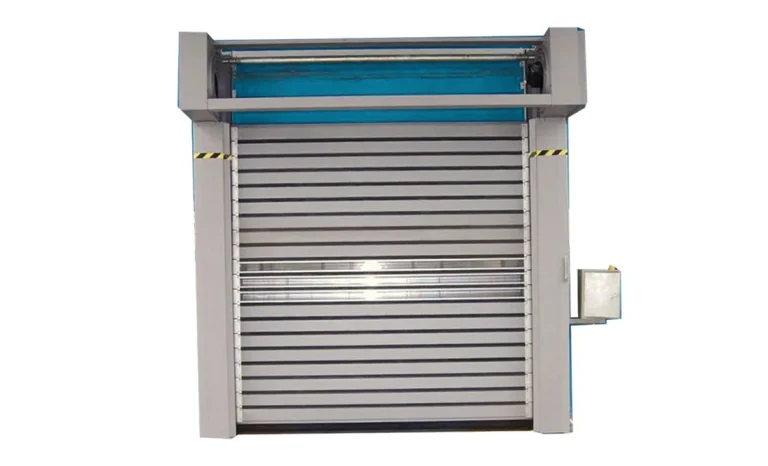
Security reviews usually end at the attacker and forget the weather. Wind on a large curtain loads the same guide engagement that resists prying, and a curtain blown out of its rails leaves the opening open to anyone. On industrial doors the two protections share hardware, so wind class belongs on the security checklist. Our spiral rigid doors are built to wind resistance Class 5, and our windproof roller shutter line carries reinforced guides for exposed openings.
Retention hardware is the second half of that story. Deeper guide channels, retention flanges or added rail sets hold the curtain edge under wind suction. Choosing between them is the choice a security buyer is already making. We keep the mechanics in how wind locks keep the curtain tracked. The takeaway: specify wind class and intrusion rating together, because both are claims about the same steel in the guide.

| Build | Curtain | Wind behaviour | Security character |
|---|---|---|---|
| Single-skin steel shutter | 0.8–1.5 mm galvanized slats | Needs retention hardware | Deterrence and delay, fastest cycle |
| Insulated double-skin shutter | Double skin with PU core | Stiffer curtain, same guide logic | Delay plus energy performance |
| Spiral rigid high speed door | Insulated aluminium slats | Wind Class 5 rated | Highest stiffness per cycle |
A Security Checklist to Run Before Sign-Off
On any industrial door project, acceptance is where security specifications quietly die, so run the doorway through a fixed list before the invoice is paid.
- The rating line names the standard, the grade and the certifier, with a certificate number you can look up.
- Guide rails state depth, material and fixing centres, and the installed rails match the drawing.
- The locking set is identified: bottom-rail edge lock, end locks or ground lock, with key control noted.
- Side clearance is measured at three heights; nothing thicker than a coin fits, and nothing shifts when the curtain is pulled by hand.
- The manual override disengages cleanly, and its unattended state is in the site’s closing procedure.
- The operator reports door state to the intrusion panel, and arming fails while the curtain is up.
- The audit log shows who commanded the door, when, and from which credential, on the test day.
- Wind class and security rating appear on the same document, signed by the same supplier.
The list earns its keep in the failures it catches. A rail bolted to sheeting instead of steel misses line two. An operator wired without state feedback sails through line six until the first false alarm. Those findings are cheap on handover day and expensive after a break-in. That is the argument for accepting a doorway against a written list, not a demonstration. For the component itself, our guide to release position versus locks and anti-lift covers the release types and their security trade-offs.
Documents close the list because insurers read them before they pay. The energy side of the same door earns its own paperwork, and the security line deserves identical treatment. A doorway documented this way reads to adjuster, auditor and attacker alike as a finished decision, not an assumption.
A shutter is a chain of curtain, guides, locks, controls and procedure. Attackers, standards bodies and insurers all test the weakest link, so accept the doorway as one system.
The security argument does not sit alone; it is one of five levers that make steel the default leaf material in demanding openings. The five-advantage case is set out in our guide to high performance steel doors, alongside strength, fire, maintenance, and lifecycle cost.
Frequently Asked Questions
What is the difference between door safety and door security?
Safety protects people from the door moving, and is governed by EN 12453. Security protects the opening against people, and is measured by EN 1627 or LPS 1175 resistance ratings.
Which security rating should a warehouse roller shutter meet?
Openings near stored goods usually justify RC3 or the LPS 1175 B-class range; low-value or interior openings often accept RC2 or A1. Match the rating to attack time an insurer would recognise.
Can a high-speed roller shutter integrate with access control?
Yes. A high performance roller shutter security link works when the operator offers status feedback over links such as RS485. Then door state, credentials and alarm arming share one log.
Does a thicker curtain automatically mean a more secure door?
No. Attackers target guide fixings, side clearance and the bottom rail. A thin curtain in deep, closely fixed guides with end locks outperforms a thick curtain on shallow rails.