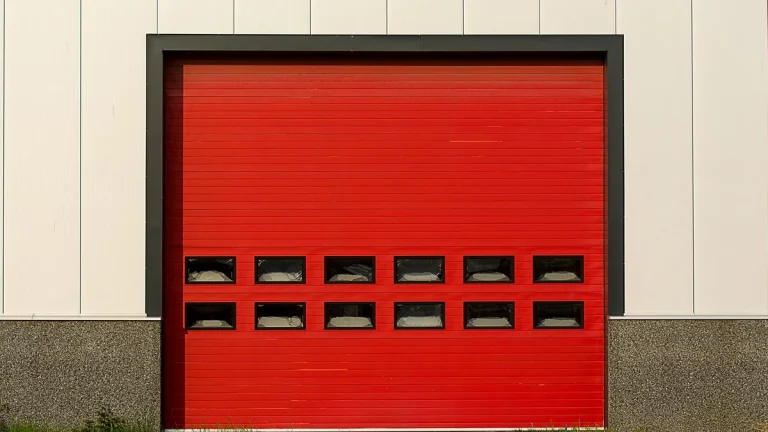
A loading dock door starts to bite its latch. The lock side has dropped half an inch, and the top edge scrapes the frame head every cycle. Nobody suspects the two pieces of steel holding the whole leaf: the hinges. The delay is expensive, because a sagging door points to worn hinge knuckles or pins, and every extra week grinds the whole opening out of square.
Hardware below the panels belongs in the same inspection walk-down, starting with industrial door bottom seals, which wear faster than any hinge.
We build industrial doors and their components at the factory, and our view of this part is blunt: a hinge is a bearing that got sold as a bracket. Treat it as one, and the decisions below become straightforward.
Panel weight reaches the rails through the hinges; the guide to industrial door guide rails and brackets follows that load path into the brackets and the structure.
How Hinges Carry an Industrial Door
Follow the load path. The full weight of the door hangs on its hinges through every opening cycle. The hinges pass it into the roller stems, and the industrial door tracks and rollers hand it on to the building. Panel hinges on a sectional door do double duty, carrying the next panel and the roller stem together. A hinge is therefore the axle of the door: knuckle, pin and leaves working as one bearing.
Reading it as a bearing explains most field behavior, because bearings fail from overload, dirt, corrosion and lost lubrication, and hinge knuckles fail the same way. The rest of this page applies that logic: pick the class, match the material, then read the wear.

Hinge Types and Where Each One Belongs
Ball-bearing butt hinges are the default on industrial swing doors, because the bearing inside the knuckle carries frequent cycles far better than a plain pin. Continuous hinges, often called piano hinges, run the full door edge and spread the load along the whole height. Pivot sets carry very heavy leaves on a single rotating point, moving the stress into the frame.
Several special-purpose designs earn their place. Lift-off hinges let a crew remove a door without unscrewing anything, and weld-on types suit fabricated steel frames where no mortise exists. Spring hinges close the door on their own power.

Concealed hinges stay hidden when the leaf shuts, which matters on food and cleanroom lines. Counterbalance and torque-assist types belong mostly to lids and machine guards, so we leave those to the enclosure engineers.
Matching Hinges to Door Weight, Height and Traffic
Sizing starts with three numbers and a setting. Heavy-weight hinges are specified for doors over 175 pounds and past 400 cycles per day. The same class applies above 7 feet of height, past 3 feet 6 inches of width, and on wind-loaded exterior doors. Miss a threshold and a standard hinge becomes an undersized one, the part that later shows up as fatigue cracks.
Door height sets the hinge count. Usual practice runs two hinges up to 5 feet, three from 5 to 7 feet 6 inches, and four above that, with one more per additional 2 feet 6 inches. A heavy or high-cycle door needs heavy-weight hinges no matter how many are fitted, and one hinge beyond the minimum stretches service life. The standard commercial leaf measures 4.5 by 4.5 inches.
| Door height | Hinges |
|---|---|
| Up to 5 ft | 2 |
| 5 ft to 7 ft 6 in | 3 |
| Over 7 ft 6 in | 4 |
| Each extra 2 ft 6 in | +1 |
Weight alone is not the whole specification: hardware engineers also weigh the center-of-gravity moment of an offset leaf, hinge spacing, frame stiffness and vibration. One fit detail traps replacers, because hollow metal frames are machine-prepped to the ANSI A156.1 template pattern, and a non-template hinge will not line up. Our industrial door hinges are made to drawing, so leaf size, holes and material match the door, not the shelf.
Materials, Environments and the Fire-Rated Boundary
Material follows the wash water and the weather. Carbon steel carries load in dry interiors, stainless 304 handles washdown and humidity, and 316 earns its premium where chlorides or coastal air attack hardware. Plated and zinc-alloy pieces stay on light duty.
Fire doors draw a hard line around this choice. Every hinge on a fire-rated assembly must be listed for the rating, in steps of 20 to 180 minutes, in steel or stainless only. A non-listed hinge voids the rating of the whole assembly, which is what the annual NFPA 80 check exists to catch. A spring hinge may close a fire door only when it carries the same listing.
Wear Signs You Can Check Before the Door Sags
Worn industrial door hinges announce failure in three ways. Look first for a door dropped on the lock side, cracked or dented leaves, corrosion on the knuckles, elongated barrels, shavings under a pin, and pins creeping upward. Cracks in a leaf deserve special respect: they are fatigue from an undersized hinge, and the next stop is a torn-out screw field.
Listen second. A hinge that squeaks, takes oil and goes quiet is simply dry. A hinge that squeaks again after proper oil has surfaces worn beyond what grease can rescue, and that noise is a replacement trigger. Measure third: watch the gap margin swing unevenly, and check whether hinge screws still hold torque.
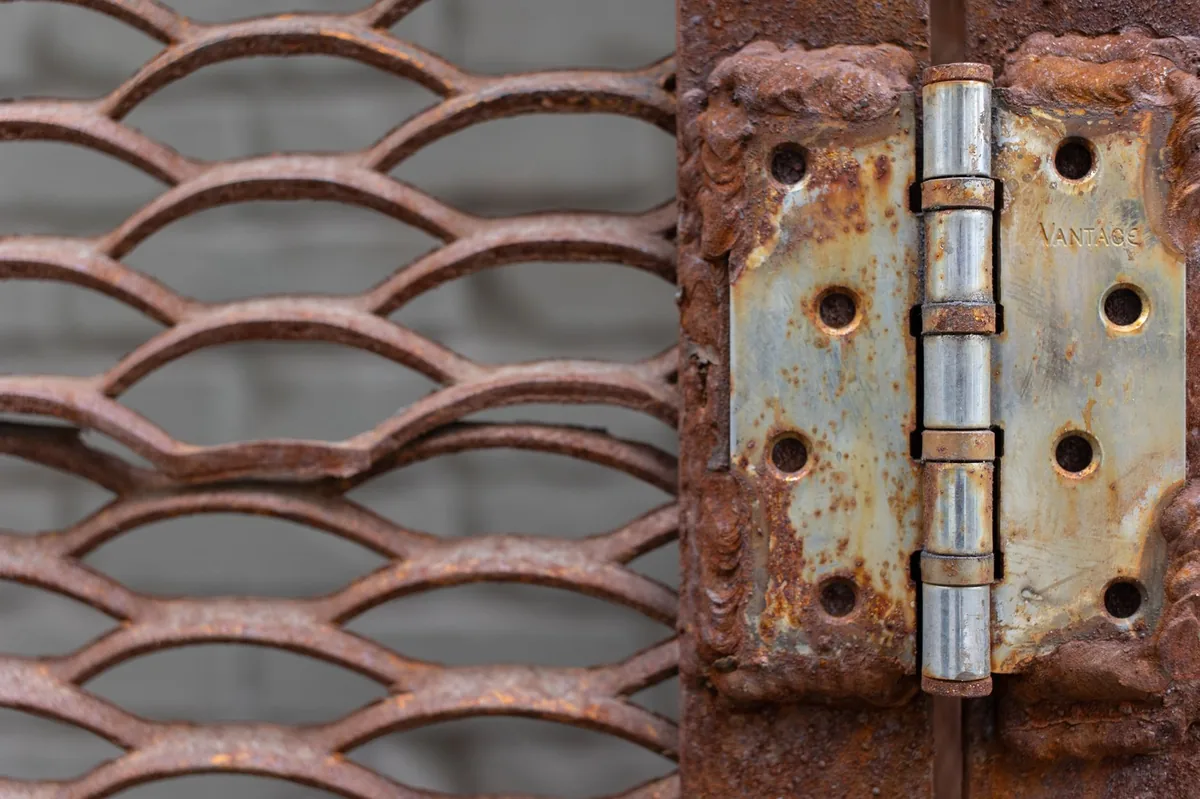
One hard-sign rule keeps crews honest. A cracked leaf, post-lubrication squeaking, pin wear with shavings, or a door that will not square back up each justifies replacement. Age alone does not.
Replacing Hinges: Sequence, Fit and Safety
The sequence is the safety system. Replace hinges one at a time, starting at the top, so the remaining hardware keeps carrying the door. Pulling all of them at once leaves a heavy leaf hanging on nothing. Remove the pin or screws of one hinge, then test-fit the new leaf in the mortise. Drive the frame-leaf screws first, the door-leaf screws second, and verify swing and latch before the next hinge.
Stripped screw holes have a standard fix: longer screws that reach into the frame reinforcement or the door core. Badly damaged preparations belong with the door manufacturer’s approved repair methods, not with improvised drilling.
The boundary matters as much as the procedure. Work on power-operated doors belongs with trained personnel using proper equipment, as the UK safety authority frames it, and EN 12453 sets the same bar. On a sprung sectional door the hinges sit near stored torsion energy, so read our industrial door springs and torsion spring systems guides before unbolting hardware under a loaded spring.
Getting More Life from Industrial Door Hinges
Lubricate on a schedule rather than on a scream. Light machine oil into the knuckle keeps the bearing surfaces alive, and squeaks appearing between rounds mean shorten the interval. On fire doors, fold the hardware into the annual inspection so labels, pins and screws are verified on paper as well as by ear.

Manage the loads you control. A forklift strike that racks a jamb overloads every hinge above it, and that is the same door that bites its latch a month later.
Sourcing Hinges Matched to the Door
Buy the hinge with the door, not after it. Hinges sized from the same drawing as the panels, rollers and track wear in together and diagnose cleanly, while shelf-picked hardware pairs a heavy leaf with an unknown frame prep. That is why the conversation at RaxDoor starts with the door schedule, not the hinge catalogue.
First-party facts. RaxDoor has manufactured doors and components since 1999 and ships to more than 70 countries, certified to ISO 9001:2015, CE under EN 13241 and EN 12453, and SGS verified. We work in galvanized steel and stainless 304 and 316, with no minimum order quantity.
CAD records stay archived for five years, so repeat orders skip new tooling. First orders run 20 to 35 days and repeats 15 to 20, with warranty-period spare parts shipped by DHL or FedEx within 5 to 7 days. Matched industrial door hinges ship on the same drawing set as the door, which is what makes the pairing verifiable.
The opinion we opened with is the one we close on. An industrial door hinge is bought like a bracket and works like a bearing. Plants that size and replace it on bearing logic never meet the sagging door at the latch. That half inch of drop is not the failure; it is the invoice for every decision made before it.
Frequently Asked Questions About Industrial Door Hinges
How many hinges does a heavy industrial door need?
By height: two hinges up to 5 feet, three from 5 to 7 feet 6 inches, four above that, and one more per extra 2 feet 6 inches. Doors over 175 pounds or cycled more than 400 times a day also need heavy-weight hinges.
What are the signs of a worn industrial door hinge?
The door drops on the lock side, the top rubs the frame head, knuckles show elongation or metal shavings, pins creep upward, and squeaking survives lubrication. Cracked leaves mean fatigue from an undersized hinge.
How do I match a replacement hinge?
Measure leaf height and width, note the corner radius (square, 5/8 or 1/4 inch), and count the screw holes. On machine-prepped hollow metal frames the replacement must follow the ANSI A156.1 template pattern.
Can standard hinges be used on a fire-rated door?
No. Hinges on a fire-rated assembly must be listed for the same or higher rating, in steel or stainless steel. A non-listed hinge voids the assembly rating and fails the NFPA 80 annual hardware check.
Why do hinges keep failing on a high-traffic door?
Usually the hinge class, not the brand. Doors cycled more than 400 times a day, heavier than 175 pounds, or taller than 7 feet need heavy-weight hinges. A standard-weight hinge there fails by fatigue.