
A crate of springs arrives on a loading dock, and the delivery note says the part number was copied straight from the old door. The depot fits one, winds it, and the door slams down hard enough to shake the track brackets. Nothing was wrong with the spring; the order was wrong, because nobody on the buying side speaks the spring’s own language.
Industrial door torsion springs reward buyers who can read three things: the torque rating, the wire, and the wind. This page takes each one in turn, the way our factory reads an enquiry. It then covers high-cycle design, safe replacement, and the specification lines that get a matched set shipped the first time. The spring topic is wide, so if you need the family overview first, our earlier guide to industrial door springs covers both spring types at catalogue level.
The Measurements Behind Every Matched Spring
An industrial door torsion spring is described by a short list of numbers, and every return shipment we have traced came back to a missing one. The list has five lines: wire diameter, inside diameter, spring length, winding direction, and the cycle rating the door actually needs. Read them off the old spring in that order and the replacement balances the same door the old part did. Skip any line and the new spring balances a different door from yours, which is how the crate at the start of this page came to exist.
The order matters because the first line is the hardest to measure and the rest depend on it being right. Wire size drives the torque, the inside diameter decides which cones and shaft the spring will accept, and the length fine-tunes how many turns the spring can absorb. The winding direction is binary; there is no close enough. We will take the lines one at a time, starting with the language that decides whether a spring is strong rather than merely similar.
IPPT: The Torque Language of Springs
Industrial door torsion springs are rated in IPPT, which stands for inch-pounds per turn. That figure is the torque a spring delivers for every full turn you wind it. It is the closest thing the spring industry has to a common currency, because two springs with completely different dimensions can be interchangeable if their IPPT matches. When a door runs two springs, the ratings simply add together, and the combined total has to suit the door weight through the cable drums. A door that sits halfway open when lifted by hand and neither drops nor runs away is the physical proof that the total is right.
The conversion from IPPT to door weight runs through the drum, so suppliers work from the drum size rather than guessing. For standard 400-style drums the drum multiplier sits near ten, which means the effective lift per spring is roughly the total IPPT divided by that figure. The turns you wind follow the same logic. Divide the door weight requirement by the spring’s IPPT to get the winding count, then let the drum geometry trim the final number. None of this is precision physics at the buyer’s desk, but it is precise enough to catch a mismatched quote before it ships.
Wire diameter is the variable that dominates IPPT, because the torque rate rises with roughly the fourth power of the wire. A spring whose wire grows from a quarter inch to just over a quarter inch does not gain a few percent of torque; it gains a large multiple. That sensitivity cuts both ways. It lets a designer raise torque without touching the shaft. It also explains why a misread wire size leaves a door wildly out of balance rather than slightly out.

The practical consequence for a buyer is simple: ask for the IPPT in writing. Suppliers who work from door weight, drum size, and shaft speed can state the figure before they quote, and the number travels well between vendors.
Because of that sensitivity, treat any quote that changes wire size without restating IPPT as unfinished. The correct move is to hold the IPPT constant while the dimensions change, which is exactly what high-cycle upgrades exploit, as the cycle-life section below shows. The same rule runs in reverse when a distributor offers a spring that looks like yours but weighs less in the hand. If the IPPT is not printed, calculated, or stated in the offer, the spring is not specified yet.
Measuring Wire Size by the Coil Method
Nobody measures a spring wire by putting calipers on one coil and trusting the number. A spring wire is round, hardened, and easy to misread by a few thousandths. For industrial door torsion springs, the coil method is the standard everywhere wire has to be proven rather than estimated. It calls for compressing ten or twenty coils tightly together, measuring the total length, and dividing by the coil count.
Industry guidance and spring makers agree on this approach, and the reading should be taken to the nearest sixteenth of an inch. A broken spring makes the job easier rather than harder. The loose coils on the broken halves can be pushed together while the tape is pulled gently the other way.
The arithmetic is forgiving. If twenty compressed coils span exactly five inches, the wire is 0.250 inch, and the same division works for the ten-coil shortcut when access is tight. Most buyers then check the result against a wire size chart of standard coil lengths. Spring wire comes in a known set of diameters rather than a continuous range. If your measured number lands between two chart values, one of the measurements is off, and it is faster to re-measure than to order between sizes.
Two habits keep the method honest. First, compress the coils hard; a slack measurement adds the coil gaps into the length and inflates the result. Second, measure in the middle of the spring body, away from the end coils that can flare or bind. Industrial springs live on long shafts, where a wrong wire means unwinding and re-shipping a heavy part. Two extra minutes with a tape measure is the cheapest quality gate in the counterbalance chain.
Inside Diameter, Length and Cone Markings
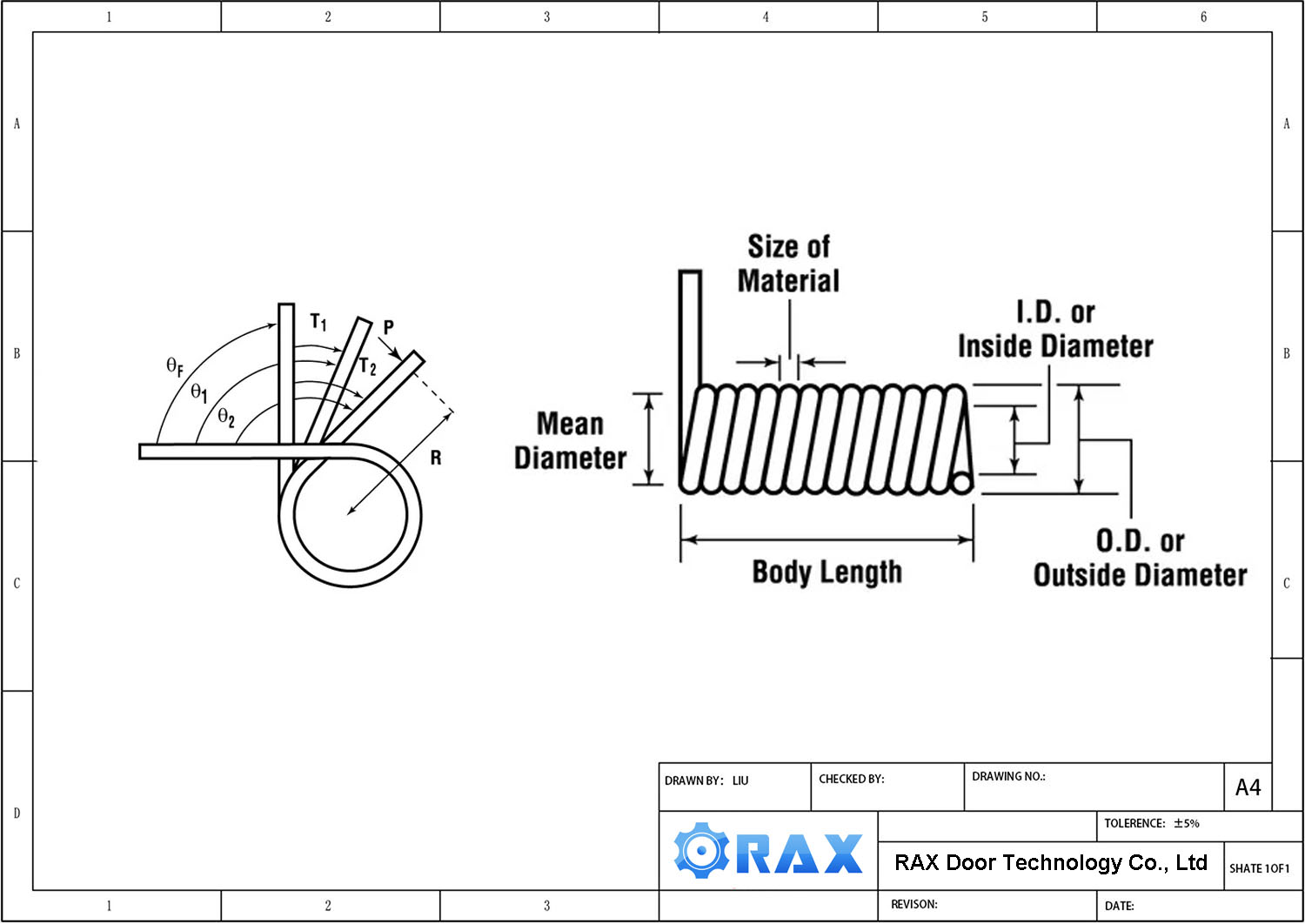
Inside diameter decides what the spring fits, and in practice the choice is short. The common sizes are 1-3/4 inch and 2 inch inside diameter, with larger IDs reserved for heavy shafts. You do not need to guess at the ID either, because winding cones and drums carry etched numbers. A cone stamped 175 is telling you it belongs to a 1-3/4 inch spring. Read the cone before you read the tape, and the measurement becomes a confirmation instead of a discovery.
Spring length is the line most often copied wrong, because the cones bookend the coil and invite the tape to include them. Measure coil end to coil end, cones excluded, and do it with the spring fully unwound; a spring measured under tension reads stretched and long. Take the length to the nearest quarter inch. Combined with wire and ID, the length sets how many turns the spring can absorb and how much shaft room it takes. That is why suppliers treat length as a primary dimension rather than a trim value.
Write the three dimensions as one line: wire first, inside diameter second, length third. That line, plus the winding direction from the next section, is what a spring maker needs to identify stock or cut a custom part. When the dimensions arrive in this form, quotation becomes a lookup; when they arrive as a photo of a rusty spring on a workbench, quotation becomes archaeology.
Wind Direction and Cone Color Codes
Winding direction is where otherwise careful orders fail, partly because the naming itself is inconsistent across the trade. One vendor’s left-wound spring is another’s right-wound, and the labels printed on boxes do not always agree with each other. The reliable reference is the spring in your hand: look at how the last coil closes, following the wire around the spring from the end. Describe that physical direction in the order instead of quoting a label, and no vendor’s vocabulary can send you the mirror image of your part.
Color codes help when they are present. The common convention paints the winding cones red for right-wound springs and black for left-wound. A two-spring door normally carries one of each, so the pair winds in opposite directions on the same shaft.
On a standard installation the left-wound spring sits on the right side of the shaft, and the right-wound one sits on the left. That sounds backwards until you picture the torque path through the drums. When the paint has faded, the coil direction check above settles it.
When industrial door torsion springs are ordered, they are ordered as a matched pair, never one at a time. A new spring working beside a worn one carries an unequal share of the load. That pulls the door out of balance and spends the new part’s cycle rating compensating for the old. The paired set should also share wire, ID, length, and wind as a manufactured pair, which is how component suppliers ship them. Our OEM door components line follows that rule, with torsion springs supplied on matched cones for single-shaft and multi-spring doors alike.
Designing for High Cycle Life
A standard commercial grade for industrial door torsion springs sits around 10,000 open-and-close cycles. That is roughly seven years of everyday use in normal service. Facilities that run two or three shifts do not have seven years; they have proportionally less. A spring that dies mid-shift stops a door that the production line depends on. Cycle life is therefore a specification decision, not a surprise, and it belongs on the order line next to the dimensions.
Two design moves buy cycles honestly. The first is a larger wire diameter, which raises the torque steeply, so the spring length is increased to hold the same IPPT while the stress in the wire drops. The second is a longer spring in general, which spreads each cycle’s working strain over more coil and lowers fatigue per turn. Multi-spring shafts do the same job another way, letting two or three springs share the load so no single coil set carries the full door. Each path costs more up front than a standard spring, and each one is cheaper than a stopped dock.
First-party numbers make the decision concrete. RaxDoor sectional doors are engineered with torsion springs specified for at least 30,000 cycles, three times the standard commercial rating, on leaves built from 40 to 50 mm polyurethane panels. At that grade a multi-shift site measures spring life in years of production rather than months of rationing. The rest of the system benefits too, because a spring that holds its balance spares the operator. An out-of-balance door drags the drive through the difference on every cycle, which is one of the fastest ways to shorten a motor’s working life.
Environment decides how much of the rating you actually collect. A spring in a washdown food plant or a coastal warehouse loses wire section to corrosion. A thinner wire loses torque at that fourth-power rate, so the cycle rating on the label quietly shrinks. Where moisture, salt, or chemical vapour is present, specify coated or stainless wire and inspect the coils annually for pitting near the cones. The same visit can verify that the door still holds half travel, which is the field test of whether the springs are delivering the cycles they were sold with.

Replacing Torsion Springs Without Guesswork
Here is the sentence that belongs above every spring job. A wound spring from the industrial door torsion springs family stores enough torque to cause severe injury, and most spring accidents trace back to improvised tools or skipped steps.
Screwdrivers, socket extensions, and similar substitutes for proper winding bars are the classic failure. A bar that slips out of a winding cone releases the spring’s energy through whatever is holding it. New springs are also at their most fragile during the first winding, so even a correct procedure deserves a calm hand and no bystanders. Standards for powered doors expect this work to be done by instructed persons with proper equipment. EN 13241 covers the product side and EN 12453 covers safe use, and the UK safety authority treats planned inspection of powered doors as part of staying legal.
The procedure itself follows the same discipline as the measurement. With the door fully closed, secure it so it cannot rise. Fit winding bars fully into the cone eyes and relax the spring turn by turn, keeping a bar in the cone at all times. Loosen the set screws only when the spring is unloaded, then slide the old pair off the shaft.
Fit the new matched pair with the correct wind on the correct side. Rewind in the turn count calculated from the door weight and drum size. Lock the set screws, then run the door by hand through a full cycle before anyone powers it up.
The balance check is the proof of the whole job. Lift the door by hand to about half travel and let go; a correctly matched set holds the door there, while a heavy door sinks and an over-wound door climbs. Small corrections belong in quarter-turns, not half rotations, because the wire’s torque sensitivity cuts in both directions. Log the spring grade and the commissioning date on the shaft tag so the next maintenance visit reads remaining life instead of guessing at it.

Facilities that prefer not to run this procedure in-house should treat spring replacement as supplier work, and the hardware supports that choice. When the replacement is ordered against the five spec lines with a stated cycle grade, the fitting crew receives parts that need no interpretation. Components such as the torsion spring with cones arrive pre-matched, which removes the last place a mistake can hide.
What a Supplier Needs to Quote a Spring
A spring enquiry for industrial door torsion springs fits in six lines. Line one is the wire diameter from the coil method. Line two is the inside diameter, confirmed against the cone marking. Line three is the length excluding cones, measured unloaded. Line four is the winding direction described by the coil itself.
Lines five and six are the cycle rating or duty the door runs, plus the shaft and drum details on multi-spring doors. With those lines a supplier quotes a matched set. Without them, every figure in the offer is an assumption.
Spring enquiries land exactly like the rest of our component work at the factory. Single doors are accepted with no minimum order, and CAD records are kept for five years so repeat orders skip new tooling. First orders run 20 to 35 days and repeats 15 to 20, while the door body carries a two-year warranty. Distributors who standardize the six-line format across their fleet find that spring replacement stops being an emergency purchase and becomes a scheduled one.
Frequently Asked Questions
What does IPPT mean on a torsion spring?
IPPT stands for inch-pounds per turn: the torque a spring delivers for each full winding turn. In a two-spring system the ratings add together, and the combined IPPT must match the door weight through the cable drums.
How do I measure the wire diameter of a broken torsion spring?
Compress 10 or 20 coils tightly, measure the total length to the nearest 1/16 inch, and divide by the coil count. Twenty coils spanning 5 inches equals 0.250 inch wire.
How do I tell a left-wind spring from a right-wind one?
Look at the direction the last coil closes. Because wind labels differ between vendors, order by describing the physical coil direction and cone color rather than the printed label alone.
Can you replace only one of two torsion springs?
No. Replace them as a matched pair. A new spring working beside a worn one carries an unequal share of the load, which unbalances the door and shortens the new spring’s life.
How long do industrial torsion springs last?
Standard commercial industrial door torsion springs are typically rated around 10,000 cycles, roughly seven years of everyday use. Heavy-duty specification goes higher; RaxDoor sectional doors are engineered with torsion springs for at least 30,000 cycles.
Should facility staff rewind a torsion spring themselves?
No. A wound spring stores enough torque to cause severe injury if released with improvised tools. Winding bars, a controlled procedure and instructed persons are expected under the standards covering powered doors.
A broken spring on the floor is the most honest specification sheet your door will ever produce. The wire, the cones, and the coil direction are all printed on it, waiting to be read with the methods on this page. Order against those five lines and the next crate through your dock is the one that fits.