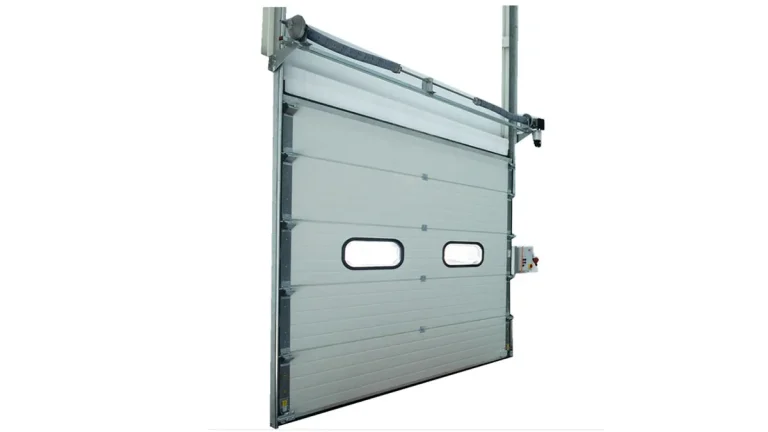
A coastal warehouse project fails plan review, and the rejection line is one sentence long: the door schedule states no design wind pressure and no test basis. The door itself is heavy, expensive and freshly installed. Nothing on the manufacturer’s page translates into a number the reviewer can check, because words like windstorm are not ratings.
We build sectional doors at the factory, and our view of this subject is blunt. Wind resistance is not a marketing layer; it is measured behavior under a pressure difference across the closed door. Read the ratings that way and the code expectations below become straightforward.
What Wind Does to a Large Sectional Opening
Wind load is a live load. It pushes on the door from outside as positive pressure, then pulls as negative pressure when a gust passes or the building leaks air on the lee side. That is a different problem from dead load, the mere weight of the panels in the tracks. A door can carry its own weight for decades and still fail its first serious storm.
The opening itself is the reason reviewers care. A large door is the weakest panel in the building envelope. When it fails, wind enters, internal pressure spikes, and the load on the roof and walls jumps. The failure modes are readable in advance: panels bowing between tracks, leaves flapping in gusts, rollers disengaging from guides, and water forcing past the seals.
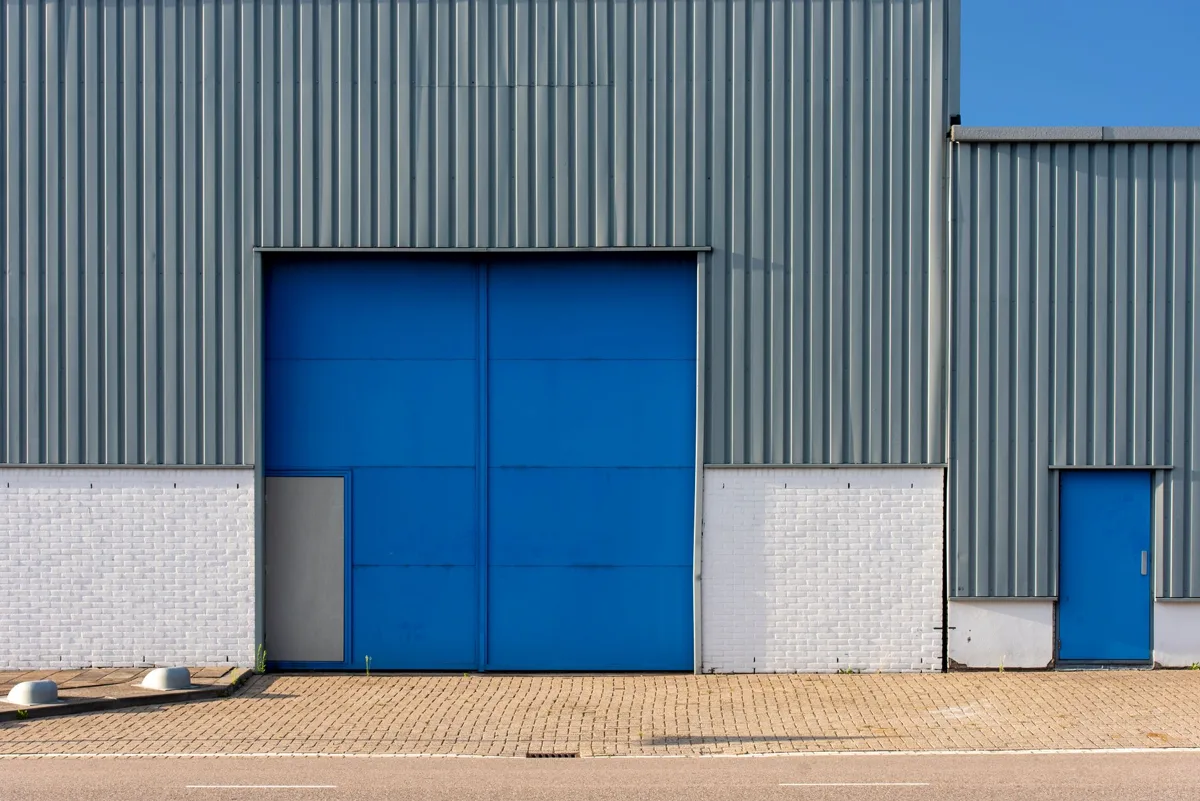
Wind Classes Under EN 12424
In the EN world the vocabulary is fixed. EN 12424, titled resistance to wind load classification, grades doors from Class 0 to Class 5 by the differential pressure they withstand when fully closed. The table below is the one buyers should demand on paper.
| Wind class | Test pressure | Approx. wind speed |
|---|---|---|
| 0 | 0 Pa | no test, no information |
| 1 | 300 Pa | about 80 km/h |
| 2 | 450 Pa | about 100 km/h |
| 3 | 700 Pa | about 120 km/h |
| 4 | 1,000 Pa | about 150 km/h |
| 5 | 1,600 Pa | about 180 km/h |
Class 0 deserves a warning: it does not mean the door passed an easy test, it means no test happened and the door carries no wind-load information. Speeds in the table are conversions for orientation, and real pressure also depends on site factors. Water is graded in parallel under EN 12425, so coastal specifications normally name both classes.
Real products anchor the scale. Mainstream industrial sectional doors are commonly declared Class 3 under EN 12424, and our high-speed spiral door line publishes Class 5 for force 12 conditions. Both sit under EN 13241, the harmonized standard that turns wind resistance into a declared performance characteristic.
How Building Codes Set the Design Wind Load
North American codes take a different route to the same obligation. The model codes, the IBC and IRC, are revised on roughly three-year cycles. Their wind numbers come from ASCE 7, the standard that carries the wind-speed maps and the calculation methods. Since the 2006 IRC, garage and commercial doors are named explicitly and must show performance tested to ANSI/DASMA 108, with design wind speeds anchored to a 50-year recurrence.
The number that reaches your door is therefore local. States adopt the code at state or local level, coastal jurisdictions tighten it, and Florida enforces some of the strictest versions. In the EN markets there is no national door map either: the project engineer hands the supplier a design pressure, and the door answers with a class. Either way, sectional door wind resistance is never guessed at acceptance; it is documented against a number the code chain produced.

Design Pressure Versus Test Pressure on Labels
Two different numbers live on wind-rated doors, and mixing them is the most common acceptance mistake. Design wind load is what the code calculates for that opening on that building. Test wind load, sometimes called ultimate wind load, is what the door proved in the chamber. The usual rule is that it must reach one and a half times the design load.
A 30 psf design requirement therefore shows up as a 45 psf test rating on the label. Write the 45 into the specification as if it were the design number, and the margin shrinks by a third unnoticed. Check both pressure directions too, because negative load often governs on large doors, and confirm the rating fits the width, height and opening zone.
Where Wind Resistance Comes From in the Door
A wind class is carried by hardware, not by slogans. It starts with the panels: double-skinned steel skins over a PU foam core, embossed faces and stiffening ribs at the edges and joints so the leaf resists bowing. Our own sectional panels run 40 to 50 mm of PU foam with a U-value of 0.33 W/m²K. That core does double duty: thermal insulation covered in our sectional door insulation guide and its cold storage application, plus the shear web that stiffens the leaf.
Next come the guides and the locks. Heavier and deeper guide angles, closer anchor spacing, and locking rollers or windlocks that pull the panel into the track transfer the pressure into the building steel. The counterbalance matters as well, because wind adds torque the springs must manage every cycle. Our torsion springs are sized past 30,000 cycles. The panel material choice behind the coating is covered in our aluminum versus steel sectional doors comparison.

One correction belongs here because it costs buyers money. Adding thicker slats does not raise a wind rating by itself. The extra dead load can even make the locking hardware less effective. That is why upgrades are engineered as packages, not bought as heavier panels.
Large Openings Multiply the Force
Pressure acts on area, so sectional door wind resistance gets harder to hold as every square meter is added. The classic example: a 20 by 20 foot commercial door weighs around 1,600 pounds. A 20 psf wind load adds about 4,800 pounds, roughly triple the weight the hardware was sized to lift.
Scale that up and the consequences follow. Wider logistics openings raise the force faster than the door grows, so the guide anchors, the header steel and the frame must be checked at the same level. If the opening also protects goods and people, our warehouse security guide covers that envelope.
Specifying and Verifying a Wind-Rated Sectional Door
Acceptance is a paperwork exercise if you order it as one. Ask the supplier for six things. One, the project design pressure in psf or Pa for both directions. Two, the declared wind class or pressure rating with the standard it answers to. Three, the test report showing the one-and-a-half-times relationship.
Four, the structural package that achieves the rating. Five, the product label or declaration of performance. Six, the layout of panels, guides and anchors for your exact opening size.
The sectional door wind resistance conversation at our sectional door line starts from that checklist. We manufacture to drawing with no minimum order quantity. Certification runs to ISO 9001:2015, CE under EN 13241 and EN 12453, and SGS verification. First orders ship in 20 to 35 days and repeats in 15 to 20. The opinion we opened with closes here: a rating is verifiable behavior under pressure, and suppliers who cannot show the report are selling the word, not the number.
Inspection and Storm Recovery for Sectional Doors
After any severe wind event, walk the door in a fixed order. Look for bowed panels, gaps at the seals and rollers sitting shallow in the guides. Listen for new grinding on the first cycles, and measure whether the door still squares in the opening. Re-torque the anchors and locks, because a storm that bent nothing may still have loosened something.

Keep the boundary hard: work on power-operated doors belongs with trained personnel using proper equipment, as the UK safety authority frames it and EN 12453 demands. Fold labels, anchors and the counterbalance into the annual inspection, and order warranty-period parts early: we ship them by DHL or FedEx within 5 to 7 days.
Frequently Asked Questions About Sectional Door Wind Resistance
What wind class should an industrial sectional door have?
The class follows the project’s design pressure, not a catalog default. Class 3 (700 Pa) is common for mainstream industrial sectional doors, while exposed coastal sites often demand Class 4 or 5.
Is design wind pressure the same as test wind pressure?
No. Design pressure is the code value for your opening; test pressure is the door’s proven capacity, conventionally 1.5 times the design load. A 45 psf test rating answers a 30 psf design requirement.
How many pascals is EN 12424 Class 3?
Class 3 is graded at 700 Pa across the closed door, roughly a 120 km/h wind. Class 5 tops the scale at 1,600 Pa, near 180 km/h.
Does a larger door need a higher wind rating?
The pressure class stays the same; the force does not. Wind load acts on area, so a bigger opening multiplies the total force that the guides, anchors and building steel must carry.
Can a standard sectional door be upgraded for wind load?
Yes, as an engineered package: stiffer panels or struts, heavier guides, locking rollers and a counterbalance check. Thicker slats alone add weight without adding rating.
How do I prove wind compliance at acceptance?
Collect four items: the project design pressure, the declared class with its standard, the test report showing the 1.5 times relationship, and the door label. File them with the as-built drawings.