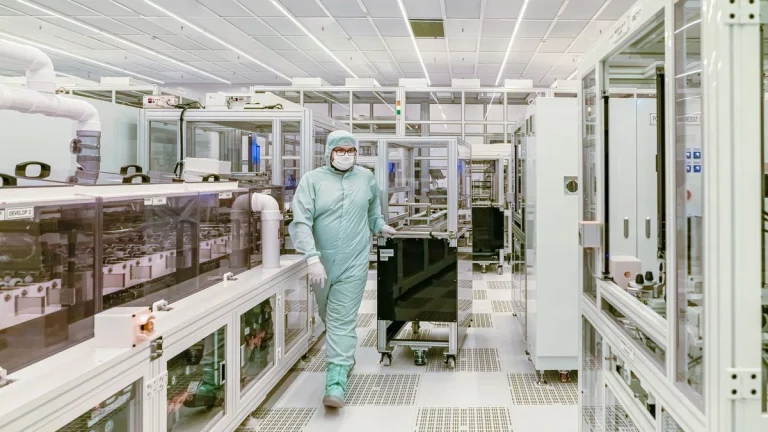
On a commissioning walk two years ago we watched a new operator save a few seconds the wrong way. The outer door of the airlock was still closing behind him when he pulled the inner door open a hand’s width. The differential pressure gauge across the suite dropped before the door even reached its stop. The HVAC system then spent several minutes clawing the cascade back.
That moment explains what an airlock actually is. It is not a corridor with two doors in it; it is a machine that trades time for cleanliness, and every beat of its cycle exists for a reason. Anyone who has asked how does a cleanroom airlock work will find the full answer below. We walk one entry cycle beat by beat, then cover the personnel and material versions, the three pressure modes, and what the door hardware itself does to the sequence.
The airlock cycle shows why open time matters; the manual or automatic cleanroom door decision guide turns that cycle logic into a cost, traffic and maintenance comparison for every opening.
The airlock cycle shows why open time matters; the manual or automatic cleanroom door decision guide turns that cycle logic into a cost, traffic and maintenance comparison for every opening.
What Happens When an Airlock Door Closes
An airlock is a small enclosed transition space built between two areas of different cleanliness, fitted with two interlocked doors. The interlock is the defining part. It is an electrical or mechanical linkage that allows only one door to be open at a time. Without it, the room between them would be nothing more than a lobby where the two environments mix.
Closing the outer door is not the end of an action; it is the start of one. The moment the leaf seats against its frame, the interlock locks the opposite door and the chamber begins to recover. Filtered supply air dilutes whatever the entering person or pallet carried in. The pressure controller then restores the differential that the open door let sag, and only when the room is back in condition does the system release the inner door.
Field guidance on interlock behavior is consistent on one point: the two doors must never be open together. Forcing both at once collapses the pressure cascade for a moment. It also opens a direct path between the clean side and the dirty side, which is exactly the failure the whole arrangement exists to prevent. The asymmetry matters too. The dirty side pushes far more particles per open door than the clean side can accept, so the chamber must be back in condition before any exchange is allowed.

The Entry Sequence Step by Step
Strip away the panels and gauges and every cleanroom airlock runs the same four-beat cycle. The wording below follows a person entering, but the beats are identical for a cart of components. So how does a cleanroom airlock work in practice? These four beats are the whole machine.
Beat one is approach and entry. The operator steps in from the less controlled side, pulls the outer door shut behind them, and confirms it has latched. Nothing else in the cycle can start until the door position is proven to the interlock. A door left ajar simply freezes the whole sequence.
Beat two is the hold. The interlock keeps the inner door locked while the chamber does its work. In ventilated airlocks, and most pharmaceutical designs are ventilated, filtered air flushes the space and the pressure controller re-establishes the set differential. The wait is a design parameter, not a delay. Its length is set by the air volume, the supply airflow, and the recovery target the facility was validated against.
If the inner handle does nothing right after the outer door closes, that hold is the answer. The dead handle means the sequence is still proving the chamber back into condition. Reaching for it anyway, or worse, leaning on it, only teaches the team that the interlock is an obstacle instead of the guard it is.
Beat three is transfer into the clean side. Once conditions are met, the inner door releases and the operator moves through. The discipline here is to keep it brief and shut the door fully. Every second the leaf stands open bleeds air from the cleaner room to the dirtier one.
Beat four is reset. With the inner door closed and latched, the interlock returns to neutral, the chamber resumes standby, and the outer door is released for the next person. A full cycle, in other words, is close, hold, cross, reset, repeated for every transit with no exceptions for seniority. Close, hold, cross, reset: that is the honest answer to how does a cleanroom airlock work, one transit at a time. For the deeper physics behind the hold, our guide to the cleanroom airlock working principle covers pressure behavior and recovery in detail.
Personnel Airlocks and the Gowning Cycle
A personnel airlock, usually shortened to PAL, is the airlock people walk through, and in most facilities it doubles as the gowning room. That double duty stretches the cycle. Before the inner door opens, the operator must also don hood, mask, gown and gloves in the right order. The airlock is the last controlled space between street clothes and the classified room, so the gowning beats belong inside it.
The added beats change how the room must be built. A gowning cycle needs bench space, garment storage and mirrors. It also needs room for people to move without brushing a colleague’s clean garments. As field guidance notes, an undersized gown room recreates the failure the airlock was meant to prevent. People hold doors open, rush the interlock, or prop a leaf to keep it free while they finish dressing.
Higher classification rooms sometimes run a two-stage arrangement instead. A gowning room is followed by a second airlock closer to the clean core, so street clothes and cleanroom garments never share a space. The cost is time, one full cycle per stage. This is why shift changes in tightly classified suites are scheduled around the airlocks rather than the other way round.

Material Airlocks and Pass-Through Chambers
A material airlock, or MAL, is sized and finished for equipment, totes and supplies rather than people. Running materials through the personnel airlock is a common design mistake, and a costly one. It couples two different traffic rhythms. It drags pallet-scale contamination through a room full of gowned staff. And it slows both flows at once.
MALs come in a size ladder. At the smallest end sit pass-through chambers: two interlocked doors set into a wall, just large enough for a tray or a tote. Small items cross without a person entering at all. Mid-size versions are rooms with swing doors for carts and equipment. At the largest end, interlocked roll-up doors sized for pallets keep the cycle fast where full pallets must cross a classified boundary.
The operating logic mirrors the personnel cycle: load, close, purge, release, retrieve. Some chambers add an air shower for the load: HEPA-filtered air blows across garments or packaging to knock loose particles off before the inner door opens. That step is commonly specified ahead of the most classified rooms, and some chambers double as decontamination spaces in their own right. If you are selecting hardware for a new suite, our clean room doors range lists airtight, stainless and interlocked models with the surface options each classification needs. The principle scales unchanged from the smallest pass box to the largest MAL.

Pressure Modes: Cascade, Bubble and Sink
Every airlock also runs one of three pressure personalities. In a cascade airlock the pressure steps down from the cleanest space toward the dirtiest, so air always drifts outward from clean to less clean. That is the default for protecting a product from its surroundings. A bubble airlock holds the chamber above both neighbors, so air pushes out whichever door opens, useful when both sides must be protected from each other. A sink airlock runs below both neighbors and pulls air inward, containing hazardous work rather than excluding dust.
The mode you pick decides how the hold in beat two behaves, because it sets which way the air moves during the flush. A cascade flush pushes contaminants back toward the corridor. A sink flush pulls them away from the clean side. The differential values themselves sit in guidance ranges, and sources around ISO 14644-4 commonly work between 5 and 20 pascals between rooms, but the numbers belong to a dedicated discussion. Our guide to cleanroom airlock pressure cascades works through the bubble, sink and cascade arithmetic in full.
One practical note closes this section. The mode is a property of the whole airlock, fans, dampers and controllers together, not a setting on the door. Changing it after commissioning means re-balancing the air system. So the mode belongs in the design conversation years before the doors arrive, not in a retrofit order after a failed balance reading.
Interlocks, Purge Timers and Door Hardware
Stand in an airlock and you never see the controller; you see its behavior. The inner handle stays dead during the hold. Many interlock systems add a warning if a door is held open beyond a preset time, because a propped leaf quietly drains the cascade while sounding harmless. Some installations pair the interlock with a visual indicator over each door, green and red, so the state of the cycle is readable at a glance.
The doors themselves decide how well each beat goes. Supplier guidance notes that manually operated sliding doors leak noticeably more air than swing doors. That is why high-pressure boundaries favor hinged or hermetic leaves, whose compression gaskets clamp the panel into the frame and restore the seal at every closure. On a pallet route, a fast interlocked roll-up shortens beat two by shrinking the open time, not by skipping it.
Sizing the opening is the other half of the decision. A clean room door that is too narrow for the widest cart forces a daily stall at the threshold, door standing open, an everyday leak no cascade calculation survives. Behind the scenes, the wiring, door sensors and sequencing logic are their own subject. Our guide to cleanroom door interlock systems covers them from the control side.
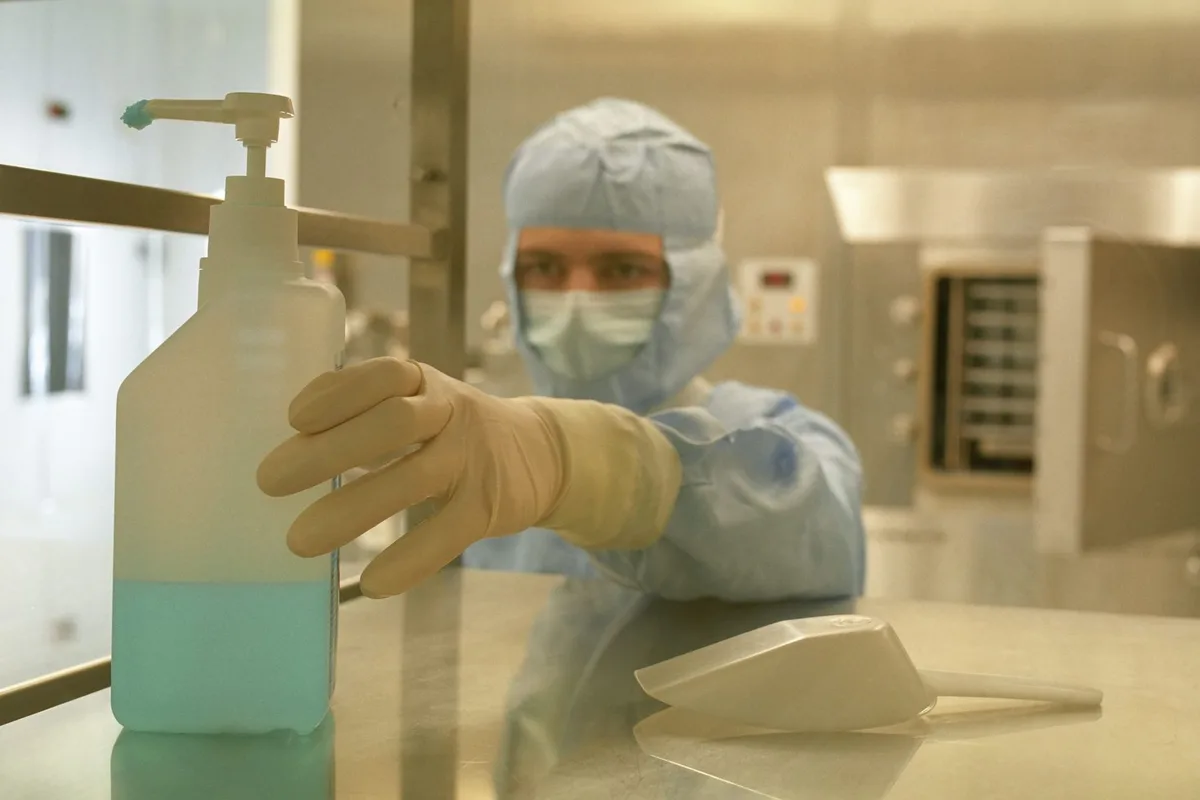
Treat the wait as a specification and the airlock repays it daily. The hold that annoyed that new operator on commissioning day was the machine working, trading a few seconds of patience for a differential that held all afternoon. Facilities that staff, size and door their airlocks around the real cycle stop noticing the sequence entirely. Four beats for people, five for pallets, every transit without exception. That invisibility is the highest compliment a transitional room can earn.
How Does a Cleanroom Airlock Work Questions
Can both doors of a cleanroom airlock open at the same time?
No. The interlock exists to prevent exactly that. Both doors open together collapse the pressure cascade and open a direct contamination path between the two rooms.
How long should you wait inside a cleanroom airlock?
Until the interlock releases the inner door. The hold is a validated design parameter set by chamber volume, airflow and recovery target, not a fixed number you can shortcut.
What is the difference between a personnel and a material airlock?
A PAL is sized for people and usually doubles as the gowning room. A MAL is sized for carts, totes and pallets, often with roll-up doors or a wall pass-through instead.
Why do some cleanroom airlocks include an air shower?
It blows HEPA-filtered air across a person or load to knock particles off before the inner door opens. This step is commonly specified ahead of the most classified rooms.
Do all cleanroom airlocks hold positive pressure?
No. Cascade designs step pressure down toward the dirty side. Bubbles hold the chamber above both neighbors, and sinks run below both to contain hazardous work.
Door timing inside that sequence is industry-specific; see our mapping of high speed doors for pharmaceutical cleanrooms.