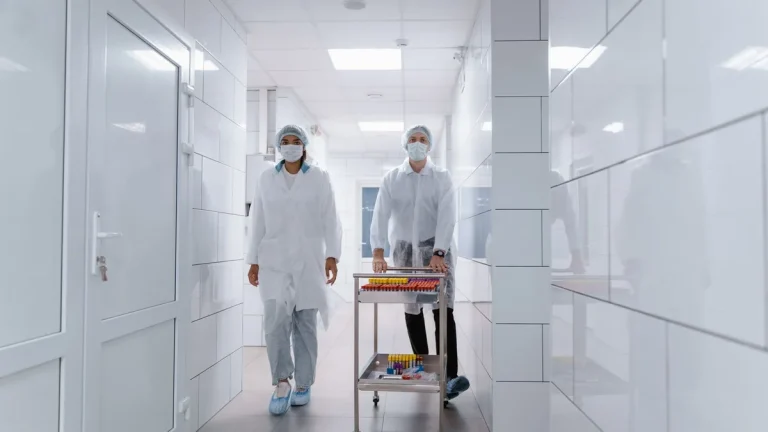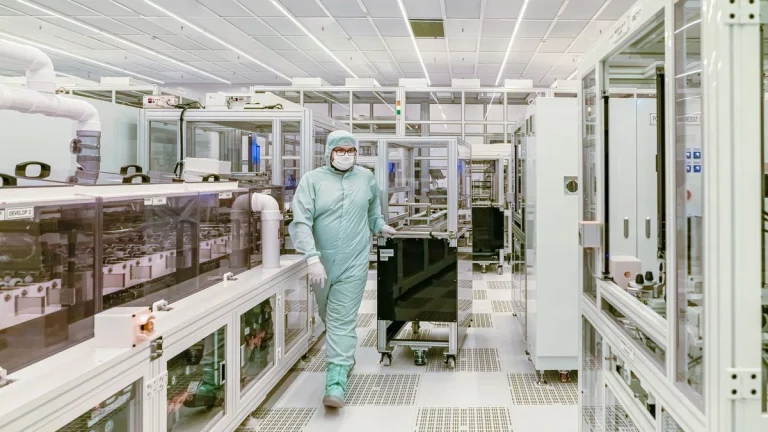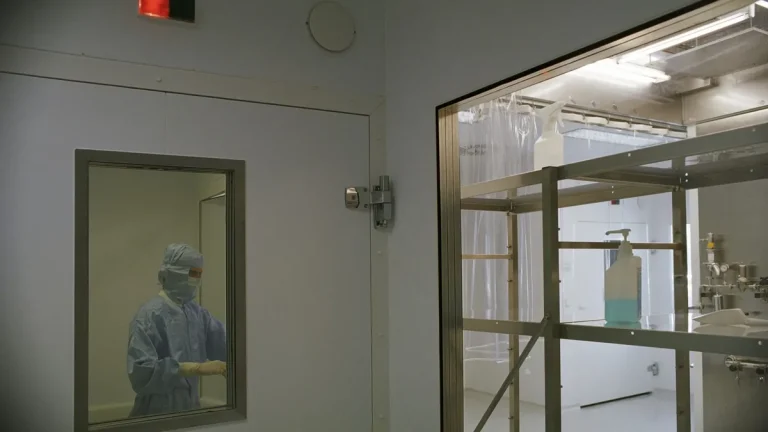
Imagine a power-cut drill at a pharmaceutical suite: the lights die and every head turns toward the airlocks. Nobody moves, because nobody can say what the doors will do.
That pause is the real test of cleanroom door safety systems. Their worth is judged in the seconds after something fails. This guide works through the three layers that matter. We cover failsafe logic on power loss, panic hardware under differential pressure, and the verification that proves the arrangement behaves when it matters.
Failsafe behavior differs by drive too; the manual or automatic cleanroom door decision guide compares how manual and powered leaves cost, fail and comply across a facility.
Failsafe behavior differs by drive too; the manual or automatic cleanroom door decision guide compares how manual and powered leaves cost, fail and comply across a facility.
What a Cleanroom Door Safety System Must Do
A cleanroom door safety system carries three duties at once, and they pull against each other. The first is containment: the interlock keeps airlock doors from opening together so the pressure cascade survives. The second is release: whatever else is true, a person inside the room must be able to get out quickly, one-handed, without instructions. The third is endurance: the leaf, its panel and its hardware must keep performing after impact and years of cycling.
The tension sits between the first two duties. The more airtight the door, the harder it seals, and the more engineering it takes to let it open in one fast motion during an evacuation. A door that gives nothing away on leakage but needs two hands and a shove fails its release duty. A door that flies open at a touch undermines the cascade it was bought to protect.
Good safety system design is the discipline of satisfying both on the same leaf. It is why guidance on anti-panic cleanroom doors treats GMP compliance, ISO classification and emergency exit rules as one combined problem, not three checkboxes.

Fail-Safe Interlock Logic and Emergency Override
The first question to ask any interlock supplier is not what the system does, but what it does when power disappears. A fail-safe arrangement de-energizes into the unlocked state, so a blackout leaves the doors free to swing. A fail-secure arrangement holds them locked until power returns. Containment favors fail-secure; life safety favors fail-safe; most installed systems resolve the conflict with unlocked-on-failure logic plus a mechanical escape provision behind every leaf.
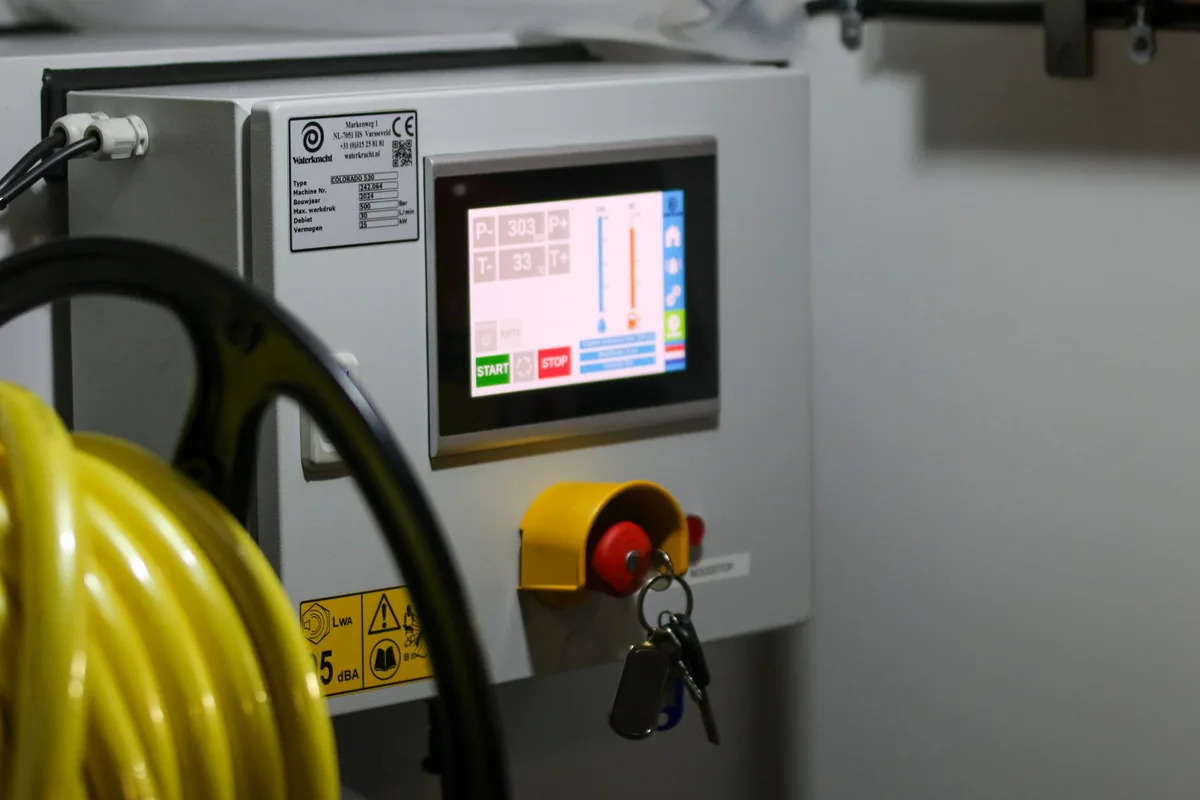
Whatever the wiring choice, the emergency override is the non-negotiable part. Field guidance is blunt about its purpose. The override exists for the moment somebody is trapped inside an airlock and must get out for safety reasons; it overrides the interlock to release the doors. Many panels add one button that unlocks all doors at once, turning a single push into a building-wide evacuation signal. If your suite lacks that provision on every interlocked leaf, fix it first.
The override also creates a second problem that shows up months later. A button that frees every door will eventually be pressed when nothing is burning, and each casual press quietly suspends containment. Access-control practice offers a workable answer. Place override stations where they are reachable but deliberate, use latching switches that need a key to reset, and let door-prop alarms flag every leaf left open. The aim is not to make the override hard to reach in an emergency; it is to make every non-emergency use leave a trace.
The wiring and sequencing logic behind this are their own subject, covered in our guide to cleanroom door interlock systems.
Emergency Egress Hardware Under Differential Pressure
Exit hardware in a cleanroom works harder than the same hardware in an office corridor. The leaf is sealed by compression gaskets, the room beyond may sit tens of pascals from neutral, and the person leaving may be gowned, gloved and stressed. Egress codes agree on the human side. The door must open with one hand, in one motion, without special knowledge or effort, and the unlatching force is typically cited at around fifteen pounds. Panic hardware exists so that requirement is met by reflex rather than by memory.
Under differential pressure, the arithmetic changes. A pressure push adds a real resisting force to a leaf that already seals tightly, the same pressure cascade that containment relies on. That is why breakout-style leaves and flush panic bars are engineered together with the seal. The hardware must release the latch while the gasket lets go cleanly, at the worst case: highest pressure, full gown, no daylight. When you audit a suite, work the doors from the inside at the highest differential the schedule allows, not from the comfortable side at zero.
Two boundaries keep this section honest. The mechanical detail of breakout leaves is its own discussion, covered in our guide to cleanroom emergency exit doors and panic breakout. Installation belongs to the dedicated clean room emergency exit doors walkthrough. The point here is narrower: egress is a system property that only shows up when interlock, seal and hardware are tested together under load.
What HPL Door Panels Contribute to Safety
The panel is the third layer of a safety system, and high-pressure laminate earns its place on behavior rather than looks. An HPL face shrugs off the daily knocks of carts and cylinders far better than softer surfaces. That matters for safety, because a panel that cracks is not just ugly. A split laminate sheds fragments into a controlled space and lets moisture reach the core. That is how a cosmetic blemish grows into a seal failure at the edge.
Impact behavior also decides repair economics, which in cleanrooms is a safety question in disguise. A damaged HPL panel is usually replaced as a unit, returning the leaf to its original seal geometry. The discipline is to log every significant impact, inspect the edge banding and gasket line, and treat a compromised panel as a containment finding, not a cosmetic one. If you are weighing HPL against other facings on cost, hygiene or chemistry, our HPL cleanroom doors buyer’s guide handles that comparison in full.
One compliance boundary belongs in every specification. Fire ratings such as EI60 or EI120 describe a capability that must be verified per project under EN 1634-1 testing. They are not a certificate a door ships with by default. Writing that sentence into your spec prevents the most expensive kind of misunderstanding, the kind found during an audit.
Testing the Whole System, Not the Parts
Interlocks, panic bars and panels are usually commissioned as separate line items, which is exactly how integrated failures slip through. A short whole-system script closes most of the gap. Step one: cut power to each interlocked leaf in turn and record what every door does. A documented fail-safe state is the difference between a drill and a guess. Step two: run a trapped-person check from inside each airlock, one hand, one motion, no instructions.
Step three: press each emergency override and confirm every door releases, then verify the reset procedure and its audit trail. Step four: re-measure the pressure cascade recovery and confirm the room returns to condition within its validated time. Step five: put the sequence on a recurring schedule tied to the facility’s validation plan, and repeat it after every electrical or hardware change.
Facilities that approach cleanroom door safety systems this way converge on a short list of door requirements. It usually means hermetic leaves with compression seals, hardware rated for the closing force, flush panic devices, and an interlock package with documented failure behavior. Our clean room doors range covers airtight, stainless and interlocked models in HPL and SS304/SS316, engineered to order for exactly this kind of combined specification.
Common findings from such reviews cluster around one theme: state logic, overrides and alarms that were installed but never tested as a set. Testing the assembled system once, honestly, is cheaper than discovering its behavior during a real failure.
Building the Safety Case Your Auditor Asks For
Auditors rarely ask whether you own safety hardware; they ask what it does when conditions change. That answer lives in documents. A credible case binds together the interlock logic description, power-cut test records, the override event log with its key-reset trail, and the impact history of every panel. Together they show something no datasheet can: the system’s behavior is known, repeatable and watched.
That is the quiet conclusion of every point above. Cleanroom door safety systems are not lists of components but sets of behaviors you have written down and verified. The file covers everything from the fail-safe state on power loss to the laminate that survives a cart strike. Facilities that treat them that way pass that first drill without thinking about it: when the lights go out, the doors do what the file says.
Cleanroom Door Safety Systems Questions
Should a cleanroom door interlock fail locked or unlocked on power loss?
Life safety favors fail-safe, meaning doors release when power fails, paired with documented mechanical escape. Confirm your system’s actual de-energized state by test, never by assumption from the datasheet.
Can the emergency override be used during normal operations?
No. It exists for trapped-person and evacuation scenarios. Routine use silently suspends containment, so key-reset switches and door-prop alarms are used to make every non-emergency press leave a record.
How hard should cleanroom panic hardware be to operate?
One hand, one motion, no special knowledge, and low unlatching force as egress guidance typically cites. On pressure boundaries, test it at the highest differential the schedule allows, from the inside.
Are HPL cleanroom doors suitable for GMP suites?
Yes, when the panel’s impact and sealing behavior suits the traffic and the surface tolerates your cleaning agents. Fire ratings such as EI60/EI120 remain a capability verified per project under EN 1634-1.
How often should a cleanroom door safety system be tested?
On the schedule your validation plan defines, and always after electrical work or door hardware changes. Power-cut, trapped-person, override and cascade-recovery checks belong in the same routine.
Configuration choices feed these behaviors; our guide to high speed doors for pharmaceutical cleanrooms shows the spec lines.