Two inquiries reached our factory in the same week. An electronics buyer asked us to quote a door package for a “Grade B” fabrication area. A pharmaceutical buyer wanted “an ISO 8 filling room.” Each had borrowed a vocabulary from the wrong industry, and neither specification could be built as written.
That mix-up is the clearest way into the industrial clean room vs biological clean room question, because each room is defined by what it must keep out. One fights inert dust. The other also fights living organisms that land, settle and multiply. We build door systems for both worlds, and this guide sets out where the two room types genuinely differ.
Two Rooms Built Around Different Enemies
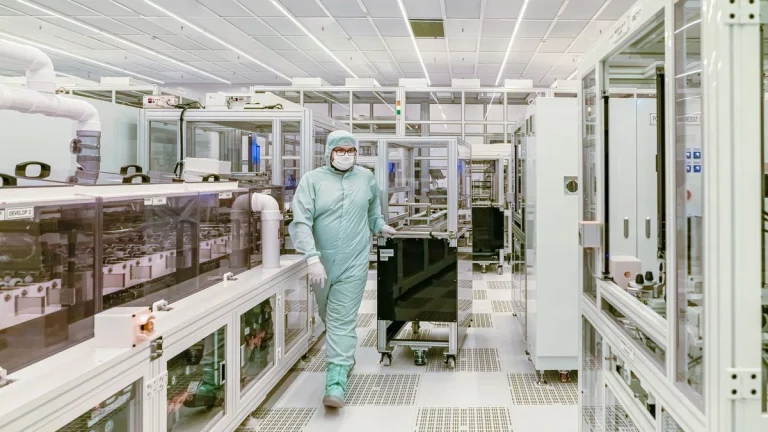
An industrial clean room is built around non-viable contamination. The enemies are inert particles of dust, metal, silicone or fiber that can ruin a wafer, a hard drive read head or a precision bearing. Electronics, semiconductor fabrication, aerospace optics and precision machining all live in this world. The product fails if a particle lands on it at the wrong moment, so the room removes particles faster than people and machines shed them.
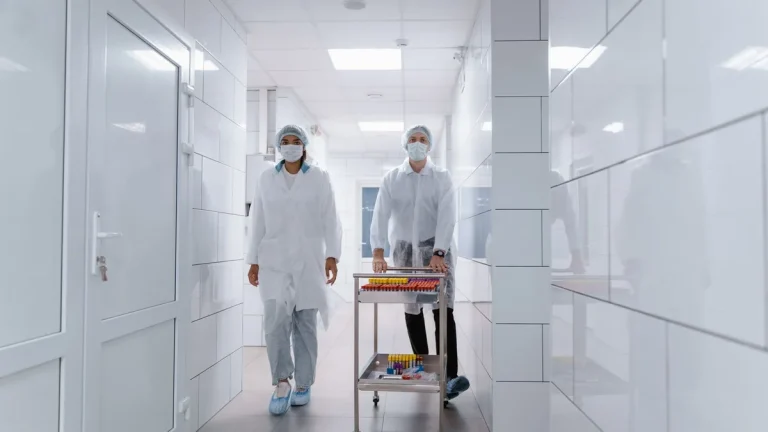
A biological clean room carries a second enemy on top of the first: viable microorganisms. Bacteria, spores and fungi do not just sit on a surface; they grow. A contaminated vial, wound dressing or food tray can harm a patient months after it leaves the building. The analogy we give buyers is simple. An industrial clean room is a museum vault keeping out dust, while a biological clean room is an operating theatre keeping out things that are alive and hungry.

ISO 14644-1, the base classification standard for both room types, grades air cleanliness purely by particle concentration. Its own abstract states it cannot characterize the viable nature of airborne particles. That single sentence explains why a second framework exists. Particle counts are necessary for both rooms; they are not sufficient where living contaminants matter.
ISO 14644 and GMP Grades Explained Side by Side
Most comparisons of the industrial clean room vs biological clean room split come down to the governing framework. Industrial rooms classify under ISO 14644-1, which grades air cleanliness from ISO Class 1 to ISO Class 9. The classification counts particles between 0.1 and 5 micrometers per cubic metre of air. A semiconductor photolithography area typically targets ISO 3 to ISO 4. Assembly and test areas relax to ISO 6 to ISO 8, though these are typical industry ranges rather than fixed rules.
Biological rooms classify under a second layer. In sterile pharmaceutical manufacturing, EU GMP Annex 1 defines Grades A, B, C and D. Grade A is the critical zone for high-risk operations such as aseptic filling. Grade B is its background room. USP <797> applies similar logic to sterile compounding in pharmacies and hospitals, requiring an ISO Class 7 buffer room with an ISO Class 8 anteroom.
| Parameter | Industrial clean room | Biological clean room |
|---|---|---|
| Primary contaminant | Non-viable particles | Particles plus viable microorganisms |
| Governing framework | ISO 14644-1 classes 1 to 9 | ISO 14644 plus EU GMP Annex 1 or USP <797> |
| Typical classification | ISO 3 to ISO 8 by process step | Grades A to D; ISO 7 buffer, ISO 8 anteroom |
| Classification metric | Particle count only | Particles plus microbial monitoring |
| Typical industries | Semiconductors, electronics, optics, aerospace | Pharma, medical devices, food, hospitals |
| Door surface priority | Low particle shedding, ESD control | Chemical-resistant, washable, sterilizable |
Why a Mapping Table Is Not a Translation Dictionary
Annex 1 Table 1 aligns Grade A with the ISO Class 5 particle limit. That limit is 3,520 particles of 0.5 micrometers or larger per cubic metre at rest. Buyers often read the row as “Grade A equals ISO 5” and stop there. In our view that is the costliest shortcut in cleanroom procurement, because the two systems answer different questions.
ISO 14644 tells you how clean the air is. GMP tells you whether a manufacturing process is controlled, documented and monitored. A Grade A zone carries requirements no ISO class contains, including continuous monitoring of viable air during operation. When you brief a supplier, state the process and the regulation first, then the class. The hardware specification will follow correctly.
How Pressure Cascades and Airflow Strategies Diverge
Industrial rooms usually defend one direction. The room runs positive to its surroundings, and filtered air flushes particles away from the product. The main design questions are air change rate and uniformity of airflow. Pressure matters mostly as a stability condition for that flushing process.
Biological rooms defend in stages. EU GMP Annex 1 calls for a minimum pressure difference of 10 Pascals between adjacent rooms of different grades. It is a guidance value, arranged so clean air always falls from the cleanest zone toward the dirtiest. Grade A zones add unidirectional airflow protection over the critical area. Operators enter through a cascade of changing rooms rather than a single door.
The instrumentation burden scales with the biology. A pharmaceutical suite logs pressure differentials continuously, because a regulator can ask what happened in the filling zone at any hour of any shift. An industrial room documents its airflow performance at commissioning and rechecks it on a schedule. Both monitor; only one has to prove an unbroken chain of control.
Warning: retrofitting an industrial room into a biological one by changing filters alone fails audits. A cascade needs matched doors, airlocks and interlocks. Annex 1 also expects the time between closing and opening interlocked doors to be defined and controlled. The wall and door package is part of the compliance case, not an afterthought.
Materials and Sterilization Demands by Room Type
Walk through an electronics clean room at shift change and you will see dry handling. ESD-safe garments, ionizers, and surfaces chosen so they shed nothing. The enemy is a particle, so the material priority is low outgassing and static dissipation. Stainless steel appears where durability matters, but powder-coated steel and HPL panels also serve well in less critical zones.
Walk through a pharmaceutical suite at night and you will see the opposite ritual: wet cleaning rounds on a fixed schedule. Disinfectants and sporicidal agents touch every surface a wipe can reach, including door leaves, frames, seals and vision panels. Each surface must survive repeated chemical attack without cracking, corroding or shedding. This is where Grade 304 or 316 stainless steel earns its premium. Gasket compounds are selected against the site’s own disinfectant list, a topic our cleaning validation guide covers in depth.

Temperature and humidity targets diverge too. Industrial rooms often run near ambient conditions chosen for machine stability. Biological rooms hold tighter bands that support product stability and operator gowning. Some areas add dedicated sterilization cycles for transfer equipment entering the suite, and the door hardware must tolerate those cycles as well.
The cleaning regime also decides the details you rarely see on a drawing. Coved skirtings, sealed hardware pockets and gaskets rated for the actual disinfectant all come from the wet-cleaning requirement, not from the particle class. Specify them from the process side, and the audit trail stays consistent from wall panel to door leaf.
What Doors and Airlocks Each Room Type Needs
Hardware is where an industrial clean room vs biological clean room decision becomes physical. In an industrial room, the door is mainly a particle barrier. Flush leaves, smooth skins and minimal ledges keep surfaces easy to clean and hard to shed from. Electronics applications add conductive surfaces to bleed static. Speed matters where logistics flow through, which is why high speed PVC doors appear at the boundary between a clean zone and a warehouse.
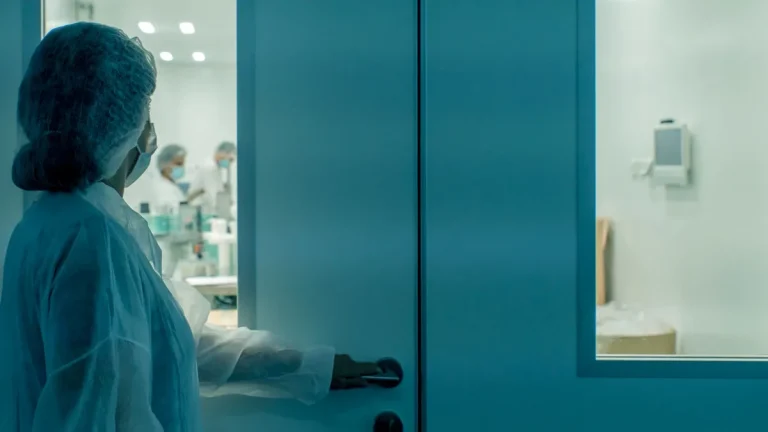
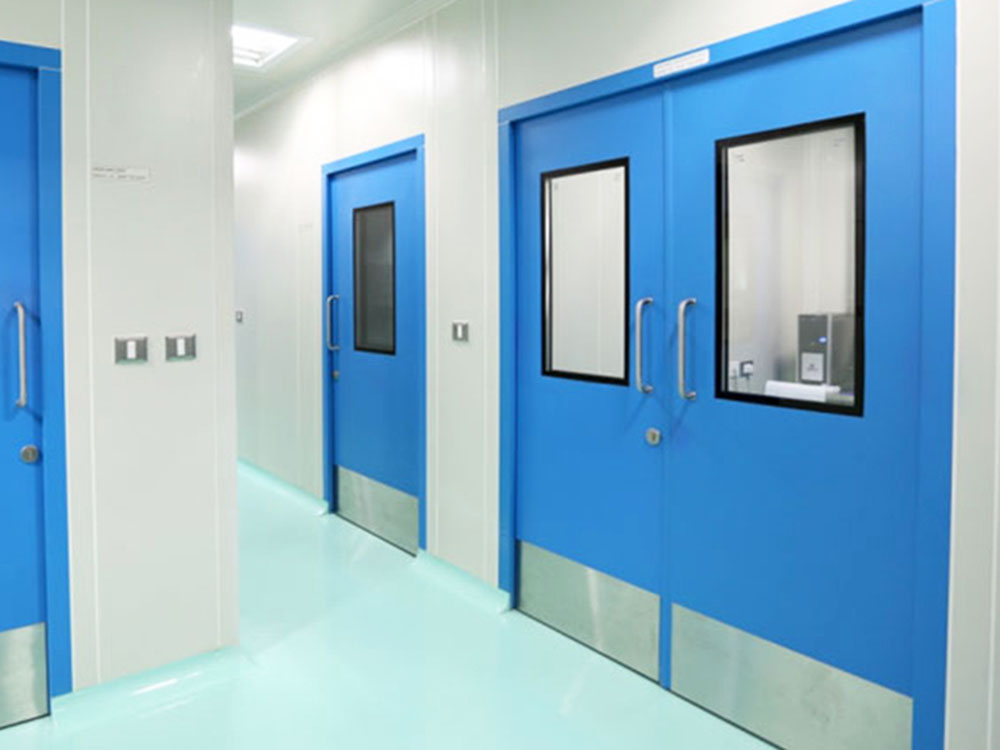
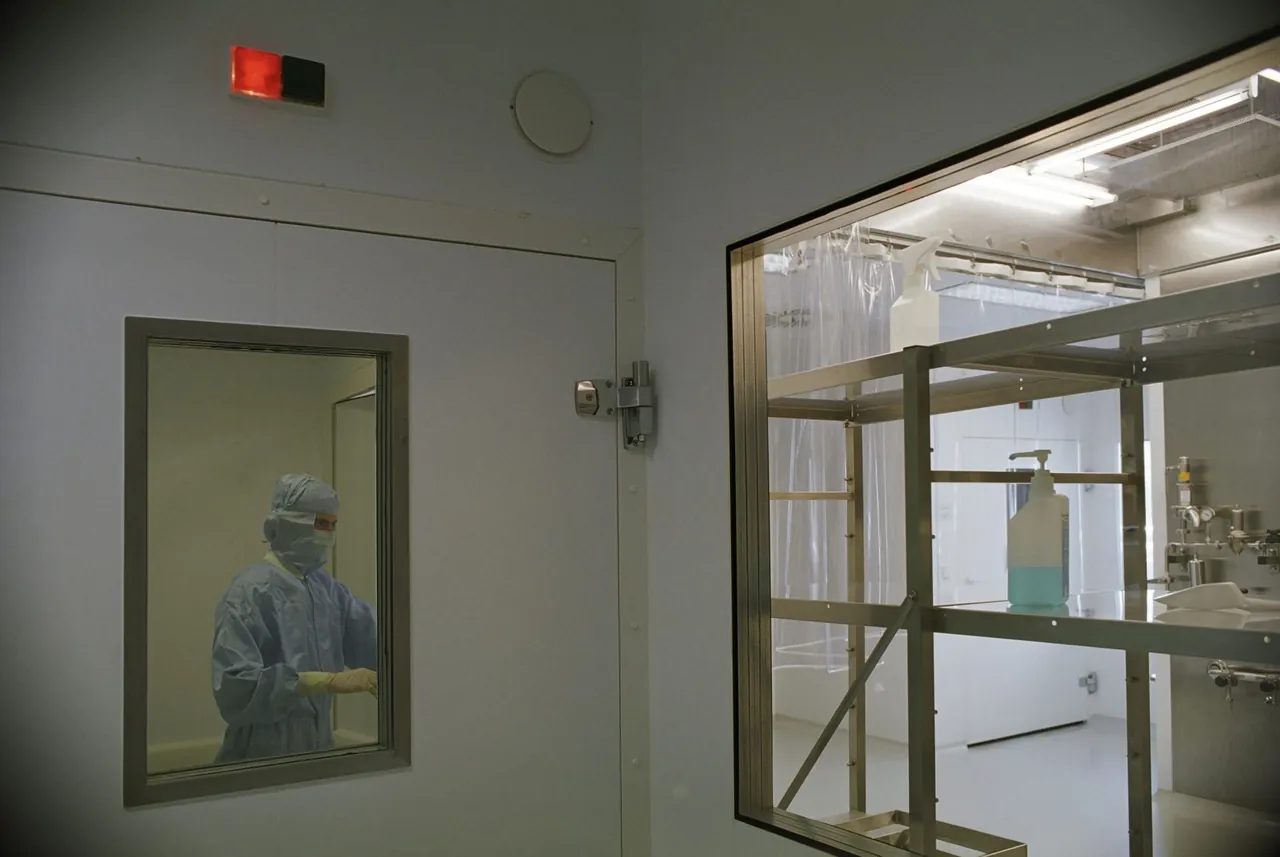
In a biological room the door joins the contamination-control case. Airtight seals hold the 10 Pascal steps of the cascade, and interlocked pairs stop two doors opening at once and dumping the pressure gradient. View panels let supervisors check conditions without entry. Annex 1 also expects materials to move through staged airlocks or pass boxes rather than walk-through traffic. A pass-through hatch therefore sits next to nearly every Grade B door we ship.
Seal construction differs as well. An industrial room tolerates a simple compression gasket, because its pressure target is a single stable setpoint. A biological room needs inflatable or continuous bulb seals that close the leaf against the frame on every cycle. Each failed step vents the cascade and can trigger an environmental monitoring excursion.
Door furniture follows the same logic of cleanability. Biological rooms favor flush pull handles, concealed hinges and stainless kick plates, because protruding hardware collects disinfectant residue and sheds particles into the lower air stream. Industrial rooms accept visible heavy-duty hardware where traffic is palletized and impact risk is real. The right choice is the one that matches the traffic, the cleaning agent and the grade of the room it serves.
If you are mapping a project against these hardware differences, our clean room doors overview lists the airtight, stainless and interlocked options side by side. For the airflow architecture behind them, see our walkthrough of cleanroom airlock pressure cascades. It shows how bubble, sink and cascade layouts use these doors in practice. Our ISO standards guide then details how door specification maps to each classification level.
Which One Should You Choose for Your Project
The industrial clean room vs biological clean room choice usually resolves from three questions about your product and process. None of them depends on what competitors in your industry built. Two facilities inside the same plant can legitimately belong to different types.
Answer These Before Specifying
First, what must the room keep out? If the failure mode is a particle landing on a surface, you are in industrial territory, and ISO 14644 classification carries the project. If a living organism could land, survive and later reach a patient or a food product, you are in biological territory. A GMP or USP framework then sits on top of the ISO base.
Second, how is the product sterilized? A terminal sterilization step tolerates simpler boundaries. Aseptic processing pushes Grade A and B requirements deep into the layout, including airlocks and interlocked doors.
Third, who audits the room? An internal cleanliness program is one obligation; a regulatory inspection with documented environmental monitoring is another. The audit regime dictates how much of the cascade you must instrument.
A worked example shows the logic in motion. A maker of implantable screws machines titanium under ISO 7 particle control, then packs the screws in an aseptic area graded for ISO 5 conditions at rest. The machining cell is an industrial clean room. The packing suite is a biological one, with a cascade, interlocked doors and pass boxes, even though both rooms sit behind the same corridor.
Answer those three and the specification writes itself. The room type follows from what the process must keep out, and the door package follows from the room.
Frequently Asked Questions
What is the core difference in an industrial clean room vs biological clean room comparison?
An industrial clean room controls non-viable particles only. A biological clean room controls the same particles plus viable microorganisms, adding GMP or USP requirements for microbial monitoring, disinfection and sterilization.
Is GMP Grade A the same as ISO Class 5?
They share the at-rest particle limit of 3,520 particles per cubic metre at 0.5 micrometers, but Grade A adds unidirectional airflow, continuous monitoring and full GMP process controls.
What pressure difference does EU GMP require between grades?
Annex 1 gives a guidance value of at least 10 Pascals between adjacent rooms of different grades. Air must flow from cleaner to less clean zones, protected by airlocks and interlocked doors.
What does USP 797 require for a sterile compounding suite?
An ISO Class 7 or better buffer room holding an ISO Class 5 primary engineering control. Staff reach it through an ISO Class 8 or better anteroom, where they garb before entry.
Do the two room types need different doors?
Yes. Industrial rooms prioritize flush, low-shedding, sometimes ESD-safe leaves. Biological rooms add airtight seals for pressure cascades, chemical-resistant stainless surfaces and interlocks, plus pass boxes.