
Picture a winter Monday at any frozen food distribution center. The hinged freezer door on the −20°C pick room has frozen shut overnight. Two workers spend forty minutes with a heat gun while a queue of pallets idles behind them. Two meters away, the high-speed door on the ambient buffer room has opened four thousand times that week without complaint. Same facility, same cold chain, two completely different machines, because the two openings do two completely different jobs.
That story is the core of selecting industrial cold room doors. It comes from someone who builds them: the opening is a logistics decision before it is a thermal one. We have built cold chain doors for over 25 years and shipped to projects in more than 70 countries. The most common specification mistake we see is not a bad door. It is the right door installed on the wrong opening.
Start With Temperature, Not Door Style
Every cold room sits somewhere on a temperature ladder, and the ladder decides which mechanisms can survive. Chilled rooms handling produce, dairy or pharma typically run between 0°C and 8°C. Freezer rooms for frozen goods typically run between −18°C and −22°C, and specialty blast cells go lower still. A door rated for a chill room will ice up and seize in a freezer, because sub-zero conditions change how moisture behaves around every seal and frame.
Manufacturers publish duty ratings accordingly. Jamison rates its Jamoglide vertical sliding freezer door down to −20°F (−29°C). It adds that any temperature difference above 90°F across the leaf calls for project-specific engineering. Use the room setpoint as your first filter, door family second, and hardware trim last. Reverse that order and the door you buy will fight the room it serves.
Five Door Families Cover Most Cold Rooms
Walk any cold storage facility and you will find the same five families of industrial cold room doors doing the work, plus strip curtains as an accessory. Each family owns a niche defined by opening width, traffic type and duty. Here is how the families actually divide the territory.
Insulated Sliding Doors
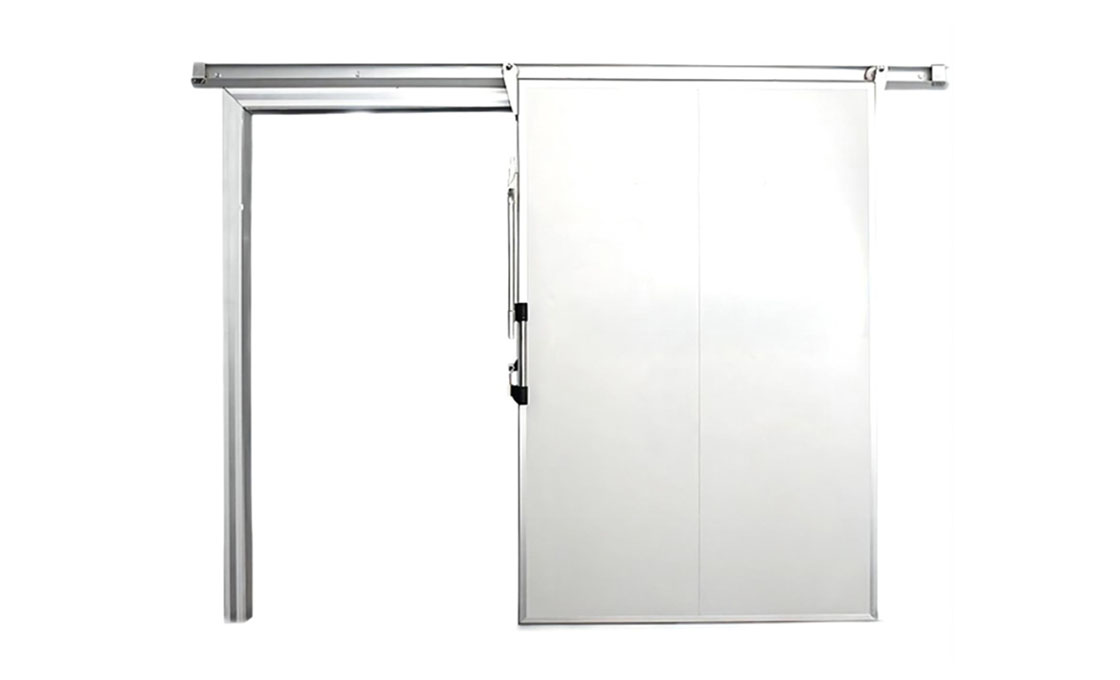
Sliding doors hang from a top rail and park the leaf beside the opening, so they need wall space but zero floor space. Cores commonly run 80–120 mm of polyurethane, sized to the room’s duty. They suit forklift traffic on wide openings up to several meters, with manual slides on low-duty chill rooms and powered versions on busier lanes. Rytec’s high-performance Turbo-Slide reaches opening speeds up to 125 inches per second with insulation values up to R-40, showing how far the family stretches.
Sectional Overhead Doors
Sectional doors lift vertically on tracks and stack under the ceiling, which keeps the opening clear for dock work. Panels of 40–50 mm PU are the industrial baseline, and premium cold-storage panels run 40–80 mm. The family earns its place on dock faces where trailers dock continuously and wind, weather and impact all arrive together. If you are weighing panels, U-values and spring life for a dock opening, our buying guide to insulated sectional doors for cold storage covers that decision in depth.
Vertical Lift Freezer Doors
Vertical lift doors slide up instead of sideways, trading wall space for nothing at all. That makes them the answer in narrow machine corridors and tight pick modules where a parked sliding leaf would block an aisle. Jamison’s Jamoglide spans openings up to 14 by 16 feet, carries UL 471 and UL 508 listings, and uses a counterbalanced track with an automatic top latch. The family is the niche specialist of the five, priced accordingly and worth it exactly where space runs out.
High Speed Roll-Up Doors
High speed fabric and rigid roll-up doors exist to shorten the seconds a room stands open. Doors in this class handle 50 or more cycles per hour against fewer than 20 for a hinged leaf. Our own high speed line runs 0.8–2.5 m/s. In freezer work they usually sit as an inner or outer stage in a two-door airlock, chopping air exchange while the insulated door handles the deep cold. The family pays for itself wherever traffic is continuous and the temperature bill is metered.
Hinged and Double-Acting Swing Doors
Hinged insulated doors remain the default on small rooms and personnel openings, typically below about 20 openings per hour. Double-acting swing doors add spring hinges that return the leaf to closed after a push-through, which keeps pedestrian lanes moving without handles. Both are the cheapest family to buy and the first to suffer when asked to serve forklift duty. Frozen-swing complaints almost always trace back to that mismatch rather than to the door itself.

Matching Door Duty to Traffic Levels
Temperature decides what industrial cold room doors must survive. Traffic then decides how hard you should make them work. Field data gathered across manufacturer ranges bands out cleanly. A hinged door on a personnel opening sees 5–30 cycles a day. A powered sliding door on a forklift lane sees 30–80, and a high speed door on a continuous pick line sees 80–300 or more.
Service life tracks the same ladder, with hinged doors lasting 8–12 years, sliders 10–15, and spiral high speed doors 15–20.
| Door family | Typical duty | Best fit |
|---|---|---|
| Hinged or swing | Under 20 openings per hour | Personnel and small walk-in rooms |
| Insulated sliding | 30–80 openings per day | Wide forklift lanes with side wall space |
| Sectional overhead | Continuous dock shifts | Trailer docks and weather exposure |
| Vertical lift | 30–80 openings per day | Tight aisles with no wall space |
| High speed roll-up | 50+ cycles per hour | Continuous traffic and airlock stages |
One warning belongs here. A door specified one duty class below its opening does not fail politely. The gaskets polish away, the hinges starve, and the room pays the difference in every kilowatt-hour. When an opening carries mixed traffic, size for the peak, not the average.
Insulation Thickness and Panel Specs
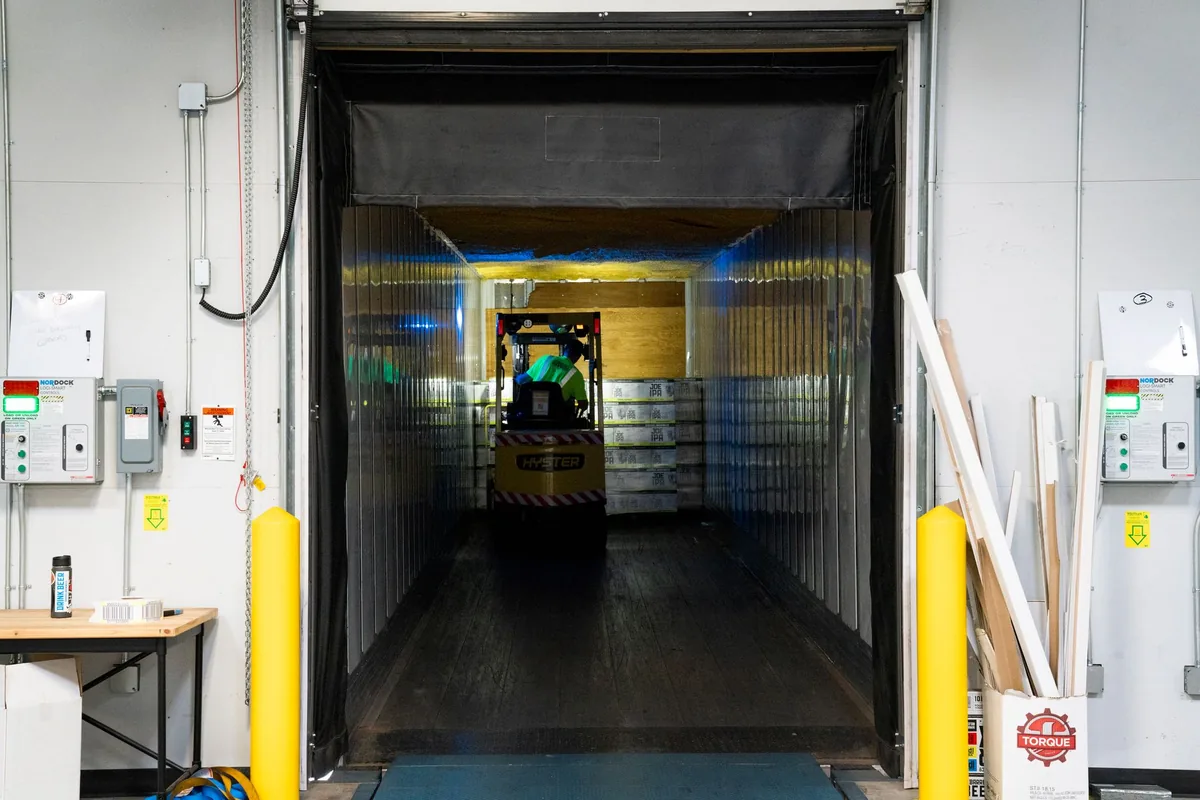
Across the industrial cold room doors market, panel thickness follows the temperature ladder. Chill duty typically carries 80–100 mm of PU core, freezer duty 120–150 mm, and sliding leaves commonly 80–120 mm. Sectional cold-storage panels run thinner at 40–80 mm because they gain performance from panel density, joint geometry and the whole-door assembly rather than from thickness alone. Our sectional line, for example, reaches a whole-door U-value of 0.33 W/m²K with 40–50 mm panels, which a thicker leaf with a poorly sealed frame cannot match.
That is the specification trap worth naming: thickness is easy to compare on a quote, but the whole-door U-value is the number that reaches your energy bill. Ask for the tested assembly value, frame included. For the short-version orientation question, see our earlier post on what kind of door do you use in a cold room.
How Ice Attacks Seals and Frames
Think of every cold room door as a valve between two climates, because that is exactly what it is. Warm air holds moisture; when it leaks toward the cold side it crosses its dew point and deposits that moisture as frost on the first surface it meets. The first surfaces are usually the gasket, the frame and the threshold. Frost thickens and the leaf stops compressing the seal. Leakage grows, and the loop feeds itself until a morning shift finds the door frozen shut, exactly like the Monday-morning scene above.
Freezer-rated assemblies break the loop with hardware, not luck. Heated door frames and heated thresholds keep the seal surfaces above freezing, and compression gaskets hold contact despite frost. The maintenance load is small but non-negotiable: inspect gaskets twice a year, lubricate sliding rails every three months, and test the frame heating monthly before winter sets in. If a door has been hard to open after closing, suspect negative pressure across the leaf as well as ice, and let the room rebalance before forcing it.
Door discipline carries the rest. Strip curtains and vestibules shorten open-door seconds, and our engineering blueprint for how to prevent temperature loss in cold storage facilities details the envelope side of that work. Ice is a symptom of airflow you have not controlled yet.

Safety Features and Compliance Basics
Cold room doors close on people as well as pallets, so the compliance layer matters as much as the thermal one. In Europe, powered door systems fall under EN 13241 with EN 12453 governing the safety requirements of the operator: force limitation, pressure-sensitive edges and controlled reopening. Our own production runs under ISO 9001:2015 with CE documentation to EN 13241 on every powered leaves shipment. North American buyers will see UL 471 and UL 508 listings on freezer-rated equipment instead.
Three features deserve a line in every specification. First, a pneumatically or electrically reversing edge that restarts the leaf on contact. Second, an internal safety release on every personnel door, so nobody is ever locked inside a room at −20°C. Third, compliant break-glass or panic hardware in walk-in rooms. The UK’s HSE workplace temperature guidance adds the human side of the same duty for staff working in cold environments.
Choosing the Right Door by Scenario
Put the three filters together, temperature, duty and space, and most openings name their own door. The routing table below compresses everything above into the five decisions a cold storage project actually faces. Find your opening in the left column and read across.
| Your opening | Family | Why it wins |
|---|---|---|
| Personnel entry, low duty | Hinged insulated | Lowest cost, simplest hardware |
| Wide forklift lane, chill duty | Powered sliding | Clear opening, proven 10–15 year life |
| Trailer dock face | Sectional overhead | Weather sealed, impact tolerant |
| Narrow freezer aisle | Vertical lift | Zero wall and floor footprint |
| Continuous traffic, airlock stage | High speed roll-up | Cuts open-seconds, recovers from impact |
The catalog behind these families lives on our industrial cold room doors category page, where each family is broken out by leaf type and hardware. My working opinion after enough winter commissioning visits is simple. Buy the cheapest family that honestly survives your duty, then spend what you saved on seals, frame heating and installation detail. Doors rarely fail in the middle of the leaf.
Frequently Asked Questions
What kind of door do you use in a cold room?
Chilled rooms usually take insulated sliding or hinged doors with 80–100 mm PU cores. Freezer rooms need 120–150 mm cores, heated frames and compression gaskets. High-traffic openings add a high speed door as an airlock stage.
Does a freezer door always need a heated frame?
Below about −18°C, effectively yes. Heated frames and thresholds keep seal surfaces above freezing so the gasket does not ice over. Guidance on freezer doors treats frame and threshold heating plus monthly heater checks as standard practice.
Are swing doors suitable for freezer rooms?
Single-leaf hinged swing doors work on small freezer rooms and personnel openings with light duty. Double-acting swing doors belong on pedestrian lanes at chill temperatures. Heavy forklift traffic will wear out hinges and gaskets early.
Sliding or vertical lift: which suits a narrow aisle?
Vertical lift. A sliding door needs clear wall beside the opening to park the leaf, which a narrow aisle rarely offers. Vertical lift doors stack the leaf above the opening within the door frame footprint.
How often should cold room door gaskets be replaced?
Inspect every six months and replace at the first sign of hardening, tears or permanent compression set. Most gaskets last several years in chill duty; freezer duty with heated frames shortens that interval. Log checks with rail lubrication every three months.