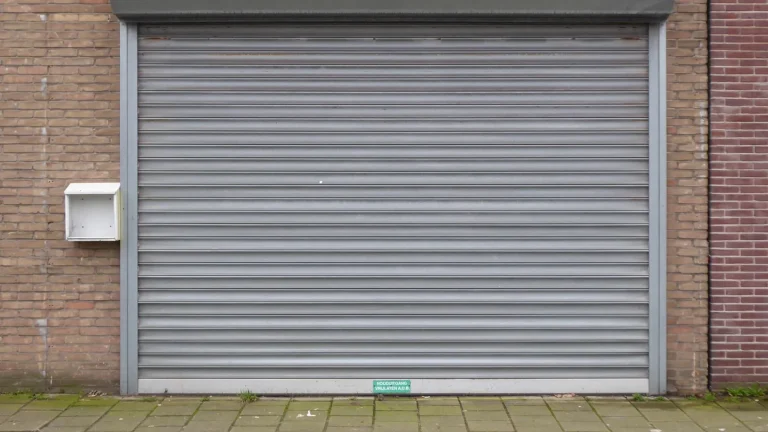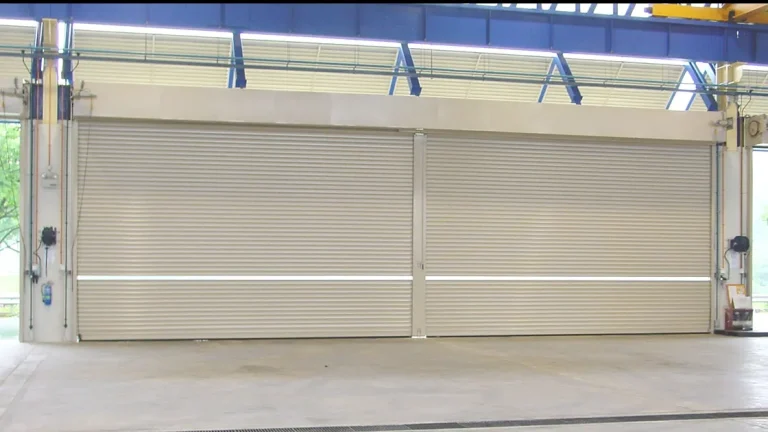







Somewhere in your facility sits a row of manual roller shutters, and someone upstairs has decided they should be automated. Three suppliers visit, three quotes come back, and none of them agree on what the conversion involves. One prices a motor swap, one prices a new curtain, and one quietly recommends replacement. Nothing in the paperwork tells you which shutters can actually be converted, what the finished door must satisfy, or who signs for it.
We build roller shutter doors and door operators in the same factory, and the first question our engineers ask is never which motor to buy. Roller shutter automation retrofit is a feasibility decision before it is a purchase: the curtain, the barrel and the guides either qualify for a motor or they do not. This guide walks the decision in the order a conversion crew works it: feasibility first, then drive selection, safety duties under EN 12453, the conversion sequence and the acceptance tests.
When a Manual Shutter Can Be Motorized
Start with the curtain, because a motor only automates what the curtain already does smoothly. Run the shutter by hand through three full cycles and feel for dead spots, scraping and slack. Curtains also wear differently by material, and our comparison of galvanized steel and aluminum curtain slats shows why the same wear reads differently on each. A curtain that fights you by hand will fight the motor harder.
Automation retrofits put a door in daily service, and duty accelerates every surface question. What powder coating colours and film grades survive high-cycle operation is collected in our finish guide.
Next, look at the barrel and the box it lives in. One conversion guide puts typical domestic axle diameters at 40 or 60 mm, with a headbox at least 150 mm deep for a standard tubular motor. Shutters built since about 2000 usually accept tubular motors on those axles, while older barrels may need adapters or may not be worth opening at all. Measure before you quote, not after.
Guides and seals come third. Worn guide channels let the curtain drift, and a drifting curtain under power is a jam waiting for rush hour. Our guide to brush seals for worn guide channels explains what they buy time on, but they do not rebuild a guide that has gone oval.
Size closes the list. Shutters wider than 2.4 metres or larger than 4 square metres need higher torque or a professional assessment. Industrial curtains in 0.8 to 1.5 mm steel sit well above the domestic weights those numbers assume. On our own range, clear widths run to 12,000 mm, which is why the feasibility verdict for a wide industrial door is rarely the one written for a shopfront shutter.

The checklist below is the pass and fail screen that a roller shutter automation retrofit has to clear before anyone quotes a motor:
- The curtain runs smoothly by hand: no dead spots, no scraping, no permanent set in the slats
- The axle is a standard 40 or 60 mm tube with room in the headbox for a motor
- The guides are true and the curtain tracks them without drift
- The door holds position today, because a shutter that free-falls needs a brake or anti-drop hardware before automation, not after it
- Power can reach the barrel end without opening the whole facade
A door that passes all five is a candidate; a door that fails two is a repair job wearing a conversion quote. Fix the curtain and guides first, then re-test. The motor only ever multiplies whatever condition the hardware is already in.
Tubular Motor or External Drive
Two drive families cover nearly every conversion. A tubular motor slides inside the barrel and drives it directly, while an external geared motor bolts onto the shaft end and turns it from outside. Chain-operated industrial shutters already carry the shaft-end hardware an external drive needs, and our comparison of industrial chain shutter door motor types shows why the gearbox choice matters there.
Torque decides between them as much as space does. The same conversion guide quotes 10 Nm for shutters under 900 mm wide and 20 Nm up to 1,800 mm, rising to 40 Nm for large openings. Anything over 4 square metres asks for 20 Nm or more. Controls also carry an energy dividend: see how sensing changes the doorway energy bill.
| Shutter size | Motor torque | Read it as |
|---|---|---|
| Under 900 mm wide | 10 Nm | Light domestic curtains |
| 900 to 1,800 mm | 20 Nm | Standard windows and small doors |
| Over 1,800 mm | 40 Nm | Large openings, higher duty |
| Over 2.4 m wide or 4 m² | 20 Nm plus assessment | Industrial curtains, verify the curtain weight first |
Torque ladder as one conversion guide quotes it for domestic-class curtains; industrial curtains shift every row upward.
Match the drive to the axle, not the brochure. A 60 mm octagonal barrel and a 40 mm round barrel do not accept the same motor, and adapter kits cost less than a returned motor.
An external drive wins whenever the barrel cannot be opened: welded shafts, oversized industrial barrels, or a curtain too heavy for any tubular motor in stock. The manual chain stays on the gearbox as an override, which is worth more than any feature list the first time the building loses power. Duty rating matters here too. A dock door cycling fifty times a day needs a motor built for that count, not a window motor with a bigger number on the box.
Keep the boundary with new hardware honest, because this is a conversion decision for an existing door, not an operator purchase. If the verdict is a new electric door rather than a motor for the old one, the commercial garage door opener guide covers that route instead.
Power options complete the roller shutter automation retrofit decision. Mains-fed tubular motors are the default where cable reaches the barrel. One guide prices battery motors at 190 to 350 US dollars with 30 to 40 full cycles per charge. A small solar panel suits shutters with no electrical connection at all. Control add-ons run from 50 US dollars for a radio remote to 80 to 120 US dollars for a Wi-Fi bridge, which matters in the next section.
Controls and Safety Under EN 12453
A motorized shutter is a powered door, and powered doors are governed by EN 12453 in Europe and by equivalent duty-of-care rules elsewhere. The core of the standard is force limitation: the moving door must not crush, and where it can only impact, it must impact gently.
BS EN 12453:2017 force limits: 400 N maximum for crushing and draw-in hazards, 1,400 N for impact. Time above 150 N is capped at 0.75 seconds. Static force above 25 N is capped at 150 N for no more than 5 seconds, and end force at 25 N.
Those numbers are not self-claiming. Britain’s HSE powered-doors bulletin confirms the 400 N crushing and 1,400 N impact limits still stand. Where force limitation is the main safety measure, it adds, forces should be kept as low as possible and verified by testing after installation. A crew that sets limits by feel has not finished the job.
Gravity is the second hazard. A converted shutter hangs from its motor and brake, so the brake, the release mechanism and the curtain suspension all become safety parts. Suspension failure on a vertically moving door must prevent unintended movement beyond 300 mm. Where the curtain relies on hardware to survive a drive failure, our anti-drop device engineering guide explains that layer in depth.
Sensors finish the safety set:
- Photocells or light beams across the closing plane, so presence beats force
- A pressure-sensitive safety edge on the closing edge, for gaps the beam cannot see
- A control that self-checks the safety function before each cycle where the technology permits
- A manual release or override that works without power, because the door still has to open during an outage
- Operator instructions that say what the door will and will not do
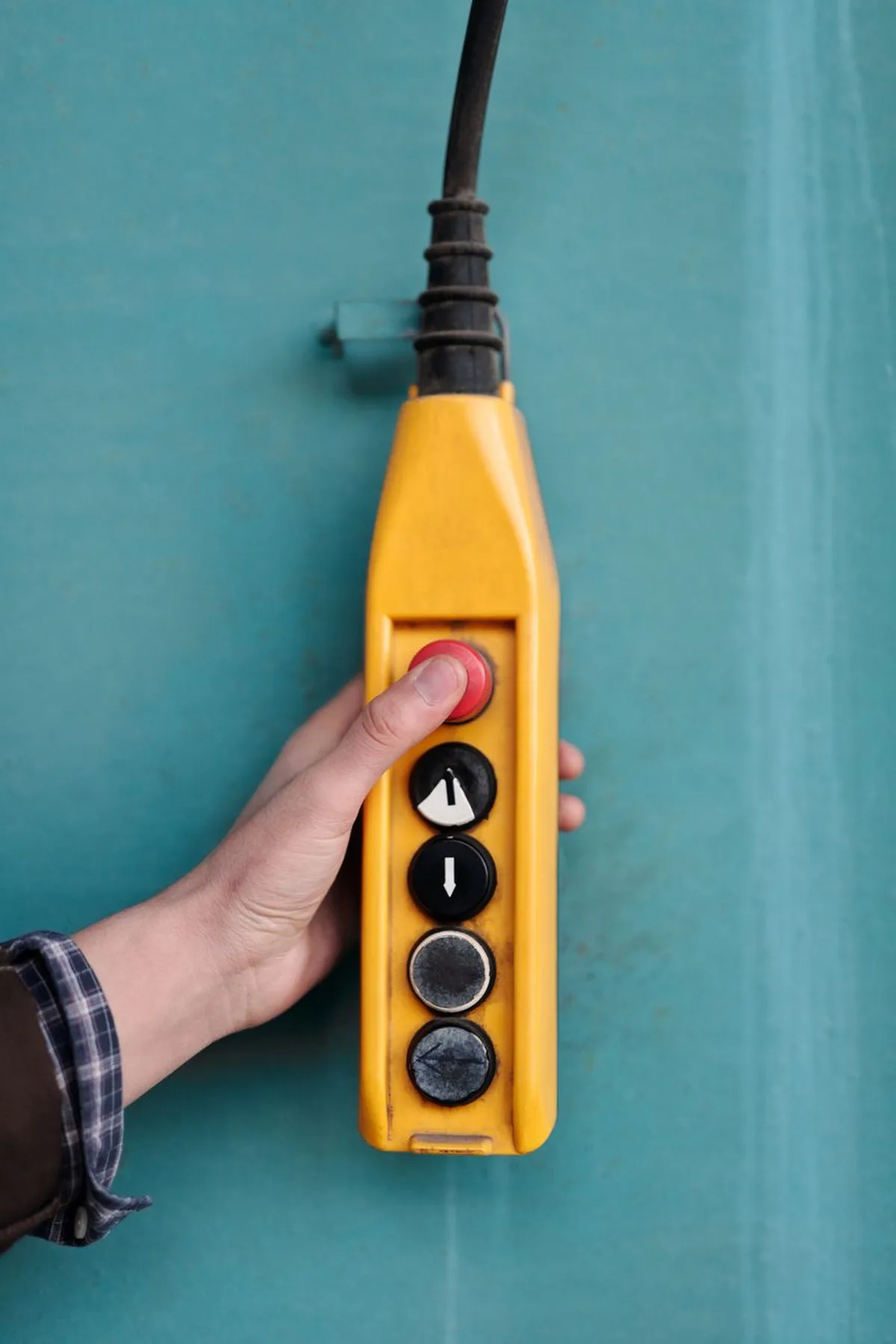
Controls scale with the building. A key switch satisfies a store room, a warehouse dock wants grouped push buttons, and a managed estate wants status visibility. Our guide to smart door opener app control draws that line honestly. Whatever the interface, a roller shutter automation retrofit must ship with the safety layer above it, because convenience without force limitation is a liability with a remote control.
The Retrofit Sequence, Step by Step
A clean roller shutter automation retrofit follows the same order whether the door is a shopfront or a bay door. The order exists so that errors surface while they are still cheap.
- Survey and measure: axle diameter and shape, headbox depth, curtain weight, guide condition and the cable route, all recorded before anything is ordered
- Isolate and secure: lock off the supply, lower the curtain fully and block it, because a released curtain under tension is the sharpest hazard on site
- Remove the manual gear: the winding handle, belt or chain drive comes off, keeping whatever will serve as the manual override
- Fit the motor: brackets set just below the axle centreline, around 20 mm by one guide’s figure, so the drive takes load without fighting the bearing
- Wire it: mains connections belong to a licensed electrician under local wiring rules; Australian practice cites AS/NZS 3000, and most EU sites have an equivalent
- Set the limits: program the upper and lower stops so the curtain halts about 10 mm short of the headbox and the sill, before it can press on either
- Run and calibrate: several full cycles on the hand control, watching tracking and listening for load, then set drive force to the lowest value that moves the curtain reliably
One conversion guide budgets two to four hours of mechanical work for a domestic shutter, plus under two hours for the electrician. Industrial doors scale that up with weight and access. The numbers matter less than the sequence. A crew that sets limits before the curtain runs true will set them again after the first jam. The component-level walkthrough of that chain lives in inside the tubular motor.

Keep the manual override honest through all of it. The chain or crank that stays on the door is not scrap; it is the power-failure version of the door. The crew should prove it works at the end of the job, not assume it survived the motor install. Label the override point while the ladder is still up, because the person who needs it in two years will not have this guide. If the drive decision itself is still open, our manual vs motorized comparison of rolling shutters lays out the frequency and cost arithmetic. If the drive decision itself is still open, our manual vs motorized rolling shutters comparison lays out the frequency and cost arithmetic.
Acceptance Checks and Handover Tests
An installer who puts a converted door into service supplies a technical file, user instructions and a Declaration of Conformity. The duty-holder then keeps the door safe for its working life. Acceptance is where a roller shutter automation retrofit earns its signature, and the table below is what gets signed. The on-site side of that work is covered step by step in the new-install method and its acceptance checks.
Handover proves a retrofit once; a schedule proves it for years. The three-cadence fire shutter inspection plan is the template for keeping an automated or manual shutter ready after the handover sheet is signed.
| Check | What passes | Why it matters |
|---|---|---|
| Force measurement to BS EN 12445 | Crushing at or under 400 N, impact at or under 1,400 N, measured with an instrument | The limit is a ceiling, not a target |
| Limit switch verification | Curtain halts short of headbox and sill at both ends of travel | Prevents pressing and climbing |
| Safety device function | Photocells and edges trigger reversal on every test cycle | The self-check only counts once proven |
| Brake and suspension check | No unintended movement on a released load, anti-drop hardware engaged | Gravity does not take days off |
| Manual override test | Chain or crank opens the door with power isolated | Outages and maintenance depend on it |
| Documentation pack | Technical file, Declaration of Conformity, wiring diagram, service schedule | The duty-holder keeps these for the door’s life |
Force limits are ceilings, not targets. A converted door measuring 380 N at the closing edge has passed the test; it has not passed the risk assessment. For the component itself, our guide to why an override cannot be bolted on covers the release types and their security trade-offs.
Acceptance also sets the maintenance clock. Heavy-use shutters benefit from servicing about twice a year, one UK guide notes, and curtain and guide cleaning every six months preserves the low friction the force test relied on. Record the force measurement in the service record so the next test has a baseline. Drifting force readings between services usually mean guides or bearings, not the motor, and the record is what turns that observation into a diagnosis.

Hand over the file, walk the supervisor through the release and the self-test, and record the date. A door accepted this way starts its powered life with evidence instead of assumptions.
Cost Drivers and When Replacement Wins
Published prices cluster around domestic work, so read them as anchors rather than quotes. One UK contractor quotes £400 to £650 per shutter converted. The Australian guide lands at 550 to 900 US dollars for a professional job, or 400 to 650 US dollars for self-fit mechanics with an electrician on the wiring. Industrial doors move those numbers with curtain weight, drive type, cable distance and access.
Replacement wins more often than the retrofit literature admits. When the curtain is tired, the guides are oval and the barrel is non-standard, the conversion bill buys a motor for a door already past its best. A roller shutter automation retrofit stops making sense the moment the hardware fails its own feasibility test.
Rule of thumb: if the feasibility checklist fails on two or more lines, price a new door before you price a motor. A new door arrives with matched drive, certification and warranty; a converted one inherits all three from hardware never designed as a system.
When the verdict is replacement, the honest comparison is a factory-built electric door. Our roller shutter doors are built motor-ready with 0.8 to 1.5 mm steel or aluminum curtain and clear widths to 12,000 mm. EN 13241 and EN 12453 sit in the certification file, and single-unit orders are welcome. First orders run 20 to 35 days, with two years of warranty on the door and three on the operator.
Back to that row of shutters and the three disagreeing quotes. The feasibility screen decides which doors are candidates, the acceptance tests decide who signs, and the doors that fail both belong in the replacement column. Judge the door before the motor, and judge the motor by measurements, not by promises.
Frequently Asked Questions
Can every manual roller shutter be motorized?
No. A roller shutter automation retrofit needs a healthy curtain, a standard 40 or 60 mm axle with headbox room, true guides, a door that holds position and a cable route. Fail two or more of those and repair or replacement comes first.
What torque do I need for my shutter?
One conversion guide quotes 10 Nm under 900 mm width and 20 Nm up to 1,800 mm, rising to 40 Nm for large openings. Beyond 4 square metres, expect 20 Nm or more. Industrial curtains weigh more, so verify curtain weight before trusting any ladder.
Is a converted shutter as safe as a factory-electric one?
It can be, if it meets the same EN 12453 duties. That means force limits of 400 N crushing and 1,400 N impact, working photocells or safety edges, protection against unintended movement, and an instrumented force test after installation.
How long does a conversion take?
One conversion guide budgets two to four hours of mechanical work for a domestic shutter plus under two hours of electrician time. Industrial doors scale with curtain weight, drive type and site access, so survey before promising hours.
What documents should the installer hand over?
A technical file, a Declaration of Conformity, user and maintenance instructions and the wiring diagram, per HSE’s reading of the powered-door standards. Keep the measured force results with them as the baseline for future tests.
When is replacement better than retrofit?
When the curtain, guides or barrel fail the feasibility screen on two or more counts. A factory-built electric door brings matched drive, current certification and fresh warranty, while a conversion inherits all three from aging hardware.