






The winter heating bill lands higher than last year, and nothing else in the building changed. The shifts are the same and the lights are the same, yet the meter keeps finding new money. In many warehouses the uninspected gap is the roller shutter openings. Three separate loss paths run through one doorway, and most buyers have only ever heard about one of them.
We build roller shutters in Hebei on our own auto PU foam line, a line we have run since 1999. Cost-conscious buyers ask us a fair question. Where does the saving actually come from? The honest answer is an account with three lines. Each line can be counted at your own doorway before you spend anything.
Where a Roller Shutter Door Loses Energy
High performance roller shutter energy efficiency starts with splitting the account, because each path responds to different hardware. Heat conducts through the curtain while the door is closed. Air leaks around the curtain edges and under the bottom rail around the clock. Then every open cycle trades inside air for outside air at full exchange rate.
A single-skin steel curtain handles none of the three paths well. The panel is metal end to end, and the guides are metal on metal. A slow open cycle hands the doorway to the weather for half a minute at a time. Two industrial doors with the same dimensions can therefore behave nothing alike once a winter arrives.
The standing-loss line is decided by curtain construction. The choice between skin materials matters as much as the insulation inside them. We cover that decision separately in steel versus aluminum slat trade-offs, so this article stays on the thermal arithmetic.
The leakage line hides in the details most specification sheets skip. Worn guide brushes, a bottom rail with no floor seal and an unsealed top casing each bleed air day and night. The UK regulator’s workplace temperature checklist asks employers to screen for draughts. An under-door draught is the classic finding.
The exchange line only exists while the door is open, which makes it a duty-cycle problem rather than a construction problem. One supplier guide puts it plainly: joints, perimeter seals, the bottom interface and the way the opening is used all decide how much air moves. Our own guide on where brush seals beat rubber covers the sealing matchup.
Score the three paths separately before comparing quotes. A doorway that stays closed all day is a construction problem. A doorway that cycles a hundred times a day is a controls problem first. No amount of foam fixes the seconds.
How PU-Filled Double Skin Slats Slow Heat
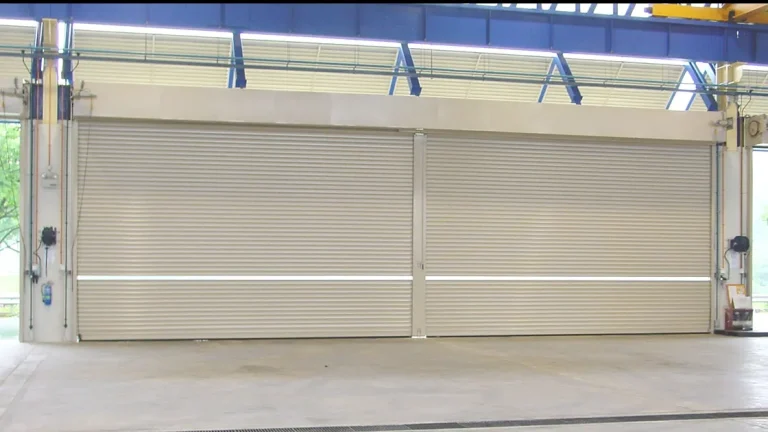
Among industrial doors, the roller shutter carries a reputation for thin steel. Heat moves through a curtain by conduction, so the fix is a low-conductivity core between two rigid skins. That is the construction of insulated aluminum roller shutter doors. Two extruded aluminum skins bond around a high-density polyurethane foam core, foamed in-house so the bond stays void-free. That sandwich is the working heart of high performance roller shutter energy efficiency.

The physics is simple enough to trust. Closed-cell foam conducts heat poorly, while a single steel skin conducts it well, so filling the sandwich changes the curtain’s behavior completely. One US rolling door manufacturer publishes the point with hard numbers. Its flagship insulated door pairs double-skin interlocking slats with a closed-cell urethane fill. Add perimeter seals and thermally broken guides, and the published result is a U-factor of 0.82 with air infiltration down 94 percent against its standard model.
Rolling shutters do not reach sectional panel numbers, and honest specifiers say so. Our sectional line reaches a door-set U-value of 0.33 W/m2K with 40 to 50 mm panels, which we unpack in the guide to what the sectional U-value means. A curtain has to coil, so its foam layer stays thinner. The table below shows what each construction actually buys.
| Curtain construction | Thermal behavior | Best duty |
|---|---|---|
| Single-skin steel, 0.8 to 1.5 mm | Minimal resistance; inner-face condensation in winter | Unheated sheds, security closures |
| Double-skin extruded aluminum, PU foam core | Transmittance falls to a fraction of single-skin; exact figure confirmed per door set | Conditioned warehouses, chilled zones, noise-sensitive faces |
| Sectional panel, 40 to 50 mm PU (reference) | Door-set U 0.33 W/m2K on our line | Cold rooms, freezer lobbies, heated work halls |
When a quote claims a U-value, ask which one it is. A curtain-only slat figure is not a door-set figure measured to EN 12428. The gap between them is where disappointed expectations live. We confirm the achievable door-set number on the technical layout before an order is cut.
That efficiency has a labor side too, and our work efficiency breakdown for high performance roller shutters guide counts the minutes each faster cycle returns.
Why Seals and Guides Decide the Real Number
A good curtain inside bad peripherals still loses. The guide rail is a metal bridge from the inner slat face to the wall, and it short-circuits the foam along every metre of the doorway’s edge. The bottom rail repeats the mistake where the door meets an uneven floor.

This is why the same US manufacturer’s low U-factor rests on perimeter seals and thermally broken guides as much as on the foam. Our insulated shutters ship the same way. Sealed guide tracks carry a continuous weather-seal, and the insulated bottom rail adds a thermal break and a floor seal in one member.
Check the peripherals in this order during a site survey. First, run a hand along the guide lines of the closed curtain on a cold, windy day. Second, look for daylight under the bottom rail with the door seated. Third, inspect the top casing, which every buyer forgets and every draught finds. Each gap you find is a leakage line that no curtain upgrade will close.
What Traffic Frequency Does to the Energy Bill
Construction decides the cost of a closed door. Frequency decides the cost of an open one. A doorway that cycles a few times a day spends its life on the standing-loss account, so insulation and seals pay. A busy logistics face runs the exchange account, and that account scales with seconds, not with slats. The same account sits inside every industrial doors specification; only the numbers change.

The exchange account is countable with four numbers you can log this week:
- Count passages per day from the access log or a door counter.
- Time one full cycle, including approach, with a phone stopwatch.
- Multiply the two to get open-door seconds per day.
- Apply your temperature gap and electricity price to turn seconds into money.
Run the model once and the trade-offs become visible. Take a 3 by 3 metre opening at 80 passages a day. A shutter held fully open through each passage runs about 35 seconds; the same door released by radar and parked at a half-open transit position runs about 12. At a 20 degree gap, the first pattern exposes roughly three times the daily air volume, from controls alone. That gap between the two patterns is what high performance roller shutter energy efficiency means on a busy face.
Controls are the cheapest lever, and we cover the hardware in the guide to retrofitting an existing shutter with radar or geomagnetic sensing. When traffic keeps climbing, the ceiling of this family is speed itself. That is the moment to read how high speed doors cut coolstore energy loss, because open-time physics takes over there.
Do not buy insulation to fix a frequency problem. On a high-cycle doorway the open seconds dominate. A thicker curtain only improves the fraction of the day when the door is shut.
Pairing Shutters with Dock Seals and Air Curtains
No single product covers all three paths, so efficient buildings run a team of measures. Energy is one axis; how the same doorway is rated for security is the other, and the curtain and guides serve both. The roller shutter owns the closed state. The peripherals own the leakage paths. Everything else owns the seconds when the doorway has to be open anyway.

| Loss path | First measure | Supporting measure |
|---|---|---|
| Standing loss, door closed | Insulated double-skin curtain | Sectional door where U 0.33 class performance is required |
| Leakage around the curtain | Sealed guides plus thermal-break bottom rail | Brush seal renewal on an inspection cycle |
| Exchange while open | Sensing controls and a shorter cycle | Air curtain where doors stand open during loading |
| Dock-face losses | Compressed dock seal against the trailer | A written energy plan across all dock positions |
The matrix earns its keep at loading docks, where a worn shelter undoes everything upstream of it. One supplier guide makes the point directly. An insulated door still fails its account when the shelter is worn, the trailer does not seal, or the door stands open between moves. Read that failure chain in a full loading bay energy plan, and chilled zones in the cold room door energy ledger.
Layer the measures in the order the account lists them. Insulation first, because it works while you sleep; seals second, because they are cheap. Controls third, because they shrink the exposure window without changing anyone’s habits. Air curtains and PVC strips come last as insurance on residual open time. Stacked this way, high performance roller shutter energy efficiency becomes a building habit rather than a single purchase.
When an Insulated Shutter Upgrade Pays Back
A payback claim you cannot recalculate is marketing. The method below uses four numbers from your own site, and all four are collectable in an afternoon. Electricity keeps making the case. US industrial rates averaged 8.13 cents per kilowatt-hour one year and 8.62 the next, per the EIA Electric Power Monthly, and the trend has pointed one way for years.
Start from the account you built in the traffic section. If open seconds dominate, spend on controls before anything else. If the doorway is quiet but the space never holds temperature, the standing account is the villain, and an insulated curtain is the fix. Mixed doorways need both, which is why we specify the foam core, sealed guides and thermal-break bottom rail as one package.
The same logic prices industrial doors honestly across quotes. Our doors carry a two-year warranty on the door body, three years on the operator and five years on the servo motor. Warranty spares ship in 5 to 7 days. Lead times run 7 to 15 days for a sample, 20 to 35 days for a first custom order, and 15 to 20 days on repeats.
Log four numbers first: temperature gap across the doorway, cycles per day, seconds per cycle, and your electricity price per kilowatt-hour. Any upgrade that cannot move at least one of them, at a price the movement justifies, does not belong in the budget request.
Bring those numbers to the RFQ and ask every supplier to answer in the same units. A door-set U-value commitment, a seal and guide schedule, and a stated cycle behavior will separate the quotes faster than any brochure. That is the whole discipline of high performance roller shutter energy efficiency. One doorway, three loss paths, and a number attached to each.
Frequently Asked Questions
Are roller shutter doors energy efficient at all?
Single-skin shutters are not. Double-skin curtains with a PU foam core cut heat transfer substantially, and with sealed guides and a thermal-break bottom rail they hold conditioned spaces stably in ordinary industrial doors duty.
What U-value should I ask for?
Ask for a door-set figure measured to EN 12428, not a curtain-only slat figure. We confirm the achievable door-set value for your opening on the technical layout before the order is cut.
Do I still need an air curtain with an insulated shutter?
Only on openings that stand open during work. The shutter and its seals own the closed state. An air curtain only blunts the exchange while the doorway is open, so the two stack rather than replace each other.
Insulated roller shutter or high speed door for a busy opening?
Judge by open seconds. A few dozen cycles a day favors the insulated shutter. Hundreds of quick cycles favor a rapid door, because open-time savings scale with frequency.
What warranty applies to the insulated shutters?
Two years on the door body, three years on the operator and motor, and five years on the servo motor. Warranty spare parts ship within 5 to 7 days.