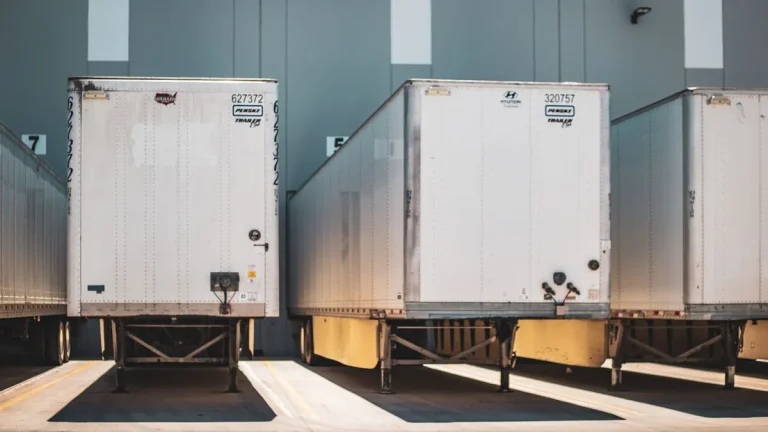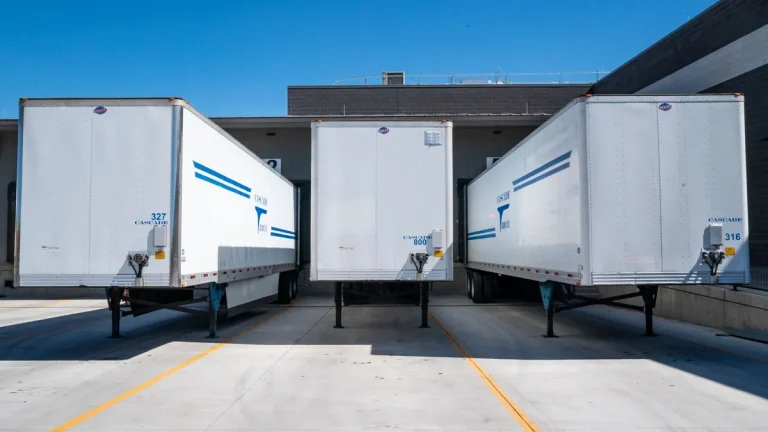







Two clean black rectangles mark the wall at dock four, one at each bumper face. Between them runs a band of scraped concrete, flecks of paint and trailer rub rail still lodged in it. The pads did their job. The scar above them is the record of a height nobody ever measured.
We build loading dock systems: levelers, seals, shelters, and the bumpers that take the first hit. The bumper face goes into the same drawing as the pit and the enclosure, never onto the wall afterwards. Dock bumper height positioning is fleet arithmetic, not habit. Measure the trailers, set one datum across the wall, and anchor into concrete that can carry them.
Measure Bed Heights Before You Fix Bumper Height
A trailer bed is not a shelf; it is a spring plank that moves. Load it and it settles, empty it and it climbs. An air-ride suspension breathes through the whole shift, and a reefer sits at its own height again. One dock equipment maker gives the movement a name — float. The same notes warn that bumper size and face material must match the float range present at the installation.
So the first survey number is a range, not a point. Walk the fleet and record two bed heights for every body style that calls: empty and loaded, with air-ride units flagged separately. Center the strike face on that band. The choice also hands the leveler a smaller angle to bridge. It is the same trade that lets a longer platform carry a taller bed in our guide to how a hydraulic dock leveler works.
- Bed height, empty and loaded, for every trailer body style at the fence — dry vans, reefers, flatbeds, step vans.
- Suspension type per unit, because air-ride floats wider than spring ride.
- Approach geometry at each door: level, falling toward the wall, or rising away from it.
- Wall face condition where the pads will land — sound slab, patched crack, or painted cladding.
- Call frequency per door, so the busiest bay gets the most careful geometry.
The list maps to the survey checklist one major bumper maker publishes: approach, dock height, air-ride trailers, mounting face, yard jockeys, trailer mix and call frequency. The checklist is common. The procedure for dock bumper height positioning is not, so most docks skip it and let the trailer find the height by collision.

Measure once, in writing, and keep the sheet with the dock drawings. The band on that sheet becomes the authority behind every other number in this piece. A wall placed from memory is a wall placed from the last truck that hit it. File the sheet where the enclosure vendor and the pad supplier can both read it.
Time the survey to the dock audit, before the enclosure is quoted and before pads are ordered. Seals, shelters and pads all price against the same geometry. One honest afternoon with a tape and a clipboard keeps three suppliers from quoting three different walls.
Reefer accounts deserve their own line on that sheet. Their beds sit higher than dry vans, and their call patterns spike by season. A band drawn without them is a band drawn for half the fence.
Match Bumper Height and Projection to the Fleet
With the band measured, picking hardware stops being a catalog decision. Matching pads to the band is the working core of dock bumper height positioning. It borrows a rule from parking design: bays are painted for the car, not for the lot. Width and height come off your own survey sheet, which is why custom face sizes exist at all. The table below is how that matching gets written down. Bumper geometry also decides seal compression, which is why bumper wear shows up on the energy bill.
| Measured fleet band | Pad arrangement that covers it |
|---|---|
| Narrow band, one body style | Single horizontal pad, face centered on the band |
| Band spread beyond one pad height | Stacked pads built into a vertical face, low to high |
| Mixed fleet, vans to semis | Tall vertical pads so every body style strikes centered rubber |
| Falling approach or wall overhang | Extra-thickness face plus slope arithmetic, checked against lip reach |
Projection runs on its own arithmetic. A level approach wants the industry-standard standoff, and a drive that falls toward the building wants roughly an inch more per percent of slope past two. The sizing basis, the slope rule and the eight-inch leveler-lip limit all live in our dock bumper types and sizing guide. They bound every row of that table.
Face material is the float question again. Steel-faced pads let the face slide as the bed scrapes up and down. That sliding cuts pad wear and the shear passed into the anchors, per one maker’s installation notes. A sliding nylon face takes the same motion a different way, in one Canadian distributor’s line. Our molded dock bumpers are cast to the face size the survey calls for — the geometry leads, the rubber follows. Seals and shelters sit on that same strike face; our seal and bumper geometry handbook keeps the two aligned.

A falling approach rewrites the table: the trailer tilts in as it backs, so the face that met the bed on level ground now meets it high. One manufacturer builds extra-thickness pads with 9 to 12 inches of projection for exactly this case — and the leveler lip still has to reach past them.
Check the pit side of the arithmetic too. Every inch of added projection spends reach that the leveler lip needs inside the trailer, and platform length changes the bridge angle as well. One equipment maker’s selection guide settles on six, eight and ten foot platforms, with eight feet the common choice. Longer decks flatten the bridge at the band’s extremes. Height, projection and platform get matched as one decision, the way the dock itself is built.
Watch the edges of the band, not just its middle. A face centered on paper can still leave the lowest reefers striking shy and the emptiest vans riding high. If the extremes arrive weekly, move the center; if they arrive once a quarter, note them and leave the geometry alone. That trade belongs to your traffic sheet, not to the catalog.
Set a Height Datum Across Every Dock Position
Picture one trailer working three doors in a morning. If each door’s pads sit at whatever height that day’s crew chose, the driver meets three strike faces with one suspension. Fleets roam, and pads that drift door to door tax every crossing.
- Fix one elevation figure for every bumper face on the wall — the datum — taken from the fleet band, not from door-specific habit.
- Set a tolerance between faces; our rule is a quarter inch across positions, and it goes on the drawing, not in conversation.
- Tie the datum to the leveler pit and the enclosure face, so pit, seal and bumper are built to one line.
- Re-survey at every construction phase boundary, because separate pours and separate crews drift.
That line is what dock bumper height positioning is really about: a row of doors that behaves as one facility. A dock built as one loading dock systems package — pit, seal face and bumper face on the same datum — accepts any trailer at any position. The bumper stops being a door-level afterthought.
Paint the datum elevation onto the wall after the pads pass inspection. The next crew, and the surveyor three years from now, can then check the wall without ever finding your drawings. Repaint it after any wall repair.
Phased construction is where datums go to die. Each phase pours its own pit and hangs its own pads, and small honors accumulate into a wall that steps. Make datum sign-off a hold point between phases, with the tape on the record.
Write the datum into the handover pack next to the leveler’s install sheet. A facility that changes owners or contractors keeps its geometry in documents, not in folklore. The sheet costs one page and saves one re-survey.
A datum also gives disputes a referee. When a trailer sits wrong at one door, the tape answers whether the pad drifted or the driver parked crooked. Without the line, both sides argue from memory, and the wall settles it their way. The line turns a standoff into a measurement.
Anchor Bumpers Into Concrete That Can Carry Them
Anchoring is where positioning becomes load-bearing. Once the face is set, the anchors carry that float motion thousands of times a day. The load arrives in shear as much as in compression, which is one reason a steel-faced design exists at all: it slides instead of working the bolts loose.
- Sound structural face only: the pad belongs on the foundation wall, and the substrate rules in our bumper guide are absolute.
- Cracks and spalls repaired before drilling, so anchors bite sound concrete rather than a future failure plane.
- Mounting face condition recorded during the survey, because a proud or uneven face moves the strike face you just calculated.
- Hole diameter and embedment to the anchor manufacturer’s numbers, measured and torqued, never guessed.
The installation sequence one equipment maker publishes is short enough to keep. Inspect and repair the face first, even before the old pads come off. Hold the new pad on its marked line, pre-mark the holes, drill to the anchor maker’s diameter and depth, then set and tighten. Nothing in that sequence says eyeball it.

Anchors torqued into sound concrete make the pad a replaceable wear item. Anchors in cracked or hollow substrate make the wall the wear item. That trade is the entire anchoring decision.
Position also decides what the anchors never have to do. A face at the center of the float band spreads impact across the whole pad. A face at the band’s edge concentrates every strike on one corner. The anchors feel the difference long before the rubber shows it.
What Misplaced Bumpers Cost You Later
Dock bumper height positioning failures rarely announce themselves at commissioning; the first truck looks fine. The evidence accumulates through load cycles, wear and weather. It writes itself on the wall in a dialect worth learning to read, and the pad is the cheapest part of the wall to learn it on.
A mispositioned face is not only a maintenance bill. A trailer that reaches structure instead of rubber is the kind of strike the UK warehousing safety authority counts among warehouse injury causes. The table below is that dialect, written out: each positioning error, the cost it books, and the symptom it shows.
| Positioning error | What it does over a season | Symptom you can see |
|---|---|---|
| Strike face too high | Frame and sidewall above the rub rail strike the pad below center; the face wears from its bottom edge, and no trailer rides up or over it | Wear banded at the pad’s bottom edge; sidewall scuffed, wall above clean |
| Strike face too low | Trailers ride up and over the pad; frame and crossmembers strike first, the wall takes the load, and the face wears at its top edge | Black print low, metal scuff and a scrape band above intact pads |
| Face too proud | Trailer stops short of the enclosure; seal compression and shelter penetration fall out of design | Gaps at enclosure corners; lip struggling to seat |
| Face recessed | Structure contacts before the pads; anchors take the hit in shear | Unworn pads, anchors working loose |
The enclosure is the quiet victim. Bumper projection sets where the trailer stops, and the seal was designed around a set compression while the shelter was designed around a set penetration. A face that moves invalidates both. The arithmetic continues in our dock seals versus dock shelters guide.
Re-check positioning the way you re-check anything that moves: after repaving raises the grade, after any enclosure replacement, and whenever the fleet mix changes materially. A pad line set for dry vans is wrong for the reefer account that just signed, whatever the dock shelter types involved. Repeated scrapes above or below the pads are the wall asking for the survey again. Ten minutes with the survey sheet ends that conversation.
The wall keeps the record of every positioning decision you did or did not make. Leave it a decision, not a scar. Bumper height also fixes the starting geometry that any plate or leveler has to bridge, as our dock plate versus leveler guide explains.

Frequently Asked Questions
How high should dock bumpers be mounted?
There is no universal figure. Dock bumper height positioning starts with the fleet: record empty and loaded bed heights for every body style, then center the strike face on that measured band.
What happens when bumpers sit too low or too high?
Low faces sit under the impact line, so trailers ride up and over the pad and leave a scrape band above intact pads. High faces take the strike below center, wearing the pad from its bottom edge while the frame takes the load. Both end in concrete repairs.
Do all dock positions need the same bumper height?
Yes. Set one datum from the fleet band and hold every face to it within a stated tolerance, because trailers work across doors in a single shift.
How does a sloped approach change bumper positioning?
A falling approach tilts the trailer into the wall, so the face meets the bed high. Add projection for slope and check lip reach; one maker offers 9 to 12 inch extra-thickness pads for this case.
Can a bumper be mounted on any wall face?
No. Bumpers belong on sound structural concrete with cracks repaired first, and hole diameter and depth follow the anchor maker’s numbers. Substrate exceptions are engineering calls, not field decisions.
When should bumper positioning be rechecked?
After repaving, after any seal or shelter replacement, and whenever the fleet mix changes materially. Repeated scrapes above or below the pads are the wall asking for the survey again.