






Automatic door tenders are usually settled on three visible grounds: price, brand name, and panel finish. Safety performance rarely enters the comparison, because buyers have no verifiable yardstick to apply. The one Japanese standard that defines that yardstick barely surfaces in English. Its only in-depth explainer spends half its length promoting its own sensors, and the real figures sit locked inside Japanese pages.
In our practice, verification begins with the paperwork attached to the door. Every door we ship leaves the factory with a signed inspection report recording measured opening speed, noise, and insulation resistance. That is the same handover logic JIS A 4722 demands when a finished installation is checked and accepted. Safety that cannot be produced as a document at handover does not exist for the buyer, and Japan’s automatic door standard is arranged around that test.
What the JIS A 4722 Standard Actually Covers
JIS A 4722 is Japan’s national safety standard for powered automatic door sets used by pedestrians. It was first published in 2017 and revised in 2022. The revision added requirements for automatic doors on accessible toilet compartments and introduced a recommendation for finger-protection buffers in places where children gather.
Scope is the second thing worth reading closely. The standard follows a powered pedestrian door set across its whole life: product design, technical specifications, installation, completion inspection, and the maintenance checks that continue through years of service. The supplier performs the completion inspection and hands the results to the building owner and the building manager.

For a buyer, compliance lives in documents as much as in hardware. Ask what the completion inspection measured and who received the record. A supplier who answers both quickly has done most of the work.
Three Parties Hold the Safety Duty
Safety duty under the standard is split among three parties, and each holds a piece the others cannot cover. The supplier manufactures, sells, and installs the door set with compliant devices, designing countermeasures around pedestrian behavior at doorways. Building designers and owners carry the planning stage, where traffic volume and user groups are fixed into the specification. Decisions skipped there cannot be repaired by hardware later.
The building manager holds the longest duty. Daily checks continue for the life of the installation, professional maintenance is arranged with qualified personnel, and the results are kept as records. When a maintenance result fails to meet the standard’s requirements, the manager must take appropriate and necessary measures.
Buyers can use this split directly during procurement. Ask which party performs each duty in your project, and get the answer in writing. A door set with no named maintenance holder is unfinished engineering.
Opening-Phase Hazards and the Fix Options
Opening is where the standard concentrates its hardest numbers. On the door-pocket side of a sliding leaf, the hazards are squeezing and collision against the parked door, plus fingers drawn into the gap as the leaf starts to move. The standard answers with a menu of countermeasures and lets a design satisfy it by choosing one.
A guard screen over the pocket area is one option, with gaps no wider than 8mm or held between 25mm and 100mm. Coverage must reach 2500mm above the floor, and removal is possible only with tools. A protective fence stands at least 900mm high, its bottom gap should stay within 100mm, and its top rail withstands 490N per 1000mm of width without damage. Safety distance, door speed control with low-energy operation, and an opening protection sensor complete the menu.
Finger entrapment gets its own rules. The facing surfaces of the door leaf and the adjacent fixed panel must carry no ribbed or grille-like projections. Where the gap between stile and glass exceeds 8mm, the distance from the leading stile to the fixed member must be at least 25mm. The 2022 revision recommends finger buffers at the door pocket and stile where children use the door heavily.
Closing-Phase Sensors and Knowing-Act Devices
Closing flips the hazard to the open side, where a person or a trolley stands in the moving leaf’s path. Protection there means a reflective optical sensor or an auxiliary photoelectric sensor, one of the two, creating a protective zone across the opening. Door speed control with low-energy operation can substitute where the design suits it. Dash-through protection relies on the sensor’s starting detection range, alone or with a tactile switch.
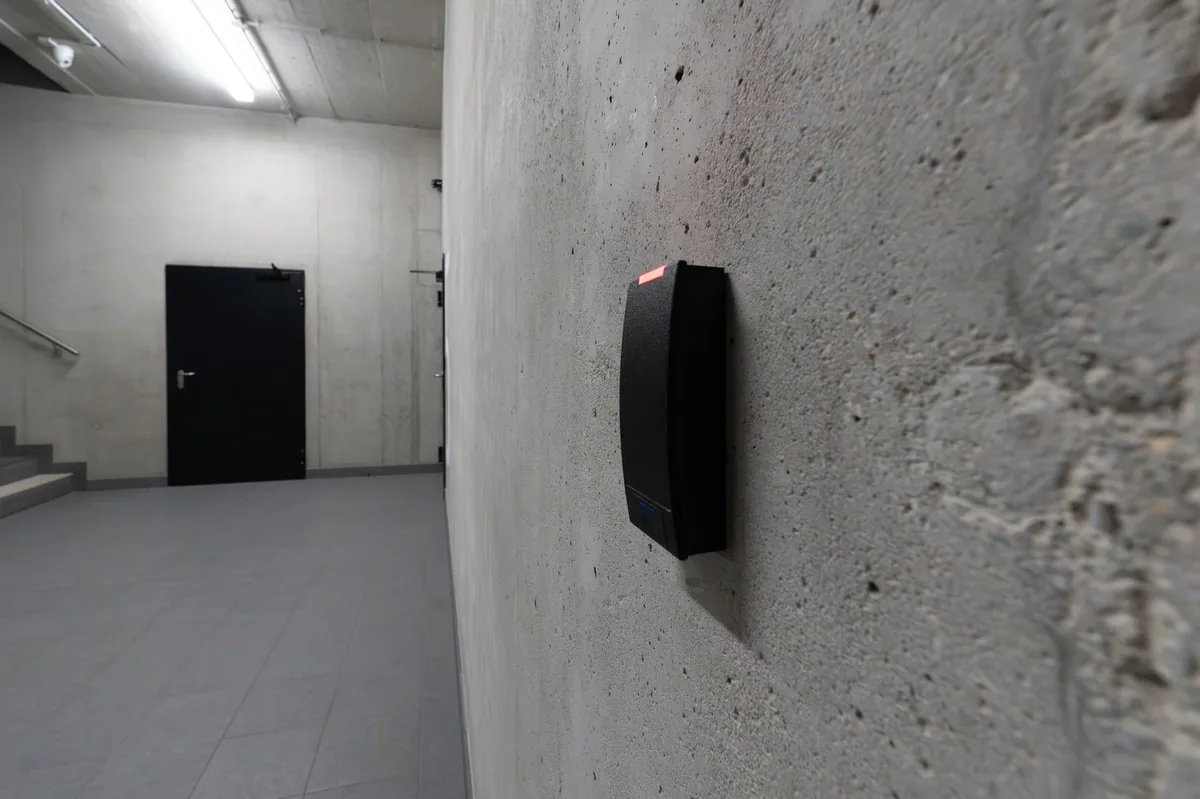
Touch switches follow a universal-design figure: 950±50mm from the floor to the center of the switch. The band accommodates wheelchair users and older pedestrians without a separate installation. Knowing-act devices such as card readers and push buttons belong to the same family, opening the door in response to a deliberate action.
Sensor coverage is only as reliable as the controller supervising it. A controller that self-checks its sensors detects a drifting or failing unit before the failure reaches a pedestrian. Our guide to the high speed door control panel explains how that self-check logic is built.
Materials, Glass and Signage Rules
Some requirements apply no matter which countermeasures a design selects. Door leaves and frames must carry no sharp edges, and glass must not form sharp fragments if it breaks. Signage is mandatory in four respects: an automatic-door display, an indication of opening direction, caution guidance against standing still or dashing through, and a pull-in warning at the pocket side.
Records and signage extend the building manager’s duty rather than ending at delivery. The maintenance record and the warning signs are the two things a visitor actually sees of the whole safety system. Treat both as deliverables on the order, not as site extras.
Who Checks the Safety Files on Your Automatic Door Order?
Specify the operator, sensors, and handover documents together, and our engineering team matches powered door hardware to the safety duties your project assigns.
How the US Framework Handles the Same Risks
The American framework answers the same hazards with quantified performance thresholds instead of a countermeasure menu. Under ANSI/BHMA A156.10, a swinging powered door must take at least 1.5 seconds to open to 80 degrees. The force able to stop it within the final 10 degrees must not exceed 30 lbf (133 N). A knowing-act hold-open runs at least 5 seconds after release, with 1 second added per foot beyond 12 feet.
Accessibility sits in a separate instrument. The 2010 ADA Standards treat a full-power automatic door as part of an accessible route, with the 32-inch minimum clear width measured with the door in the full open position. A leaf stopped partway steals width exactly where the standard checks it.
The two systems reward different verification habits. JIS A 4722 hands you a countermeasure matrix per hazard phase plus a three-party duty chain, so you verify by matching measures to traffic and asking for the documents. A156.10 hands you thresholds, so you verify with a stopwatch, a force gauge, and a tape. ADA adds the accessibility width check on top.
A Selection Checklist for Specifiers
Verification is easier with a fixed list. The checklist below is what we keep beside the drawing set when a pedestrian automatic door order under JIS A 4722 is reviewed. It maps one to one onto the duties described above, and each row ends in a document or a measured value.
| Check item | What to request | What a pass looks like |
|---|---|---|
| Compliance declaration | Certificates for operator and sensors | Standard scope named for the full door set |
| Opening-phase measures | Countermeasure chosen for the pocket side | Guard screen, fence, distance, speed control, or sensor |
| Closing-phase protection | Sensor type and coverage drawing | Reflective or auxiliary photoelectric zone across the opening |
| Completion inspection | Signed completion check results | Measured values delivered to owner and manager |
| Maintenance plan | Named duty holder and check schedule | Manager’s duty and records confirmed in writing |
| Signage and warnings | Required signs supplied with the set | Automatic display, direction, caution, and pull-in warning |
One boundary should be drawn before the list is applied. Pedestrian automatic doors and industrial door operators are separate product domains, and our industrial operators follow EN 12453 with CE certification under EN 13241. For gate and warehouse openings, this article on how an industrial sliding door opener works covers that regime instead.
For pedestrian entrances, matching the operator to the sensor set and the handover documents matters more than any brochure figure. Our automatic sliding door opener range lists 16 models, backed by a 3-year operator warranty, 5 years on servo motors, and 2 years on the door panel. The delivery pack follows the same logic: measured values, signed.
Frequently Asked Questions
These are the questions procurement teams raise most often when this standard appears in a specification. The answers stay within the standard itself. Our own practice is marked where it adds context.
Is JIS A 4722 mandatory in Japan?
JIS A 4722 is Japan’s national standard for pedestrian automatic door sets. Its force in projects comes through the three-party duty structure it defines, which assigns checks, records, and follow-up measures to supplier, building owner, and manager.
What changed in the 2022 revision?
The 2022 revision added requirements for automatic doors on accessible toilet compartments and recommended finger-protection buffers where children gather, extending the countermeasure framework first published in 2017.
What sensor coverage does the standard require on closing?
Either a reflective optical sensor or an auxiliary photoelectric sensor must create a protective zone on the opening side during closing. Door speed control with low-energy operation may serve as the alternative.
How does JIS A 4722 compare with ANSI/BHMA A156.10?
A156.10 sets quantified thresholds. Swing doors must reach 80 degrees in at least 1.5 seconds, stopping force stays within 30 lbf in the final 10 degrees, and knowing-act hold-open runs 5 seconds or more.
Who is responsible for maintaining an automatic door?
The building manager performs daily checks, arranges professional maintenance through qualified personnel, keeps the records, and must take appropriate measures when a maintenance result fails to meet the standard’s requirements.
What documents should come with a compliant door set?
Expect the completion inspection result, continuing maintenance records, and the required signage. In our practice, every door order also ships with a signed factory inspection report recording measured opening speed, noise, and insulation resistance.