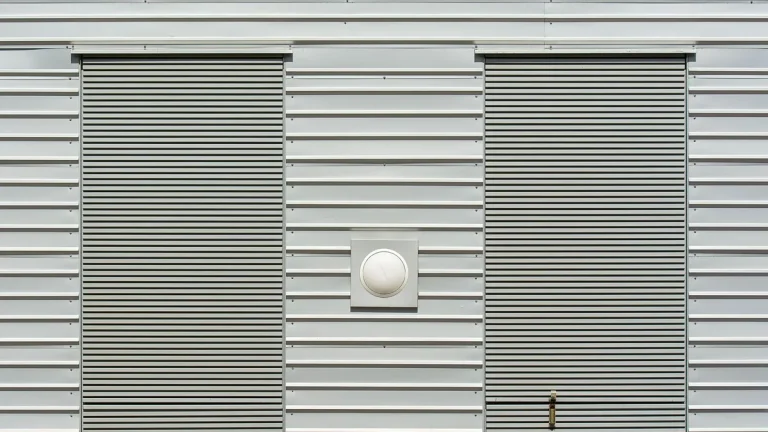
The fire officer walks the door schedule with a highlighter and stops at the loading bay. One line item, one phrase: fire shutter. He asks which class it holds, E or EI, and for how many minutes. The purchase quote on file cannot answer, because nobody wrote a classification into the specification in the first place.
We build fire-capable industrial doors and rolling shutters on the same factory floor, and this question lands on our desk almost every week. This guide decodes what the letters and minutes in EN 13501-2 really mean for fire rated roller shutters. It also shows what evidence separates a rated assembly from a steel curtain with a confident label.
Fire is one ignition scenario; explosive atmospheres are another. Where the hazard is a flammable atmosphere rather than heat, the selection logic runs through ATEX zones and explosion proof industrial doors instead of EI classes.
How EN 13501-2 Classifies Fire Shutters
Two standards do two different jobs, and mixing them up causes most of the confusion. EN 1634-1 is the furnace test: it puts a complete door or shutter assembly in front of a standard fire curve and records what happens. EN 13501-2 is the classification language: it converts the test result into a short code that fire strategies, building control, and insurers can all read the same way.
The code is a letter, or a pair of letters, followed by minutes. Each letter names a performance criterion:
- E — integrity. The curtain does not crack, split, or let flames and hot gases through the opening for the stated time.
- I — insulation. The unexposed face stays cool enough that the fire cannot ignite or cook whatever stands on the other side.
- S — smoke control. Guides and seals limit smoke leakage, assessed under EN 1634-3.
An E120 shutter therefore holds back fire for 120 minutes but transmits heat. An EI60 shutter holds back fire for 60 minutes and limits heat transfer at the same time. Reading the letters before the minutes is the whole trick, because the letters tell you what the number is a number of.
What an EI Rating Actually Guarantees
On fire rated roller shutters, a rating is not a property of steel thickness. It is a statement about one tested assembly: that exact curtain, those guides, that barrel, those fixings, in that wall, closing the way it closed in the furnace. Change any element and the classification no longer travels with the product. Suppliers of tested systems are blunt about this: a certificate for one design does not automatically cover every installation.
Most steel fire shutters on the market carry E classifications only. Integrity is what a rolling steel curtain is structurally good at. Insulation is harder, because metal conducts heat straight through the slats, so EI shutters need insulated or composite curtain construction and cost more to build.
The wall matters too. The European product standard defines standard supporting constructions such as masonry, aerated block, and plasterboard-faced steel stud partitions. The test evidence names which ones the shutter was actually built into.

The practical consequence for a buyer is simple. Ask for the classification and the tested configuration it belongs to. A minute count quoted without size limits, wall types, and a control arrangement is a brochure claim, not a rating.
Roller Shutters Versus Fire Doors
Fire doors and fire shutters sit under the same European product standard family for fire and smoke characteristics, but they answer different geometry. A hinged or sliding fire door carries an insulated leaf, so EI classes are routine for it. A rolling shutter coils into a box above the opening, trading insulation for span. Wide industrial openings that a fire door cannot economically cover are exactly where shutters earn their place.
Our own shutter range runs to 12,000 mm wide, territory where door-leaf construction is unrealistic. The trade comes in protection class and escape rules. Shutters typically serve compartmentation, not evacuation, and guidance is clear that openings people pass through regularly should have a separate fire exit or personnel door beside the shutter. For the mechanics of furnace testing in depth, see our piece on EN 1634 ratings. Occupancy-specific ratings are worked through in our hotel fire door rating guide.
Matching Ratings to Fire Compartments
On fire rated roller shutters the rating comes from the fire strategy, never from the budget or the catalogue. A fire compartment drawing, prepared under local code or by a fire consultant, states the required resistance time for each boundary. The shutter is then selected to meet or exceed that line.
As supplier-reported general guidance, the ladder usually looks like this:
| Classification | Holds back fire | Common placement |
|---|---|---|
| E 30 – E 60 | 30–60 minutes | Small service openings, plant rooms, low-risk boundaries |
| E 120 | 120 minutes | Standard industrial compartments, warehouse zone lines |
| EI 60 – EI 120 | 60–120 minutes | Boundaries shielding people, stock, or heat-sensitive processes |
| E 180 – E 240 | 180–240 minutes | High-bay storage and high-risk process areas |
Two boundaries on this ladder need honesty rather than ambition. First, the wall itself must carry a matching fire resistance, because a shutter cannot rescue a weak partition. Second, integrity alone does not protect what sits close behind the opening, since radiant heat passes through an E curtain long before flames do. Where that matters, specify the I.
Cleanroom operators face a stricter version of this logic, which is why our cleanroom fire door standards guide reads the same letters with GMP consequences attached.
Certification Papers Behind a Real Rating
In Europe, the paperwork trail for a fire-resisting industrial shutter runs through EN 16034. That is the harmonized product standard for fire and smoke characteristics of industrial doors, shutters, and operable curtains. It works alongside the general industrial door product standard EN 13241-1, and together they drive the CE marking and the Declaration of Performance that accompanies the product.
Behind the marks sits a chain you can audit:
- Furnace test report to EN 1634-1, issued by a notified test body, naming the exact model, size range, and configuration.
- Classification to EN 13501-2, assigned by a notified product certification body.
- Factory production control, audited so the units leaving the line match the ones that burned in the furnace.
- Certificate of constancy of performance, keeping the CE marking valid over time.
Here is our own position, stated plainly. We quote EI60 and EI120 as a capability, and each project is verified through EN 1634-1 testing for that configuration rather than presented as an off-the-shelf certificate. A manufacturer who cannot show which link in the chain above covers your exact opening is asking you to trust a label instead of evidence. Our general certifications cover ISO 9001:2015, CE under EN 13241, EN 12453 operator compliance, and SGS material reports. We keep fire capability on that same verifiable footing.
Drop Testing and Maintenance Records
Fire rated roller shutters spend their lives open, which means the only moment that counts is the one they must close in. Activation runs from the fire alarm panel, local smoke or heat detection, or a fusible link. Well-engineered systems descend at a controlled speed instead of free-falling. Power-failure behaviour belongs in the design brief, not in an afterthought.
A drop test checks the installed system rather than the certificate. A competent engineer works through a sequence that UK guidance describes consistently:
- Record the shutter’s identity, location, and stated classification.
- Activate the approved release, isolating the alarm signal from monitoring first.
- Watch the descent: smooth, inside the guides, at designed speed.
- Confirm full closure with the bottom rail seated and nothing under the curtain.
- Test warnings, obstruction sensing, and backup supply where fitted.
- Reset, re-inspect, and log the result.
Frequency is not a single national number. It follows the manufacturer’s instructions and the site’s fire risk assessment, and many operators put professional servicing twice a calendar year around escape-relevant openings.
The duty itself is legal. In England and Wales, the Regulatory Reform (Fire Safety) Order 2005 makes the responsible person maintain fire precautions. HSE workplace fire guidance frames the same expectation. Records need specifics, because an entry reading shutter checked convinces nobody at audit.
Specifying Fire Shutters Without Overbuying
Overbuying fire rated roller shutters is common and mostly wasted money. The efficient sequence is compartment first, class second, hardware third. Fix the boundary from the fire strategy, then read off the letters and minutes. Size the assembly next: opening dimensions, headroom, side room, and the wall build-up the test evidence covers. Daily traffic decides controls, because a busy forklift bay needs motor operation and alarm interlock, while a rarely-used plant room opening may not.
Slat material follows the environment rather than the fire rating. The corrosion logic is the same one in our roller shutter slat materials comparison. We build fire-rated shutters within our industrial door range to order, one unit minimum, in galvanized steel or stainless. The same engineering team handles the fire-rated industrial steel door when a boundary calls for door-leaf construction instead.
Frequently Asked Questions
What is the difference between E and EI fire ratings?
E is integrity: the assembly blocks flames and hot gases for the stated minutes. EI adds insulation, which keeps the unexposed face cool so people and stock behind the opening stay protected for that period.
Is a steel roller shutter automatically fire rated?
No. Steel resists heat as a material, but the rating covers the assembly as tested. A standard security shutter with no EN 1634-1 test evidence carries no classification, however heavy its curtain.
How often should fire shutters be drop tested?
There is no single legal interval. Frequency follows the manufacturer’s instructions and the fire risk assessment; many operators schedule professional servicing, including release and descent checks, twice a year.
What does CE marking prove on a fire shutter?
CE marking under EN 16034 with EN 13241-1 shows testing by a notified body, EN 13501-2 classification, and audited factory production control. The Declaration of Performance documents all of it.
Can a fire shutter replace a fire door on an escape route?
No. Shutters serve compartmentation, not evacuation. Openings people use regularly need a separate fire exit or personnel door beside the shutter so escape stays possible when it descends.
Which EI rating does an industrial building need?
The fire strategy decides, boundary by boundary. Commonly specified classes run from E60 on minor service openings through E120 on standard industrial compartments to EI60-EI120 where heat-sensitive contents or people sit behind the line.
The Rating Is a Claim Until Proven
An EI label on a drawing is a claim. What converts it into evidence is paperwork plus a witnessed descent. That means a test report naming your configuration, a classification your fire strategy calls for, and a drop-test log dated after installation. Buildings rarely burn, so the file is usually all the protection you will ever see, and it is the part inspectors read.
Work that checklist before the next order leaves your desk. Letters and minutes come from the compartment drawing, the tested configuration from the report, the DoP from the handover pack, the drop test from the maintenance calendar. Get those four right and the fire officer’s highlighter moves on to the next line without a question.