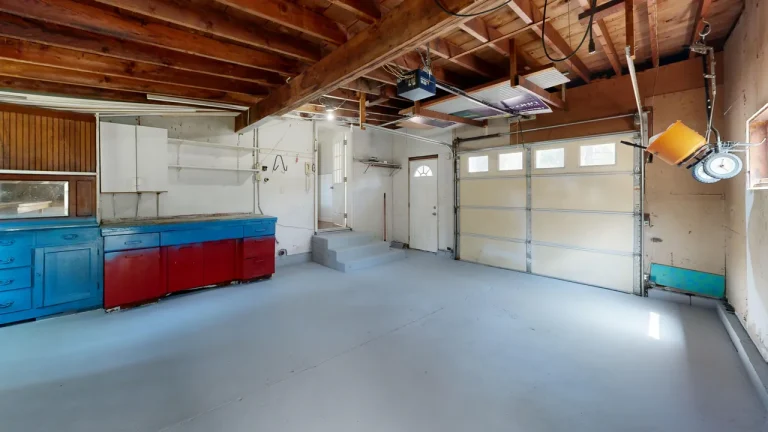







One garage opening can hand two buyers two completely different outcomes. Specify a sectional door for a garage whose ceiling is already claimed by beams, pipework and storage racks, and the tracks have nowhere to run. Specify a single-skin freestanding roller door for a workshop you heat through winter, and the heating bill carries the difference for years. The freestanding roller vs sectional garage door decision rarely turns on which door is better in the abstract. It turns on what the building lets you install and what the project actually needs.
We manufacture both curtain-style and panel-style garage doors. Every door leaves our line with a factory inspection report, and its open-speed line gives buyers one verifiable number to hold each type against.
How Each Door Moves and Where It Settles
A freestanding roller door is a curtain of interlocking slats that hangs in side guides and coils around a barrel above the opening. Nothing travels back into the garage, so the ceiling stays clear from wall to wall. The curtain, the barrel and the guides make up the whole moving assembly, which is why the design carries so few parts to adjust. The guides bolt to the opening reveal or the wall face, so the structural demand sits at the jambs rather than across the ceiling.
A sectional garage door works on a different route. Hinged horizontal panels ride vertical tracks at the jambs, then follow a curved track until the door rests parallel to the ceiling. That final leg of travel is where the door asks for room, because the panels need the full door height in clear ceiling depth plus headroom for the track radius. The fixed tracks keep the opening nearly full-width, and the flat panel face carries most factory finish ranges without adaptation.
Both types open vertically, so neither swings out over the driveway and both leave the approach free for a parked car. Both also sit at the light end of our industrial doors range, which is why the same two mechanisms turn up on everything from home garages to light commercial bays. The difference between them lives entirely inside the building, in where the door stores itself once it is open.

Side-by-Side Comparison at a Glance
The freestanding roller vs sectional garage door trade-offs compress into seven factors. Read the table by ruling out the rows your building cannot satisfy first, because one disqualifying row ends the comparison faster than any advantage can rescue it. Compare the survivors on insulation, price and finish only afterwards.
| Factor | Freestanding roller door | Sectional garage door |
|---|---|---|
| Mechanism | Curtain of slats coils onto a barrel above the opening | Hinged panels track back and park parallel to the ceiling |
| Ceiling depth used | None; the ceiling stays clear end to end | Full door height in clear depth, plus track radius |
| Headroom above opening | From about 205 mm, growing with door height | Track-radius room, reducible with low-headroom kits |
| Side room | About 85 mm per guide | Vertical tracks plus counterbalance hardware |
| Insulation | Single-skin standard; insulated curtains narrow the gap | Thicker foam-core panels reach the best U-values |
| Security | Curtain locks along the full guide width, motor brake holds | Solid panels with multi-point locking on the frame |
| Maintenance | Fewest parts; keep guides clean and never greased | More hinges, rollers and springs to inspect |
Two rows act as gates rather than preferences. Ceiling depth decides the sectional before any other row is read, and headroom decides the roller the same way. Everything after those two rows only ranks doors that have already passed.

What Each Door Asks of the Building
Headroom is the space directly above the opening. A roller curtain coils onto a barrel whose diameter grows with door height. The coil sets the first clearance: a typical domestic door needs roughly 205 mm of headroom to start, plus about 85 mm of side room for each guide. Taller doors wrap more curtain onto the barrel, and the coil diameter grows with every turn.
Depth is where the sectional pays for its parking position. The door’s full height must run back as clear ceiling depth. A steel beam, a service run, a boiler or garage racking anywhere along that path rules the type out. Curved track sections add a further headroom demand at the point where the panels turn from vertical to horizontal. Where that return path is blocked, no low-headroom kit recovers the lost depth, it only trims the entry height further.
Tight garages and converted outbuildings favour the roller almost by default, because the curtain asks for depth nowhere. Under a shallow roof pitch or a low bulkhead, a sectional needs a special low-headroom track set, and fitting one trades away part of the opening height in return. The same three-clearance check opens every industrial doors order we quote, because a drawing that ignores the building is a drawing that gets revised on site. Our guide to how low-headroom garage door setups reclaim clearance covers the kit options in detail.

Insulation, Sealing and Interior Comfort
Sectional panels insulate to the highest levels because their thickness accepts a genuine foam core, and a polyurethane core outperforms the polystyrene used in cheaper panels. If you read one thermal number before ordering, read what the U-value on a sectional door actually measures, because labels differ in what they cover. An insulated roller door, with a double-skinned curtain around a foam-filled core, closes most of that gap and suits the majority of garages, converted ones included.
The curtain construction explains the difference. A single-skin roller curtain is one sheet of ribbed steel, fast to install and adequate where the garage stays unheated, and its slats carry no meaningful core at all.

Sealing splits along the same lines as the opening itself. On a square, modern opening a sectional closes tight against the frame. On older, out-of-square openings a roller curtain with well-set guides seals more forgivingly — one UK installer’s field observation, our single source for the claim. When you compare thermal claims between suppliers, check them against the U-factor and R-value definitions in the association’s technical data sheet library. The same library documents the thermal performance verification program for garage door U-factors.
What You Pay and What You Ship
Sticker prices overlap more than brochures suggest. On one Australian installer’s 2026 price list, a standard single roller door runs about $1,200 to $3,000 installed. A single sectional door of the same size lists at $1,800 to $3,800. The bands move with opening size, insulation level and motor choice far more than with door type.
Comparing a freestanding roller vs sectional garage door on price only means something at matched specification. A single-skin curtain and an insulated, automated sectional differ in kind, so line up insulation grade, motor type and finish before you put two quotes side by side. Two quotes written to the same specification answer the price question honestly; quotes written to different specs only measure how each supplier itemised.
Freight is where the roller quietly wins on export and multi-site projects. In our practice, a roller kit of curtain, barrel and guides packs into a fraction of the container volume that stacked sectional panels occupy. The same packing logic carries across our industrial doors consignments. Installation follows the same pattern, because a roller kit bolts together in fewer site steps than a track-and-counterbalance system needs for commissioning.
Which Door Type Fits the Opening You Actually Have?
Send us your opening sizes and ceiling layout, and our engineers will return both door specifications with the factory test lines attached.
How Security and Daily Operation Compare
Both types secure a garage far better than the up-and-over doors they usually replace. A roller curtain drops into its side guides and locks along their full width, with the motor’s brake holding the door closed and no external handle to attack. A sectional brings solid panels to the fight, closing tight against the frame with multi-point locking along it, and the panel stiffness resists bending better than a sheet curtain does.
The two types share the same electronic discipline. Rolling-code remotes stop code grabbing, manual releases cover power cuts, and the opener holds the closed position without relying on a padlock. Neither design leaves a hasp exposed, so forced entry usually means attacking the panel or curtain material itself. Battery backup keeps both release paths live through an outage, so the manual release stays a fallback rather than the only exit.
- Encrypted rolling-code remotes on both types
- Manual release for power outages on both types
- Motor braking holds the door closed without a padlock
Daily operation differs mainly in sound. A rolling curtain is the noisier traveller, while a sectional paired with a belt-drive opener runs quietest, a difference that matters when a bedroom shares the garage wall. Guide condition moves the noise figure on a roller more than the curtain itself, which is why our installers hand over every unit with guides cleaned, never greased.
Maintenance Routines and Repair Economics
A roller door carries the lighter routine. Its moving parts are few, so the work is keeping the guides clean, washing the curtain face down and having the motor checked if the sound changes. The same quarterly guide-and-track walkover we schedule across our industrial doors installations covers it.
A sectional spreads its attention across more hardware. Hinges, rollers, springs and cables all need periodic inspection and lubrication, and the track alignment matters as much as any single component. Spring tension, cable wear and hinge play age at different rates, so a written inspection log turns scattered repairs into planned ones.
The upside sits in the repair economics. A dented panel can be replaced individually where the design is still available. A deep dent in a roller curtain usually means replacing the whole curtain.
Whichever type you fit, keep the safety chain professional. Door and operator systems should be specified, installed and maintained by trained technicians, a point the industry association’s door system safety guidance makes plainly. Monthly safety-feature testing costs nothing but a minute.
Which One Should You Choose for Your Project
Choose a freestanding roller door when the building, not the brochure, makes the call:
- The ceiling carries beams, pipework, a boiler or storage racks
- The garage is shallow, lofted or a converted outbuilding
- Budget leads and insulation sits mid-pack in the requirements
- Fewest moving parts and the simplest service routine win the vote
Choose a sectional garage door when the project can feed it the room it needs:
- Clear ceiling depth runs the door’s full height back into the garage
- The space is heated, attached or used as a workshop
- Street-facing appearance and panel finishes carry project weight
- Panel-level repairs and the quietest running matter to the owner
For importers weighing garage doors against an existing industrial doors programme, the same logic scales: match the mechanism to the building stock you serve, then standardise on hardware. If the project is a warehouse or a dock rather than a garage, the calculus shifts again. How the same two door families compare in warehouse bays walks through that route. Run the three-clearance check first, insulation second and price last, and the freestanding roller vs sectional garage door decision makes itself on paper before anyone orders steel.
Frequently Asked Questions
Do roller garage doors take up less space than sectional doors?
In depth, yes. A roller curtain coils into the box above the opening and needs almost no garage depth. A sectional needs the door’s full height in clear ceiling depth plus headroom for the track curve.
Which type insulates better, roller or sectional?
Sectional doors insulate best, because their thick panels take foam cores that roller slats cannot match. A double-skinned insulated roller closes most of that gap and suits most garages, converted ones included.
Which is more secure, a roller or a sectional garage door?
Both secure far better than the up-and-over doors they replace. A roller locks along the full width of its guides; a sectional adds solid multi-point-locked panels. Fitted properly, the difference is small.
Is a sectional garage door always more expensive?
Installed pricing overlaps. In the freestanding roller vs sectional garage door comparison, insulation level, motor choice and opening size move the figure more than door type does. Match specs before you compare quotes.
Can both door types be automated?
Yes. A roller takes a tubular motor inside the barrel; a sectional runs a trolley or jackshaft opener on the track. Both accept encrypted rolling-code remotes and battery backup.
Which door suits a garage with beams or storage overhead?
The freestanding roller. Its curtain coils above the opening with no ceiling tracks, so beams, pipework and racking stay untouched; a sectional needs that space for its panels to travel back.