A fogged pane tells on a clean room window faster than any audit. In one temperature-controlled suite, the observation glass clouded over in the first week of operation. Supervisors wiped the inner face for three days and the haze kept returning. The moisture sat between the panes, not on them. The cavity seal had failed, the desiccant inside was saturated, and the unit had to be replaced.
That mistake was made at the order stage, where nobody asked how the glazing was built, filled and sealed. Clean room windows fail in quiet ways. There is the haze no cloth can reach, the crazed pane after a disinfectant change, the frame ledge that harvests particles, the pressure reading that never quite holds. Each failure maps back to one of six decisions, and each decision is checkable before the purchase order is signed. Work through the glazing material, the cavity build-up, the seal, the sightline, the cleaning regime and the drawing notes.
The doors around those windows follow the same logic, as our clean room door vs industrial door comparison (seven dimensions side by side) shows.
Why Clean Room Windows Are Specified Differently
A clean room window is not a commercial curtain-wall unit dropped into a white wall. It is a penetration through a sealed envelope, and the envelope has one job: hold the pressure cascade and shed no particles. The window has to serve that job while still letting supervisors watch the process without gowning up. That dual duty changes every component, from the frame profile to the sealant chemistry.
Integration with modular sandwich panels is the first difference. Walls in controlled facilities commonly run 50 to 100 millimeters thick. The window frame must close against that exact build-up so the glazing sits flush with the wall face on both sides. Installation guidance for higher classifications describes flush tolerances of about plus or minus one millimeter. Anything recessed or proud creates a ledge, and ledges collect dust, hold disinfectant residue and shed particles back into the room at exactly the height where people look through.
The second difference is air tightness. A window that leaks turns the wall into a bypass, and the pressure differential between adjacent zones drifts every time the HVAC breathes. That is why clean room windows are specified with hermetic frame seals rather than weatherproofing gaskets. The frame-to-panel junction deserves the same scrutiny as a door frame, because both close the same wall. Our guide to cleanroom partition wall materials covers the wall side of that junction in depth.
Glazing Choices That Survive Daily Disinfectant
The glazing material decides how a window ages under your cleaning regime, so pick the rag before you pick the pane. Tempered glass is the default in pharmaceutical and food plants because it is non-porous, scratch resistant and shed-free. It also tolerates the aggressive end of the disinfectant spectrum. Glass surfaces generally withstand isopropyl alcohol, quaternary ammonium compounds, chlorine dioxide and vaporized hydrogen peroxide cycles without hazing. For any room cleaned daily with rotating sporicides, glass is the safe answer.
Polycarbonate buys impact resistance at a chemical price. Diluted isopropyl alcohol and mild soapy water are safe on it. Concentrations above about 70 percent IPA craze polycarbonate, and aggressive solvent-bearing agents turn a clear pane into a frosted one within months. Acrylic fares worse still, with poor resistance to many solvents, which is why suppliers advise against it in ISO Class 6 rooms and cleaner. If polycarbonate is on your schedule because of breakage risk, ask the supplier for a written disinfectant compatibility list and keep it next to the cleaning SOP.
Classification narrows the field further. One widely followed manufacturer mapping pairs ISO Class 4 to 5 rooms with tempered glass in fully flush, hermetically sealed frames, often electropolished 316L. ISO 6 to 7 rooms take glass or polycarbonate in anodized aluminum or SS304 frames. ISO 8 rooms accept powder-coated aluminum or uPVC.
Treat that mapping as a starting point rather than a rule, because your disinfectants and traffic can push the requirement one class stricter. The cleanroom vision panel options published by component makers give a useful cross-check on what each glazing family is offered with. Whatever you shortlist, confirm the frame material matches the wall it closes against.

Double Glazing, Inert Gas and Fog Control
Single panes suit rooms at ambient temperature with no humidity swing. Wherever a steady temperature difference exists between the room and its corridor, condensation moves to the cold face, and the answer is a sealed double-glazed unit. Suppliers commonly build these with tempered panes of 5, 6 or 8 millimeters. The overall cavity runs 50, 75 or 100 millimeters, matched one-to-one to the wall panel thickness so the assembly lands flush on both faces.
The cavity is not empty air. Quality units are commonly filled with dry inert gas, often nitrogen, together with a desiccant charge that traps the residual moisture left inside at assembly. That build-up is why a properly made unit stays clear for years in a chilled room. It is also why the fog test matters at acceptance. Look at each window the day the room is handed over, after the HVAC has run at setpoint, and confirm the view is sharp from edge to edge.
Then learn to read fog if it ever appears. Haze on either face is an environmental condition, and a wipedown or a humidity adjustment fixes it. Haze between the panes is a seal failure. The desiccant is saturated, the moisture is inside the cavity, and no cleaning will reverse it, so the unit gets replaced rather than wiped.
Writing that acceptance check and that failure definition into the purchase documents costs nothing now. Later, it settles the warranty conversation before it starts. Our companion guide to cleanroom door vision panels applies the same double-pane logic to door leaf glazing.
Sealing Windows Into Walls Under Pressure
Clean room windows are one link in the room’s airtightness chain, and they see the same pressure duty as the doors beside them. Ask each supplier for pressure test data on the glazing assembly. Serious manufacturers publish figures for their vision panel systems up to 2,000 pascals. A window specified for a low-grade enclosure and installed in a high-differential suite will breathe at the frame. The leak will surface later as a pressure complaint nobody can trace, usually after two rounds of door resealing that never fix it.
Sealant chemistry is the detail that quietly decides whether the frame survives. Acetoxy-cure silicones release acetic acid as they cure, and that acid attacks aluminum and stainless steel frames from the joint line outward. Specify a neutral-cure, low-VOC silicone compatible with both the frame alloy and your disinfectants, and reject substitution on site. The gasket and sealant families used on doors follow the same logic, which we compare in our cleanroom gasket materials guide.
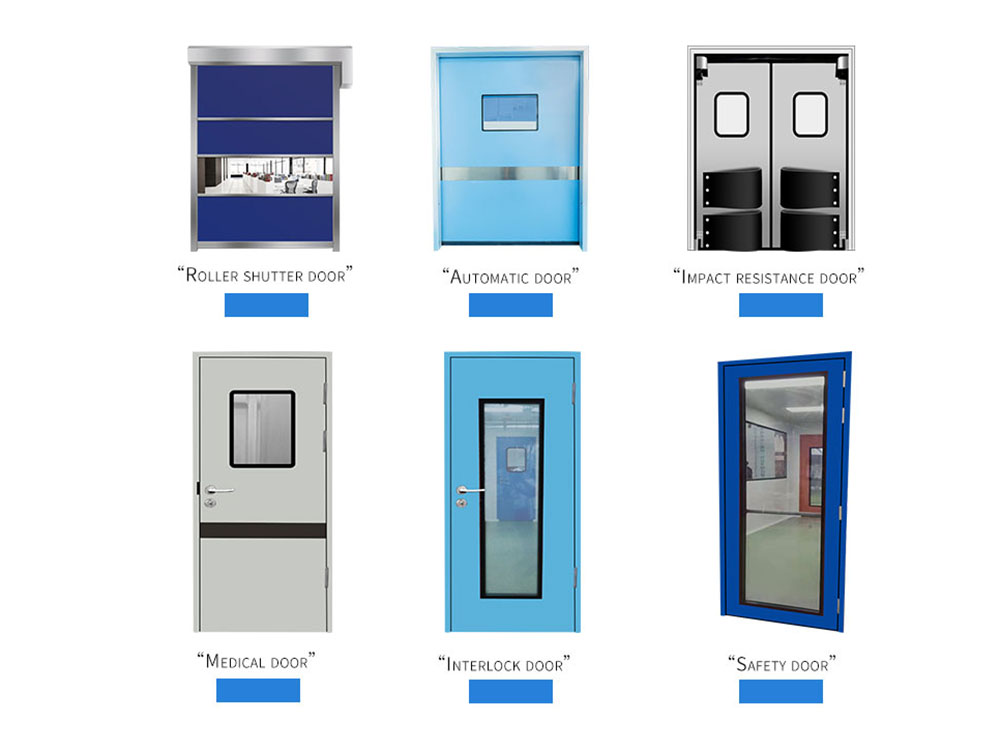
Installation tolerance completes the seal. The frame must land square in the opening, close flush against the panel skins on both faces, and leave no fastener heads exposed to the room. Because we manufacture doors and frames to order rather than install them, we ask for the wall build-up, panel thickness and opening dimensions with the inquiry. The factory can then match frames and trims to the wall instead of guessing at them. To see how windows, doors and frames come together as a set, the clean room doors line lists airtight, stainless and interlocked models that share the same architectural detailing.

Sightlines, Sizes and Where Windows Belong
Size the window to the viewing task, not to the catalogue. A door vision panel exists so staff can see people and carts on the other side before the leaf swings. That is why 400 by 600 millimeters is the common answer. A wall window exists to watch a process, read a gauge or supervise a suite from the corridor, and those tasks pull sizes upward.
Engineered units run to about 2,400 by 2,200 millimeters where the wall system allows. Decide what must be visible, from where, and at what height, and the dimensions follow.
Placement carries hygiene consequences. Windows sit flush inside cleanable surfaces, so keep them out of door swing arcs and away from corners where trolleys bite the wall. A pane at transfer height takes the same abuse as a door push plate. Give it the same protection or the same location discipline.
Some rooms also need to control what can be seen. In high-containment or dark-adaptation areas, integral blinds solve privacy without adding cloth to the clean zone. Magnetically operated venetian and blackout options seal inside the glazing cavity and move without any part crossing the room boundary. Ask for them at order stage, because retrofitting blinds into a sealed unit means replacing the unit.
For electronics and other ESD-sensitive manufacturing, add one line to the same conversation: static-dissipative glazing. Coated panes and polycarbonate sheets with permanent conductive coatings are offered for viewing windows in electronics cleanrooms, in line with the intent of ANSI/ESD S20.20 programs. Specify the surface resistance class with the supplier rather than assuming a clear pane is a safe pane. A window is the largest transparent insulator in most rooms, and it deserves a line in the ESD control plan like any workstation.

Everyday Cleaning and Inspection Routines
Daily cleaning of clean room windows follows the room’s wider regime, and it starts dry. Remove settled particles with a vacuum or tacky pad before any wet pass. Then wipe with lint-free wipes and a validated disinfectant, working from the cleanest area outward so residue never walks back across a clean pane. Glass accepts the full pharmaceutical rotation without complaint. Polycarbonate needs the compatibility list from the glazing section, a soft cloth, and a rinse step wherever the regime runs hot.
The frame and seal line deserve their own cadence. Inspect sealant joints quarterly to annually depending on cleaning aggressiveness and pressure duty. Look for shrinkage, adhesion loss or discoloration at the frame-to-panel junction.
When a section fails, cut it out and replace the whole run. Overcoating degraded sealant traps the failure underneath and hands the problem back to you within a year. Log each inspection, because a joint that keeps failing points at a detail problem in the frame, not at the material.
Validation paperwork belongs in the same file as the rags. Disinfectant contact times, wipe materials and rotation should match the room’s cleaning validation. The window should be cleaned the way the room is validated, not the way convenience suggests. Our cleaning validation and disinfectants guide walks that documentation trail for doors, and the same records cover the windows beside them.
Close the job at the drawing, because that is where the next purchase repeats or repeats the mistake. Three lines on the fabrication drawing carry most of this article. List the glazing build-up with its cavity fill, the sealant by brand and cure chemistry, and the flush tolerance at the wall face. Send those three lines with any inquiry and competing quotes become comparable on substance.
A window specified this way stays clear, flush and cleanable for the life of the room, which is the entire point.
Clean Room Window Questions, Answered
What does fog between the glass panes of a clean room window mean?
Fog, droplets or streaks between the panes mean the cavity seal has failed and the desiccant is saturated. This cannot be cleaned away; the glazing unit has to be replaced. Surface fog on either face is an environmental condition, not a seal failure.
When is double glazing worth it in a clean room?
Specify double glazing wherever a steady temperature difference exists between the room and adjacent spaces, such as cold rooms or temperature-controlled suites. Match the cavity to the wall panel, commonly 50, 75 or 100 millimeters, so the window sits flush on both faces.
Can polycarbonate vision panels handle disinfectants?
Only within limits. Diluted isopropyl alcohol and mild soapy water are safe, but concentrations above about 70 percent IPA craze polycarbonate, and aggressive sporicides shorten its life. Tempered glass tolerates the full pharmaceutical range, including quats and vaporized peroxide.
How large should a clean room window be?
Size the window to the viewing task. Door vision panels commonly measure around 400 by 600 millimeters to check traffic, while wall windows for process observation are made larger, up to about 2,400 by 2,200 millimeters. Decide what must be visible first, then pick the size.
How often should window seals be inspected?
Inspect sealant lines quarterly to annually depending on cleaning aggressiveness and pressure duty. Replace degraded sealant in full sections rather than overcoating it, and record each inspection so recurring failures point to a detail problem, not a materials one.