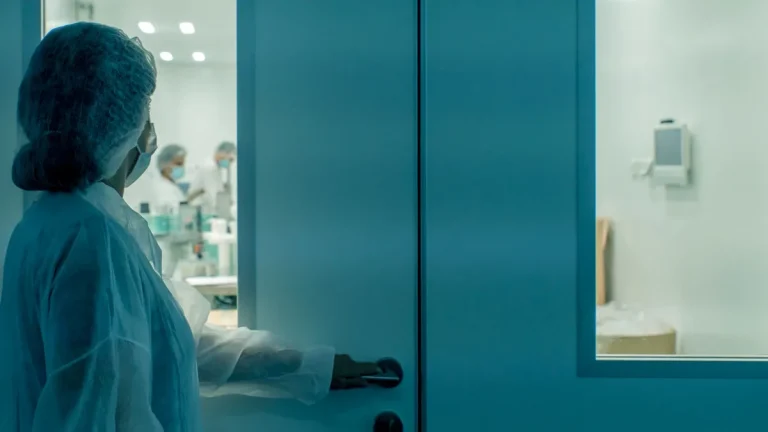
Every cleanroom runs on a chain. Air handlers and filters clean the supply, walls and ceilings hold the zones apart, and written discipline tells people how to move. Every component in that chain is bolted in place. Exactly one of them moves all day, opens to shoulders and carts, and swings shut hundreds of times per shift.
That moving part is the door. It is also where the role of clean room doors gets underestimated. A clean room does not lose its grade through the wall; it loses it through the openings. The door decides how far the environment drifts every time the room is used, and the sections ahead trace that role through pressure, traffic, hygiene and audit.
Where those doors sit beside ordinary plant hardware is laid out in our clean room doors vs industrial doors comparison (read it here).
The Contamination Control Chain and Its Moving Gate
Think of contamination control as a chain of barriers rather than a single room property. Filtration handles the air, surfaces handle settling particles, and procedures handle people. The door sits at the junction of all three, which is why it belongs to the control strategy instead of the hardware list.
It is also the least forgiving link. Industry data cited by door engineers attributes more than 30 percent of contamination incidents to door seal failures or improper operation. A door that leaks, wedges open, or closes too slowly undoes the work of the filtration system behind it.
Unlike a filter, a door cannot be swapped and forgotten; its performance depends on hinges, gaskets, closers and the habits of every user. The door is a system component with a duty cycle, not passive sheet metal.

Holding the Pressure Cascade at the Boundary
Cleanroom grades live on air moving in the right direction. EU GMP guidance expects at least 10 Pa between adjacent rooms of different grades. FDA guidance typically cites 10 to 15 Pa, and ISO 14644-4 recommends 5 to 20 Pa between zones. Pharmaceutical suites are often engineered near 25 Pa, the value expressed as 0.10 inches of water column, so every boundary has a number to hold.
The door holds most of that number. When it closes, its perimeter gaskets and drop seal turn a wall opening back into a wall. The leakage through that boundary decides whether the cascade survives or decays. When it opens, the room borrows air from the ventilation system, and pressure recovers only as fast as the HVAC can supply it.
Direction matters as much as magnitude. A positive pressure suite pushes air outward, so seals work from the inside. Isolation and containment rooms run lower than their surroundings, which reverses the load on the same leaf. How cascades are laid out between rooms is covered in our airlock and pressure cascade design guide. Satisfying whichever direction the design assigns is the pressure-side role of clean room doors.
Where People and Materials Cross the Line
People and materials are the largest contamination carriers in any cleanroom, and every one of them passes through a door. Gowning airlocks, interlocked door pairs and pass-through chambers keep that crossing one-directional. Interlocks prevent the simultaneous opening of connected doors, which protects the pressure differential and blocks cross-contamination from riding straight through.
Operation style shapes the risk as much as the hardware does. Automated and touchless activation removes the grab rail and push plate, the surfaces every gloved and ungloved hand shares. Faster cycles shorten the window in which two zones share one air volume.
Trolleys and parts enter through doors sized and sequenced for transfer, and access control keeps unqualified traffic out of graded zones. Our cleanroom workflow guide examines the daily pattern, and the door sets how much discipline every crossing demands.
A Surface That Survives the Hygiene Regime
The door leaf is one of the largest cleanable surfaces in the room. The clean room door product range exists because that surface has to survive its cleaning regime, not just fit the opening. Disinfectants, wipe-downs and washdown routines attack paint, exposed edges and porous cores. Corrosion-resistant stainless faces, flush geometries without dust ledges, and chemical-compatible gaskets keep the boundary cleanable for the life of the room.
A rough or degraded surface does more than look worn. It shelters bioburden and sheds particles at the worst possible location in the room. In practice the door plays the role of a fixture in cleaning validation. If the surface cannot hold up under the documented regime, the regime or the door will have to change.

What Auditors Ask About Clean Room Doors
In a qualification audit, the door stops being hardware and becomes evidence. Inspectors working through ISO 14644 and GMP checklists look for recorded pressure differentials, continuous monitoring across the zones the door connects, and a boundary that still matches its approved specification. The classification framework behind those questions is published as ISO 14644.
What the door brings to that conversation is a paper trail. Certificates for the applicable safety standards, material test reports, cleaning validation for the surface, and inspection logs for seals and interlocks all tie the leaf to a documented specification. Doors that ship with factory inspection reports and CE declarations start their site life audit-ready. That is the same discipline we apply as an ISO 9001:2015-certified manufacturer with CE EN 13241 and EN 12453 documentation.
The practical role of clean room doors in an audit is to shorten the gap between question and proof. A facility that can produce the leakage report, the certificates and the maintenance record on the same afternoon closes findings before they open. Our cleanroom doors and ISO 14644 compliance guide lists what those documents look like in detail.

When the Door Slips, the Room Slips
Door failure is rarely dramatic. Gaskets compress and take a set, hinges drift out of alignment, and closers lose their timing. The leakage rate then rises a little every month. Pressure cascade failures are routinely traced back to door leakage or poor closer timing, so the first symptom usually appears on the differential pressure gauge, not on the door.
Leakage grows, the cascade decays toward its setpoint, and the room drifts out of its qualified state. Every batch produced in that window inherits the doubt. What cost one gasket ends as an investigation, a requalification, or in regulated industries a recall exposure.
This is why maintenance belongs to the door’s role rather than after it. Scheduled inspection of seals, alignment, closing force and interlock function keeps the boundary at its qualified performance. Our preventative maintenance checklist turns that interval into a routine.
Treating the door as an equal of the filters and air handlers is the whole argument. It moves, it wears, and it is touched more than any other surface, yet it must hold a number measured in pascals. Facilities that give it that status keep their grade, and audit season proves it.
Frequently Asked Questions
What pressure difference must a clean room door hold?
EU GMP guidance expects at least 10 Pa between adjacent rooms of different grades, FDA guidance typically cites 10-15 Pa, and ISO 14644-4 recommends 5-20 Pa. Pharmaceutical suites are often designed near 25 Pa, so doors are judged on tested leakage at the design differential.
Do clean room doors really cause most contamination events?
Industry data cited by door engineers attributes over 30 percent of contamination incidents to door seal failures or improper operation. The exact share varies by facility, but the door is consistently among the most common leak paths auditors investigate.
What door evidence does an auditor expect?
Expect requests for pressure records, cleaning validation for the door surface, and seal and gasket inspection logs. Certificates such as ISO 9001 and CE EN 13241 declarations tie the installed door to a documented specification.
How does door maintenance protect the cleanroom grade?
Gaskets wear, hinges drift and closers lose timing, and each defect raises leakage until the cascade can no longer hold its setpoint. Scheduled inspection of seals, alignment and interlock function keeps the boundary performing to its qualified value.
Why not let people prop doors or pass materials freely?
Every uncontrolled opening breaks the pressure cascade and mixes air between zones. Interlocked airlocks, self-closing doors and pass-through transfers keep flow one-directional, which is how the room keeps its classification between openings.
The role of clean room doors comes down to one sentence: the room is only as controlled as the part of it that moves. Pressure, people, hygiene and audit all meet at the leaf. The facility that treats the door as system hardware keeps its grade where it was qualified.