
Table of Contents
- Clear Opening Dimensions and Pallet Transfer Constraints
- How Center Astragals Leak Pressure in Double Doors
- Never Ignore Door Coordinators and Inactive Leaf Hardware
- Spatial Swing Arc Clearance and Airlock Usable Footprint
- Side-by-Side Comparison Matrix for Cleanroom Swing Doors
- Consult Our Architectural Specialists on Airlock Door Sizing
Over 65% of airlock differential pressure drops in material corridors trace directly to unlatched inactive leaves and degraded center meeting astragals on cleanroom swing doors. Cleanroom facility planners often specify double doors assuming wider openings provide universal flexibility for future equipment moves. In practice, this architectural choice introduces chronic air balance deficits and hardware maintenance headaches.
Double swing doors resolve pallet width constraints in processing areas. Yet they create ongoing liabilities along vertical center seams. In contrast, single leaf swing doors provide reliable four-sided perimeter sealing and high structural durability. Selecting the right door configuration requires evaluating physical transit envelopes, orifice leakage mechanics, and daily operating stress.
Clear Opening Dimensions and Pallet Transfer Constraints
Airlock door sizing dictates material flow efficiency and envelope integrity. Evaluating certified ISO compliant cleanroom doors ensures structural frames and active seals accommodate strict cleanliness classifications.
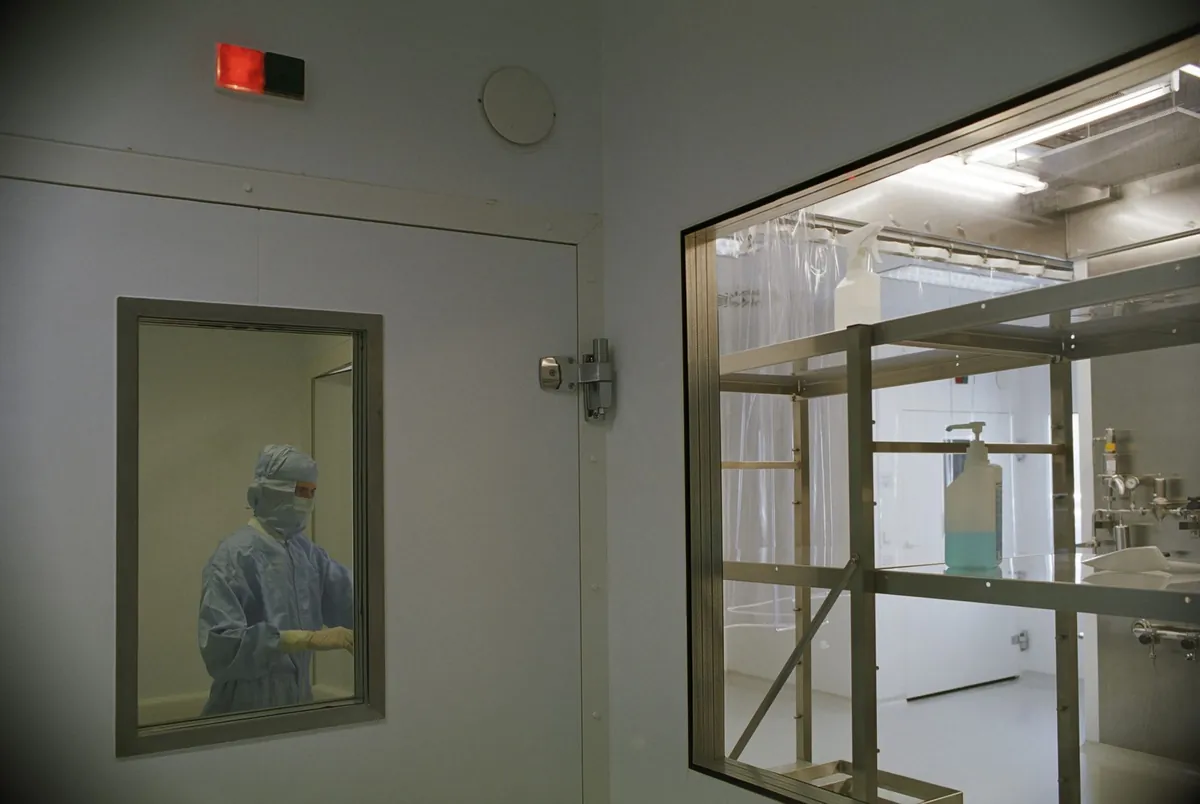
Euro Pallet vs ISO Pallet Transit Clearances
Cleanroom logistics depend on two primary pallet standards. Standard European Euro pallets measure 800 mm wide by 1200 mm long. International ISO pallets measure 1000 mm wide by 1200 mm long. Moving loaded pallets requires pallet jacks that add substantial operational width.
A standard 900 mm clear opening single door accommodates walking personnel. However, moving an 800 mm Euro pallet through that 900 mm opening leaves merely 50 mm of side clearance. Handlers maneuvering heavy loads frequently strike door jambs, gouging aluminum frames and dislodging perimeter gaskets.
For 1000 mm ISO pallets, single doors become structurally obsolete. Safe material transit protocols mandate at least 200 mm of side buffer clearance, dictating a minimum doorway width of 1400 mm. Double swing doors deliver clear openings from 1400 mm to 2200 mm, allowing bulk containers, processing skids, and pallets to pass without frame impact.
Why Single Doors Face Structural Width Limits at 1200mm
Engineers often ask why manufacturers do not produce 1500 mm single leaf cleanroom doors. The constraint stems from structural mechanics rather than panel fabrication limits. A standard 50 mm cleanroom door leaf with aluminum skins, honeycomb core, and vision glass weighs 70 to 90 kilograms.
As single leaf width expands beyond 1000 mm, cantilever torque on the frame increases exponentially. Heavy-duty EN 1935 Grade 14 cleanroom hinges withstand high vertical loads. However, wide panels exert extreme rotational leverage against the top hinge pivot. On single leaves wider than 1200 mm, hinge deflection causes the latch edge to sag by two to four millimeters.
This mechanical sag ruins perimeter airtightness. Bottom drop-down seals drag across epoxy floors rather than depressing squarely inside their housing. The top latch edge strikes the frame rebate, preventing automatic door closers from completing positive latching. Therefore, 1200 mm represents the practical architectural ceiling for reliable manual single cleanroom swing doors.
How Center Astragals Leak Pressure in Double Doors
Cleanroom suites rely on differential pressure cascades between 15 Pa and 50 Pa to prevent airborne particulate ingress. Sealing integrity verified under ASTM E283 pressure chamber standards ensures minimal air loss across closed leaves.
The Physics of Center Seam Deflection Under 50 Pa Pressures
Air leakage through doorway gaps follows fluid dynamic orifice flow principles. The mathematical formula for volumetric air leakage through an opening is expressed as Q = Cd × A × √(2 × ΔP / ρ). In this equation, Q represents volumetric flow rate, while Cd is the discharge coefficient of the gasket geometry.

The variable A denotes leakage gap area, ΔP represents differential pressure, and ρ is air density. Single swing doors seal against a continuous four-sided rigid frame rebate. Under 50 Pa pressure, the single leaf presses firmly into frame gaskets, achieving verified EN 12426 Class 4 airtightness below 0.5 cubic meters per hour per meter.
Double swing doors lack a central frame post. Instead, the two leaves meet unsupported in the center opening. Under 50 Pa differential pressure, both door panels deflect outward like cantilevered plates. This deflection widens the meeting stile seam, increasing effective orifice area A along the vertical center joint.
Field testing confirms center astragal joints leak between 1.5 and 2.0 cubic meters per hour per linear meter at 50 Pa. This rate is three to four times higher than a continuous frame rebate. Air handling systems must supply excess conditioned air to offset this continuous pressure bleed.
Overlapping Aluminum Astragals vs Dual-Durometer Silicone
Door manufacturers employ two primary sealing strategies at double door meeting stiles. When comparing glass vs metal cleanroom doors, specifiers observe that rigid metal stiles maintain tighter rebate tolerances than flexible full-glass panels.
Overlapping aluminum astragals withstand cart impacts but create cleanability hazards. Sanitizing liquids pool behind the lip, creating microbial harborage zones that fail hygienic inspections. Aluminum profiles also demand an exact closing order. If the active leaf swings shut first, the astragal impacts the inactive leaf and jams both doors open.
Modern pharmaceutical specifications favor dual-durometer extruded silicone meeting profiles. These gaskets combine a firm 70 Shore A base with a flexible 30 Shore A sealing bulb. The firm base seats into precision aluminum edge extrusions on both leaves, maintaining a flush exterior surface that wipes clean quickly.
Dual-durometer silicone seals compress smoothly upon closure, absorbing minor leaf misalignments while resisting aggressive vaporized hydrogen peroxide decontamination cycles. While silicone astragals provide better pressure retention than aluminum blades, they require periodic inspection to detect tears caused by abrasive pallets.
Never Ignore Door Coordinators and Inactive Leaf Hardware
Hardware durability determines whether a cleanroom door assembly functions reliably over years of heavy cycling. Single swing doors utilize simple hardware components consisting of butt hinges, a latch set, and an overhead closer. Double swing doors require coordinated mechanical systems that experience high operational stress.
EN 1158 Sequential Door Coordinators Prevent Leaf Binding
Double swing doors with overlapping astragals cannot close in random sequence. The inactive leaf must close and seat its seals before the active leaf swings shut over it. If the active leaf closes ahead of the inactive leaf, the overlapping lip collides with the opposing edge, stranding both leaves partly open.

To eliminate this failure mode, engineering specifications require sequential door coordinators compliant with EN 1158. A mechanical coordinator installs inside the frame head channel. When both door panels open, the coordinator holding arm catches the active leaf closer arm, holding the active door in a waiting stance.
As the inactive leaf swings shut, its top edge trips a release trigger inside the coordinator mechanism. This trigger disengages the holding arm, allowing the active leaf closer to pull the active door shut. If a coordinator falls out of alignment, the doors jam open, tripping facility alarms because magnetic interlock switches never close.
Concealed Flush Bolt Wear and Operator Tampering Risks
The inactive leaf of a double cleanroom door serves as a virtual door jamb for the active leaf. To provide a solid latching surface, the inactive panel must lock firmly to the building envelope. This locking relies on two-point concealed flush bolts positioned at the top and bottom of the vertical stile.
Cleanroom flush bolts feature stainless steel levers recessed into the door edge. Activating the lever drives solid steel shoot bolts twenty millimeters into frame head strikes and floor sockets. Floor strike sockets require spring-loaded dust-proof designs so internal springs raise flush stainless steel discs to prevent disinfectant accumulation.
Facility managers regularly encounter human error with manual flush bolts. Cleanroom operators unlock the inactive leaf to roll equipment through, but forget to throw the bolts afterward. When left unlocked, differential air pressure pushes the inactive panel outward, creating a 5 mm whistling gap that compromises cleanroom cascade containment.
Spatial Swing Arc Clearance and Airlock Usable Footprint
Airlock layouts must balance containment performance with ergonomic functionality. Door leaf swing arcs directly govern personnel movement velocity, where optimizing cleanroom doors workflow prevents shift-change bottlenecks in primary gowning airlocks.
Door Sweep Dead Zones in Confined Personnel Airlocks
Every swinging door leaf carves out a radial sweep path during operation. Cleanroom designers cannot place step-over benches, glove dispensers, or hand wash sinks within this swing envelope. In a compact two-meter by two-meter gowning airlock, wide door leaves consume over thirty percent of available floor area.
Engineering Cleanroom Swing Door Systems
Consult our technical team for custom clear opening dimensions, certified astragals, and coordinated hardware.
A single leaf door with an 1100 mm blade swings an arc radius of 1.1 meters into the room. Operators must step backward against wall panels to allow the door to open fully. This movement creates physical crowding during shift changes, increasing the risk of gown fabric contacting contaminated surfaces.
Double swing doors divide the opening width across two leaves, reducing individual swing depths. An opening width of 1600 mm uses two 800 mm leaves. Each leaf swings only 800 mm into the airlock interior. This shallower swing arc leaves clear walking paths, although simultaneous opening displaces air and prolongs HVAC particle recovery times.
Equal Pairs vs Unequal Active-Inactive Leaf Configurations
To balance pallet clearance against everyday airtightness, facility architects frequently specify unequal cleanroom swing doors. An unequal door assembly pairs a wide active leaf with a narrower inactive leaf within a common frame. Typical layouts combine a 900 mm active leaf with a 500 mm or 600 mm inactive leaf.
During standard operations, staff use only the 900 mm active leaf for walking access and small sample carts. The narrow inactive leaf remains bolted shut. This setup provides the rapid closure, small air displacement, and reliable perimeter sealing of a single door.
When technicians must move large processing skids or pallet jacks, they unlatch the inactive leaf. Opening both leaves reveals a clear opening width of 1400 mm to 1500 mm. This hybrid layout eliminates the need to install costly separate equipment transfer airlocks in modular wall partitions.
Side-by-Side Comparison Matrix for Cleanroom Swing Doors
Selecting the optimal cleanroom door configuration requires weighing mechanical width capabilities against differential pressure retention. The comparison matrix below details operational benchmarks across single swing doors, unequal pairs, and equal double swing assemblies based on cleanroom engineering field data.
Ten-Point Engineering Performance Breakdown
| Design Parameter | Single Swing Leaf | Unequal Leaf Pair (900+600mm) | Equal Double Swing (800+800mm) |
|---|---|---|---|
| Max Clear Width | 1100 mm to 1200 mm | 1400 mm to 1500 mm | 1600 mm to 2200 mm |
| Air Leakage at 50 Pa | Under 0.5 m³/h·m | 0.8 to 1.2 m³/h·m | 1.5 to 2.0 m³/h·m |
| EN 12426 Airtightness | Class 4 Certified | Class 3 to Class 4 | Class 3 Rating |
| Center Seam Vulnerability | None (continuous rebate) | Moderate (gasketed seam) | High (unsupported astragal) |
| EN 1158 Coordinator | Not Applicable | Required for dual swing | Mandatory for overlapping seals |
| Inactive Leaf Hardware | None required | 2-point flush bolts | 2-point flush bolts + keeps |
| Swing Arc Depth | Deep (up to 1200 mm) | Medium active (900 mm) | Shallow dual (800 mm each) |
| Pallet Handling (Euro/ISO) | Incompatible with pallets | Fits Euro & ISO pallets | Ideal for wide pallet flow |
| HVAC Wake Turbulence | Low volumetric displacement | Low in daily single mode | High when both leaves open |
| Lifecycle Maintenance | Low (minimal parts) | Moderate annual inspection | High (coordinators & seals) |
Audit Non-Compliance Risk Mapping for cGMP Facilities
Regulatory inspectors evaluate cleanroom containment under cGMP Annex 1 rules. Door assemblies represent a primary audit target during differential pressure inspections. Double swing doors present substantially greater compliance risks due to astragal flex and hardware wear.
Air velocity dips and pressure cascade deviations frequently point back to center meeting seals. When pharmaceutical auditors test room differential pressure with double doors in place, degraded astragals allow air bypass that drops cascading pressures below validated specifications.
Unlatched flush bolts represent another recurring audit deficiency. If staff leave bottom shoot bolts disengaged, inspectors cite the facility for inadequate physical barriers. In Grade A and Grade B cleanroom environments, single swing doors should be selected wherever equipment sizes permit to minimize these validation risks.
Frequently Asked Questions on Cleanroom Door Configurations
Can a single cleanroom swing door accommodate standard forklift or pallet jack traffic?
A standard single door cannot safely clear standard 800 mm Euro pallets or 1000 mm ISO pallets. While single leaves up to 1100 mm handle manual drums, pallet logistics require double doors to prevent frame impact.
Why do double cleanroom swing doors leak more air than single doors under pressure?
Double doors lack a continuous central frame rebate, relying on flexible center astragals. Under 50 Pa pressure, door leaves deflect outward, widening the center seam and producing 2.5 to 4 times higher air leakage than single frames.
When is an EN 1158 door coordinator legally required on double cleanroom doors?
EN 1158 coordinators are mandatory on double doors with overlapping astragals or rebated stiles. The coordinator forces the inactive leaf to close before the active leaf, preventing mechanical collisions and seal binding in pressure airlocks.
What are the operational advantages of specifying an unequal leaf cleanroom door?
An unequal pair pairs a 900 mm active leaf for daily pedestrian traffic with a 500 mm bolted inactive leaf. It preserves airlock floor space and pressure integrity while providing 1400 mm clear width during equipment moves.
How do you prevent microbial contamination in inactive leaf floor strike sockets?
Install spring-loaded, dust-proof floor strikes made from 316L stainless steel. When the shoot bolt retracts, an internal spring plate rises flush with the finished floor, preventing sanitizing chemicals and bioburden from pooling inside the socket.
Consult Our Architectural Specialists on Airlock Door Sizing
Balancing logistical access with containment integrity requires calculating physical transport envelopes, HVAC pressure cascades, and hardware lifecycle costs. Over-specifying double doors increases ongoing energy loads and validation risks. Under-specifying single doors causes chronic frame damage from material carts.
Our engineering team manufactures custom single, equal double, and leaf-and-a-half cleanroom doors with precision aluminum framing and dual-durometer seals. Explore our complete selection of cleanroom doors or submit your airlock layout drawings to our architectural specialists for door schedule reviews.