A high-speed door works on one idea: close the opening before the air on either side has time to mix. The mechanism behind that idea is a servo drive, a lightweight curtain, and a control system that times every phase of the cycle to the traffic in front of it.
This guide walks through the parts, the opening cycle, the control logic, and the safety layer — so you can see what actually changes between a high-speed door and a standard industrial door.
What Is a High-Speed Door?
A high-speed door is a powered industrial door that opens far faster than a conventional sectional or roller shutter door. Typical opening speed runs from 0.8 to 2.5 m/s. The door is usually a flexible PVC curtain or a rigid aluminum panel set, and the speed is driven by a servo motor rather than a simple gearbox.
That speed is not cosmetic. It shrinks the window where two environments exchange air, and every second saved is a second of temperature, pressure, or cleanliness that is preserved.
Main Components
Five parts do the work, and each is chosen for the duty cycle the door will run.
The drive. High-speed doors use a servo drive, which can accelerate and brake with far more precision than a standard induction motor. That precision is what allows the door to reach full speed and still stop gently, cycle after cycle.
The curtain or panel. Most high-speed doors use a flexible PVC curtain rolled around a drum above the opening; rigid versions use interlocking metal panels that coil into a spiral. RAX builds the rigid panels from 6063-T5 aluminum and galvanized steel, with a polyurethane foam core for insulation. The curtain is light because a lighter door accelerates faster with less energy.
The side columns and guides. Two vertical columns hold the curtain in its track and keep it from flapping under air pressure. On higher-spec doors, a light curtain is integrated into the columns, and wind bars reinforce the curtain against gusts.
The control box. This is the brain. It holds the servo controller or variable-frequency drive, plus the logic that sets acceleration, deceleration, and hold-open time. The same box usually carries the diagnostic readout and the manual override.
The sensors and seals. Radar or motion sensors trigger the door before a forklift reaches it, and a safety edge stops it if the opening is not clear. The seals and gaskets around the perimeter do the quieter job of closing the air gap when the door is shut.
How the Opening Cycle Works
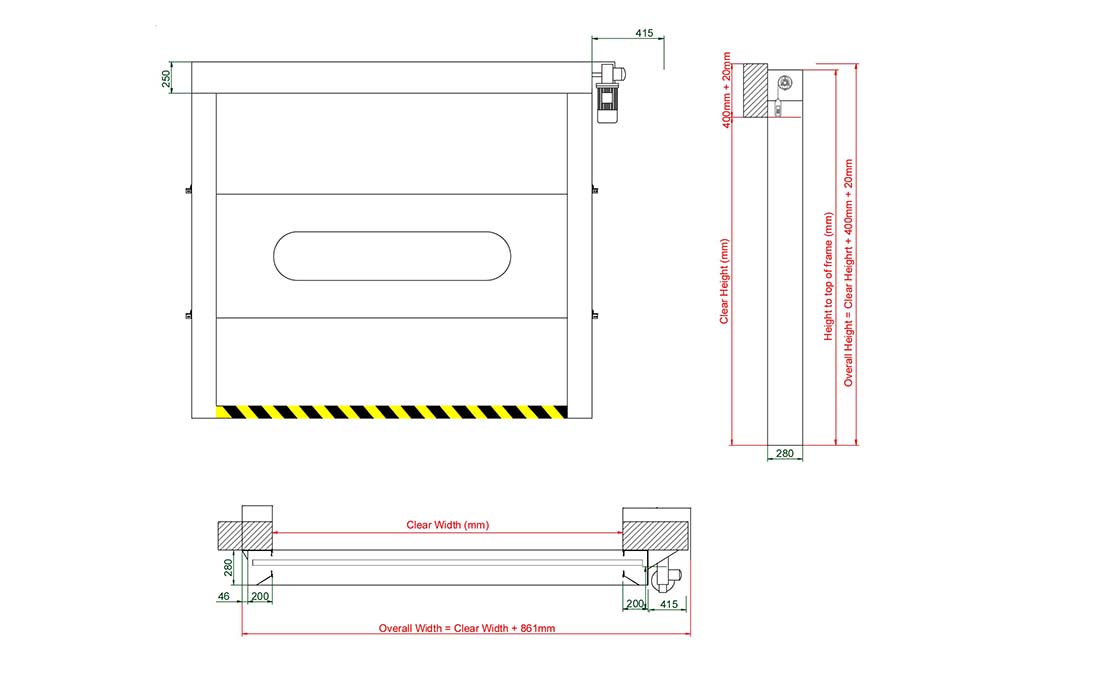
A high-speed door does not simply open and close at full speed. Every cycle runs three phases: a fast acceleration up to speed, a short travel, and a controlled deceleration into the closed or open position.
When a sensor sees a forklift, the drive ramps up and the curtain clears the opening at up to 2.5 m/s. The door holds open just long enough for the forklift to pass, then closes the moment the opening is clear. The whole point is to minimize the time the two sides are connected, without ever cutting a cycle so short that equipment or people are put at risk.

Control Systems
The control system is what separates a high-speed door from a fast motor. It lets you tune acceleration, deceleration, and hold-open time to the traffic, so a busy loading dock and a low-traffic cleanroom pass-through can run different profiles on the same hardware.
Most controllers also log cycle counts and fault codes. That data matters because a high-speed door is production equipment — knowing how many cycles it has run tells you when a spring or a curtain is approaching replacement, before it fails mid-shift.

Safety Features
Speed has to be paired with safety, and the safety layer is built from several overlapping devices.
A light curtain or photo eye across the opening detects a person, forklift, or object and stops or reverses the door before contact. A reversing safety edge along the bottom of the curtain does the same by sensing an obstruction under a closing door. After an accidental impact, a breakaway system lets the curtain release from its side guides and re-feed itself on the next cycle, instead of jamming.
Warning lights or audible alerts signal before the door moves, vision panels give forklift operators a line of sight, and self-monitoring diagnostics stop the door and request service if the safety system itself fails. Together these are why a compliant door carries a safety standard such as EN 12453 — not to slow a fast door down, but to make it stop the instant the opening is not clear.

Why the Speed Matters
The physics are simple: a door that is open half as long lets in roughly half as much air. On a freezer or a cleanroom, that is the difference between a compressor holding a stable temperature and a compressor fighting a constant leak.
A standard sectional door does the same job on an opening that cycles a few times a day. A high-speed door earns its cost on an opening that cycles constantly, where every extra second of open time repeats itself all day. A door that has passed a 100,000-cycle fatigue test is built for exactly that duty.
Choosing the Right Mechanism
The right door follows the duty cycle and the environment, not the catalog. An interior opening between two production zones needs a different drive and curtain than an exterior dock facing wind, and a freezer needs anti-icing features a warehouse door does not.
If you are buying rather than specifying, the checks that matter — material, motor, safety, and cycle rating — are laid out in this high-speed PVC door buying guide. Whatever the choice, the door should carry CE marking to EN 13241, the product standard for industrial doors and gates.
Get a high-speed door matched to your duty cycle
RAX manufactures high-speed doors to the opening size, cycle rate, environment, and wind load you actually run. Tell us where the door goes and how often it cycles, and we will recommend the right drive, curtain, and controls.
FAQ
How fast does a high-speed door open?
Most high-speed doors open at 0.8 to 2.5 m/s, driven by a servo motor. The right speed depends on traffic and safety requirements rather than chasing the highest number.
What motor drives a high-speed door?
A servo drive, because it can accelerate and brake precisely enough to reach full speed and still stop gently cycle after cycle. RAX backs its servo motors with a 5-year warranty.
Are high-speed doors safe?
Yes, when the safety layer is specified correctly. A compliant door uses a light curtain or photo eye, a reversing safety edge, and a breakaway auto re-feed system, following a standard such as EN 12453.
How is a high-speed door different from a standard roller shutter?
The difference is the drive, the control system, and the duty rating. A high-speed door opens at 0.8 to 2.5 m/s and is built to cycle constantly, while a standard roller shutter is slower and built for lower-frequency use.