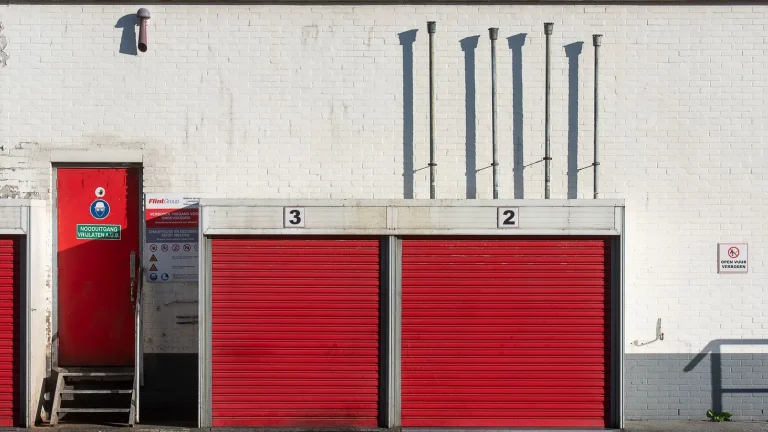







A driver stops a metre inside a high speed door and stays there, because from the cab the far side is a white blank. Nothing is wrong with the door or the operator. The high speed door vision window fitted three years ago has gone yellow and cloudy, and it is the only thing that ever let that driver see across. A food plant case in China reported the same chain. A PVC pane left three years, two collisions followed at that bay, and both were traced to drivers who could not see what was coming.
The mistake I meet most is treating a high speed door vision window as a piece of glass instead of an aperture cut into a tensioned fabric curtain. Every cut in that fabric is a stress concentration, and the winding cycle loads it again every time the door opens, which means the judgement comes before the tools. We build all 21 of them ourselves, with PVC or aluminium curtains at 0.8 to 2.5 m/s. Appearance sits on the factory test report beside speed, noise and insulation resistance. Before you pick up a spanner, understand the fabric you are about to cut — how a high speed door works covers the cycle that loads the cut.
Four Outcomes Before You Touch the Door
Most vision window callouts start with the screwdriver, and a good share replace the wrong part. Before anything comes off, the job has one of four answers: replace the pane, replace the curtain, replace the door, or take the window out of the specification. Our diagnosis order is location first, then size, then the condition of the rest of the curtain. The same hole means different things in different places, and guessing turns a small job into a new curtain.
Outcome one is the pane. A tear under 50mm sitting in the middle of the curtain panel is a pane job. One service dealer’s published criteria set that line deliberately low, because a mid-panel cut is the only cut that never runs into an edge.
Outcome two is the curtain. A tear over 50mm, any tear at the edge close to the guide, or a badly worn bottom edge closes the pane discussion. An edge tear opens a little further every time the curtain winds onto the drum. The same criteria warn against patching edge damage for that reason, and our diagnosis order puts it the same way.
Outcome three is the door, and it arrives without a hole in it. When the fabric has gone broadly brittle and lost its elastic recovery, a new pane is a repair on a curtain that has already failed. Outcome four is removal. In cold rooms the correct answer is usually no window at all.
Numbers deserve an honest reading. A double-sided patch recovers about 70% of the original strength, and only in the middle of the panel. Patching a high speed door vision window is closer to repairing a tyre sidewall than fitting new rubber. It keeps the water out, and it does not put the load rating back. Nobody should sign a patched opening as a restored one, or budget a patch as though it were a new pane.
That last point is where the four outcomes get expensive, because they do not cost the same. A high speed door vision window is a consumable fitted to a single opening. A curtain is the whole flexible body, matched to the guide, the bottom rail and the winding end. Removing the window is the cheapest of the four, and the one most often left unsaid.
The location call is usually settled by touch. Picture a forklift guardrail on the approach side, and a curtain edge with a frayed burr along it where a truck clipped the fabric. That is edge territory, and it belongs to outcome two whatever the tear measures. Forklift strikes account for over 60% of curtain breakage cases in one published breakdown, and jamb guardrails do more for this door than any repair we could sell you.
Edge damage also travels, and this is where the four-outcome decision earns its keep. A tear that starts beside the guide does not stay beside the guide. The curtain rolls over the drum, and every pass loads the same line of fabric. One published service breakdown lists guide friction as a cause in its own right, alongside sharp points, ageing fabric and trapped debris. A repeat tear at the same height is evidence, not bad luck.

Cracks carry their own scale. A hairline crack with no sign of extension can be repaired locally. A crack past 5mm, or a chunk of fabric missing from the panel, finishes the pane. Replacement lists keep naming five signals: yellowing, surface crazing, hardening and brittling, an actual tear, and a seal that no longer seals.
| Failure mode | What you can observe | Where it lands |
|---|---|---|
| Impact strike | Frayed opening, torn edges, debris marks along the opening | Pane if under 50mm and mid-panel, otherwise curtain |
| Edge wear | Curtain rubbing the guide, thinning edge along the run | Curtain |
| UV yellowing | Hazy amber pane, reduced view across the opening | Pane, then check the curtain for embrittlement |
| Tension tear | Crack that extends with every cycle | Curtain |
| Cold-room icing | Frost inside the opening, split pane after a freeze-thaw cycle | Remove the window from the specification |
Work through the table before you touch the trim, not after. The row that decides it is usually the one about location. If the answer lands in the curtain column, stop pricing a pane. When repair stops paying off on an industrial door works through that money question against the whole door instead of one part.
Why Material Choice Is a Physics Decision
A broken pane has to be replaced with something that bends, and that rules out the most obvious candidate. One door maker’s service bulletin puts flexible PVC at one to two years of life, with yellowing as the usual complaint. The same bulletin puts TPU at three to five years for roughly fifty per cent more money. It also lists polycarbonate, which scores well on clarity and impact, as unusable on a rolling door, because a rigid sheet will not roll. That single physical fact is what decides the question, and it is not a commercial one.
Polycarbonate earns its place on other doors for good physical reasons. One specifier’s guide notes that it bends under impact instead of breaking into fragments, and that the surface scratches easily enough to need a scratch-resistant coating. None of that rescues it here. We are not weighing polycarbonate against flexible PVC on impact ratings, because a rigid sheet cannot follow the curtain onto the drum. Flexibility settles the question before price enters it, and that matters at speed, since pane and curtain reach the guide together on every cycle.
The same physics ends a different argument in cold rooms. One UK technical note from a high speed door manufacturer points out that a vision window is thin transparent PVC with almost no insulative value. It drags the insulation of the whole opening down with it. In a chiller that becomes condensation dripping onto the floor and a slip hazard, and in a freezer the pane ices up and breaks. A UK regulator treats dripping water and wet floors as a predictable injury mechanism, so we will not sign a cold room panel on a promise.
Our position is that the correct move on a cold room door is usually to remove the window rather than fit a better one. We will not quote a multi-glazed pane we have not tested, and that boundary is deliberate. Cold chain doors fail in their own ways, and our zipper door repairs in cold chain notes them.
Curtain gauge is the other half of the pane decision, because a heavy curtain lies flatter and resists the tearing that starts at a cut. One service dealer’s published criteria match gauge to daily cycles, and the same gauge-to-cycles mapping tells you when a curtain has been asked to do more than its thickness allows.
- 0.8mm suits a curtain doing under 200 cycles a day, with published criteria putting its life at about 2 years.
- 1.0mm covers the 200 to 500 cycle band, quoted at 3 to 4 years.
- 1.2mm is the match above 500 cycles a day, quoted at about 5 years.
Fitting a new pane on a 0.8mm curtain that runs more than 500 cycles a day makes the pane the cheap half of the conversation. That mismatch is a curtain conversation, and it is why the gauge check comes before the material chat.
There is a sequencing point that catches people out. Fitting a longer-life panel into a tired curtain buys you the panel’s life in a fabric that will split around it. The upgrade that pays is the one where curtain gauge and panel material move together, matched to a measured cycle count. Count the cycles the bay actually runs instead of trusting the nameplate figure, and specify the heavier curtain when the count sits well above it.
All of this assumes the pane is specified against the curtain actually on the opening, and that is a build-to-order conversation rather than a shelf conversation. Our large industrial doors are made to order from a single piece, with no minimum order quantity, so an unusual opening is a normal order rather than an exception. Custom high speed doors follow the same build-to-order route. A pane matched to the real curtain is a small job. Specified against a guess, it turns into a new curtain rather than a new door.
Releasing Tension Before You Remove Anything
The step that gets skipped is the one before the step everybody plans. A high speed door vision window sits in a curtain held under tension across its whole width. Pulling a pane out while that fabric is still taut redistributes the load around the cut, and the redistribution does not stay where you left it. Our own service practice is to bring the tension in that panel down to a workable state before the trim comes off. That is our practice rather than a clause we can quote, and we will not invent a tension figure to make it sound official.
Isolate first. Cut the power, bring the curtain down to the bottom by hand, and lock it so nothing moves while hands are on the opening. Gloves and eye protection belong on the job from the first hour, because an aged pane sheds fragments that stay trapped in the fabric. A fragment left inside becomes the next tear, and it does that under load.
Work in a temperate, dry spot. One published repair procedure asks for 15-30°C, humidity at or below 60%, and ventilation. On a chilled dock bay that means closing the door, waiting, and working the off-shift. Adhesive does not key off the same curve in a cold bay as in a workshop, and any cure time you were given assumes the warmer of the two. Sealant that skins over before it wets through will hold a bead and still leak behind it.
If the old pane resists removal, stop. One door service dealer’s published criteria treat an insert that will not come out as information rather than an obstacle. Resistance points at distortion, corrosion build-up or a failed trim. On a fabric curtain the equivalents are a deformed panel, edge damage or a channel that has lost its grip. Forcing the new pane into that opening repeats the failure, and it does so on the first cycle.
Sizing is arithmetic with a margin. Cut the new pane 20 to 30mm larger than the frame’s inner dimension. Leave 10 to 15mm of overlap on each side, so the trim holds material across four edges instead of pinching a cut edge. Warm the new pane’s edge with a hot air gun on its lowest setting until it softens. Press it into the channel, then refit the trim bead, rubber or aluminium depending on the door.
Seal with neutral silicone. Ordinary glass sealant attacks PVC, and the failure surfaces later as a yellowed, softening edge. Nobody connects that edge back to the glue, because by then the bead looks fine from a distance. Leave the job twelve hours before the curtain returns to service.

Refit the trim evenly so the fabric lies flat instead of puckering around the cut. Then look at what the window depends on. Clearance between curtain and guide belongs at 2 to 3mm, and too little means the edge wears, which is the damage you just opened up arriving on a slower schedule. Brush seals and the bottom rubber go into the same check, and anything hardened gets replaced in the same visit.
Re-tensioning after the pane goes in is the part teams rush, and it decides whether the repair holds. The new pane has to sit flat enough that the fabric carries its load across the panel rather than around the opening. Run the curtain up and down by hand, slowly, and watch the fabric beside the trim. Puckering that appears only at the top of the travel means tension is uneven across the width, and uneven tension seeds the next tear. A second slow pass usually settles it, and a third that changes nothing means the panel went into a distorted opening, which makes this a curtain job after all.
- Cut the power, lower the curtain to the bottom by hand, lock it, and put gloves and eye protection on.
- Bring the tension in the panel around the window down to a workable state before anything comes apart.
- Take the trim bead off in one piece and support the panel so the cut does not travel.
- Measure the frame’s inner dimension, then cut the new pane 20 to 30mm larger with 10 to 15mm overlap per side.
- Warm the new edge on a hot air gun’s lowest setting until it presses into the channel without force.
- Refit the trim evenly, bed the fabric flat, and seal with neutral silicone only.
- Leave twelve hours to cure, then check guide clearance at 2 to 3mm and inspect seals and the bottom rubber.
Our practice, not a standard clause: the tension release in step two is how our own service teams work, because a cut in tensioned fabric redistributes load around the opening. No EN or ISO clause gives a force figure for it. Any supplier who quotes one to you is estimating, and estimating is not a method.
All of that assumes the curtain behind the window is worth keeping, and the fabric itself decides how long the next pane lasts. Weight, wear behaviour and service life differ between the available options, and that ordering is why the gauge question comes first.
Testing the Repair Under Real Cycles
A repair is not finished when the last bead goes back on. One service dealer’s published sign-off after a glazing change covers the checks below, and all of them carry over to a fabric curtain. The door runs its full travel with no added resistance, and the seal line stays continuous with no visible gap. The sightline is clear enough for vehicles and pedestrians, and the work has not changed the rated state of the opening.
| Check | Method | What counts as a pass |
|---|---|---|
| Travel | Cycle the door through full travel | No added resistance across full travel |
| Seal line | Walk the perimeter with the door closed | Continuous line, no visible gap around the opening |
| Sightline | Look through from both approach directions | Clear enough for drivers and pedestrians |
| Light test | Bright torch from one side of the pane | No light showing on the other side |
| Air test | Door closed, light wind pressure around the pane | No escaping air at the edges |
| Rated state | Compare against the repair record and the test record | Repair has not changed the rated status of the opening |
| Record | File the sign-off sheet | Travel, seal, sightline, light, air and rated state all logged |
Both leak tests matter, because a pane can pass them and still leave you with a cold draft. One dealer’s criteria describe winter distortion that develops into repeat leakage and callbacks. The fabric equivalent is uneven curtain tension or a worn brush seal. Check the perimeter before you condemn a second pane.
It is worth being precise about what the powered door safety standard covers, because a high speed door vision window is not a safety device. EN 12453 limits impact force to 400N within 0.75 seconds, and to 25N for the 5 seconds after that. It tests an electro-sensitive protective device with blocks of 700 × 300 × 200mm and 50mm × 300mm, and asks for PL c Category 2 on the safety-related control system.
Those clauses govern what happens to a person in the path of a moving door. A yellowed pane is an operational problem and a safety culture problem, and no impact figure in the standard gives the driver back the view.

One piece of housekeeping belongs with the sign-off. Record the pane material, the cut size, the sealant and the person who fitted it. The next engineer to open this door will not have your memory of the job, and an unrecorded repair tends to be diagnosed as a failed one.
Run the acceptance checks in the morning, not at the end of a long shift. A curtain cycled repeatedly in a cold dock bay tells you about noise, drag and seal behaviour that a fresh fitting hides. The travel test catches the most, because added resistance is the first thing a tired fabric or a catching trim will tell you. If resistance appears part way up, find the height at which it starts.
A Light Curtain Is Not a Window
The most common wrong answer at a door like this is to fit two light curtains and call the problem solved. Our position is that the trade buys a different risk rather than removing the one you have. The D and E classes in EN 12453 watch the path of the moving door, one as an auxiliary detection device and the other as an electro-sensitive protective device. Something enters the path, and the door stops or reverses.
A blind high speed door with a light curtain installed gives a forklift operator the same view as a blind door with a broken pane in it. That view is none at all, and no high speed door vision window in either case changes it. The light curtain answers whether the door will hit somebody as it closes. The vision window answers whether the driver can see across before going through. The driver stopped inside my bay is still waiting on the second answer.
Adding the light curtains is allowed. Clause 5.2.1.8 asks for a supplementary device on each side, where the distance from the leading edge is 150mm or more. It applies to a vertically moving door that does not project, and it gives a driver protection without a pane while leaving the view problem where it was.
There is a test for that costs nothing. Stand at the operator’s seat with the door closed and the light curtains active, then walk the same line with the door open and the pane in front of you. The light curtain contributes nothing to the second view, so a bay that needs both needs both.
Do not sign these against each other: a light curtain belongs on the safety checklist, and a vision panel belongs on the operations checklist. Reporting a safety device as the fix for a visibility problem leaves the risk assessment intact and the collision history unchanged.
The habits that keep the next pane serviceable are unglamorous. Put the window into the routine check for scratches, cracks and discolouration, instead of waiting for a complaint. Fit guardrails or soft bollards at the jambs, so a forklift never reaches the curtain edge. Check the sacrificial bottom rib daily, since it is built to take the hit and it should be the part that does. Cleaning is the cheapest life extension available here, and the one most often skipped.
Wipe the curtain with a damp cloth each week, particularly where it runs against the brush seal. Use mild cleaner only, because a harsh one takes the coating off. The contact zone is the one that pays, since it is where fabric and seal fight each other on every cycle. Our warehouse door maintenance schedule puts those checks on a calendar with an owner and a record per door.
- Every routine visit: scratches, cracks and discolouration on the panel.
- Daily: sacrificial bottom rib wear, and guardrails or bollards still in place.
- Weekly: damp cloth on the curtain, with attention to the brush seal contact zone.
- After any strike: photograph the opening before anyone trims or patches it.
Five Questions Before You Specify a Replacement
Specification is where vision window jobs go wrong, usually by treating a cut in a curtain as a consumable like any other part. Our position is that changing the hole position, the size or the material changes how the curtain is loaded and how it winds. That makes it a configuration change rather than a spare part, and such changes get confirmed against the door in front of you. CE EN 13241 is a conformity declaration for the whole door, so we will not claim a re-cut opening leaves certification untouched. A specifier’s guide for a different substrate makes the same point: a compliant component does not make a compliant assembly.
- What is the curtain material and thickness, and what daily cycle count was it specified for?
- Which panel material do you propose, and what life figure do you commit to for this duty?
- What is the cut size, and how is the edge seated, tensioned and sealed?
- What is the measured daily cycle count at this opening, rather than the design figure?
- What warranty and spares apply, and what documentation arrives with the door?
On that last question our own figures are worth stating plainly. Two years on the door body, three years on the opener and motor, and five years on a servo motor. Spare parts ship by DHL or FedEx within five to seven days while the warranty runs. Documentation comes with the door: English installation manual, CAD installation drawings, wiring diagram, the CE declaration of conformity and the EN 13241 test report.
Send the five answers back as a set rather than a paragraph of adjectives. Ask each supplier to state curtain material and thickness, panel material, cut dimension, cycle count and warranty in the same reply, so the answers can be compared. Our high speed door vision window spec carries all five, which is why we can answer them in writing too.
A cracked pane never improves; the high speed door maintenance checklist carries the vision-window line on every weekly walk so the replace-or-rebuild decision lands early.
Frequently Asked Questions
Can you replace a vision window on a high speed door?
Yes, when the tear is under 50mm and sits mid-panel. Above 50mm, at the curtain edge near the guide, or with a worn bottom edge, the curtain is what fails. Release the tension on the high speed door vision window first, and size the new pane 20 to 30mm.
Should I replace the whole curtain or just the window?
Replace the pane for a mid-panel tear under 50mm, and replace the curtain when the tear is larger, sits at the edge, or the bottom edge is worn through. A double-sided patch recovers about 70% of original strength mid-panel, which is a tyre sidewall repair rather than new rubber.
Why is polycarbonate not used on high speed doors?
Because a rigid polycarbonate sheet cannot roll. The pane has to bend and wind onto the drum with the curtain on every cycle. Polycarbonate bends rather than shattering under impact and scratches easily enough to need a coating, so flexibility settles this before price does.
Can a light curtain replace a vision window?
No. EN 12453 D and E devices detect an obstruction in the path of the moving door and stop or reverse it, which protects people during closing. They give a driver no view across the opening, so a blind door stays blind with a light curtain fitted.
Can high speed doors have vision windows in cold rooms?
Usually not. A UK high speed door manufacturer’s technical note points out that thin PVC has almost no insulative value, so the pane lowers the insulation of the whole opening. Condensation drips in a chiller and creates a slip hazard, and a freezer pane ices up and breaks.