Ask what high-speed doors are used for and the honest answer is narrower than most catalogs suggest: anywhere an opening cycles constantly and the two sides must stay separate. Cold storage, food plants, cleanrooms, loading docks, and busy assembly lines all share that one condition.
A high-speed door opens at 0.8 to 2.5 m/s — fast enough to close before a forklift fully clears the opening. That speed is not cosmetic. It shrinks the window where warm air, dust, or unfiltered air crosses between zones, and that is where the real value lives.
Key takeaways
- High-speed doors open at 0.8–2.5 m/s and close before a forklift clears the opening.
- Rigid spiral models reach wind load Class 5, roughly 12 on the Beaufort scale, for exterior docks.
- They earn their cost in cold storage, food plants, cleanrooms, logistics, loading docks, and manufacturing.
- A high-speed door only pays off where the opening cycles constantly — not on a door opened a few times a day.
- On a low-traffic opening, an insulated sectional door (U-value around 0.33 W/m²K) is usually the better spend.
Cold Storage and Freezers
A freezer door is a hole in the thermal envelope. Every cycle lets warm, humid air in, and that air condenses and ices the panels, the floor, and the product. The compressor then runs harder to pull the room back down, and the temperature swings enough to shorten shelf life on the goods nearest the door.
A high-speed door attacks the problem at its source: it stays open for a fraction of the time a conventional door does, so less warm air crosses on each cycle. The best cold-storage versions add anti-icing seals and insulated curtains so the door does not freeze shut and does not become a second thermal leak. That combination is why a cold storage door costs more than a plain interior door — the details are the product.

Food and Beverage Processing
Food plants have two door problems at once: temperature control and hygiene. A slow door holds the opening open long enough to pull in warm air and whatever dust or insects ride on it. A door that is hard to clean becomes a contamination surface that an auditor will eventually flag.
High-speed doors used in food processing close fast and use smooth, washable curtains and stainless hardware so there are fewer places for residue to collect. In a washdown area, that washability matters as much as the speed — a door that traps food residue is a liability, not a closure.

Pharmaceutical and Cleanroom Facilities
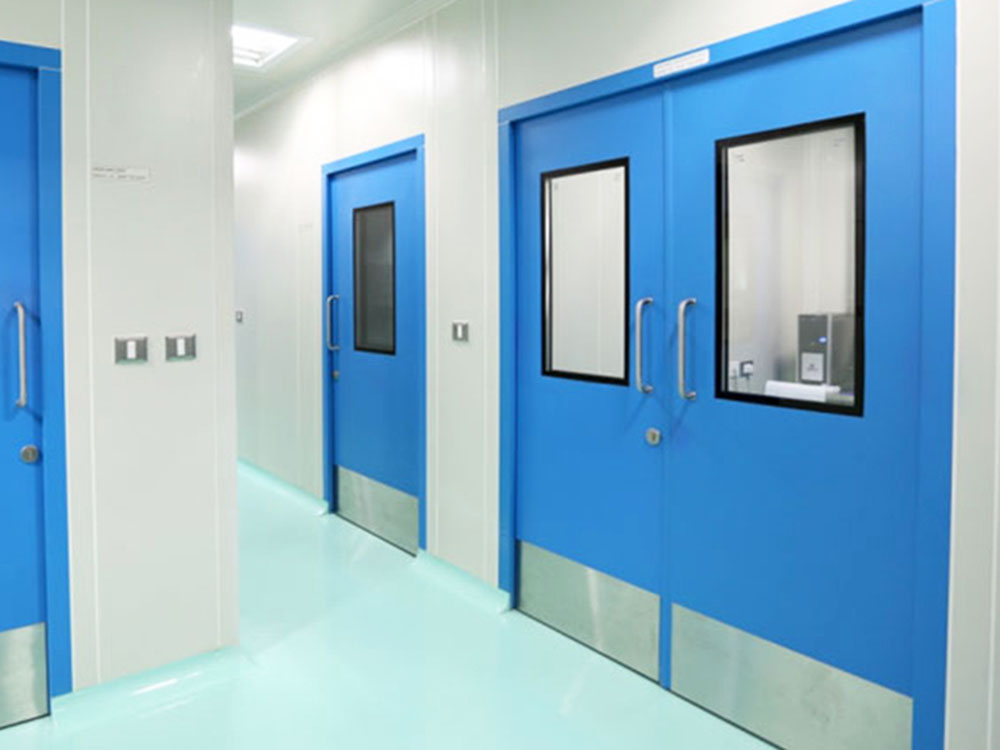
A cleanroom keeps its classification by holding positive pressure against the outside. Every time a door opens, that pressure leaks, and unfiltered air has a path in. A slow door turns a brief pass-through into a measurable pressure loss, and in a GMP or ISO-classified room that can mean a failed audit rather than a draft.
A high-speed door closes before the room loses its differential. The cleanroom variants use non-porous curtain material and stainless tracks so the door can be washed without leaving places for particles or bacteria to collect. In these rooms the speed and the material are one specification, not two options.
Logistics and Distribution Centers
In a distribution center the door is a traffic signal. When it opens too slowly, forklifts queue, and the queue is the same every shift. The cost is not energy — it is throughput, paid in operator minutes and idling equipment.
A high-speed door opens fast enough to let a forklift keep moving without a full stop. Over a shift of constant traffic, those saved seconds compound into fewer lost minutes and a smoother flow between zones. In a busy DC the door is production equipment, and it should be specced that way.
Loading Docks
An exterior loading dock is the worst case for a door: it cycles constantly and faces wind, rain, and temperature swings. A fabric curtain that works fine indoors gets pushed around by weather, and every gust through the opening is energy lost and a comfort or safety problem on the dock.
Rigid spiral high-speed doors are built for this. Their interlocking panels handle wind up to Class 5 — roughly 12 on the Beaufort scale — and they pair with a dock seal or shelter for the weather. That is why exterior docks default to a rigid door rather than a light PVC curtain.

Automotive and Manufacturing
On an assembly line a slow door becomes a bottleneck between two stations, and every lost second at the opening ripples into cycle time. In paint shops and welding areas the door has a second job: keeping dust, fumes, and overspray on the correct side of the wall.
High-speed doors keep material flow continuous and help contain the atmosphere around the process. The payoff is a line that does not wait for a door and a work environment that stays cleaner and safer for the people on it.
When a High-Speed Door Is Not the Right Choice
A high-speed door is not the answer for every opening, and the honest suppliers will say so. If the door cycles a few times a day, the extra cost buys you nothing — a standard sectional door with a thick PU foam panel does the same job for less and lasts longer.
The rule is simple: spend on a high-speed door only where traffic frequency justifies it. A high-speed door on an opening used three times a day is a feature you paid for and never use. The same budget on a busy cold-chain opening is a tool that pays for itself.
How to Choose the Right High-Speed Door
Start with the environment, then the duty cycle. An interior door between two zones has different wind and washdown needs than an exterior door facing weather, and a high-cycle opening needs a motor rated for constant cycling, not occasional use. The type follows from those two answers.
| Type | Best for | Key limitation |
|---|---|---|
| PVC roll-up | Interior traffic, cost-sensitive openings | Low insulation, low security |
| Spiral (rigid) | Exterior walls, high wind, security | Higher cost |
| Cleanroom | GMP/ISO rooms, washdown areas | Material spec critical |
| Cold storage | Freezers, cold-chain openings | Needs anti-icing features |
Finally, ask what happens if the door fails. If a failure stops production or breaks a cold chain, the door is critical equipment and should be specified accordingly. If you are still weighing a high-speed door against a sectional door, that comparison sorts the trade-offs. Whatever the choice, the door should carry CE marking to EN 13241, the product standard for industrial doors and gates.
Get a high-speed door matched to your duty cycle, not a one-size-fits-all product
RAX manufactures high-speed doors to the opening size, cycle rate, environment, and wind load you actually run. Tell us where the door goes and how often it cycles, and we will recommend the right curtain, motor, and controls.
FAQ
What is the typical opening speed of a high-speed door?
Most high-speed doors open at 0.8 to 2.5 m/s. The right speed depends on traffic and safety requirements rather than chasing the highest number — a slower door with the correct duty cycle often lasts longer than a fast one pushed past its rating.
Are high-speed doors only for cold storage?
No. Cold storage is one common application, but high-speed doors are also used in food processing, cleanrooms, logistics, loading docks, and automotive or manufacturing facilities where the opening cycles frequently.
Do high-speed doors provide good insulation?
Flexible PVC high-speed doors provide less insulation than a thick sectional door. If insulation is the top priority and traffic is low, a sectional door with a PU foam panel is usually the better choice. High-speed doors earn their value through speed and reduced air exchange, not their R-value.
How do I know if I need a high-speed door or a sectional door?
Count the cycles and weigh the priorities. High traffic with temperature or pressure control points to a high-speed door. Low traffic with insulation and security as the priority points to a sectional door. Many facilities use both.