
The motor is the most over-rated part of a compact door project. In a properly built door, the springs lift the curtain and the motor only turns a balanced drum. That is why a motor for compact industrial door projects is chosen by weight, space, and cycle count long before anyone compares brands.
Once the size is right, it is worth reading what the drive actually buys you: six advantages of the motor of an industrial door.
We build these doors from a factory in Hebei, and we have shipped to more than 70 countries. The pattern below repeats on almost every small workshop and storefront job. Work through it in order and the motor choice usually makes itself.
Start With Door Weight and Spring Balance
Weight drives everything else. A steel curtain rolled from 0.8 mm strip is a different load from a 1.5 mm insulated one, and width multiplies the difference. Ask the door supplier for the curtain weight in kilograms before you talk about motors at all.

Estimate the Curtain Weight
If you inherit an existing door, weigh one slat on a bathroom scale and count the slats. Add the bottom rail, which is usually the heaviest single part. The total rarely lands where a buyer guesses, and the guess is what kills motors.
Check the Spring Balance First
Torsion springs do the real lifting, and a balanced curtain should hold still when stopped halfway. If it runs down, the motor will fight the spring on every cycle. That mismatch shows up as slipping, heat, and eventually gearbox damage, which is the most common failure chain we see on returned parts. A quality spring set is rated for tens of thousands of cycles; ours are specified to at least 30,000. Fix the balance before you size the motor, or the new motor pays for the old springs.
Torque Margin and the 20 Percent Rule
The basic calculation fits on a sticky note. Torque in newton metres equals curtain weight in kilograms multiplied by the barrel radius in metres. A 50 kg curtain on a 100 mm barrel works out to roughly 2.5 Nm before friction.
- Step 1: Confirm the curtain weight in kilograms.
- Step 2: Measure the barrel radius, not the shaft diameter.
- Step 3: Multiply weight by radius for the base torque.
- Step 4: Add about 20 percent for guide friction and wind pressure.
That 20 percent margin is the difference between a motor that idles through its work and one that runs at its limit every single cycle. For any motor for compact industrial door installations, this margin is where cheap quotes quietly cut corners. Buying a motor at the theoretical minimum is like buying a pickup truck based on its empty fuel range. The day you load it, the maths stops working.
Warning: sizing to the calculated minimum leaves nothing for dust in the guides, a stiff bottom seal, or wind load on the curtain. Motors sized with margin run cooler and last longer.
Tubular Motor or Compact External Motor
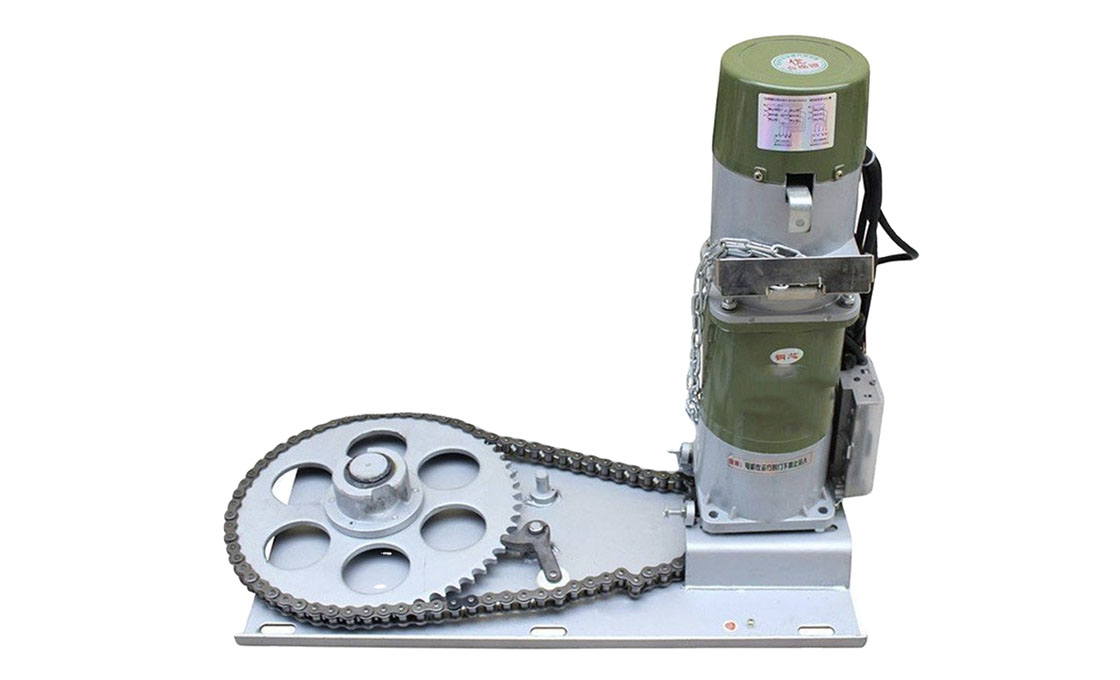
A tubular motor hides inside the barrel. It suits lighter curtains, keeps the headbox slim, and needs no side room beyond the drive end. An external geared motor mounts beside the barrel and trades bulk for higher torque and a heavier duty rating.
Our own rule is blunt: measure the headbox and the electricity supply before you discuss brands. A compact sectional door package, for example, pairs low-headroom track hardware with a side-mounted operator, and the geometry decides the fit. The same logic separates these packages from chain-driven shutter motors, which we compare in a separate guide to chain shutter door motor types. The drive type is an installation decision first and a catalogue decision second.
Installation Space: Shaft Diameter and Headbox Size
Compact sites run out of room above the opening before they run out of budget. A tubular motor needs a barrel with enough inner diameter to swallow it. Every extra wrap of curtain on the barrel then raises both the torque demand and the coil diameter.
The coil is the part people forget. A curtain that clears the lintel when closed can still foul a shallow headbox when fully open, because the wound coil is fatter than the closed stack. Confirm the headbox depth against the coil diameter at the top of travel. Low-headroom sectional hardware can bring the lintel clearance down to around 11 inches, but only when the tracks and shaft were planned for it.

Measure the Shaft and the Headbox
Record the shaft diameter, the headbox depth, and the distance from the shaft centre to the wall. Bring those three numbers to the motor conversation. A motor that cannot physically enter the barrel is not a candidate, whatever its spec sheet says.
Manual Override Needs Room Too
On one refit job, the headbox measured fine until someone swung the manual override crank. It hit the wall every time. Leave an arc of clear space for the crank or chain, and check it during the site survey, not during commissioning.
Single-Phase Supply and What It Rules Out
Small shops and workshops usually have a single-phase supply, and most shutter motors are offered at 110, 220, 230, or 380 volts with three-phase options for larger loads. A motor for compact industrial door sites rarely needs more than single-phase, but the supply still draws its own line. A three-phase geared motor starts more smoothly under heavy torque, so as curtains get wider and heavier, three-phase becomes the practical default.
Running a big motor on a long extension lead is its own trap: voltage sag under load adds heat, and heat is what kills windings. Give the motor its own fused supply and short, properly sized cable runs. UK safety guidance on work equipment is a useful reference for isolation and maintenance routines.
Heat Protection and Duty Cycle
Four things cook small motors: undersized torque, a duty cycle beyond the rating, friction in the guides, and poor ventilation around the headbox. Thermal protection answers the first three by cutting power before the windings melt, which is why the door stops halfway and refuses to move.
Troubleshooting guides from tubular motor makers note a useful fingerprint: if the motor restarts after 15 to 30 minutes, thermal protection was the trigger. A bakery we worked with cycled their shutter a dozen times through the morning rush and hit exactly that wall. The fix was not a bigger motor; it was a repair to a binding guide that had doubled the load. Duty cycle is a rating, not a suggestion, so count your honest cycles per hour before ordering.

Protection ratings belong in the same conversation. Our operators are sealed to IP65 against dust and wash-down water, and the motor warranty runs three years, five for servo units. A rating on paper only holds if the motor can shed the heat its duty creates.
Matching Motor Size to Door Size and Daily Cycles
Choosing a motor for compact industrial door sizes comes down to three inputs used together: curtain weight, available space, and honest cycle count. The table below is how we sort enquiries at first contact. It is deliberately qualitative, because the final number always comes from the weight calculation above.
| Curtain weight | Cycles per day | Typical drive | Supply | Watch point |
|---|---|---|---|---|
| Light (storefront) | Under 20 | Tubular | Single-phase | Spring balance still matters |
| Light to medium | 20 to 60 | Tubular, high duty grade | Single-phase | Check duty rating in writing |
| Medium (small warehouse) | 60 to 150 | Compact external geared | Single- or three-phase | Headbox depth and override arc |
| Heavy or wide | 150 plus | External geared, three-phase | Three-phase | Dedicated supply, thermal headroom |
When the row points to a tubular drive, our roller shutter tubular motor range covers the light and medium bands with manual override options. When it points to a side-mounted operator on a low-headroom sectional door, the geometry section above is the part to re-read. Either way, the weight, the space, and the cycle count decided the outcome before the model number did.
For the wider picture, work through the seven functional features of an industrial door motor before you size a compact unit.
Frequently Asked Questions
What size motor do I need for a roller shutter door?
Multiply curtain weight in kilograms by the barrel radius in metres, then add about 20 percent for friction and wind. A 50 kg curtain on a 0.05 m radius needs roughly 3 Nm.
Why does my shutter motor stop halfway and restart later?
That is thermal protection cutting in. If the motor restarts after 15 to 30 minutes, heat was the trigger. Look for friction, low voltage, or a duty cycle above the rating.
Can I run a compact industrial door on single-phase power?
Yes for light and medium curtains. As weight and cycle counts rise, three-phase becomes the practical choice because it starts more smoothly under heavy torque.
How often should the spring balance be checked?
Check it at every service interval and after any impact. Disconnect within safety rules and the curtain should hold position when stopped halfway. A sinking curtain means the motor is lifting, not turning.
Does a bigger motor fix a noisy shutter?
Usually not. Buzzing and straining point to a spring balance problem or friction in the guides. A larger motor just masks the fault while burning its duty margin faster.