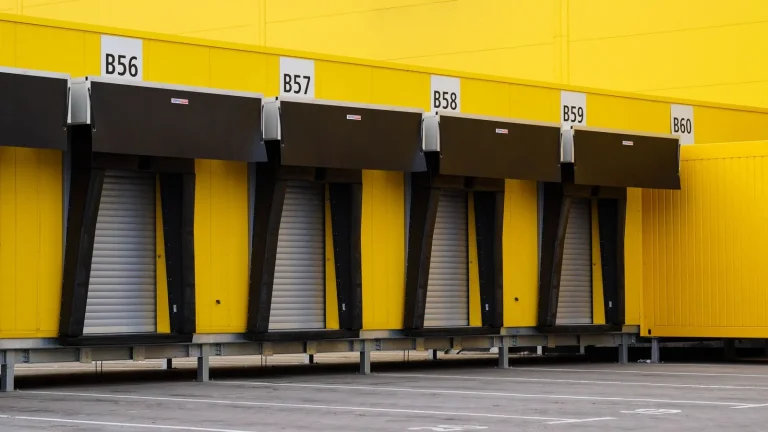
On the nameplate of most door operators there is a small line that buyers photograph and never read: S3, 30%. A procurement manager we worked with sent us that photo during commissioning, proud that his new motor was finally in place. Eight months later the same door was stopping halfway through the morning rush, and his team blamed the hardware. The label had predicted it all along. S3 30% licenses the motor in industrial doors of this kind to run three minutes and rest seven, and his dock cycles every two minutes at peak.
How those parts translate into buyer value is ranked in our guide to six advantages of the motor of an industrial door.
That gap between what a motor is and what buyers assume it is costs real money every week. This page defines the motor in industrial doors plainly. We cover the parts inside the housing, the nameplate numbers, torque matching, and the failure signs worth early attention. We build these operators at our factory in Hebei, and most of what follows applies to any brand you may be evaluating.
One Motor Does One Job Inside a Bigger Machine
Strip the marketing away and a door motor is an energy converter. It takes electrical input and produces rotating torque at its output shaft, nothing more. That is the whole job, and the motor in industrial doors is best judged on how well it holds that narrow brief. Everything else that makes a door open and stop on command lives in the surrounding machine.
Suppliers often say “motor” when they actually mean the operator, so the vocabulary needs sorting early. A complete operator bundles the motor with a gearbox, limit switches, a brake, and a control board into one certified unit. Standards such as EN 12453 regulate the operator as a whole, which is why our own door-operators line ships as matched assemblies rather than bare motors. When you compare quotes, confirm which of the two you are actually being priced on.
One more boundary matters. In a well designed industrial door, the counterbalance springs, not the motor, hold the weight of the curtain. Torsion springs on sectional doors are rated for at least 30,000 cycles precisely because they do the heavy holding every single cycle. The motor supplies torque for the residual imbalance, friction, and acceleration, and reading it any other way leads to chronic overheating.
For the wider machine view, including sensors and control logic, see our guide to how automatic door openers work and their main types.
What Sits Inside the Housing
Open a door motor and you find six things that together explain almost every behavior on site. The stator is the stationary winding package that creates a rotating magnetic field. The rotor spins inside that field and carries the shaft. Everything else in the housing exists to tame, measure, or protect that rotation.
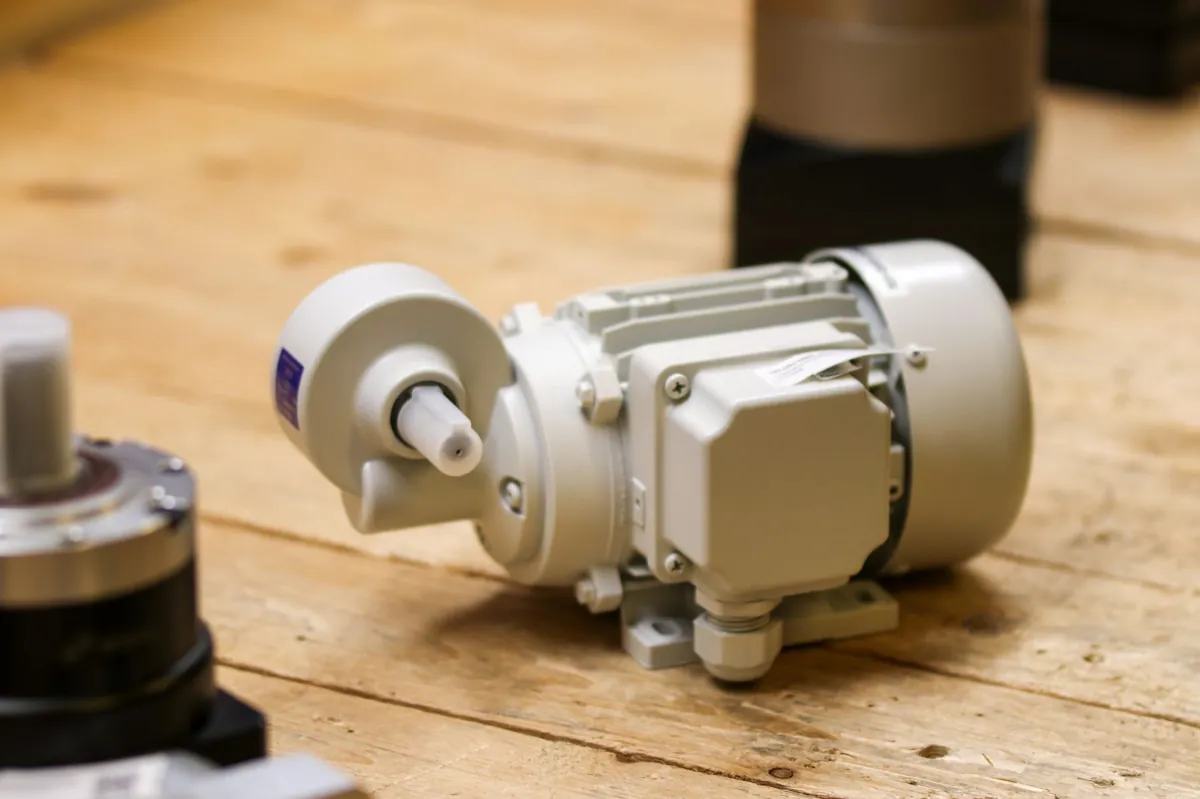
The gearbox is the quiet hero. A rotor spinning at thousands of revolutions per minute has speed to spare and torque to lack, so a reduction stage converts surplus speed into usable force. After reduction, the drum typically turns at 12 to 20 RPM, which translates to a curtain speed of roughly 8 to 16 centimeters per second. Gear wear shows up as new noise long before it shows up as failure, which makes unusual sounds worth investigating.
Three quieter components complete the picture. Limit switches tell the operator where the upper and lower stopping points are, and drifting limits are why a door suddenly refuses to close fully. A brake holds the curtain still against wind and gravity when power is cut. A thermal sensor disconnects the windings near roughly 120 degrees Celsius, which is protection rather than defect. The motor in industrial doors is therefore a guarded system, and most roller shutter operators add a manual override chain for hand cranking.
Voltage completes the nameplate check. A single phase supply caps the practical motor size and pushes cycle heavy sites toward three phase. Low voltage control circuits keep the push buttons safe to touch. None of these lines is optional reading, because each one narrows the list of operators that will survive on your door.
Three Drive Types in One Paragraph Each
Tubular motors slide inside the door barrel and suit lighter curtains and moderate cycle counts. External geared motors mount beside the shaft and trade visibility for lifting capacity and service access. Servo drives add closed loop control for precise positioning and high cycle duty. Their electronics watch load and temperature continuously, which is why we warrant them five years against three for standard units.
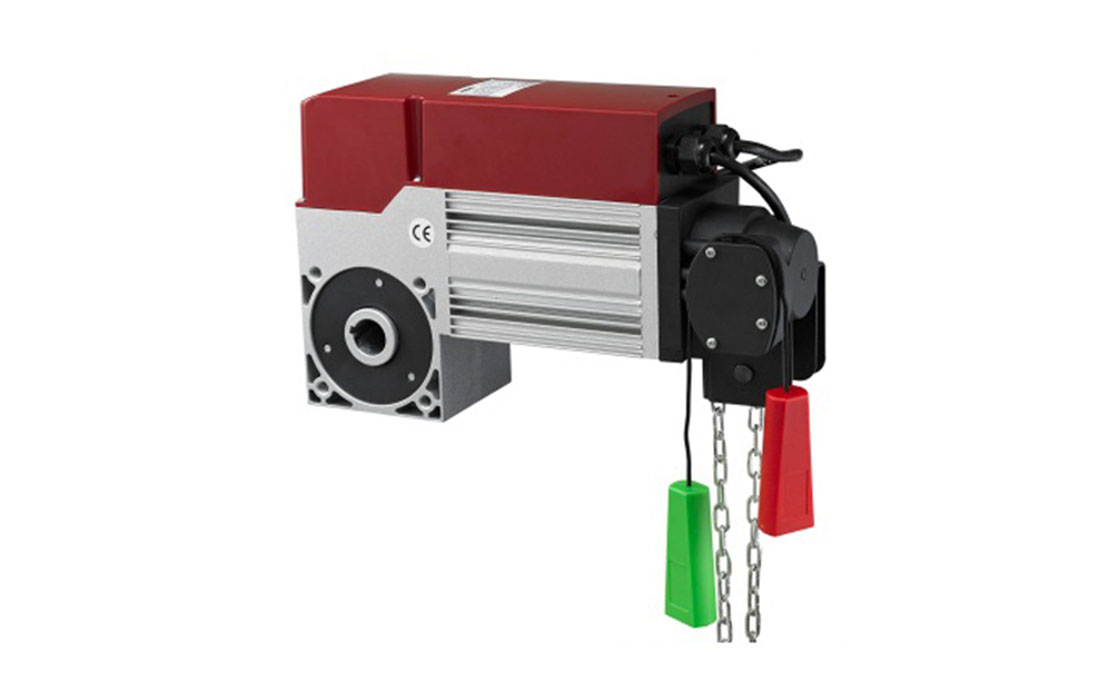
Choosing between these is a selection question, not a definition question, so we keep this section deliberately short. The compact door case, where headroom decides between tubular and external mounting, has its own guide on choosing a motor for a compact industrial door. For chain drive shutters, our comparison of chain shutter door motor types walks the full typology. The figure below shows the shape of an externally geared sectional door operator for reference.
How to Read the Nameplate
The nameplate is the motor’s contract, and most buying mistakes start with reading only one line of it. Torque in newton meters states what the output can turn. Power in watts states how fast energy flows, and it is routinely mistaken for lifting capacity. We consider that the most expensive misreading in the trade, because watts never tell you whether the drum can turn. The remaining lines describe duty, protection, and supply.
| Nameplate line | What it states | How to use it |
|---|---|---|
| Torque (Nm) | Turning force at the output shaft | Tubular units run 6 to over 100 Nm; above roughly 120 Nm you are in external drive territory |
| Power (W) | Electrical energy drawn per second | Compare only within the same drive class, never across tubular and external units |
| Duty cycle (S1–S10) | IEC 60034-1 duty rating | S1 means continuous; S3 means intermittent cycles with a stated percentage |
| IP rating | Dust and water protection | Our operators specify IP65 for dust and washdown exposure |
| Voltage and phase | Supply the winding expects | Match the building; single phase limits practical motor size |
Read the duty line with particular care, because it is written for a thermodynamics ledger rather than for humans. Think of the S3 rating as a napkin allowance for the motor in industrial doors. Stay inside the percentage and heat dissipates between cycles; run past it and the balance lands in the windings. A warehouse that cycles a door every two minutes during peak hours needs that percentage checked before the brand name is even discussed.
Matching Torque to the Door
Torque sizing has a core formula used across the industry. Required torque in newton meters equals curtain weight in kilograms, times 9.81, times the maximum winding radius in meters, times a safety factor. The safety factor runs from about 1.3 for light duty to 1.5 for commercial high cycle doors. Galvanized steel curtain slats weigh roughly 8 to 12 kilograms per square meter, which is how door weight gets estimated in the first place.
Here is the arithmetic on a common mid size shutter. Take a 300 kilogram galvanized steel curtain on a drum with a 0.15 meter radius, and apply a 1.3 safety factor. The result is 300 times 9.81 times 0.15 times 1.3, about 575 Nm. No tubular motor reaches that comfortably, so the calculation itself points you to an external geared unit. If the project needs one, our roller shutter opener range covers this drive class.
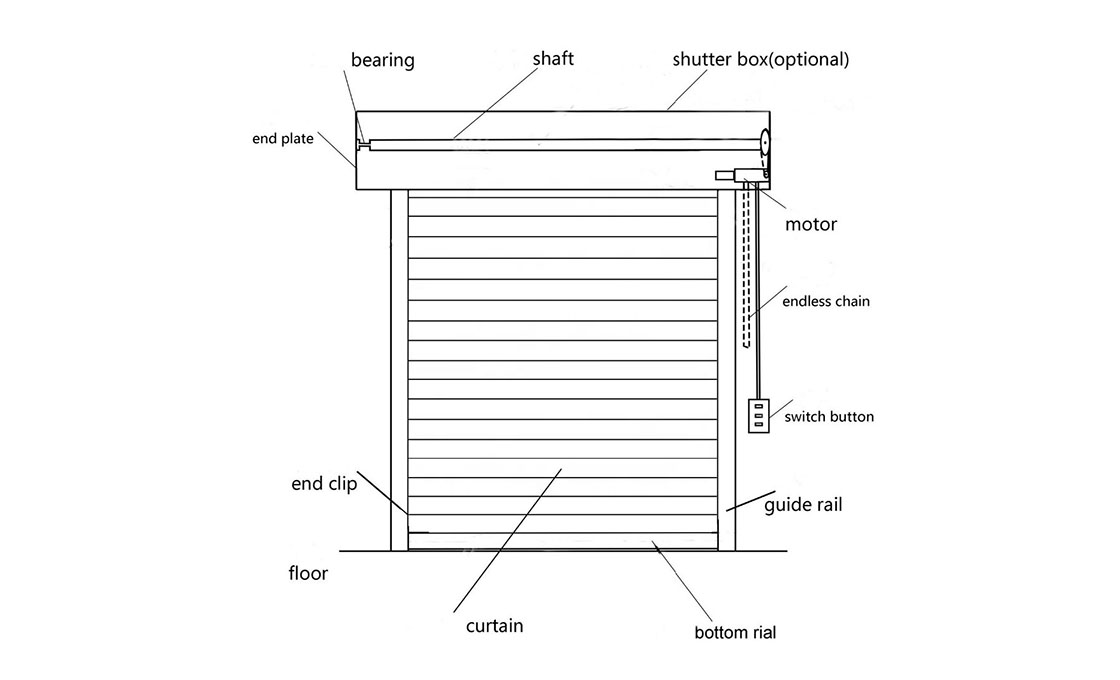
Two corrections refine the raw number. A curtain winds onto itself, so the effective radius grows 40 to 80 percent beyond the bare drum as the door opens, and the demand rises with it. Good spring balance cuts the requirement by 30 to 50 percent, which is why spring condition belongs in every motor conversation. The drawing below shows the drum and curtain geometry these factors describe.
Heat Is the Budget and Duty Cycle Is the Ledger
Every motor cycle deposits a little heat in the windings, and every pause removes some. Duty cycle ratings simply formalize that budget, and thermal protection is the enforcement officer. When winding temperature nears 120 degrees Celsius, the sensor trips and the motor stops, often halfway through a cycle that suddenly looks like a breakdown.
A cold chain example shows the stakes. One frozen food plant we supplied ran its morning peak on two minute pallet movements, and no S3 30% unit was licensed to sustain that pace. The door did not need a bigger brand, it needed an operator specified for the actual cycle count. That is also why our motor warranty runs three years and the servo class five. Sustained thermal stress is the main difference between a motor that ages and one that endures.
The practical warning is simple. A thermal cutout that trips repeatedly is not a reset problem, it is a specification debt being repaid with downtime. Cooling and restarting the same undersized unit every morning only moves the failure date closer.
Four Failure Signs Worth Reading Early
First, a humming motor that does not turn usually points to the starting capacitor. It is a low cost component that ages before the windings do. Swap the cheap part before condemning the whole unit, because a capacitor costs a fraction of a replacement operator. Second, a door that stops mid cycle suggests either a thermal trip or a curtain binding in its guides. Check that the curtain slides freely by hand, and the cause is usually settled.
Third, drifted end positions, where the door no longer closes flush, indicate limit switches that need resetting rather than a dying motor. Fourth, a drum too hot to rest a hand on for two seconds, or repeating trips, signal a motor running past its specification. As the UK Health and Safety Executive notes in its powered gates guidance, powered doors carry legal maintenance duties for the responsible party. Recurring symptoms belong in the log, not in memory. In the UK, resetting misadjusted limits is a service call priced around 95 to 180 pounds, small money beside a full replacement.
Before ordering, score any quote against the seven functional features of an industrial door motor — torque margin, limits, duty, safety, release, soft start and sealing.
Frequently Asked Questions
How long does the motor in industrial doors usually last?
No honest universal number exists, because duty and heat decide. Well specified units under correct duty commonly serve past their warranty, which typically runs three years, with servo classes warrantied to five.
Can the motor lift the door without springs?
Technically yes for small shutters, practically no for industrial doors. Springs cut the torque requirement by 30 to 50 percent, and removing them forces chronic overload and thermal trips.
What IP rating should an industrial door motor have?
Match the environment. Dusty workshops and washdown areas justify IP65, which our operators carry, while protected interiors can step down. Exterior doors need water jet protection.
What does S3 mean on a door motor label?
S3 is an IEC duty rating for intermittent cycles, stated with a percentage. S3 30% licenses roughly three minutes of running followed by seven minutes of cooling at rated load.
Tubular or external geared motor for a roller shutter?
Follow weight, radius, and cycles. Light curtains with modest cycles suit tubular units; heavy curtains, large drums, or frequent cycling call for external geared drives as the torque math shows.