






The floor plan flatters every opening. Two doors get drawn with the same rectangle and the same arrow, one between the production hall and the dispatch corridor, one in the external wall where the trucks queue. On paper both are “an opening that closes”. In operation, one wants to move a pallet every ninety seconds and the other wants to hold the heat in all night.
We build both families — twenty-two high speed door models and twenty sectional models leave the same factory floor — so this is not a pitch for either side. The high speed door vs sectional door question is really five accounts: speed, heat, repair, price and placement. Score each opening against them and the decision makes itself.
One Opening, Two Different Jobs
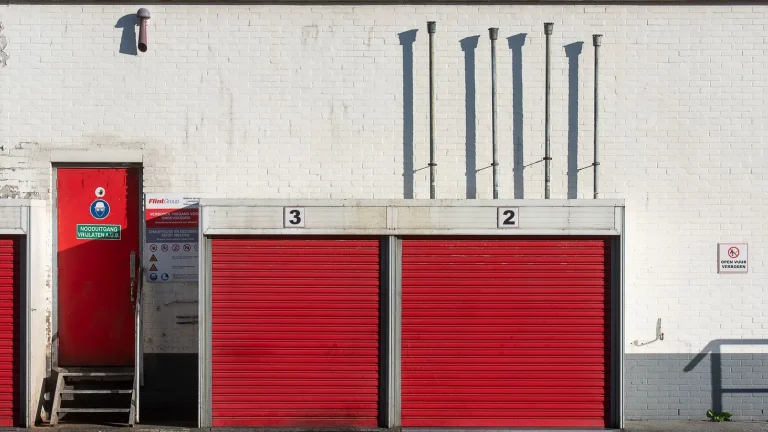
A sectional door is a stack of hinged insulated panels that lift vertically, then run flat along ceiling tracks. It is engineered to close a wall, where weight, rigidity and seal area are the point. A high speed door is a light PVC curtain or a rigid spiral slat roll built to clear the same hole in seconds, hundreds of times a day. From a forklift seat they look like cousins; in the specification they are different tools. The verdict also changes on wide elevations, as covered in high speed folding doors for large openings.
Speed is the headline account, and the gap is not close. Doors in the standard operator class run 0.2 to 0.3 m/s, so one full open-close sweep stretches over fifteen to thirty seconds. One commercial installer’s published data puts a standard sectional at 12 to 15 seconds. A high speed door opens at 0.8 to 2.5 m/s in our build range, with flexible PVC curtains at the lower end and self-repairing zipper models above 1 m/s. That is roughly a five-fold gap in leaf speed, and matching door speed to traffic is its own selection discipline once you know the cycles per hour.

Throughput, not velocity, decides what that gap is worth. One US manufacturer’s published definitions treat a hundred cycles per day as the entry point for a high-performance door. Below that class of duty most of a high speed door’s capability sits idle. Our rule is blunt: the premium only converts into savings when the traffic counter proves it.
Dwell time is the quieter lever. Air moves through an open industrial doorway at roughly three feet per second. A tall opening that spends half a minute in transit exchanges a great deal of conditioned air. A leaf that clears in two or three seconds taxes the heating system far less on every single pass. Over a winter of shifts, the slow door pays that breathing tax on every cycle.
On paper the paperwork matches: both product lines carry CE marking under EN 13241 and their operators are certified to EN 12453, so compliance does not separate the two. Duty does. The working differences fit into five lines:
| Account | High speed door | Sectional door |
|---|---|---|
| Job | Traffic separation, flow | Building closure, envelope |
| Opening speed | 0.8-2.5 m/s | 0.2-0.3 m/s operator class |
| One cycle | 2-5 seconds | 15-30 seconds |
| Thermal direction | U 1.5-2.0 insulated curtain | U ~0.5, toward 0.33 |
| After a strike | Curtain re-feeds itself | Panel swap, part-level |
Insulation and Sealing: The Thermal Trade
Heat reads the two doors an order of magnitude apart. A sectional door earns its thermal rating from the panel: two steel skins around a core of 40 to 50 mm CFC-free PU. Across the finished leaf that works out near 0.5 W/m²K, and our own build is engineered down toward 0.33 W/m²K. The arithmetic behind that number is unpacked in our sectional door insulation breakdown. No curtain matches it.
A single-skin high speed curtain is honest about being a thermal bridge. Our published comparison puts insulated high speed doors at U-values of 1.5 to 2.0 through dual-skin PVC curtains with thermal breaks. Insulated aluminum rigid models reach as low as 0.8 to 1.2 — better than a wall of strip curtains, still not a sectional. The high speed door vs sectional door thermal account is therefore a ratio of roughly three, and the curtain’s part is defending the interior door, not the facade. For a deeper dive, see high speed.
Sealing is where the comparison tightens, because insulation only pays through the perimeter. One US manufacturer’s guide cites IECC and ASHRAE 90.1 infiltration limits of 1.3 cfm per square foot of door area for high speed doors. That is a code-level acknowledgment that fast, tight curtains belong in the building envelope conversation. Speed alone does not earn that; the curtain must seal while it moves.
The same guide cites ASHRAE 189.1, which reserves a U-factor provision of 1.2 BTU/hr·°F·ft² for doors that will average seventy-five cycles per day or more. Only machinery in near-constant motion lives in that duty class; a leaf that lifts twice an hour never will.
The two sealing paths differ in geometry. A sectional closes through perimeter gaskets and face-to-face panel joints that compress as the door seats. A high speed curtain seals through tension against its side channels, plus brush or soft-edge trims and a bottom member. Both sealing paths hold only while the hardware does. Let a guide wear, a gasket crush or a curtain go slack, and the U-value printed on the datasheet stops describing the door in the wall. Related reading: sectional door bottom seal covers this in detail.
Before comparing U-values on any door, walk the closed opening on a windy day. The draft around the guides, not the foam in the panel, decides what the insulation is worth.
Impact Repair and Maintenance Profiles
A forklift, sooner or later, writes the real maintenance budget. A strike on a self-repairing zipper curtain re-feeds the fabric out of its side channels in seconds, without tools and often without a work order. That is why every component in our high speed doors range is designed around reset-and-resume duty. The damaged state heals itself and the shift continues.
A sectional strike is a slower, cheaper kind of event. The hit usually ruins one panel, which is unbolted and replaced at part level while the rest of the door waits on the shelf. What it never does is fix itself, so the cost is downtime plus a panel, not just a panel. High-traffic interiors feel that difference every time contact is frequent, and our published comparisons treat it as a deciding line for busy interior crossings. The high speed door vs sectional door trade in miniature: one repair is automatic, the other is scheduled.

The parts shelves differ in kind, not in depth. Both families are component-level products with full spares support, which is the practical advantage of buying from a manufacturer:
- High speed door: curtain, zipper edge or spiral slats, side channels and guides, radar or light-curtain sensors, anti-pinch safety edge, drive unit.
- Sectional door: torsion springs, lifting cables, cable drums, hinges, rollers, vertical and horizontal tracks.
Upkeep follows the same split. The high speed door wants frequent light attention — sensor alignment, channel cleanliness, curtain tension — because it is an automated machine running many cycles. Our own build notes specify torsion springs from thirty thousand cycles upward, because a spring spends its life one opening at a time. The sectional wants a slower mechanical rhythm of spring, cable and hardware checks, which our sectional door hardware maintenance schedule lays out month by month.
Treat every impact as a stop-work order: isolate the door and check it by hand before anyone runs it again. A curtain hanging out of its channels, or a spring that broke while the door moved, turns a panel bill into an injury report.
What Each Door Actually Costs
The counter prices are not close, and they are not meant to be. Our published cost comparison puts high speed doors between $5,000 and $15,000 installed for equivalent openings against $2,500 to $6,000 for conventional doors — a two-to-three-times initial premium. As a rough scale reference, one European manufacturer publishes a €2,000 to €6,000 range for a typical powered industrial door, before any high speed premium is applied. Whichever door wins the comparison, the high speed door air curtain combo guide covers the seconds each cycle stays open.
The premium buys seconds back, and the account is auditable month by month. In high-traffic freezer applications the same comparison finds the investment repaid within 18 to 36 months through reduced air exchange. The same manufacturer’s guide also claims ten percent more energy savings than conventionally operating insulated doors. Those numbers belong to specific duty levels; they do not transfer to a quiet warehouse corner.
So the honest pricing rule cuts both ways. Pay the premium where the counter is busy and the air is paid for, and keep the sectional where cycles are few:
- Entry price: sectional mid-band, high speed door at a two-to-three-times premium for the same opening.
- Running savings: every avoided second of dwell time compounds through the heating bill in conditioned buildings.
- Consumables: zipper curtains and guides on one side, springs and cables on the other — price the spares with the door.
Lead time rarely breaks the tie between the two, and the clock is the same for both. Twelve days is the fastest dispatch for standard container loads, while a first production order leaves the works in twenty to thirty-five. Both doors arrive on the same truck and the same trade terms; only the duty profile decides which one is worth waiting for.
Which One Should You Choose, by Opening
Route the opening, not the building. An interior crossing between production and dispatch is the high speed door’s home ground: pallets every minute, and air you would rather not mix. The curtain resets itself after contact and clears the hole before the forklift slows down. So is any ante-chamber protecting a cold or clean zone, where speed is really a sealing strategy. The high speed door vs sectional door question there is settled by the cycle counter, not the price list.
An external wall opening under wind, weather and night security is the sectional’s brief: insulation, perimeter seal, rigidity and wind class all compound there. Where that same opening also sees constant traffic, our rigid spiral high speed doors carry insulation and security at speed. The deep-dive in our warehouse verdict on sectional versus rolling shutter doors covers how it competes against the curtain alternative. The high speed door vs sectional door pairing is not a ranking — it is a job description split along the wall line.
Most facilities end up running both, and that is the correct answer rather than a compromise. Insulated sectional doors close the external envelope; high speed doors shuttle the interior crossings in between. Our high speed door versus roller shutter comparison completes the same triangle from the curtain side, and the pattern holds: the outside door defends, the inside door flows.
A high speed door is not an upgrade to a sectional door. They are two different jobs on the same wall — pay for speed inside, pay for sealing outside.

- Interior high-frequency crossing, conditioned zones: high speed door, self-repairing curtain, sensors matched to forklift traffic.
- External logistics opening, security and weather: insulated sectional door, 40-50 mm PU, sealed perimeter, wind-rated where exposed.
- One facility, both duties: sectional doors on the envelope, high speed doors on the interior flow lines — buy by opening, not by building.
Frequently Asked Questions
Can a high speed door replace a sectional door?
Not on an external wall. A curtain cannot match a 40-50 mm PU panel on U-value, rigidity or wind class, and the premium buys nothing where cycles are low. Rigid insulated high speed models narrow the gap for sheltered, high-traffic exterior openings.
Do high speed doors insulate as well as sectional doors?
No. Insulated dual-skin PVC curtains reach U-values of 1.5 to 2.0 and rigid aluminum models 0.8 to 1.2, against roughly 0.5 W/m²K for an insulated sectional panel. Fast cycling, not foam, is their thermal argument.
What happens when a forklift hits each door type?
A zipper curtain re-feeds itself out of its side channels in seconds, without tools. A sectional strike usually costs one replacement panel plus the downtime while it is swapped. Whichever door took the hit, isolate it and inspect before the next run.
Why are high speed doors so much more expensive?
Servo drives, control systems, sensors and curtain hardware cost more than a spring-balanced panel set — a two-to-three-times premium installed. In high-traffic applications the avoided dwell time repays it, often within two to three years.
Can one facility use both door types?
Most should. Sectional doors close and insulate the external envelope; high speed doors run the interior crossings where traffic counts in hundreds of cycles per day. Buy by opening, not by building.