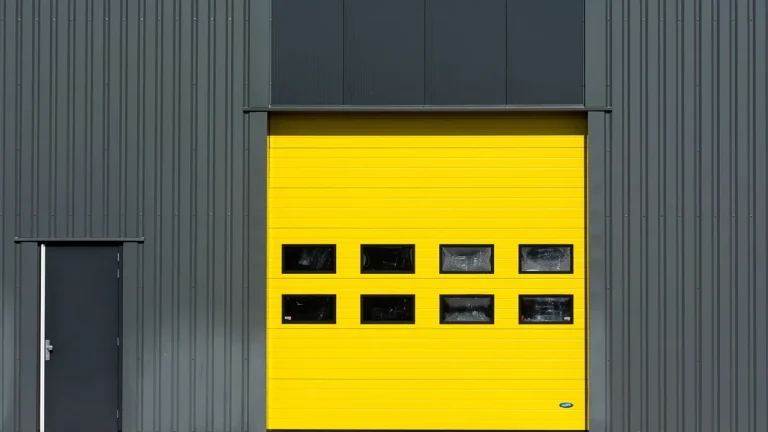
Every sectional door insulation quotation carries one line that most specification meetings skip: the U-value. The room debates price and lead time, while a figure like 0.33 W/m²K sits unexamined. Yet it describes exactly how fast the building loses heat through that opening. It also raises a fair question, because a number quoted without its measurement basis proves nothing on its own.
We manufacture sectional doors, and our advice is to treat that line as the most checkable claim on the page. A U-value is a rate, not a promise; it converts into watts and verifies against documents. This guide covers what the number means, where it comes from and when it deserves your money.
What a U-Value Actually Measures
Sectional door insulation is quantified by thermal transmittance, written as U and expressed in watts per square meter per kelvin of temperature difference. It states how much heat passes through one square meter of the closed door for every degree between the warm side and the cold side. Lower means slower heat loss, and slower is better.
The definition sounds abstract until you read it as a leak rate. A door with U 0.33 W/m²K passes one third of a watt through each square meter for each degree of difference. A poorly insulated surface can pass ten times that, so the same opening can differ enormously in heating demand.
One boundary matters here: a whole-door U-value covers more than the panel centre. It accounts for the joints between sections, the frame, the guides and the seals, all of which conduct heat faster than the foam core. Two quotations quoting the same panel number can behave very differently once the assembly is included.
R-Value Versus U-Value on Quotations
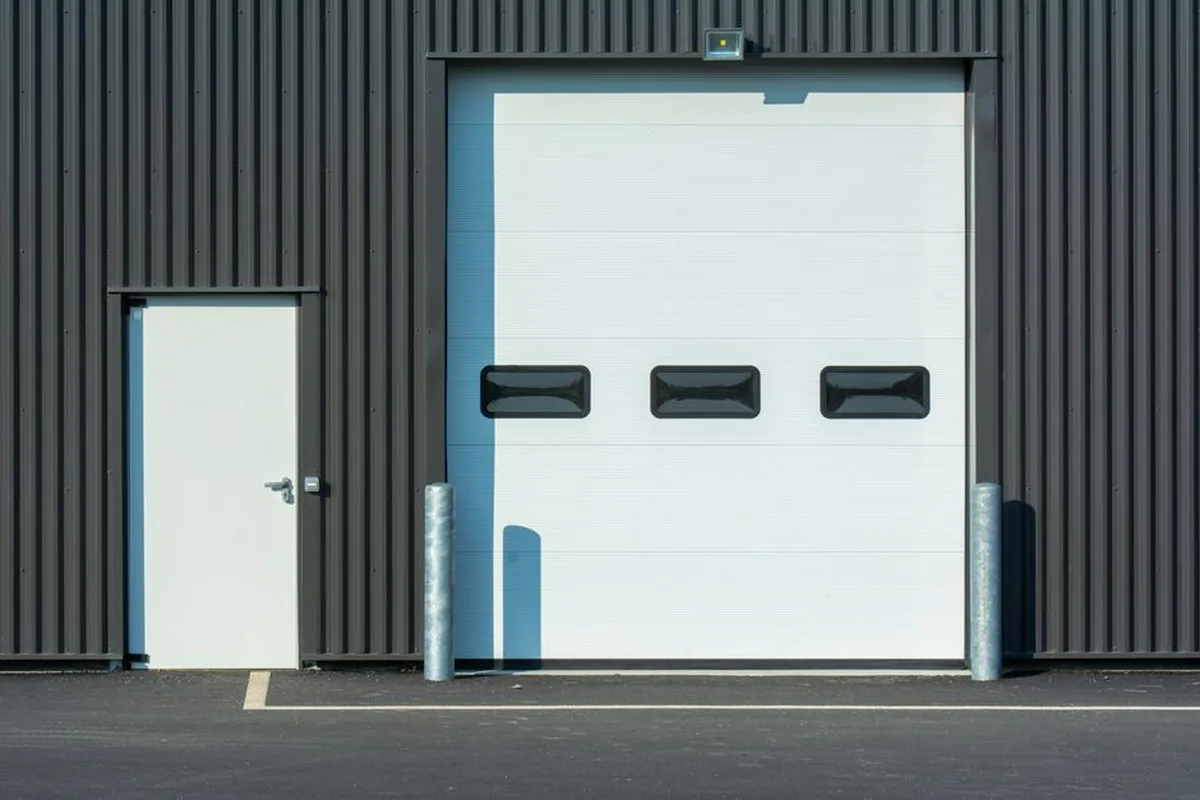
North American quotations usually lead with R-value, while European documents lead with U-value, and the two are reciprocals in consistent units: R equals one divided by U. The deeper difference is what each one rates. R-value describes a material layer in isolation, while U-value describes a finished assembly with every joint and edge included.
That difference is where sectional door insulation buyers lose money. A panel quoted by its centre R-value ignores the weakest paths, so a thick panel with poorly detailed joints can underperform a thinner, well-sealed door. Convert before comparing, and confirm whether each number describes the panel alone or the complete door.
Our own sectional panels carry a declared U-value of 0.33 W/m²K for the 40 to 50 mm PU foam construction. Converted on the same metric, that corresponds roughly to a centre-of-panel R near 3.0 m²K/W. The conversion is arithmetic, not a second test, so treat it as an orientation figure rather than a new claim.
How the Panel Structure Sets the Number
The 0.33 figure is not a coating or an accessory; it is manufactured into the panel. Our sectional sections are double-skinned, with galvanized steel faces from 0.4 to 1.5 mm bonded over a rigid polyurethane foam core, in thicknesses of 40 or 50 mm. The foam is the insulation, and the steel skins are its weather shield and structure.
In sectional door insulation, polyurethane earns its place because its closed-cell structure traps gas in millions of tiny pockets, so heat must crawl through by conduction. Foamed-in-place cores also fill the cavity completely and bond to the skins, which stiffens the leaf as a side effect. Joints and end caps get equal attention, because an uninsulated edge would short-circuit the core beside it.
Thickness is the buyer-facing variable. Moving from 40 mm to 50 mm adds core resistance, which is why the thicker option exists for heated buildings, while both remain practical for standard bays. The same core also carries a secondary acoustic benefit measured separately as a sound reduction rating, which we treat as a bonus rather than the design target.

Turning the U-Value Into Heating Costs
The conversion from specification to energy uses one formula: heat flow equals U times area times temperature difference. Take a 4 by 5 meter door, twenty square meters, holding a 20 K difference against an unheated bay. At U 0.33 W/m²K the steady conduction loss is about 130 watts, roughly two household light bulbs of continuous heat.
Swap in a minimally insulated single-skin surface and the arithmetic changes by an order of magnitude. Common uninsulated elements run on the order of U 5 to 6 W/m²K in standard engineering heat loss tables, so the same opening could shed over a kilowatt. Over a heating season, that difference funds real money.
Two honest qualifications belong next to any savings estimate. The formula counts conduction through the closed door only, so air exchanged during openings and leakage at worn seals sit on top of it. Full thermal benefit is therefore worth most on openings that stay closed for long stretches. The product range behind these numbers is our sectional door line, where panel options are matched to opening duty.

Condensation on an Insulated Sectional Door
Insulated panels fail in the field less often through heat loss than through water on the inside face. The mechanism is simple: moisture condenses whenever the inner surface temperature falls below the dew point of the room air. Drops then track down the panel onto stock and floor.
A low U-value is the first defence because it keeps the inner skin closer to room temperature. The remaining risk concentrates at thermal bridges, the spots where conduction bypasses the foam: panel joints, end caps, the guide rails and the bottom seal. Good detailing minimizes these paths, which is another reason the whole-door number matters more than the panel number.
The door also needs help from the building. Perimeter sealing keeps humid air out of the joints, and worn bottom seals are the most common leak we see; our bottom seal guide treats them as maintenance. Where moisture loads are high, dehumidification or ventilation does the last work that no panel can do.
When Insulation Pays and When It Does Not
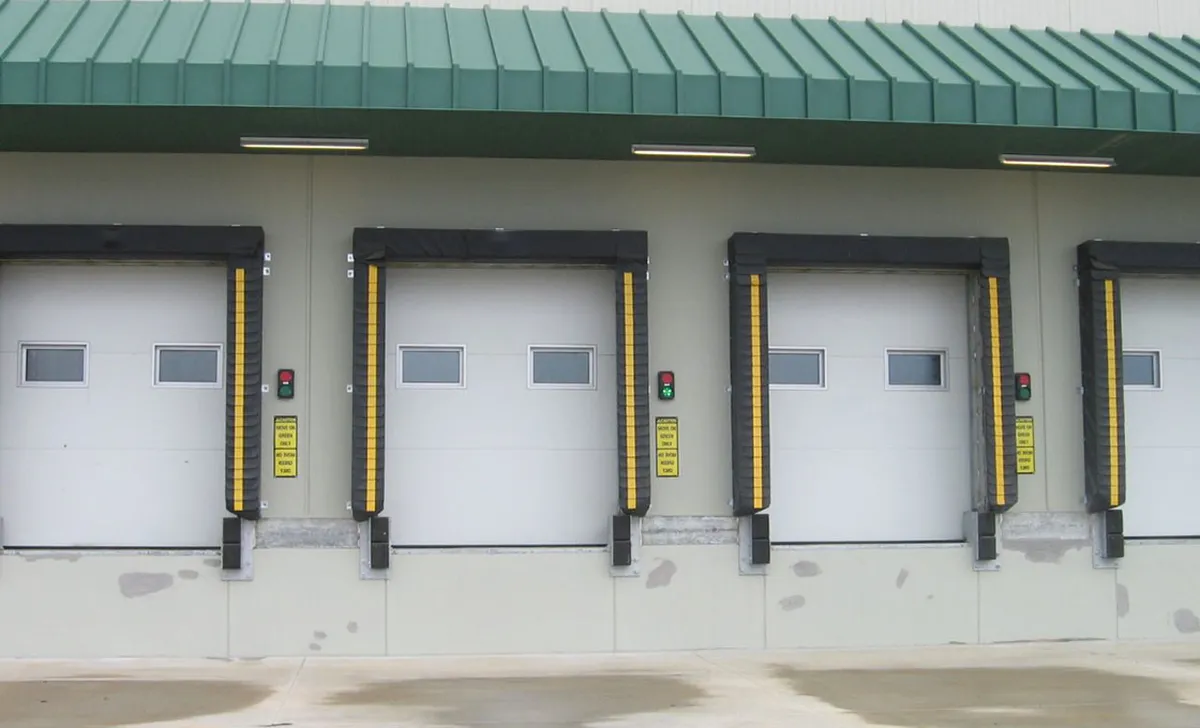
A higher specification is not automatically the better purchase, because insulation only earns its cost under the right conditions. Heated or cooled workspaces, cold storage and chilled preparation areas top the case, since every watt saved runs against a compressor or heater. Bays adjoining air-conditioned offices also qualify.
For an unheated, ventilated warehouse whose interior floats with the weather, the case weakens. Conduction matters less when both sides of the door share a climate, and the budget may serve better in seals, guides or controls. Deeper cold storage is its own discipline, covered in our cold storage sectional door guide.
Between those poles sits the common logistics bay, where the honest answer is duty-based. Long-closed openings in conditioned buildings justify the thicker panel; high-cycle transit bays justify standard panels with excellent seals. Decide from the temperature difference, the closed time and the value of the goods, not from the catalogue’s top row.
What to Verify Before Signing the Spec
Sectional door insulation becomes real at acceptance, so write the verification into the specification. First, fix the basis: state that the declared value covers the complete door, not the panel centre. Second, record the construction behind it, panel thickness of 40 or 50 mm and PU core, so substitution is detectable at delivery.
Third, demand the documents. Our shipments include the factory inspection report and the CE declaration with EN 13241 test evidence, so ask your supplier for equivalents. Fourth, read the door as one specification: thermal transmittance, wind class and spring life belong on the same page, as our wind resistance guide argues in detail.
The opinion we opened with closes here. A U-value is a rate of leakage: 0.33 W/m²K means the door passes about a third of a watt per square meter per degree. That is either a decisive saving or an unnecessary premium depending on your building. Convert the number and check its basis, and it stops being a decoration on the quotation.
Questions Buyers Ask About Sectional Door Insulation
Is a lower U-value always better?
Lower always means slower heat loss, but not always better value. The benefit scales with temperature difference, closed time and heating or cooling cost, so unheated ventilated buildings rarely recover the premium for the lowest figures.
What is the difference between U-value and R-value?
They are reciprocals in consistent units. R-value rates a material layer on its own, while U-value rates the complete assembly including joints, frame and seals, which makes the U-value the harder number to fake.
Does an insulated sectional door stop condensation?
It lowers the risk by keeping the inner skin warmer, but thermal bridges at joints, guides and the bottom seal remain. Sealing maintenance and indoor humidity control do the rest.
How much heating cost does a 0.33 W/m²K door save?
It depends on area, temperature difference and duty. A 20 m² door at 20 K loses about 130 watts by conduction, versus over a kilowatt for a comparable single-skin surface, before air exchange is counted.
Which should I choose, 40 mm or 50 mm PU panels?
The 50 mm core adds thermal resistance for heated or chilled spaces with long closed periods. For standard ventilated bays, 40 mm with high-quality seals is usually the balanced choice.
Do insulated panels also reduce noise?
Yes, as a secondary effect. The foam core damps sound and panels carry a separately rated sound reduction value, but acoustic performance should be specified through that rating, not assumed from the U-value.