A door schedule for a three-plant program landed on our sales desk last month. The same three columns were left blank on every line: opening speed, cleanliness class, and required cycle. The pharmaceutical line, the semiconductor fab and the medical device plant each needed a high speed door. Each needed a different one. The blank rows were not laziness; they were the exact decisions that decide whether the rooms hold their class or slowly drift out of specification.
This article fills in those three columns industry by industry. We manufacture both rapid roll doors and stainless clean room doors, so the mapping below is the same logic we walk through with buyers. If you want the product-class overview first, our cleanroom high speed door solutions guide covers it. Here we go deeper, from requirement to configuration line.
Why Speed, Pressure and Class Belong Together
Classified rooms breathe on a budget. Designers commonly specify around 15 to 25 air changes per hour for an ISO Class 8 room. The ISO 14644-4 design practice puts the pressure step between adjacent rooms at roughly 5 to 20 Pa. Every second a door stands open, that budget bleeds through the doorway faster than the air handler can refill it.
Speed is therefore a control variable, not a convenience. A leaf that clears the opening and closes again in a couple of seconds keeps the cascade inside its band. A slow or propped door makes the HVAC system chase a disturbance all shift. Door leakage and frequent cycling are recognized eroders of pressure cascades in pharmaceutical work, and the damage rarely announces itself.
That is the trap: differential pressure problems tend to surface first in audits, as observations or warning letters, long after the door events that caused them. Specifying speed, class and pressure together on day one is cheaper than defending a drift on day four hundred. This guide fills in the three columns for high speed doors for pharmaceutical cleanrooms first, then bends the same logic for fabs and device plants. The three industry sections below apply that logic to three different cost structures.
Pharmaceutical Lines: Cascades, Classes and Cycle Times
Pharmaceutical production lives on the pressure cascade. Corridors feed grade C or D zones, which feed grade A or B work zones. Each step is held by a few pascals that a single doorway can flatten. One manufacturer pairs its near-airtight cleanroom doors with ISO Class 5 and GMP Class C requirements. That is the tier where rapid doors most often appear inside airlocks and material airlocks.
For high speed doors for pharmaceutical cleanrooms, the specification line we steer buyers toward reads as follows. Opening speed sits near the top of the 0.8 to 2.5 m/s industrial band on busy material routes. Add full-perimeter compressible sealing and interlock readiness, so the door pair cannot stand open together. One manufacturer advertises fast action up to 2.0 m/s specifically to prevent pressure loss. Our own range runs to 2.5 m/s for exactly that reason; where traffic is pallet carts and batches, cycle time is contamination time.
Leaf material follows the zone. Washdown corridors and sensitized areas favor smooth stainless or food-grade PVC faces that survive daily disinfection. Our clean room door line carries SS304 and SS316 options for precisely those rooms. Documentation belongs on the same line: CE conformity against EN 13241 for the door, and EN 12453 for the powered operator, plus factory test reports your quality unit can file.
Semiconductor Fabs: Holding Sub-Micron Discipline
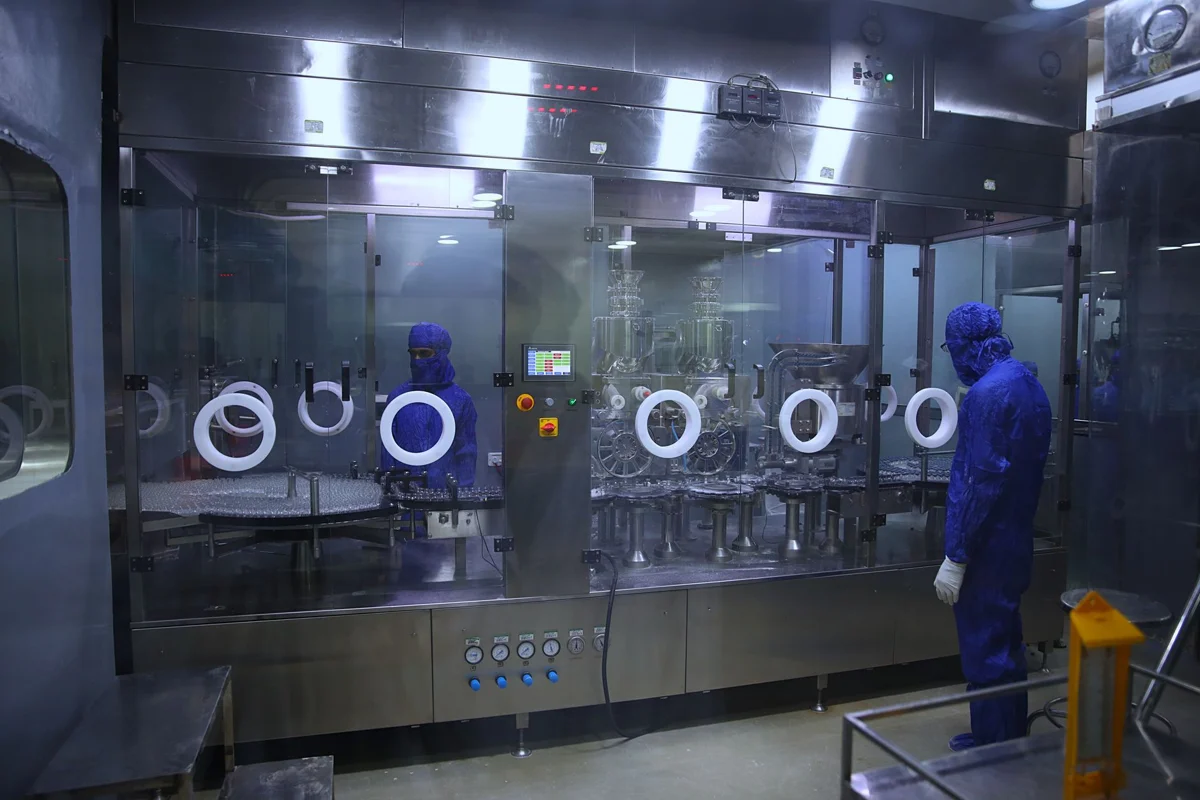
Fabs care about the same pressure physics, but they punish a different failure set. A wafer move between lithography and etch is a transfer event, and every transfer event threatens the particle, temperature and humidity stability that yields depend on. Industry guidance for fab doors stresses minimal pressure and temperature fluctuation across openings. Door cycles there are therefore engineered around the recovery time of the filtration system, not just around operator convenience.
Manufacturer listings for one cleanroom-rated roll-up door line capture the tier well. They cite ISO 5 certification, opening speeds around 2.5 m/s, and air permeability near 12 cubic meters per square meter per hour at 50 Pa. Those three numbers are a useful checklist even when you buy elsewhere. Certified cleanliness of the door itself, speed across the opening, and measured leakage through the closed leaf all belong on your line. A door is hardware inside your airflow, so its own emission behavior matters as much as its barrier behavior.
Configuration for fabs adds three items pharma rarely asks for. Rigid or low-particulate curtains keep the leaf from shedding. Guides and brushes are specified for low wear so the door does not become a particle source. Vibration-conscious hardware keeps high speed motion from trembling sensitive metrology next door. Our high speed door range includes aluminum rigid slat and fabric options, and we match curtain material to the room before we quote speed.

Medical Device Plants: Hygiene, Washdown and Wear
Medical device plants sit between the first two cases. Many lines run to ISO Class 7 or 8 with GMP-style zoning, so the cascade still matters. The audit lens, however, is hygiene: surfaces that survive daily sanitization, geometries that do not shelter microbes, and hardware that stays cleanable after years of cycling. Industry application guidance notes that doors in these plants must hold their rating through continuous washdown and use.
Two configuration rules carry most of the weight here. First, specify smooth, corrosion-resistant faces, typically SS304 stainless with SS316 where aggressive cleaning agents are routine, and insist on surfaces without exposed fasteners or unsealed seams. Second, take wear particles seriously. Supplier case studies flag sealing systems that shed particles over long-term operation as a contamination source. That argues for guides and curtains chosen for low abrasion at your actual cycle count.
Traffic patterns decide the rest. Sterile packaging corridors and clean component stores cycle all day and justify rapid doors at the top of the speed band. Equipment rooms and infrequent exits do not, and a slower insulated door protects temperature there instead. The schedule can mix them line by line, and it usually should.

A Spec Line You Can Put in the Schedule
The table below compresses the three sections into the rows your door schedule was missing. Treat the numbers as defensible starting points, then tighten them against your own HVAC balance and traffic counts. Our full high speed door range covers each configuration path listed here, built to order from a single unit.
| Industry zone | Opening speed | Class / pressure context | Configuration line |
|---|---|---|---|
| Pharma corridor / material airlock | ~2.0–2.5 m/s | 5–20 Pa cascade steps, up to ISO 5 / GMP C boundary use | Full-perimeter compressible seal, interlock-ready controls, stainless or food-grade PVC leaf |
| Semiconductor fab transfer | ~2.5 m/s | ISO 5–6 zones, low leakage target (~12 m³/m²h at 50 Pa class) | Low-particulate or rigid curtain, low-wear guides, vibration-conscious hardware |
| Medical device packaging / store | 1.0–2.0 m/s | ISO 7–8 with GMP-style hygiene zoning | SS304/SS316 smooth faces, seamless cleanable geometry, low-abrasion sealing |
Two reading rules keep the table honest. Speed on low-traffic doors buys nothing and costs maintenance, so do not copy the fastest number down the column. And a class figure is a property of the room, never of the door: the door’s job is to stop being an exception to it.
Installing and Documenting Doors for Validation
Configuration fails at the interfaces more often than at the door. Airlock logic depends on the door pair honoring its interlock, so the control wiring, the sensors and the hold-open behaviors need commissioning as one sequence. Integration guidance from cleanroom door suppliers consistently puts interlocking and cycle timing at the top of the commissioning list. The airlock cycle the door serves is itself a designed sequence; our walkthrough of how a cleanroom airlock works shows where door timing fits inside it.
Validation then runs on paperwork. A powered door brings EN 12453 operator safety into scope alongside EN 13241 for the door itself. Auditors ask for those files, the factory test report and the installation drawings as a set. We ship CAD installation drawings and wiring diagrams with every project, and archive them for five years so repeat orders skip the tooling conversation. Spares dispatch in 5 to 7 days under warranty terms that run two years on the door, three on operators and five on servo motors.
One procurement note closes the loop. These projects rarely need volume to justify a custom build. Our factory manufactures to order from a single unit with no MOQ, which matters when three plants need three different configurations in one program. If your team is still comparing a rapid door against conventional hardware, the case for why cleanrooms cannot use standard industrial doors is the companion argument to this table.

Frequently Asked Questions
How fast should high speed doors for pharmaceutical cleanrooms open?
Fast enough that the pressure cascade recovers before the next cycle. Industrial ranges run 0.8 to 2.5 m/s, and busy pharma corridors commonly sit near the top of that band.
Can high speed doors for pharmaceutical cleanrooms replace an airlock?
No. The door is a component inside the airlock. Cascade integrity still depends on interlocked door pairs, purged transfer zones and the HVAC sequence the door serves.
Do semiconductor cleanrooms need different doors than pharma?
The physics overlaps; the sensitivities differ. Fabs punish particulates, outgassing and vibration, pharma punishes microbial harborage and unvalidated surfaces. Both live on tight seals and short open times.
Which leaf material suits medical device washdown areas?
Smooth stainless faces, typically SS304, moving to SS316 where aggressive cleaning agents are routine. Seamless, fastener-free geometries survive daily sanitization without shielding seams.
What paperwork should arrive with the doors?
A CE declaration against EN 13241, operator safety documentation against EN 12453 for powered leaves, factory test reports, and CAD installation drawings your validation team can file.
Do these doors work for small custom projects?
Yes. Our factory builds to order from a single unit with no MOQ, and CAD drawings stay archived for five years, so later matching doors skip the engineering restart.