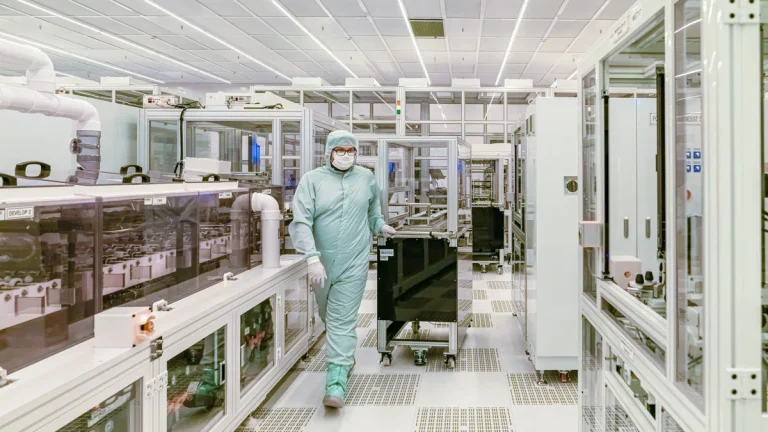
Deploying engineered cleanroom high speed door solutions requires reconciling high-frequency material transfer logistics with envelope pressure cascades. Understanding the foundational mechanics of cleanroom high speed doors helps engineers select appropriate curtain and drive technologies.
Table of Contents
- Cross-Industry Contamination Challenges in High-Throughput Cleanrooms
- Engineering Precision Airtight High Speed Door Assemblies
- Drive Train Enclosure and Particulate Non-Shedding Integrity
- Automated Material Airlock Control and Cleanroom Robotics
- Industry-Specific Cleanroom High Speed Door Solutions Matrix
- Request Engineering Consultation for Cleanroom High Speed Infrastructure
As cleanroom envelope automation architects and barrier systems specialists, we evaluate aerodynamic exposure, dynamic seal mechanics, and mechatronic interlock controls. This engineering analysis guides your facility team to implement reliable cleanroom high speed door solutions across pharmaceutical, semiconductor, and medical device suites.
Cross-Industry Contamination Challenges in High-Throughput Cleanrooms
Industrial manufacturing environments face diverse physical and biological airborne hazards. Installing rapid roll systems optimizes cleanroom doors workflow while maintaining cleanroom environmental isolation.

Pharmaceutical Bioburden and Airborne Microorganism Control
In aseptic filling suites and secondary packaging airlocks, facility teams must control microbial bioburden and viable spore counts. Slow-moving swing doors remain open for 15 to 25 seconds per trolley passage, allowing turbulent air mixing across doorways.
This prolonged opening duration exhausts positive pressure cascades, allowing airborne bacteria and mold spores to migrate from lower-grade corridors into Grade B compounding areas. High-speed roll-up doors restrict total cycle times to under 4 seconds, preserving positive pressure envelopes.
Curtain materials must endure aggressive daily sanitization protocols. Smooth, non-porous thermoplastic polyurethane (TPU) surfaces resist chemical degradation from concentrated quaternary ammonium solutions, peracetic acid, and vaporized hydrogen peroxide (VHP) cycles.
Eliminating horizontal ledges and exposed mechanical springs prevents moisture retention. Microbial swabs taken from frame profiles consistently demonstrate zero bacterial growth following standardized washdown routines.
Semiconductor Sub-Micron Airborne Molecular Contamination
In photolithography bays and wafer fabrication cleanrooms, contamination risks center on sub-micron non-viable particles and airborne molecular contamination (AMC). Volatile organic compounds (VOCs) and siloxanes outgassing from plastics ruin expensive silicon wafers.
Standard industrial roll doors utilize plasticized PVC sheets containing phthalate additives that continuously outgas volatile organic vapors. High-purity semiconductor cleanroom doors utilize low-outgassing, AMC-free polyolefin or specialized TPU curtain formulations.
Curtains incorporate embedded conductive carbon grid networks that continuously bleed off static charges to earth ground. Suppressing electrostatic potentials below 50 Volts eliminates electrostatic surface attraction of microscopic silica dust.
Hermetically sealed winding headers prevent motor gear lubricants and drive heat from entering laminar flow zones. Enclosed airflow profiles ensure minimal disturbance to high-velocity HEPA downflow velocity vectors.
Engineering Precision Airtight High Speed Door Assemblies
A physical barrier is only as effective as its perimeter sealing mechanism. Implementing reliable cleanroom high speed door solutions requires dynamic seal engineering capable of withstanding constant differential pressure.

Continuous Low-Friction Zipper Edge Tracking Mechanics
Conventional roll doors rely on discrete guide rollers or wind stiffener bars running inside loose channel gaps. These mechanical rollers rattle during movement, shed wear particles, and leave substantial air leakage openings along vertical jambs.
Advanced cleanroom doors replace mechanical rollers with continuous polymer zipper teeth molded directly onto curtain side borders. The zipper beads travel inside precision-extruded ultra-high-molecular-weight polyethylene (UHMW-PE) track channels.
This interlocking arrangement creates a continuous, unbroken vertical labyrinth seal along both sides of the door blade. When differential pressure pushes against the curtain, the zipper teeth pull tightly against track retention lips, increasing seal efficiency as pressure rises.
Third-party testing confirms compliance with EN 12426 Class 4 airtightness standards. In addition, airtight curtain retention satisfies stringent ASTM E283 air infiltration thresholds under continuous 50 Pa pressure.

Platinum-Cured Silicone Bottom Edge Profile Sealing
Floor interface sealing presents unique engineering challenges due to surface floor irregularities and drainage pitch slopes. Hard aluminum bottom bars create severe safety hazards and leak air across uneven joints.
Cleanroom rapid doors utilize a flexible, soft bottom profile fabricated from platinum-cured silicone or EPDM elastomers. The hollow bulb profile compresses softly against finished epoxy or vinyl floors, compensating for minor floor variances up to 10mm.
The soft profile contains no rigid metal weights or mechanical ballast plates that could damage equipment or injure passing technicians. A wireless optical safety sensor embedded inside the rubber edge detects contact instantaneously.
If the curtain encounters an obstruction during downward travel, the controller halts travel and reverses to full open in under 90 milliseconds. Soft materials protect autonomous robotic carts from scratching or structural shock.
Drive Train Enclosure and Particulate Non-Shedding Integrity
Drive mechanisms in controlled spaces must operate cleanly without shedding carbon dust or emitting oil mists. Complete enclosure ensures compliance with ISO 14644-14 airborne particle emission assessments.
Sloped 316L Stainless Steel Barrel Enclosures
Overhead winding barrels and motor drives are enclosed inside full-perimeter sheet metal hoods fabricated from heavy-gauge Grade 304 or 316L stainless steel. Surfaces feature an electro-polished or fine brushed finish ground to Ra below 0.6 micrometers.
The upper surface of the barrel hood features a continuous 30-degree slope. This architectural geometry prevents particulate settling and ensures cleaning fluids drain completely during facility washdowns.
The sloped profile also prevents operating personnel from using the door header as an unauthorized shelf to store clipboards, tools, or spare parts. Silicone perimeter gaskets seal cover joints against high-pressure washdown spray.
Quick-release captive hardware allows maintenance engineers to remove inspection covers rapidly without tools. Smooth internal surfaces can be wiped down during routine facility maintenance shutdowns.
Brushless Direct-Drive Helical Motors Without Belts
Standard industrial doors utilize external drive chains that generate particulate contamination. In contrast, examining modern automatic cleanroom doors reveals direct-drive vector motors that operate cleanly without lubricants.
Assemblies integrate direct-drive brushless synchronous AC motors coupled directly to winding barrels through precision ground helical gearboxes. High-efficiency gearing runs inside permanently sealed synthetic oil baths, eliminating grease lubrication requirements.
Digital vector drives provide variable opening velocities up to 2.5 meters per second and closing speeds up to 1.0 meter per second. Smooth acceleration S-curves eliminate structural vibration and noise. Integrated digital rotary encoders eliminate external limit switches. The optical feedback loop guarantees millimeter-accurate curtain positioning without mechanical friction shedding.
For facility teams requiring certified contamination control, specifying high-performance high speed doors ensures reliable non-shedding performance and tight pressure cascade retention.
Our technical team provides EN 12426 Class 4 data sheets and custom opening drawings.
Automated Material Airlock Control and Cleanroom Robotics
Modern advanced manufacturing relies on Automated Guided Vehicles (AGVs) and Autonomous Mobile Robots (AMRs) to move products across cleanroom envelopes. Seamless barrier automation eliminates manual handling errors.
Programmable Logic Controller Interlock Handshake Integration
Cleanroom material airlocks feature two or more interlocked doors configured in series. Door controllers communicate via dry-contact relays, Modbus TCP/IP, or Profinet fieldbuses to prevent simultaneous opening.
As an autonomous vehicle approaches the outer door, wireless optical or industrial Wi-Fi sensors signal the PLC. The controller verifies that the inner door is fully sealed and locks it before initiating outer door opening.
After the vehicle enters the transfer chamber, the outer door closes at 1.0 m/s. Once the outer zipper seal is verified closed, the facility HVAC system initiates a high-velocity HEPA purge cycle.
Upon completing the timed air purge, the controller signals the inner high-speed door to open, allowing the robot to proceed into the classified suite without cross-contaminating air volumes.

Multi-Spectrum Safety Light Curtains and Motion Radars
Safety systems must protect automated transport carts, expensive manufacturing tooling, and walking human operators simultaneously. Optical sensors integrated inside side guide channels provide full-height plane monitoring.
An array of dense infrared light beams projects across the doorway plane from floor level up to 2.5 meters elevation. Any broken optical beam halts downward travel instantly, preventing curtain contact with low-profile AGV chassis.
Overhead directional microwave motion radars track approaching traffic while filtering out lateral personnel movement parallel to the door. Dual-technology sensors differentiate between mobile robots and pedestrian personnel.
Pairing rapid roll barriers with engineered cleanroom doors guarantees compliance with international ISO cleanroom standards and safety machinery directives.
Industry-Specific Cleanroom High Speed Door Solutions Matrix
The following engineering matrix outlines performance criteria and material specifications across primary industrial cleanroom sectors.
Eight-Point Performance and Compliance Matrix
| Engineering Parameter | Pharmaceutical / Biotech | Semiconductor / Electronics |
|---|---|---|
| Opening Operating Velocity | 2.0 m/s to 2.5 m/s | 1.5 m/s to 2.0 m/s |
| Curtain Fabric Composition | Multi-ply FDA antimicrobial TPU | Low-outgassing anti-static carbon TPU |
| Airtightness Rating (EN 12426) | Class 4 (<0.5 m³/h·m at 50 Pa) | Class 4 (<0.5 m³/h·m at 50 Pa) |
| Side Guide Track System | Dry UHMW-PE continuous zipper track | Dry UHMW-PE continuous zipper track |
| Frame & Hood Metallurgy | Grade 316L stainless steel (Ra <0.6 µm) | Grade 304 stainless or anodized aluminum |
| Chemical Sanitizer Resistance | VHP, peracetic acid, IPA, quat biocides | IPA, ultrapure DI water, mild solvents |
| Automation Handshake Protocol | Airlock HEPA interlock / PLC relays | AGV Wi-Fi / OHT overhead dispatch |
| Particulate Cleanliness (ISO 14644) | ISO Class 5 to 7 compatible | ISO Class 4 to 6 compatible |
Specification Standards for Pharma Semiconductor and Medical Devices
Selecting cleanroom door infrastructure requires mapping operating parameters to regulatory cleanliness frameworks:
- Pharmaceutical Sterile Filling (ISO Class 5 / Grade B): Requires 316L stainless steel construction, sloped hoods, VHP chemical resistance, and hardware-interlocked HEPA purge coordination.
- Semiconductor Wafer Fabrication (ISO Class 4 to 6): Focuses on low-outgassing polymers, electrostatic discharge (ESD) suppression below 50V, and high-speed automated AGV transport.
- Medical Device Packaging (ISO Class 7 to 8): Emphasizes rapid cycle times, touchless wave sensor activation, and self-repairing curtains to maintain continuous production flow.
Frequently Asked Questions About High Speed Cleanroom Solutions
How do cleanroom high speed door solutions prevent cross-contamination?
Opening speeds up to 2.5 m/s reduce airlock exposure duration to under 4 seconds. Rapid cycling prevents pressure cascade collapse, reducing airborne particle transfer by over 80% compared to swing doors.
Why are zipper guide tracks superior to mechanical rollers in cleanrooms?
Continuous polymer zipper tracks create an unbroken labyrinth seal achieving EN 12426 Class 4 airtightness without grease lubricants. Zipper teeth disengage safely upon collision and re-insert automatically on the upward cycle.
Can high-speed doors maintain pressure under 50 Pa differential gradients?
Yes, precision-milled UHMW-PE tracks hold zipper teeth tightly under pressure loads. When differential air pressure increases, the curtain mechanically engages retention lips to tighten perimeter sealing and prevent blow-out.
How do cleanroom rapid roll doors integrate with automated guided vehicles?
Controllers interface via wireless radio, microwave radar, and dry-contact PLC handshakes. Approaching AGVs signal the door to open automatically at 2.5 m/s, coordinating sequentially with HEPA airlock purge sequences.
What maintenance routines are required for cleanroom high speed doors?
Assemblies require minimal maintenance because direct-drive motors eliminate drive belts and dry polymer tracks eliminate greasing. Routine wipe-downs with standard sanitizing agents maintain hygiene and particle compliance.
Request Engineering Consultation for Cleanroom High Speed Infrastructure
Implementing reliable cleanroom high speed door solutions requires comprehensive analysis of room volume, air changes, differential pressure, and material flow logistics.
Contact our technical engineering specialists to review your airlock layouts, request certified EN 12426 test certificates, and customize rapid roll barrier solutions for your cleanroom facility.
For a deeper, per-industry spec mapping, read our guide to high speed doors for pharmaceutical cleanrooms.