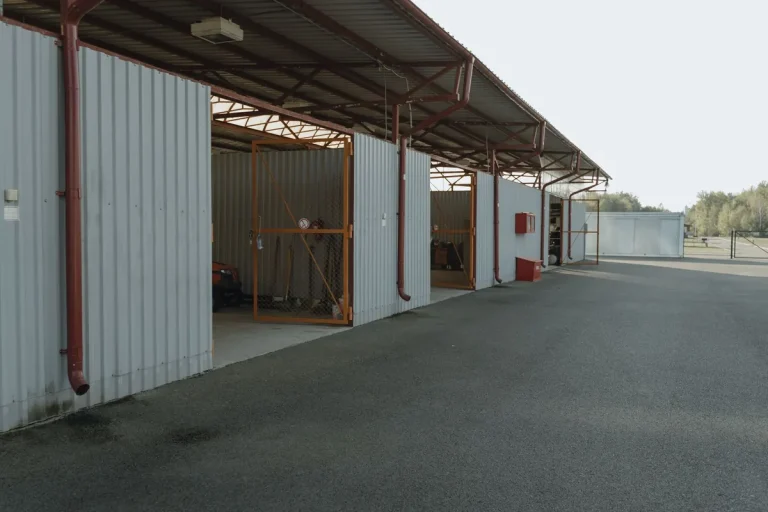
Standard sectional overhead doors still dominate industrial facilities because contractors know them and the purchase price is low. Their opening cycle is slow, and every slow cycle holds a forklift at the threshold. In a warehouse running hundreds of dock cycles a day, that waiting time compounds into labour cost. Facility teams who measure throughput at the bay usually find the door sets the pace, not the truck or the driver.
This comparison looks at what changes when a bay is served by high speed overhead doors instead of a standard sectional panel. Speed, heat loss, maintenance, security, and ten-year cost all move. We build doors in Hebei, China, and ship to more than 70 countries, so the numbers below come from our own product data rather than from published industry averages.
How Opening Speed Changes Dock Throughput
Speed is the difference a driver notices first. Suppliers commonly publish opening speeds around 0.2–0.3 m/s for a standard sectional overhead door, so a four-metre opening takes a typical estimate of 15–20 seconds to clear. High speed overhead doors run at 0.8–2.5 m/s in our range. The same opening clears in a few seconds, and the driver keeps rolling instead of braking at the threshold.
Activation matters as much as raw speed. Radar sensors, induction loops, and RFID readers open the door without the driver reaching for a remote. A programmable controller adds a second benefit, because the door can close as soon as the vehicle clears the threshold. Tailgating behind a forklift becomes difficult, and the curtain spends less time in the path of a raised mast.
Those seconds show up in the dispatch schedule rather than in a maintenance log. A bay cycling 300 times a day gives back roughly one hour of driver time when each cycle shortens by about ten seconds. Treat that as a typical estimate rather than a measured figure. Across six bays on two shifts, the door stops being a fixed constraint on the daily plan.
Traffic behaviour improves as well. Drivers who no longer wait for a slow panel stop inching forward under a moving curtain, which is how most curtain and panel damage begins. The opening becomes part of the route instead of a gate to negotiate.
Energy Efficiency and HVAC Loads in Industrial Facilities
Air moves through an open doorway in both directions at once. Warm, humid air pushes into a chilled room while conditioned air spills out at floor level. A standard sectional panel insulates well when it is shut, and our 40–50 mm PU panels reach a U-value of 0.33 W/m²K. That figure only applies while the door is closed, and a slow door spends far longer in the open state.
High speed overhead doors cut that open time to seconds per cycle. Cold stores, food plants, and pharmaceutical cleanrooms feel the difference first, because condensation and frost follow every long opening. Compressors and heaters then run longer than their design duty to recover the setpoint.
The saving is easier to see in equipment terms than in a percentage. Every minute of open door time is a minute the refrigeration plant fights the loading bay. A door that closes in seconds lets the plant return to its normal duty cycle, and that is where most of the energy case comes from. Log run hours on one bay before and after an upgrade if finance wants a number it will accept.
Maintenance Requirements and Operational Lifespan Comparison
A standard sectional door carries a lot of hardware above the opening. Hinges, rollers, cables, and a torsion spring under high tension all wear, and the spring is the part that eventually fails. Replacing it is a two-person job with a real injury risk, and the bay is out of service while it happens. Track alignment drifts as well, which adds service calls that never appear in the purchase price.
Servo-driven high speed overhead doors remove the spring from the equation. Frequency inverters ramp the curtain up and down instead of snapping it into motion, so the drive train sees far less shock. With no counterbalance to fatigue, routine work drops to inspecting the side guides, checking sensor alignment, and lubricating the guides on a fixed schedule.
Impact behaviour is the other maintenance question. A steel panel that gets hit stays bent, which usually means new parts and a service visit. A self-repairing zipper curtain releases from its guide when struck, then reinserts itself on the next cycle, so the bay returns to service without a callout.
Our factory has built industrial doors in Hebei, China since 1999, and we publish warranty terms because they show what a maker expects to fail. Coverage runs 2 years on the door body, 3 years on operators and motors, and 5 years on servo motors. Warranty spares ship by DHL or FedEx within 5–7 days. Width is the last factor: slat and shutter curtains reach a maximum of 12,000 mm, so one door covers an opening that would otherwise need two panels.
Security and Structural Integrity of Overhead Systems
Fast doors have a reputation for being light, and early fabric roll-ups earned it. Rigid slat construction changed that. Double-walled aluminium or steel slats, 0.8–1.5 mm thick, lock into heavy side guides and stack into a curtain that resists prying. When the door is down and the motor is locked, the opening is covered by a metal barrier rather than a sheet.
Wind load is the structural test that matters on exposed elevations. Spiral and rigid high speed overhead doors in our range carry a wind resistance rating of Class 5. They stay in their guides and keep cycling in weather that would bow a light fabric curtain. Drive units are sealed to IP65, which keeps dust and washdown water out of the control gear.
Access control finishes the picture. Encrypted RFID badges open the door for authorised drivers, and refused reads are logged in the control system. The result is a bay that passes traffic at speed during the shift and closes to a locked metal barrier at night, with an audit trail in between.
Standards give that claim something to stand on. We build to EN 13241 for industrial doors and EN 12453 for powered operators, under an ISO 9001:2015 quality system, and SGS issues the material test reports. Ask any supplier for the declaration and the test report covering the exact model quoted, not the product family.
Total Cost of Ownership: Is the Upgrade Worth It?
Purchase price is the number procurement sees first, and standard sectional doors win it. A ten-year view often inverts the comparison, because the costs that follow installation are where the two designs separate. Energy, unplanned service, spring replacement, and driver waiting time all land on the same operating budget.
Build the comparison from your own bay data instead of a vendor spreadsheet. Count daily cycles, note the open time per cycle, and price the labour held at each threshold. Ten seconds saved on each of 300 daily cycles is a typical estimate of one recovered driver hour per bay per day, and that hour carries a wage.
Maintenance is the second line, and it is the easiest to price. Removing torsion spring replacement removes both the invoice and the bay outage, and self-repairing curtains remove most impact callouts. Add the compressor or heater hours the plant no longer runs, and the energy line stops being a guess.
Spares availability closes the loop, because a cheap door that waits six weeks for a part is not cheap. Warranty parts ship within 5–7 days, and standard lead times run 7–15 days for samples and 20–35 days for a first order. No TCO calculation survives a replacement cycle measured in months.
The upgrade pays back fastest where cycles are frequent and the temperature gap across the opening is large. It pays back slowest on a bay used a dozen times a day with no climate control on either side. Count the cycles, measure the gap, and let those two numbers make the decision.
Frequently Asked Questions About Industrial Overhead Doors
Are rapid access systems more expensive than standard doors?
Yes, the purchase price is higher because of the servo drive and sensor package. Over ten years the Total Cost of Ownership is often lower, thanks to energy savings and fewer service calls.
How do these advanced doors handle accidental forklift impacts?
Many fabric curtains use a self-repairing zipper design. The curtain releases from the side guide when struck, then reinserts itself on the next automatic cycle, so the bay returns to service without a callout.
Do they provide adequate physical security for exterior use?
Yes. Rigid slat and spiral doors use interlocking metal slats 0.8–1.5 mm thick that lock into the side guides, and the motor holds the curtain down when closed.
What specific maintenance is required for springless motor systems?
Springless servo drives need less routine work than torsion springs. Checks focus on gearbox oil, sensor alignment, and lubrication of the side guides, on a schedule set by cycle count.