The engineering evolution of industrial doors over the past century mirrors the transformation of global manufacturing, high-throughput logistics, and automated material handling. From primitive manual timber gates to intelligent, high-speed automated barriers, doorway technologies have continually evolved to solve critical operational challenges: opening speed, thermal envelope containment, physical security, and worker safety.
Table of Contents
- The Early Industrial Era: Heavy Sliding Timber Gates and Manual Steel Slats
- The Upward-Acting Sectional Revolution: Mechanical Breakthroughs and Early Automation
- Mid-Century Industrial Expansion: Commercial Electrification and Hydraulic Power
- The Thermal Revolution: Cold Chain Logistics and Polyurethane Sandwich Panels
- The Emergence of High-Speed Fabric Doors: Rapid Cycles and Climate Containment
- Safety Engineering Milestones: From UL 325 Optical Sensors to DASMA Standards
- The Modern Connected Era: Variable Frequency Drives, IoT Telemetry, and Predictive AI
- Industrial Door Technology Century Evolution Matrix
- Specify Next-Generation Commercial Door Engineering Solutions
Based on our engineering team’s field experience commissioning commercial door systems across heavy industrial plants and automated logistics hubs, understanding this technological progression provides vital context for modern facility design. We compiled this comprehensive engineering retrospective to trace the major mechanical, material, and digital milestones that shaped modern commercial industrial doors.
The Early Industrial Era: Heavy Sliding Timber Gates and Manual Steel Slats
Early twentieth-century industrial facilities operated with primitive doorway barriers that imposed severe operational constraints on freight movement.
Limitations of Track-Hung Sliding Barn Doors in Early Freight Depots
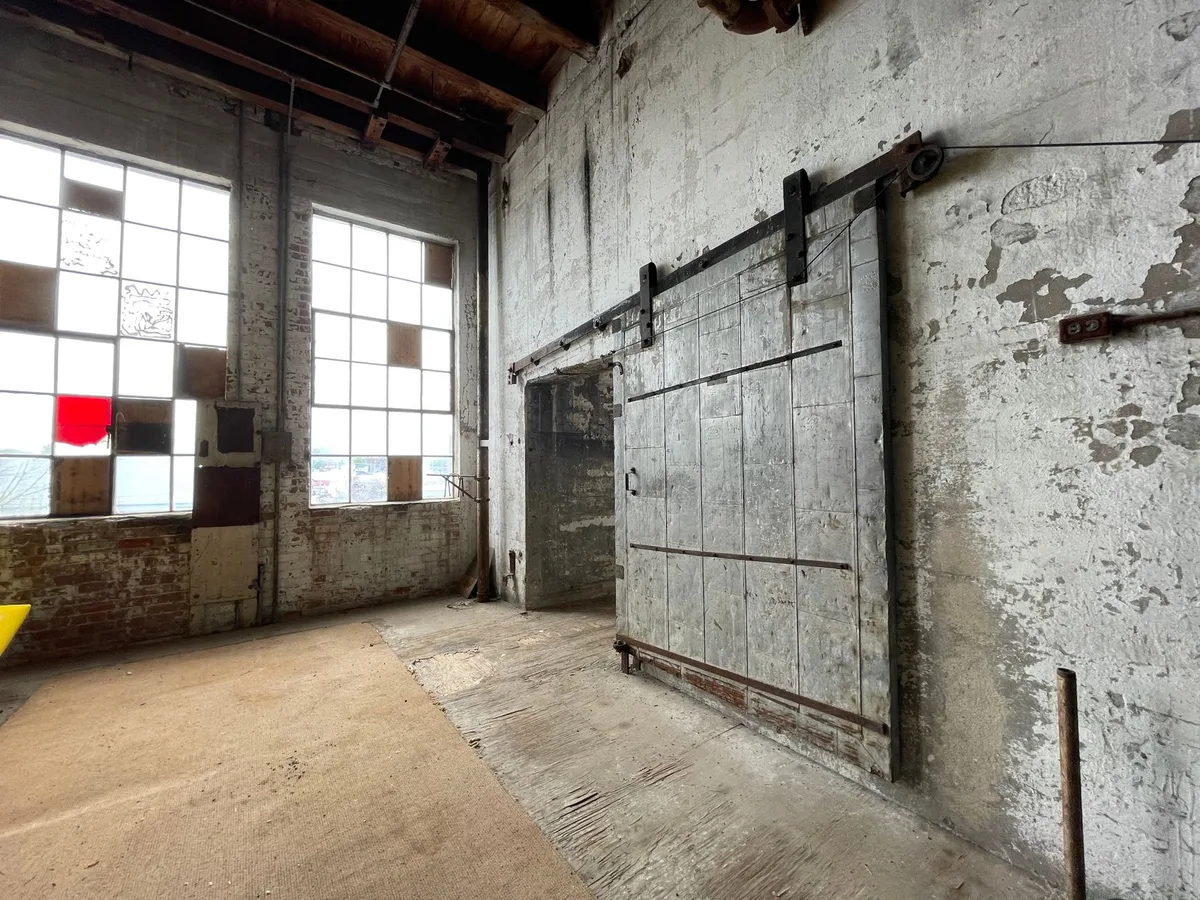
Before the emergence of upward-acting doors, industrial warehouses relied on massive wooden sliding barn doors hung from overhead trolley tracks. These doors required extensive horizontal wall clearance to slide open, preventing facilities from placing storage racks or machinery adjacent to doorway openings. External track-hung sliders frequently derailed when exposed to heavy wind gusts or ice accumulation.
Early Counterweighted Rolling Steel Coiling Mechanisms for Factory Security
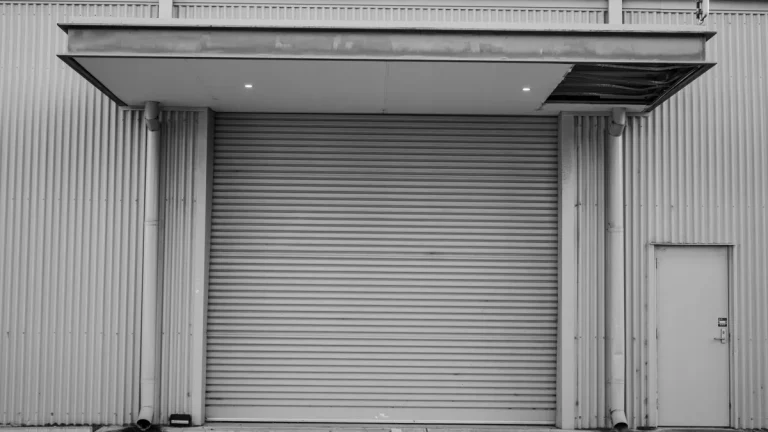
Heavy manufacturing plants and locomotive roundhouses demanded fire resistance and security that timber doors could not provide. Early engineers developed manual rolling steel doors composed of heavy interlocking galvanized slats coiling around overhead barrels. While these doors saved floor space, their primitive counterbalance springs required intense physical labor or slow hand-chain hoists to operate.
Severe Weather Infiltration and Extreme Physical Labor Requirements
Early industrial doors offered negligible weather protection. Uninsulated wooden planks and unsealed steel slats allowed massive drafts to enter factory floors, driving up winter heating fuel consumption. The physical strain required to operate heavy manual doors caused frequent worker fatigue and chronic material handling delays.
The Upward-Acting Sectional Revolution: Mechanical Breakthroughs and Early Automation
The invention of upward-acting sectional doors fundamentally transformed commercial building design and material handling efficiency.
The Breakthrough of Sectional Overhead Doors and Horizontal Track Routing
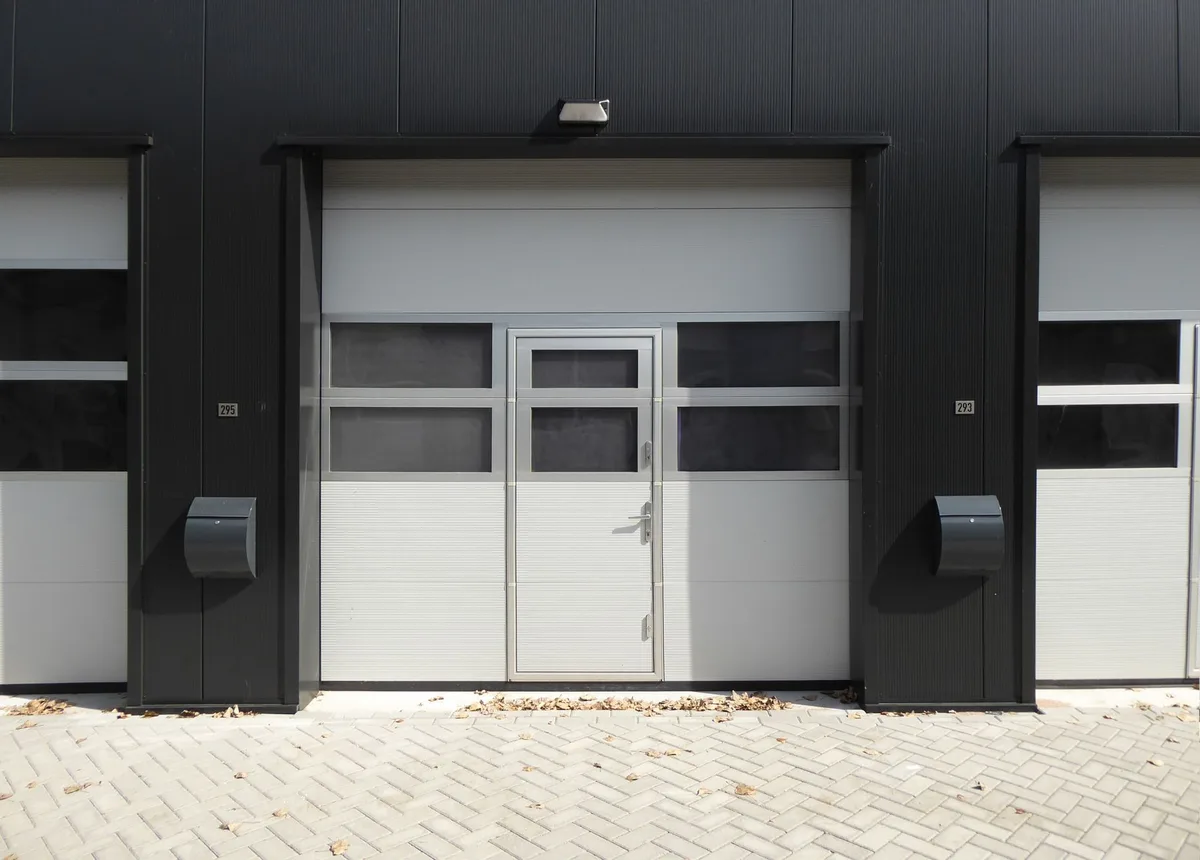
Inventor C.G. Johnson revolutionized commercial architecture by developing the first upward-acting sectional overhead door. By dividing a rigid door into hinged horizontal panels that travel along vertical and horizontal ceiling tracks, the sectional door lifted straight up and rested parallel to the ceiling. This breakthrough eliminated exterior swinging clearance and preserved full doorway access.
The Introduction of Commercial Electric Motorized Door Operators
Shortly after inventing the sectional door, engineers introduced the first dedicated commercial electric door operators. Electrification allowed workers to open large warehouse doorways with the push of a wall button. Automated operation accelerated vehicle loading times while eliminating the workplace injury risks associated with lifting heavy counterweighted doors.
Eliminating Snow Obstructions and Saving Valuable Floor Space in Commercial Bays
Upward-acting doors solved a major seasonal vulnerability in northern industrial climates. Exterior sliding and swing doors frequently became trapped by snowdrifts, requiring hours of manual shoveling before freight trucks could load. Sectional doors opened vertically inside the building envelope, operating flawlessly regardless of external snow accumulation.
Mid-Century Industrial Expansion: Commercial Electrification and Hydraulic Power
Post-war industrial growth catalyzed rapid advancements in commercial door mechanical standards and power systems.
Post-War Manufacturing Expansion and the Rise of Dedicated Motorized Operators
The post-war boom demanded rapid material throughput across massive manufacturing plants. Heavy-duty commercial jackshaft and trolley operators became standard equipment. Motor manufacturers engineered continuous-duty commercial gearboxes with oil-bath lubricated worm gears, allowing doors to cycle dozens of times daily without overheating.
Introduction of Pneumatic and Hydraulic Industrial Door Actuators
Explosion-proof chemical processing plants and heavy foundries required non-electric actuation systems. Engineers introduced pneumatic and hydraulic door actuators powered by central facility compressed air networks. These systems delivered explosive opening acceleration while eliminating electrical spark hazards in volatile atmospheric environments.
Standardization of Torsion Spring Counterbalance Engineering (DASMA 102)
As commercial doors grew larger, counterbalance engineering required precise mathematical standardization. Industry associations codified DASMA 102 standards, establishing formulas for oil-tempered torsion spring wire diameters, coil diameters, and cycle life ratings. Standardizing commercial springs into 10k, 25k, and 100k-cycle tiers gave facility engineers predictable maintenance schedules.
| Historical Engineering Era | Dominant Door Architecture | Typical Thermal Rating | Operating Cycle Speed | Primary Actuation Method |
|---|---|---|---|---|
| Early Industrial Era | Sliding Timber / Manual Rolling Slat | R-1 (Uninsulated) | Manual / Slow Hand Chain | Physical labor, manual chain hoist |
| Sectional Revolution Era | Wood & Sheet Metal Sectional | R-2 to R-3 | 6 – 8 IPS | Early electric fractional-HP motors |
| Mid-Century Expansion | Single-Skin Steel Sectional & Rolling | R-4 to R-6 (Polystyrene) | 8 – 12 IPS | Continuous-duty gearhead motors |
| Thermal Revolution Era | Foamed Polyurethane Sandwich Panels | R-14 to R-18.4 | 10 – 14 IPS | Automated electric commercial operators |
| Modern Connected Era | High-Speed Fabric & Smart Sectionals | R-2 to R-20+ | 40 – 120 IPS | Variable Frequency Drives (VFD) & IoT |
The Thermal Revolution: Cold Chain Logistics and Polyurethane Sandwich Panels
The growth of refrigerated food distribution and energy conservation mandates spurred revolutionary advancements in thermal insulation.
Shift from Solid Timber and Single-Skin Steel to Polystyrene and Polyurethane
The global energy crises prompted commercial building codes to enforce strict thermal envelope standards. Door manufacturers transitioned away from uninsulated single-skin steel pan doors toward insulated sandwich panels. Early insulated doors used glued expanded polystyrene (EPS) boards, which provided modest R-values but suffered from moisture absorption and panel delamination.
Continuous Foamed-in-Place Polyurethane Injection Technology (R-14 to R-18.4)
The definitive thermal breakthrough arrived with continuous polyurethane injection technology. High-density closed-cell polyurethane foam was injected directly between interior and exterior steel skins. As the foam expanded, it chemically bonded to the steel, creating an ultra-rigid composite panel with zero internal air voids. A 2-inch polyurethane panel achieved R-18.4, reducing building envelope thermal transfer by over 45%.
Enabling Modern Global Cold Chain and Controlled Environment Logistics
High-R-value sectional doors with full perimeter compression seals made large-scale refrigerated distribution centers feasible. Food logistics facilities could maintain sub-zero temperatures inside deep-freeze holding vaults while ambient trailers loaded outside, preventing cold chain degradation and food spoilage.
The Emergence of High-Speed Fabric Doors: Rapid Cycles and Climate Containment
As warehouse logistics accelerated, rigid commercial doors became material handling bottlenecks, prompting the development of rapid-acting flexible fabric barriers.
The High-Speed Breakthrough: Replacing Rigid Panels with Flexible Curtains
Traditional rigid sectional doors operate at speeds of 8 to 12 inches per second. In high-traffic distribution hubs, slow operating cycles caused forklift idling and continuous air exchange. European and American engineers developed high-speed doors utilizing lightweight, multi-layer reinforced PVC curtains that rolled up at high velocity around compact overhead shafts.
Variable Frequency Drive (VFD) Inverters and Speeds Reaching 120 IPS
Solid-state VFD drive units integrate programmable electronic torque limiting and dynamic braking resistors. By converting single-phase or three-phase line power into variable frequency electrical current, the inverter matches motor output torque directly to door panel load inertia throughout the opening and closing stroke, significantly extending mechanical gear lifespan.
The integration of solid-state Variable Frequency Drive (VFD) inverters transformed high-speed door performance. VFD controllers provide soft-start and soft-stop acceleration curves, eliminating mechanical shock while enabling opening velocities up to 120 inches per second (3.0 m/s). Forklifts could travel smoothly through doorways without stopping, cutting total open doorway duration by up to 70%.
Self-Repairing Breakaway Zipper Tracks and Forklift Impact Elimination
Rigid doors in busy corridors frequently suffered destructive forklift collisions, resulting in thousands of dollars in panel replacement and emergency service calls. High-speed fabric doors introduced flexible zipper edges. When struck by a forklift, the curtain safely dislodges from the vertical tracks and automatically re-feeds on the next upward cycle, eliminating collision downtime.
Safety Engineering Milestones: From UL 325 Optical Sensors to DASMA Standards
Industrial door safety evolved from simple mechanical buffers to sophisticated electronic entrapment protection networks.
Mandatory Monitored Entrapment Protection Under UL 325 Regulations
National safety standard UL 325 established mandatory secondary entrapment protection on all motorized commercial doors. Modern operators continuously monitor connected safety sensors. If a sensor circuit disconnects, loses power, or fails its internal self-check, the operator locks out automatic downward travel, requiring constant-pressure manual operation.
Evolution from Mechanical Bumpers to Infrared Light Curtains and Wireless Edges
Early motorized doors relied on mechanical pneumatic reversing edges that required physical impact before reversing. Modern installations deploy non-contact multi-beam infrared light curtains creating a dense optical safety grid across the entire doorway opening. Wireless resistive sensing edges provide instantaneous micro-second reversal upon touching an obstruction.
NFPA 80 Fire Door Auto-Reset Mechanisms and DASMA 108 Wind Load Standards
Building safety codes established strict structural integrity standards. Fire-rated rolling steel doors evolved from manual thermal fusible links to motorized auto-reset assemblies integrated directly into central building fire alarm networks. Structural engineering standards codified DASMA 108, requiring exterior commercial doors to withstand hurricane-force wind load pressures up to 50 PSF.
The Modern Connected Era: Variable Frequency Drives, IoT Telemetry, and Predictive AI
Today’s commercial industrial doors are intelligent, connected building components integrated into digital warehouse management ecosystems.
Integration with Warehouse Management Systems (WMS) and AGV Fleets
Modern industrial door controllers utilize standardized industrial communication protocols, including Modbus RTU, BACnet/IP, and MQTT. Integrating door telemetry directly into building management systems (BMS) allows central facility control rooms to coordinate door cycles with ventilation dampers, air filtration units, and security lockdown protocols across multi-building industrial campuses.
Modern automated facilities utilize intelligent door controllers that interface directly with central Warehouse Management Systems (WMS) and Autonomous Mobile Robot (AGV) dispatchers. Door controllers receive automated transit requests from approaching AGVs, opening the doorway precisely as the vehicle approaches and closing immediately upon passage.
Cloud Telemetry, Real-Time Cycle Logging, and Predictive Maintenance Analytics
Industrial IoT gateways embedded in modern door controllers stream operating telemetry to cloud management platforms. Facility managers monitor real-time cycle counts, motor operating temperatures, vibration spikes, and error codes from a central dashboard. Predictive maintenance algorithms detect component wear, alerting service technicians to replace torsion springs or roller bearings before catastrophic breakdown occurs.
Sustainable Green Building Certifications: LEED and Net-Zero Industrial Facilities
High-efficiency automated doors play an essential role in LEED-certified green building design. Advanced perimeter sealing, high thermal R-values, and rapid operating speeds minimize HVAC electrical consumption, helping commercial logistics facilities achieve carbon reduction and net-zero energy targets.
Industrial Door Technology Century Evolution Matrix
The following historical matrix highlights the major technological shifts across the past century of industrial door development.
| Engineering Dimension | Early Industrial Era | Mid-Century Modern | Late 20th Century | Modern Smart Era |
|---|---|---|---|---|
| Primary Curtain Material | Heavy wood planks & iron slats | Single-skin stamped steel panels | Foamed polyurethane sandwich | High-tensile PVC & composite steel |
| Counterbalance Technology | Cast iron counterweights | Standard torsion spring packages | High-cycle duplex spring barrels | Direct-drive VFD counterbalanced |
| Operating Speed | Manual / 4 – 6 IPS | 8 – 12 IPS (Standard motor) | 20 – 40 IPS (Early rapid doors) | 40 – 120 IPS (VFD inverter drive) |
| Safety & Entrapment | None / Manual caution | Pneumatic bottom sensing edges | UL 325 monitored photo eyes | Dense optical infrared light curtains |
| Building System Connectivity | Standalone physical barrier | Hardwired wall push buttons | Relay inputs to local alarms | Cloud IoT telemetry & WMS integration |
Frequently Asked Questions About Industrial Door History and Development
When was the upward-acting sectional overhead door invented?
C.G. Johnson invented the sectional overhead door in 1921. In 1926, he developed the first electric door operator, laying the foundation for modern commercial automation.
How have commercial industrial door materials evolved over the past century?
Industrial doors evolved from heavy timber planks in the early 1900s to stamped steel doors in the 1950s, continuous polyurethane panels delivering R-18.4, and modern high-speed polymer curtains.
What major breakthrough enabled high-speed roll-up doors?
Solid-state VFD drive units integrate programmable electronic torque limiting and dynamic braking resistors. By converting single-phase or three-phase line power into variable frequency electrical current, the inverter matches motor output torque directly to door panel load inertia throughout the opening and closing stroke, significantly extending mechanical gear lifespan.
Solid-state VFD inverters and flexible breakaway curtains allowed high-speed doors to open at 120 inches per second without mechanical damage.
Why are modern commercial doors considered essential for cold storage facilities?
Continuous polyurethane panels (R-18.4) and high-speed freezer doors prevent thermal loss, protecting food safety and cutting refrigeration costs.
How does IoT telemetry improve modern industrial door maintenance?
Embedded IoT controllers track cycle counts, motor load, and vibrations in real time. Predictive analytics allow technicians to service springs before doorway breakdowns occur.
Specify Next-Generation Commercial Door Engineering Solutions
The past century of industrial door development has transformed doorway barriers from manual physical obstacles into high-speed, energy-efficient, and digitally connected building components. Specifying the proper modern door architecture protects your facility envelope, accelerates material flow, and optimizes long-term operational costs.
Our engineering team leverages the latest commercial door technologies to optimize facility efficiency and safety. Explore our commercial industrial door systems or contact our technical specialists today to discuss modernizing your warehouse doorways with high-speed automated barriers and insulated sectional systems.