Calculating the exact weight of aluminum rolling shutters is essential for structural lintel sizing, electric motor selection, and counterbalance spring calibration. Architectural engineers and installation contractors must accurately determine dead load requirements. This ensures long-term entrance reliability and building code compliance.
The total weight depends on alloy density, slat wall gauge, internal insulation, and opening dimensions. This comprehensive engineering guide breaks down weight benchmarks per square meter, real-world opening calculations, motor torque sizing formulas, and structural load considerations for commercial facilities.
Quick Engineering Answer: Weight per Square Meter Benchmarks
For quick engineering estimates, the net curtain weight of aluminum rolling shutters falls between 6.0 kg/m² and 18.5 kg/m² (~1.23 to 3.79 lbs/sq ft). This broad range is dictated by the structural profile design and intended operational environment.
Standard single-skin extruded aluminum slats provide an exceptionally lightweight barrier for retail shopfronts and interior partitions. In contrast, double-skin polyurethane insulated slats and heavy-duty hurricane-rated profiles add mass to achieve thermal insulation and extreme wind resistance.
| Shutter Profile Classification | Slat Wall Gauge & Construction | Curtain Weight (kg/m²) | Curtain Weight (lbs/sq ft) | Typical Facility Application |
|---|---|---|---|---|
| Light Single-Skin Extruded | 0.8–1.0mm 6063-T5 solid/punched | 6.0 – 8.5 kg/m² | 1.23 – 1.74 lbs/sq ft | Retail storefronts, counter shutters, kiosks |
| Standard Single-Skin Extruded | 1.0–1.2mm 6063-T5 reinforced | 8.5 – 10.5 kg/m² | 1.74 – 2.15 lbs/sq ft | Commercial parking garages, warehouse doors |
| PU Insulated Double-Skin | 38–55mm slat, 40kg/m³ foam core | 8.0 – 12.5 kg/m² | 1.64 – 2.56 lbs/sq ft | Cold storage, food processing, logistics bays |
| Heavy-Duty Hurricane-Rated | 1.2–1.5mm extruded with wind locks | 12.0 – 18.5 kg/m² | 2.46 – 3.79 lbs/sq ft | Coastal ports, high-wind zones, secure depots |
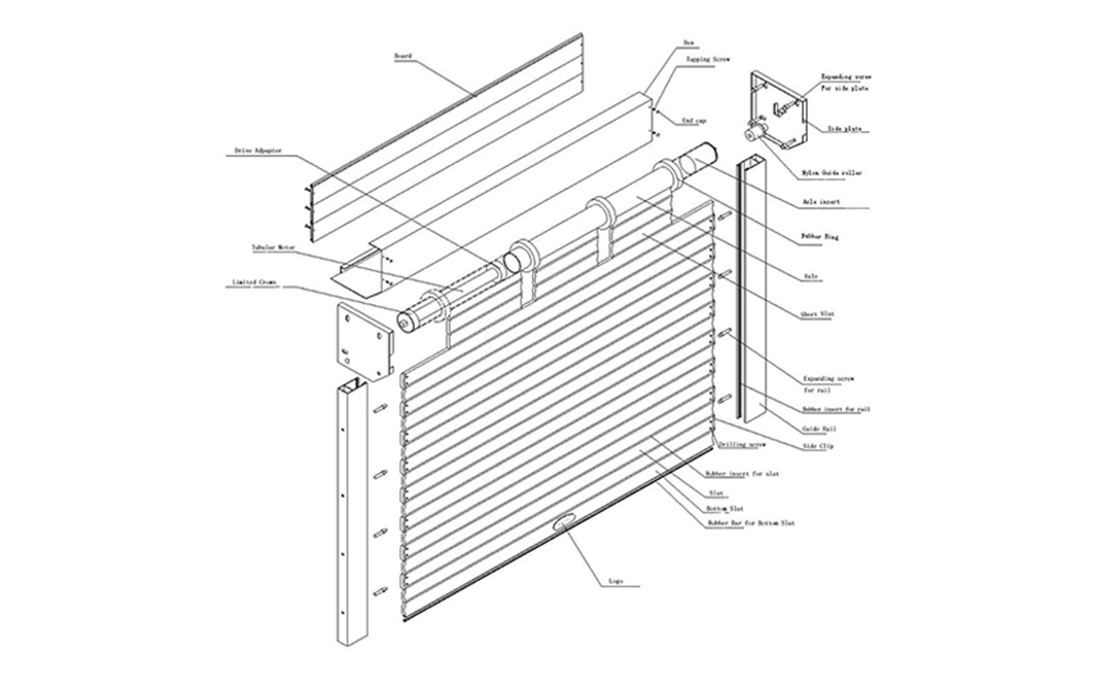
The total weight includes ancillary hardware such as side guide channels, bottom bars, axle barrels, and drive motors. Complete assemblies generally weigh 15% to 25% more than the net curtain weight alone.
Material Physics: Aluminum Alloy vs Steel Density Comparison
The fundamental physics governing the weight of aluminum rolling shutters lies in the material density of architectural aluminum alloy compared to structural steel. Extruded roll-up shutters are predominantly manufactured from 6063-T5 aluminum alloy.
According to certified ASTM international material standards, 6063-T5 aluminum has a density of approximately 2.70 g/cm³ (2,700 kg/m³). In comparison, carbon steel and galvanized sheet steel possess a density of 7.85 g/cm³ (7,850 kg/m³).
This nearly three-to-one density advantage means that an aluminum rolling shutter curtain delivers a 45% to 55% reduction in total mass compared to a steel curtain of identical dimensions. The dramatic weight reduction lowers structural dead load on building headers.
Additionally, the lower inertia of aluminum curtains substantially decreases mechanical wear on counterbalancing springs, bearings, and drive gears. This physical advantage directly translates into extended equipment lifecycles and lower maintenance requirements.
Slat Profile Design and Wall Gauge Weight Factors
Within aluminum shutter manufacturing, specific profile engineering choices directly influence finished curtain mass. Specifiers must balance structural stiffness against overall mass.
Slat wall gauge is the primary factor dictating weight. Stepping up from an economy 0.8mm profile to an industrial 1.2mm or 1.5mm profile increases linear slat weight by 35% to 50%. This profile upgrade provides higher deflection resistance under wind loads.
Insulated slats utilize double-roll-formed or extruded aluminum walls encapsulating a high-density polyurethane foam core. Because rigid polyurethane foam has a low density of 40 to 50 kg/m³, it adds remarkable structural rigidity and thermal resistance with only a modest mass increase.
Punched or micro-perforated slats, frequently utilized in commercial shopping malls for visibility and ventilation, reduce net curtain mass by 10% to 20% while maintaining adequate perimeter physical security.
Real-World Door Weight Calculations by Opening Dimensions
To assist structural engineers and estimators, complete door dead load can be evaluated across common architectural opening dimensions. Complete door dead load comprises the curtain, bottom beam, side rails, and barrel assembly.
| Opening Size (W x H) | Clear Area (m²) | Curtain Mass: Single-Skin | Curtain Mass: Insulated PU | Total Assembly Dead Load |
|---|---|---|---|---|
| 2400 x 2400 mm (Small Commercial) | 5.76 m² | ~46 – 52 kg | ~55 – 65 kg | ~75 – 90 kg |
| 3000 x 3000 mm (Standard Warehouse) | 9.00 m² | ~72 – 85 kg | ~85 – 105 kg | ~115 – 140 kg |
| 4000 x 4000 mm (Heavy Commercial Bay) | 16.00 m² | ~130 – 160 kg | ~155 – 190 kg | ~210 – 260 kg |
| 5000 x 4000 mm (Industrial Logistics) | 20.00 m² | ~165 – 205 kg | ~195 – 245 kg | ~275 – 340 kg |
| 6000 x 5000 mm (Extra-Wide Industrial) | 30.00 m² | ~260 – 330 kg | ~310 – 390 kg | ~430 – 540 kg |
For large logistics openings exceeding 20 square meters, selecting an aluminum curtain prevents excessive overhead loads. This weight advantage simplifies structural header engineering while maintaining robust industrial performance.
Motor Torque Sizing and Spring Counterbalance Mechanics
Curtain mass directly dictates the torque rating required for tubular motors and external industrial drive units. Undersizing a motor leads to thermal cut-out failures, while oversizing creates unnecessary equipment expense.
Motor torque calculation follows standard mechanical engineering equations. The required static torque in Newton-meters is calculated as: Required Torque (Nm) = [Curtain Mass (kg) × Gravity (9.81 m/s²) × Barrel Radius (m)] × Safety Factor (1.3 to 1.5).
For example, a standard 3000 x 3000 mm aluminum insulated curtain weighing 95 kg on a 150 mm barrel requires 90 to 105 Nm torque. An equivalent steel door weighing 220 kg would require an expensive 220+ Nm drive package.
In spring-counterbalanced manual systems, the reduced curtain weight enables lightweight torsion spring assemblies. Operators can effortlessly lift doors up to 10 square meters by hand with less than 12 kg of manual effort.
Get engineered weight calculations, precise motor torque sizing, and factory-direct pricing for your commercial project. Our engineering team provides complete CAD and spec support.
Selecting appropriate drive units ensures compliance with workplace safety standards. Facility managers should review certified drive ratings aligned with workplace machinery safety guidelines to guarantee fail-safe anti-drop protection.
Structural Lintel and Header Load Engineering Standards
Building structural codes establish strict deflection limits for door headers and lintels supporting overhead rolling equipment. Dead loads must not cause structural sagging that could jam vertical guide rails.
Under international structural standards, lintel beam deflection under total door dead load and live wind pressure must not exceed L/300 to L/500 of the clear span length. Excessive deflection binds the roll-up barrel axle and accelerates bearing failure.
Because the weight of aluminum rolling shutters is roughly half that of steel alternatives, structural engineers can specify lighter steel I-beams or reduced concrete lintel reinforcements. This structural efficiency delivers substantial cost savings across large commercial developments.
End bracket mounting plates transfer dead loads directly into vertical jambs. Aluminum shutter systems minimize anchoring stress on masonry and insulated sandwich wall panels, preventing fastener loosening under continuous cycling.

Operational Benefits of Lightweight Aluminum Shutter Curtains
The reduced weight of aluminum rolling shutters provides significant daily operational and financial advantages for facility operators over standard steel doors.
Lower curtain mass drastically reduces operational noise. Combined with nylon-buffered guide rails, aluminum roll-up doors operate smoothly at sound levels below 60 dB, creating a quieter environment in commercial showrooms and parking facilities.
Energy consumption during opening and closing cycles is reduced by up to 40%. The lower electrical draw extends backup uninterruptible power supply runtimes during grid power outages, ensuring continuous commercial access.
For detailed cost analyses comparing upfront capital against lifetime energy savings, explore our in-depth aluminium roller shutter price guide. You can also discover material advantages in our overview of why aluminium garage doors are popular.
Step-by-Step Guide: Calculating Total Shutter Assembly Weight
Field engineers and estimators can determine the exact total weight of aluminum rolling shutters for any bespoke opening using a four-step calculation protocol:
- Calculate Net Opening Surface Area: Multiply daylight clear opening width in meters by clear height plus coiling wrap allowance (typically height + 0.35m).
- Select Profile Unit Weight: Multiply calculated curtain area (m²) by specific slat weight (e.g., 9.5 kg/m² for insulated aluminum).
- Add Bottom Profile and Hardware: Add 2.5 to 4.5 kg per linear meter of width for heavy-duty extruded bottom bars and weatherstrip seals.
- Include Barrel and Support Brackets: Add 20 to 45 kg for steel winding axle barrels and side support end plates depending on span width.
Summing these four components gives the total dead load that will be imposed upon the building structural header and wall anchors.

B2B Engineering Specification and Procurement Checklist
When preparing procurement specifications or requests for quotation, commercial specifiers should provide complete mechanical and structural requirements to international manufacturers:
- Clear Opening Dimensions: Exact daylight width and height in millimeters, plus available sideroom and headroom.
- Alloy Specification: Prime virgin 6063-T5 architectural extrusion with verified material test certificates.
- Slat Construction: Single-skin extruded profile or double-skin polyurethane foam insulated core (specifying target U-value).
- Wind Load Engineering: Required EN 12424 wind resistance class (e.g., Class 3, Class 4, or Class 5).
- Drive Motor Configuration: High-efficiency AC tubular motor or external side-mount industrial gear motor with manual chain override.
- Safety Certifications: Mandatory CE EN 13241 and EN 12453 compliance with integrated anti-drop safety brakes.
Working directly with an agile manufacturing partner offering 1 unit custom MOQ ensures project flexibility. Fast sample prototyping (7 to 15 days) and streamlined container production (20 to 35 days) provide reliable delivery schedules.
Facility Preventative Maintenance for Counterbalance Systems
Maintaining proper balance and lubrication ensures that aluminum rolling shutters retain smooth, low-strain operation throughout their design life.
Bi-annual inspections should verify counterbalance spring tension and check barrel axle bearings for smooth rotation without binding or abnormal noise.
Guide rails and interlocking slat joints should be cleaned and lubricated with silicone spray, avoiding thick grease that traps dust and particulate matter.
Frequently Asked Questions About Aluminum Shutter Weight
How much does an aluminum rolling shutter weigh per square meter?
Single-skin extruded aluminum slats weigh between 6.0 and 10.0 kg/m². Polyurethane insulated slats weigh 8.0 to 12.5 kg/m². Heavy-duty hurricane-rated extruded profiles weigh between 12.0 and 18.5 kg/m².
Is an aluminum rolling shutter lighter than a steel rolling shutter?
Yes. Extruded 6063-T5 aluminum has a density of 2.70 g/cm³ compared to steel at 7.85 g/cm³. Aluminum shutter curtains are 45% to 55% lighter than equivalent steel curtains, reducing motor and spring wear.
How does curtain weight affect electric motor torque selection?
Motor torque scales directly with curtain mass. A 100 kg aluminum curtain on a 150 mm barrel requires approximately 95 to 110 Nm of torque, while an equivalent 250 kg steel curtain requires over 240 Nm.
How does insulated foam core affect aluminum rolling shutter weight?
Polyurethane foam core has a low density of 40 to 50 kg/m³. It adds only 1.5 to 2.5 kg/m² over single-skin profiles while delivering superior thermal insulation and noise reduction.
What structural header load allowance is needed for wide aluminum rolling shutters?
Building codes require header beam deflection to remain under L/300 to L/500 of the span. Aluminum shutters impose roughly half the dead load of steel doors, reducing steel beam sizing.