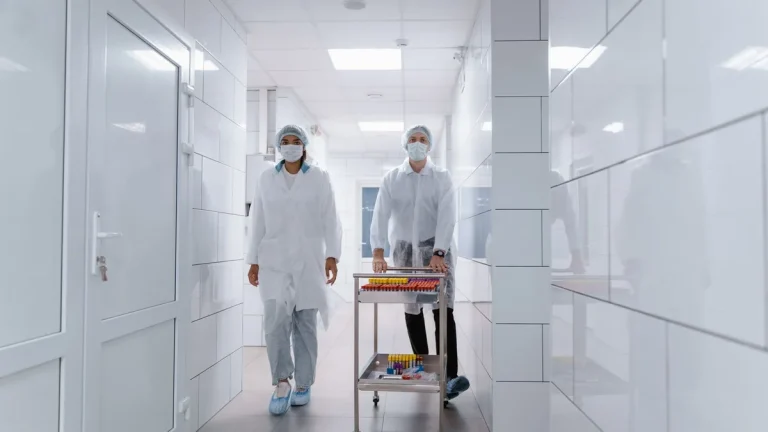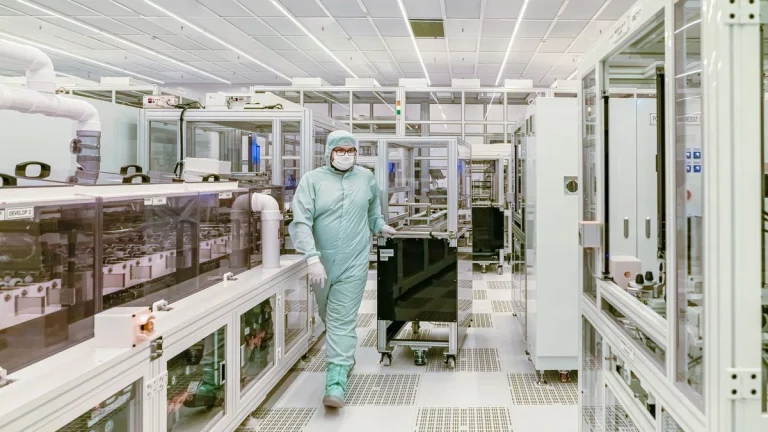
Maintaining sterile integrity inside pharmaceutical manufacturing suites, semiconductor fabrication plants, and biomedical research laboratories requires specialized architectural barriers. Standard commercial doors feature horizontal ledges, open hinges, and porous gaskets that accumulate particulate matter and harbor microbial bioburden. A high-performance clean room door functions as an active contamination barrier, combining completely flush coplanar surfaces, dynamic perimeter sealing, chemical resistance, and electronic interlocking.
Based on our engineering team’s experience designing and manufacturing custom cGMP cleanroom doors for pharmaceutical filling suites, ISO Class 5 semiconductor lithography bays, and BSL-3 biocontainment facilities, understanding key architectural features ensures specifiers achieve regulatory compliance. We compiled this definitive engineering guide to examine the essential design characteristics, sealing mechanics, and material standards governing cleanroom doors.

Flush Surface Engineering: Eliminating Particle Traps
The primary design mandate of cleanroom architecture is the total elimination of horizontal ledges, crevices, and exposed fasteners where airborne particulates can settle.
Contamination Warning: Installing non-flush doors in ISO Class 5 to Class 7 environments creates horizontal frame recesses that collect settling viable particles, increasing bioburden sampling failures during environmental monitoring audits by over 40%.
Coplanar Panel and Modular Wall Frame Detailing (50mm / 100mm Systems)
High-performance cleanroom architectural doors must sit 100% coplanar and flush with the surrounding modular partition wall panels on both the push and pull sides. Extruded aluminum or stainless steel sub-frames integrate directly into standard 50 mm and 100 mm modular cleanroom sandwich panels, creating an unbroken wall plane that facilitates laminar airflow and rapid wipe-down sanitation.
- Zero-Ledge Profile: Door frames align flush with gypsum board or modular HPL wall panels without projecting architraves.
- Concealed Hinge Integration: 3D-adjustable concealed stainless steel hinges eliminate exposed pivot knuckles that generate metallic friction dust.
- Recessed Flush Hardware: Flush-mounted pull handles and magnetic latches eliminate protruding mechanical catches.
Seamless Edge Lamination and Beveled Internal Radii
Each cleanroom door assembly undergoes particulate cleanliness inspection before protective peel-coat application, ensuring zero microscopic surface residues prior to final cleanroom installation.
- ISO Class 5 Compliance: Particle limits strictly below 3,520 particles/m³ at ≥0.5 µm.
- Packaging Standard: Double-bagged in antistatic polyethylene film inside export-grade wooden crates.
Door panel perimeters feature seamless wrap-around edge banding or fully welded stainless steel seams. Internal frame transitions incorporate 5 mm to 10 mm beveled or coved radii, preventing right-angle corners where disinfectants can pool and residual particulates can accumulate.

Perimeter Gaskets and Differential Pressure Retention
Cleanrooms rely on cascading positive and negative air pressure differentials to prevent cross-contamination between adjacent processing zones.
“Under ISO 14644-4 cleanroom design standards, physical doorways separating clean zones of differing classification must maintain static air pressure differentials between 10 Pa and 50 Pa with minimal air permeability leakage.”
Multi-Blade Silicone and EPDM Compression Gaskets
Silicone perimeter seals feature a precision-formulated Shore A hardness of 50 to 60, providing optimal mechanical elasticity across operating temperatures from -30°C to +80°C. The non-migrating, medical-grade elastomer exhibits zero volatile organic compound (VOC) outgassing, ensuring complete compatibility with optical semiconductor wafer processing.
- Shore A Hardness Range: 50 to 60 Shore A for uniform frame perimeter compression.
- Tensile Elongation: >350% recovery elongation preventing permanent seal set after 100,000 cycles.
- Outgassing Limits: ASTM E595 Total Mass Loss (TML) <1.0% and Collected Volatile Condensable Material (CVCM) <0.1%.
Perimeter sealing is achieved using continuous, non-outgassing silicone or EPDM compression gaskets fitted into CNC-machined frame channels. These multi-blade gaskets compress uniformly when the door latches, creating an airtight barrier that resists air migration under sustained differential pressures up to 100 Pa.
Automatic Concealed Drop-Down Bottom Door Seals
Cleanroom floors cannot accommodate raised floor thresholds that obstruct cart wheels and mobile vessel transit. To achieve bottom sealing, cleanroom doors incorporate heavy-duty concealed drop-down mechanical seals recessed into the bottom panel frame.
- Opening State: As the door leaf begins to rotate open, an internal mechanical actuator plunger releases, instantly retracting the high-grade silicone bottom blade 12 mm upward into the door leaf to prevent floor dragging.
- Closing State: When the door leaf reaches full closed position, the hinge-side plunger depresses against the frame strike plate.
- Sealing Compression: The mechanical scissor mechanism drives the silicone blade downward with progressive force, compressing evenly across uneven epoxy floor surfaces.
Maintaining Static Pressure Cascades from 10 Pa to 50 Pa
High-integrity perimeter seals limit air leakage rates below 0.5 m³/h·m² under EN 12426 Class 4 standards. This airtight retention stabilizes HVAC air volume balancing, reduces costly conditioned clean air losses, and prevents pressure cascade collapses during routine facility operations.

Panel Materials: Stainless Steel 316L vs HPL
The structural core and surface cladding of a cleanroom door determine its mechanical durability, impact resistance, and sanitization longevity.
Specifier Recommendation: For pharmaceutical sterile filling suites subject to daily sporicidal wipe-downs, specify 316L stainless steel with a #4 satin sanitary finish (Ra < 0.6 µm). For electronics cleanrooms and hospital operating suites, solid phenolic HPL offers superior dent and impact resistance.
304 and 316L Grade Stainless Steel for Sterile Aseptic Suites
Stainless steel doors feature 1.2 mm to 1.5 mm thick face sheets constructed from AISI 304 or molybdenum-stabilized AISI 316L stainless steel. The non-porous metallic surface withstands continuous contact with harsh oxidizing biocides without pitting, rusting, or developing surface micro-cracks.
Anodized and PVDF-Coated Extruded Aluminum Profiles
Extruded 6063-T6 aluminum door leaves and frames undergo architectural anodization (AAMA 611 Class I, >18 µm) or fluoropolymer PVDF powder coating. This surface treatment delivers exceptional scratch resistance and prevents chemical degradation from alkaline cleanroom foaming detergents.
Solid Phenolic High-Pressure Laminate (HPL) Impact Resistance
HPL cleanroom doors feature 3 mm to 4 mm solid phenolic resin face sheets laminated under high heat and pressure. The dense, thermosetting composite core absorbs severe cart and mobile equipment impacts without denting or chipping, providing decades of service life in high-traffic hospital corridors.
- Aluminum Honeycomb Core: Non-combustible, moisture-impervious core providing high flatwise compressive strength and ultra-low deflection.
- High-Density Rockwool Core: Class A1 fire-rated mineral wool insulation delivering certified 30-minute to 120-minute fire separation (EN 1634-1 / UL 10C).
- Closed-Cell Polyurethane Foam Core: Injected rigid PU foam providing superior thermal insulation and acoustic sound dampening.

Flush Double-Glazed Vision Windows with Desiccant
Vision windows allow personnel to observe cleanroom operations and monitor instrument displays without entering sterile suites, reducing gowning cycles and airlock transit.
True Coplanar Glazing on Both Door Leaf Faces
Cleanroom vision panels feature double-glazed laminated or tempered safety glass mounted completely flush with both external door leaf faces. Unlike conventional window frames with raised beading, flush cleanroom glazing creates a perfectly continuous surface that can be wiped clean in a single squeegee pass.
Internal Molecular Sieve Desiccants for Condensation Prevention
The cavity between the dual glass panes is hermetically sealed with warm-edge spacer bars filled with active molecular sieve silica desiccants. The desiccant continuously absorbs residual moisture vapor, preventing internal fogging, condensation, and microbial growth under severe temperature and humidity differentials.
- Laser Safety Glazing: Certified optical absorbing acrylic filters blocking specific laser wavelengths in medical and semiconductor processing rooms.
- Integral Magnetic Blinds: Hermetically sealed internal Venetian blinds operated via external magnetic sliders, eliminating mechanical cord penetrations.
- Anti-Reflective Coatings: Multi-layer optical coatings enhancing visibility through sterile airlock barriers.

Electronic Interlocks and Pressure Cascade Management
In personnel and material transfer airlocks, door interlocking systems represent the primary electronic barrier preventing cross-contamination.
Safety & Regulatory Requirement: Cleanroom airlock interlock systems must integrate fail-safe emergency override release buttons wired into the central fire alarm system. Under emergency conditions, power must drop instantly, releasing all electromagnetic door locks for immediate egress.
Electromagnetic Door Interlocking Systems in Cascading Personnel Airlocks
Integrated 12V/24V electromagnetic shear locks or heavy-duty holding magnets (holding force >280 kg) secure airlock doors. The programmable logic controller (PLC) monitors magnetic reed door status sensors, enforcing strict interlocking logic.
- Entry Sequence: An operator unlocks and opens Door A to enter the personnel airlock. Door B immediately locks, and its status indicator turns red.
- Airlock Dwell Time: Door A closes. The integrated timer initiates an optional HEPA air purge cycle (e.g., 15 to 30 seconds) to scrub airborne particles.
- Exit Clearance: Once the purge timer elapses, Door B status changes to green, allowing the operator to touchlessly activate and enter the higher-grade clean zone.
Touchless Infrared Sensors, Proximity Wave Switches, and Emergency Releases
Modern cleanroom door controllers incorporate CAN-bus or Modbus RS485 communication protocols, transmitting real-time door position, latch status, and access grant telemetry directly to the facility Building Management System (BMS). Audible sounders and multi-color LED visual strobe indicators alert facility operators if a doorway remains propped open beyond programmed delay thresholds (typically 30 seconds).
To eliminate touch contamination, cleanroom doors utilize optical infrared wave switches mounted at elbow or knee height. Operators simply wave a gloved hand within 50 mm to 100 mm of the sensor to command opening, preventing microbial transfer from gloves to door surfaces.
Chemical Resistance to VHP and Disinfectants
Sterile cleanroom suites undergo aggressive biocide decontamination regimens to maintain validated zero-microbial limits.
Surface Tolerance to Isopropyl Alcohol, Chlorine Dioxide, and Hydrogen Peroxide
Cleanroom door surfaces, sight glasses, and silicone seals must maintain chemical stability when exposed to standard cleanroom disinfectants:
- 70% Isopropyl Alcohol (IPA): Daily routine surface sanitization and glove spray disinfection.
- Vaporized Hydrogen Peroxide (VHP): Automated cyclic gaseous decontamination cycles with H2O2 concentrations exceeding 1,000 ppm.
- Sporicidal Sodium Hypochlorite & Peracetic Acid: Heavy weekly wipe-downs to eliminate bacterial endospores and fungal spores.
- Phenolic and Quaternary Ammonium Compounds: Broad-spectrum antimicrobial sanitizing washes.
- Electrochemical Passivation: ASTM A967 nitric or citric acid surface passivation removing free iron particles to prevent bioburden micro-adhesion.
Corrosion-Proof 316 Stainless Steel Hinges and Concealed Door Closers
All mechanical operating hardware—including concealed cam-action overhead door closers, concealed drop-down seal plungers, and flush lever latches—is fabricated from passivation-treated 316 stainless steel or anodized alloys to prevent pitting corrosion and galvanic rust.
Cleanroom Door Engineering Specifications and Standards
The following engineering matrix summarizes the primary design specifications and standards across cleanroom door types.
| Engineering Dimension | Stainless Steel Cleanroom Door | HPL Phenolic Cleanroom Door | Aluminum Frame Cleanroom Door |
|---|---|---|---|
| Primary Surface Material | 1.2 – 1.5 mm 304 or 316L Stainless Steel | 3.0 – 4.0 mm Solid Phenolic Resin HPL | PVDF / Anodized 6063-T6 Aluminum |
| Flush Mounting Compatibility | 50 mm & 100 mm Sandwich Panels | 50 mm & 100 mm Modular Partitions | Modular Cleanroom & Gypsum Walls |
| Air Permeability Rating | EN 12426 Class 4 (<0.5 m³/h·m²) | EN 12426 Class 4 (<0.5 m³/h·m²) | EN 12426 Class 3 – 4 |
| Chemical & VHP Resistance | Excellent (No degradation under VHP/IPA) | High (Resists standard biocides & IPA) | High (PVDF coating resists chemical wash) |
| Core Fill Options | Aluminum Honeycomb / Rockwool | Aluminum Honeycomb / PU Foam | Aluminum Honeycomb / Rockwool |
| Vision Panel Engineering | Double-glazed flush tempered with desiccant | Double-glazed flush tempered with desiccant | Double-glazed flush tempered with desiccant |
| Target Cleanroom Class | ISO Class 3 – 6 / cGMP Grade A & B | ISO Class 6 – 8 / cGMP Grade C & D | ISO Class 7 – 8 / Laboratories |
Frequently Asked Questions About Clean Room Door Features
What makes a door cleanroom compliant under ISO 14644 standards?
Cleanroom compliance requires 100% flush surfaces without ledges, non-outgassing airtight silicone perimeter seals, chemical resistance to disinfectants, and non-particle-generating concealed hardware.
How do automatic concealed drop-down seals work in cleanroom doors?
When the door closes, an internal mechanical plunger depresses against the frame, driving a flexible silicone blade downward to seal the floor gap. Upon opening, the blade retracts instantly into the panel to prevent floor dragging.
Why is double-glazed flush vision glass essential for cleanroom doors?
Double glazing sits completely flush on both door faces to eliminate dust ledges, while internal molecular sieve desiccants prevent internal condensation and fogging between the panes.
What is the function of electronic door interlocks in cleanroom airlocks?
Electronic interlocks prevent simultaneous opening of entry and exit doors in personnel airlocks, maintaining cascading air pressure differentials and preventing cross-contamination between clean zones.
Which material is better for pharmaceutical cleanrooms: 316L stainless steel or HPL?
316L stainless steel is the standard for Grade A/B sterile aseptic suites due to superior VHP biocide resistance, while solid HPL is ideal for Grade C/D corridors due to high mechanical impact resistance.
Specify High-Performance Clean Room Doors for Your Facility
Specifying high-performance clean room doors ensures robust contamination control, protects critical pressure cascades, and guarantees compliance during regulatory audits. Selecting coplanar flush profiles, durable 316L or HPL materials, and automated drop-down seals delivers dependable sterile performance across decades of operation.
Our engineering department designs and manufactures custom cGMP-compliant cleanroom door systems tailored to pharmaceutical, semiconductor, and biotech facility requirements. Explore our cleanroom door systems or contact our technical specialists today to request architectural submittal drawings, differential pressure test data, and project quotations.