
Purchasing a new garage door opener is one of the most significant mechanical investments a homeowner can make for daily convenience, acoustic comfort, and perimeter security. Over 70% of homeowners purchase an opener based solely on retail horsepower ratings or promotional discounts. Consequently, they experience disruptive ceiling vibration in bedrooms, rail height mismatches on 8-foot doors, and stripped internal gears within three years of installation.
Before buying a new garage door opener, homeowners must evaluate ten essential engineering parameters. Key factors include spring balance physics, DC motor electronics, and drive acoustic ratings. Buyers should also verify ceiling headroom geometry, UL 325 safety reversal, rolling-code encryption, battery backup, smart Wi-Fi integration, rail extension lengths, and 10-year total lifecycle costs. Over two decades of manufacturing custom sectional garage doors and drive systems give our factory teams deep insight. Auditing thousands of residential installations established this comprehensive homeowner buying guide.
1. Spring Balance Dictates Opener Motor Longevity
The most important mechanical reality every homeowner must understand is that the electric motor does not lift the deadweight of the garage door.
The Role of Torsion Spring Counterbalance
In a properly engineered sectional door system, overhead torsion springs or extension springs counterbalance 90% to 95% of the total door mass. When correctly balanced, a 300-pound insulated double-car door should require no more than 10 to 15 pounds of upward manual force to lift by hand. The opener’s primary function is to overcome static friction, guide travel speed, and apply positive downward sealing pressure.
Testing Balance Before Installing a New Opener
Before installing a new motor, disconnect the existing drive trolley and lift the door halfway up. If the door drifts downward or snaps upward, the springs must be professionally adjusted. Installing a powerful new motor on an unbalanced door will burn out the motor stator or strip drive gears within months.

2. DC Brushless Motors Outperform Legacy AC Drives
Motor electrical architecture determines speed control, energy efficiency, and long-term mechanical wear.
Smooth Variable-Speed PWM Control
Traditional alternating current (AC) motors operate at a single fixed speed, applying full torque instantaneously upon activation. This causes mechanical jerk against the tracks, rollers, and ceiling framing. Conversely, direct current (DC) brushless motors utilize pulse-width modulation (PWM) electronics to deliver soft-start and soft-stop acceleration profiles.
60% Reduction in Mechanical Stress
By ramping up speed smoothly and decelerating gently before floor contact, DC motors reduce mechanical shock loads on springs and hinges by up to 60%. This controlled motion extends the operating lifespan of both the door and the opener beyond 20,000 continuous cycles.
Planning a Garage Door Opener Upgrade or New Build?
Send your doorway opening dimensions, ceiling headroom, and door panel weight to our technical engineering team for custom drive sizing and factory direct proposals.
3. Belt Drives Protect Bedroom Acoustic Peace
For attached residential homes where living areas or bedrooms are situated directly above or adjacent to the garage, drive selection defines daily acoustic comfort.
Whisper-Quiet Belt Mechanics Under 50 dB
Steel-reinforced polyurethane timing belts operate at sound levels below 50 decibels (dB). The flexible polymer timing belt absorbs motor harmonics, preventing low-frequency vibration from propagating through wooden ceiling joists into bedrooms.
When Chain Drives Are Acceptable
Chain-drive openers produce 65 to 75 dB of audible metal-on-metal chatter. While economical and highly durable for detached garages, workshops, or pole barns, chain drives frequently cause noise complaints when installed in attached residential garages.
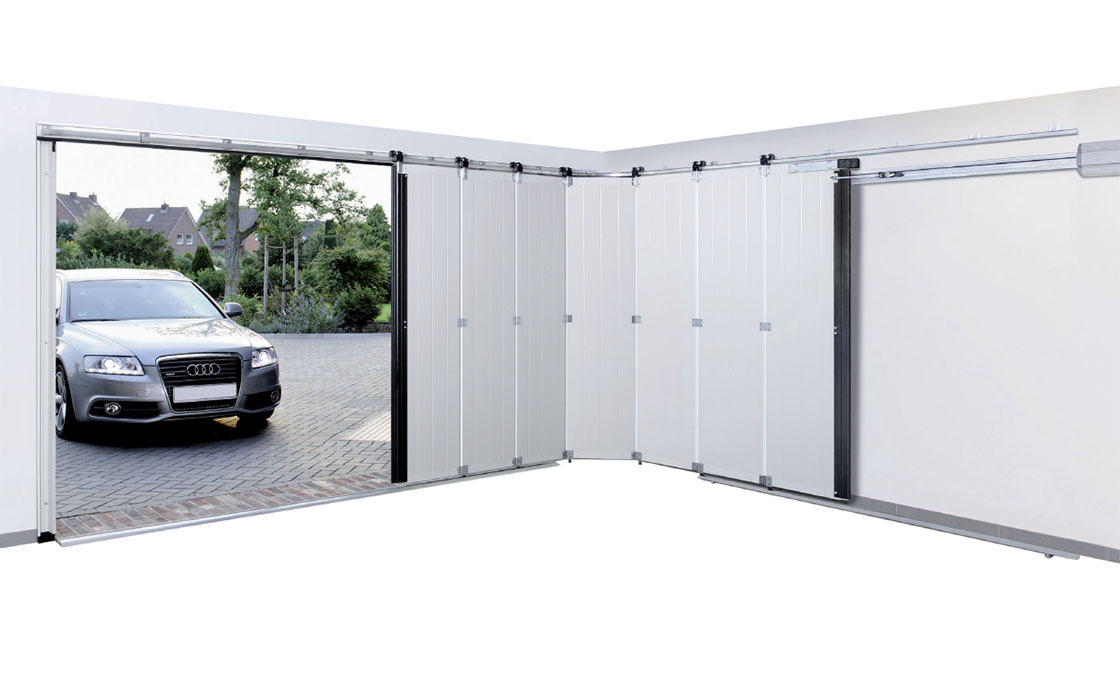
4. Headroom Geometry: Overhead Rails vs. Wall-Mount Jackshafts
Evaluating spatial clearances in your garage dictates whether an overhead trolley or wall-mount jackshaft opener is required.
Overhead Trolley Clearance Requirements
Standard ceiling-mounted trolley openers require a minimum of 2.0 to 3.5 inches of headroom clearance between the highest point of door travel and the ceiling surface. Garages with low ceilings or structural obstructions can make overhead rail installation challenging.
Wall-Mount Jackshaft Advantages
Direct-drive wall-mount jackshaft openers mount directly beside the door opening on the torsion spring shaft. By eliminating overhead ceiling rails entirely, jackshaft systems free up ceiling space for overhead storage racks, car lifts, or high-clearance SUV parking while eliminating ceiling vibration transfer.
5. UL 325 Safety Reversal & Infrared Photo-Eyes
Garage doors represent the largest and heaviest moving object in a residential home, making active entrapment protection non-negotiable.
Dual Photoelectric Safety Beams
Mandated by UL 325 and EN 12453 safety standards, modern openers require dual infrared photo-eye sensors mounted 6 inches above the finished floor. If the invisible optical beam is interrupted by a child, pet, or vehicle while the door is closing, the motor instantly halts and reverses within 0.5 seconds.
Electronic Force-Sensing Auto-Reversal
In addition to optical sensors, intelligent control boards monitor motor current draw and rotational RPM. If physical resistance exceeding 15 to 20 pounds is encountered during closure, the motor auto-reverses within 0.75 seconds to prevent crush injuries.
6. Anti-Theft Security: Rolling Codes & Motorized Deadbolts
Automated openers serve as primary perimeter security barriers protecting home access points and valuable property.
128-Bit Cryptographic Rolling Codes
Older garage remotes operating on fixed dip-switch frequencies are vulnerable to criminal code-grabbers. Modern openers utilize 128-bit rolling-code algorithms that generate a unique cryptographic transmission code out of billions of possibilities every time the remote button is pressed.
Automatic Motorized Deadbolt Locking
Premium opener packages incorporate an automated solenoid-driven side deadbolt. The motorized mechanism physically drives a heavy steel deadbolt into the vertical door track upon closure. This positive physical barrier renders forced manual crowbar prying impossible.
7. Integrated 24V Battery Backup Redundancy
Severe weather events, grid blackouts, and emergency evacuations demand dependable garage door operation without utility AC power.
20 to 50 Emergency Blackout Cycles
Modern DC openers feature integrated 24V trickle-charged backup batteries. During total electrical blackouts, the onboard battery provides 20 to 50 complete door cycles over a 24-to-48 hour period, operating lights, safety sensors, and motorized travel without interruption.
California SB 969 & Global Safety Compliance
In regions such as California, legislation (SB 969) mandates battery backups in all newly installed residential garage door openers. This legal requirement ensures residents can safely evacuate vehicles during wildfire grid outages.
8. Smart Connectivity, Smartphone Alerts & Auto-Close
Integrated Wi-Fi connectivity and smartphone monitoring transform garage door access into an active home automation hub.
Real-Time Mobile Monitoring and Push Alerts
Integrated smart openers allow property owners to check door status, open or close doors remotely, and receive instant push notifications whenever the door is operated. Timed auto-close features ensure the garage never remains inadvertently open overnight.
Voice Assistant and Secure In-Garage Delivery
Leading platforms integrate with Apple HomeKit, Google Assistant, Amazon Alexa, and secure in-garage delivery services, enabling hands-free access control and temporary guest digital keys.
9. Door Height vs. Horizontal Rail Extension Sizing
Door height dictates horizontal rail length requirements before buying a new garage door opener.
Standard 7-Foot vs. Extended Rail Kits
Standard retail opener packages include a 7-foot horizontal rail. If your garage door stands 8, 10, or 12 feet tall, an opener with a standard rail leaves the top panel partially obstructing the opening. Installing a structural rail extension kit ensures full vertical panel clearance.
Verifying Ceiling Backroom Depth
Ensure that your garage ceiling has sufficient backroom depth (door height plus 48 inches) to accommodate the full horizontal rail and motor powerhead assembly.
10. 10-Year TCO: Professional One-Piece vs. Retail Rails
Evaluating long-term total cost of ownership (TCO) reveals significant differences between professional installer lines and retail consumer models.
One-Piece Solid Steel Rails vs. Multi-Piece Snap-Together Rails
Retail consumer openers utilize multi-piece snap-together rails designed for passenger car transport. Over years of dynamic torque, snap joints flex and develop play. Professional installer models feature rigid, one-piece solid steel T-rails or I-beams that maintain precise alignment for decades.
Warranty Coverage & Spare Parts Availability
Commercial-grade openers backed by lifetime motor and belt warranties and established global parts distribution provide far greater long-term value than budget store brands with limited replacement part support.
11. Master Homeowner Pre-Purchase Decision Matrix
The decision matrix below summarizes the ten core engineering factors to review before buying a new garage door opener:
| Decision Parameter | Standard Recommendation | Upgrade / High-End Alternative | Key Engineering Benefit |
|---|---|---|---|
| Spring Counterbalance | 10,000-cycle oil-tempered springs | 25,000+ cycle high-durability springs | Prevents motor gear burnout |
| Motor Technology | 1/2 HP or 3/4 HP DC Brushless | 1-1/4 HP DC with PWM Soft-Start | 60% mechanical shock reduction |
| Drive Mechanism | Steel-reinforced belt drive (<50 dB) | Direct-drive wall-mount jackshaft | Bedroom acoustic isolation & space saving |
| Headroom Spatial Fit | Standard overhead trolley (≥3.5″ gap) | Wall mount beside torsion shaft | Frees ceiling for car lifts/storage |
| Entrapment Safety | UL 325 photo-eyes (6″ off floor) | Dual photo-eyes + bottom sensing edge | 0.75s active obstruction auto-reversal |
| Perimeter Security | 128-bit encrypted rolling codes | Motorized automatic track deadbolt | Eliminates code-grabbing & crowbar prying |
| Emergency Redundancy | Manual quick-release pull cord | Integrated 24V battery backup | 20-50 blackout emergency cycles |
| Smart Connectivity | Integrated Wi-Fi smartphone app | HomeKit, Alexa & in-garage delivery | Auto-close timers & real-time alerts |
| Rail Sizing | Standard 7-ft horizontal rail | 8-ft, 10-ft or 12-ft rail extension kit | Full vertical opening panel clearance |
| Structural Rail Build | Multi-piece sectional retail rail | One-piece solid steel contractor rail | Zero joint flex & 15+ year durability |
Quality management standards governed by ISO and safety benchmarks from the Health and Safety Executive ensure structural integrity across residential entrance installations.
12. Engineering Consultation for Residential Entrance Openers
Evaluating these ten engineering principles before buying a new garage door opener guarantees whisper-quiet operation, robust anti-theft security, and dependable performance over decades of daily service. Matching motor horsepower and drive mechanisms to door mass and ceiling geometry ensures an optimal entrance automation system.
Need guidance selecting a new garage door opener for your home?
Whether specifying systems for custom homes, upgrading noisy openers, or solving low-headroom challenges, our engineering team is ready to help. Send your door dimensions for tailored drive recommendations and factory direct proposals.
Frequently Asked Questions About Buying a New Opener
What is the most important factor when buying a new garage door opener?
Verifying that your garage door’s torsion springs are properly balanced is the most important factor, as unbalanced doors destroy new motors.
Why should I choose a belt drive instead of a chain drive?
Belt drives operate under 50 dB with zero vibration, making them ideal for attached garages situated directly beneath bedrooms.
Do I need a battery backup on my new garage door opener?
Yes, an integrated 24V battery backup ensures 20 to 50 door operating cycles during electrical blackouts and storm emergencies.
What is a wall-mount jackshaft opener and when should I use one?
A jackshaft opener mounts on the wall beside the torsion shaft, freeing ceiling space for overhead storage racks or vehicle lifts.
How do I know if I need a rail extension kit for my garage door?
Standard opener packages fit 7-foot doors; if your door is 8, 10, or 12 feet tall, a rail extension kit is required for full clearance.