






The request lands midway through every tender season: same opening, same hardware, but can the 50 mm panel be swapped for 40 mm to save freight? Behind that one-line email sit three numbers a quote sheet rarely separates. Panel depth, steel skin thickness and core thickness get flattened into one figure, and the building pays for the confusion later.
Our production team assembles every variant discussed here, and the differences show up long before the warranty does. Thickness is not a luxury dial on a sectional door; it is a structural, thermal and commercial decision taken at once. Sectional door panel thickness decides how the leaf carries wind, shrugs off forklift contact and holds the heated air you have paid for. This page separates what each number measures, what changes when panels go thicker, and how to choose without overbuying.
What Panel Thickness Actually Measures
An insulated panel is a sandwich: a galvanized steel skin outside, a polyurethane core inside, and a second steel skin within. The 40 mm or 50 mm figure buyers quote for sectional door panel thickness is the total depth of that sandwich. Our own steel skins run from 0.4 to 1.5 mm depending on the model. Two panels of equal depth can therefore carry very different steel.
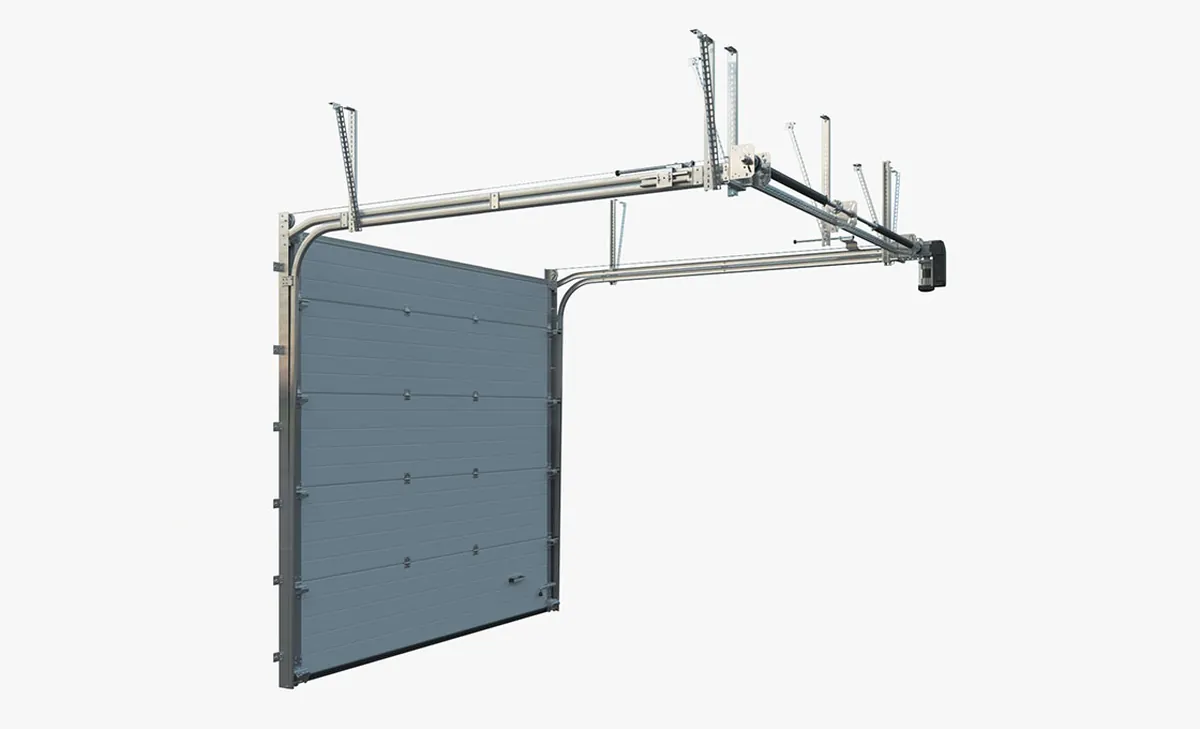
So the first question at any specification meeting is about three numbers, not one. Total sandwich depth, steel skin thickness on each face, and insulating core depth between them. As a sandwich structure works, face stiffness comes mostly from the distance between the two skins, while the core keeps them apart, insulates and bonds. Retail listings for lighter doors commonly show skins around 0.3 to 0.5 mm, one reason the same nominal depth behaves differently across suppliers.
Thickness is also the backdrop for glazing decisions; sectional door windows and light panels covers how much structure a panel keeps when a window opening is cut into it.
One boundary belongs here. Panels of 60 to 100 mm exist for cold-store envelopes, where wall and door act as one thermal shell. That is a different product family with its own selection logic.
How Thickness Changes Stiffness, Impact and Wind Behavior
Go thicker and the leaf stiffens first. A deeper sandwich resists bending across the panel width, so sections stay flatter in transport, install cleanly and tremble less in the tracks. The depth also spreads a local blow over a wider area of steel.
Impact is the daily test. Pallet corners, bumpers and the odd forklift nudge all leave marks, and a thin panel dented past its elastic limit never returns. A thicker panel with a heavier skin resists that permanent set, which is why dock-facing leaves justify the upgrade alone.

Wind works the same logic in slow motion. Gusts load the closed leaf inward and outward, and a thin leaf is the one most likely to buckle under repeated pressure. The formal grade still comes from wind-load testing to EN 13241, and our wind resistance guide explains how those ratings are read. Thickness helps the leaf behave; the test decides what it may be sold for.
The Insulation Trade: 40mm vs 50mm in Numbers
Thermally, the core is the argument for going thicker. Our 40 to 50 mm PU-foam panels are specified at a U-value of 0.33 W/m²K, and that figure is what we warrant. Published data from other makers sits in the same region. One German manufacturer’s UK arm lists 0.56 W/m²K for its 40 mm panel, and an Irish supplier lists 0.49 W/m²K for a 40 mm door. Dealer literature for that range quotes about 1.38 W/m²K for the complete installed door.
That spread is three different measuring points, not dishonesty. A panel U-value describes the leaf alone; a whole-door value adds frames, joints and seals, exactly the paths heat prefers. Ask which one a supplier is quoting. The gap routinely exceeds the gain from ten extra millimetres of foam.
There is also a ceiling on what depth alone can buy. Installed performance is capped by perimeter seals, threshold detail and how square the opening is. Our U-value guide treats the door as a system for that reason.
Where Each Thickness Earns Its Keep
Read against working conditions instead of the price list, the choice gets easier. Four questions sort most projects: temperature target, wind and impact exposure, opening width, and a budget that must still cover springs. The right sectional door panel thickness follows from the room, not the catalogue.
| Working condition | Sensible default | Why |
|---|---|---|
| Unheated warehouse, internal partition | 40 mm | Condensation control, not energy savings, drives the spec |
| Heated workshop or food area next door | 50 mm | Deeper core carries the thermal and acoustic margin |
| Wide opening, wind-exposed site | 50 mm plus reinforcement | Stiffer leaf, then a wind rating to prove it |
| Cold-store envelope | Dedicated 60–100 mm panel | A different family with its own seals |

Two refinements keep the matrix honest. A wind-exposed opening needs the thicker leaf and a verified wind class together, because neither substitutes for the other. A true cold-store application leaves this territory for our insulated sectional doors for cold storage, which are specified against envelope calculations.
Between rows, impact exposure usually gets the deciding vote, since dents are certain while energy savings are gradual. The hardware scales too: heavier leaves ask more of tracks, springs and operators, so the door is re-checked as a whole. The trade-offs across a full sectional door range repay study before one depth is fixed.
The Real Costs of Underspecifying Panel Thickness
Underspecified sectional door panel thickness rarely announces itself on day one, so its bill tends to surprise. The first cost arrives as damage. A leaf one grade too light collects the dock’s knocks, and each dent past the steel’s elastic limit stays until the section is replaced. Swaps mean matching finish and batch, plus a door held half-open meanwhile.
The second cost is thermal, hiding in the heating bill and in condensation on goods and frames. The third is wind. A leaf that flexes visibly in gusts is near the edge of its working range, and it deforms a little more each season until it drags in the guides.
The fourth is mechanical. When a damaged section is replaced with whatever thickness is available, the door’s weight changes, and a spring balanced for the old leaf now lifts the wrong load. Springs rated for 30,000 cycles lose them quickly when the counterbalance is wrong, and the operator strains every cycle.Weight also steers the drive route; the comparison of cable drum vs belt transmission for sectional doors matches each medium to leaf weight, cycle count and noise budget.
There is a warranty angle too. Bonding between the skins and the core is the failure mode makers worry about most, which is why one manufacturer backs its panels against steel-from-foam separation for ten years. A correctly specified leaf leans on that bond for decades.
A panel change alters leaf weight and balance; the guide to sectional door hardware maintenance lists what to re-verify before the door returns to service.
Heavier panels raise the counterbalance load too; the guide to sectional door cable drums shows how drum size, cable diameter and door weight are specified as one set.
How to Specify Thickness Without Overbuying

Five questions at enquiry close most of the gap between a catalogue number and a working door. What temperature must the room hold, and is anyone working next to it? What wind and impact does the elevation face, and how wide is the opening? What headroom and side room does the building offer? Are springs and operator being re-sized for the leaf you chose?
Then make the supplier prove the numbers in writing. Ask for the steel skin thickness on each face, the panel U-value and the whole-door U-value separately, and the spring calculation for the final door weight. Vague answers are themselves information.
Because we manufacture rather than assemble, none of this needs volume. One door is enough for a non-standard panel build. CAD drawings stay on file five years for repeat orders, and the door carries a two-year warranty alongside our ISO 9001 and CE EN 13241 certifications. That is how industrial doors get specified to fit, rather than fitted to a specification.
Frequently Asked Questions
What does the 40mm or 50mm figure on a sectional door panel mean?
It is the total depth of the sandwich: outer steel skin, polyurethane core and inner skin combined. Skin and core thicknesses are separate figures and should be requested on their own.
Does a thicker panel always insulate better?
Deeper foam raises the leaf’s thermal resistance, but the whole-door result is capped by joints, frames and seals. Compare a panel U-value with a whole-door U-value.
Is a thicker panel always stronger?
Deeper sandwiches resist bending better, but dent resistance also depends on steel skin thickness. A thick core with thin skins still marks under a pallet corner.
Can I replace one damaged panel with a different thickness?
Not without consequences. A different thickness changes the door’s weight, so torsion springs must be recalculated and the operator checked.
Do thicker panels need different springs or openers?
Usually yes. A 50 mm leaf weighs more than a 40 mm one of the same size. Springs, tracks and the operator should be sized for the heavier door.