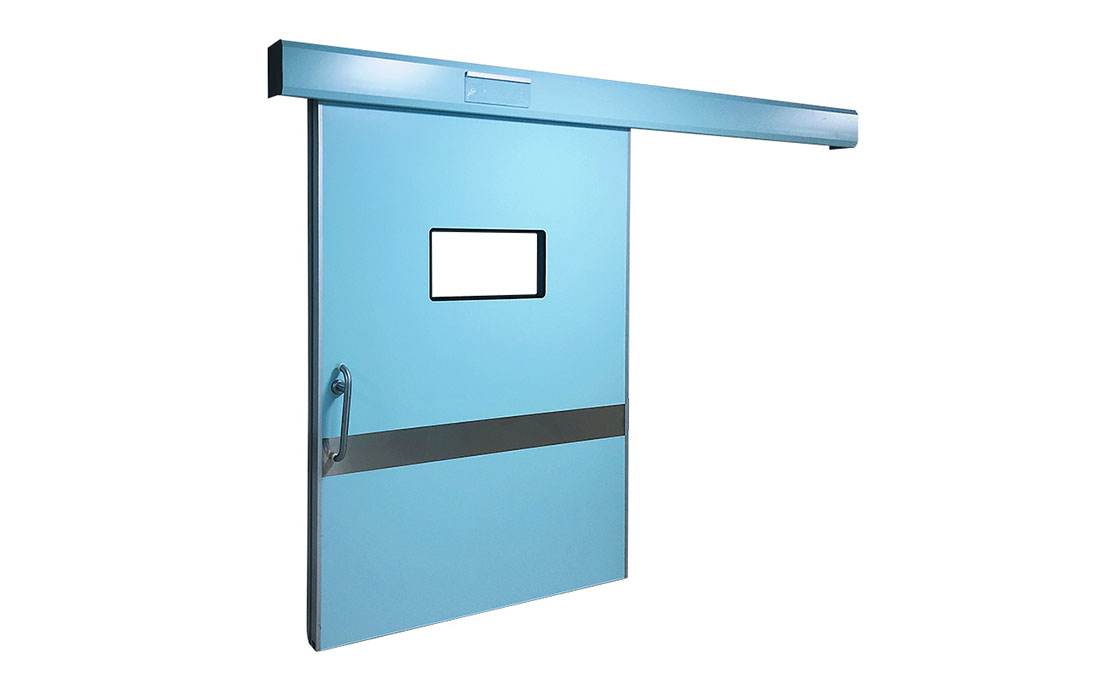
Engineered for high-wind zones, coastal sites & exposed industrial locations — EN 12424 Class 0–5
The RAX Wind Load Rated Industrial Door is purpose-engineered for installations where high wind pressures threaten standard door systems. Coastal facilities, open plains, airports, and elevated industrial parks all face elevated wind loads that can deform panels, derail tracks, and destroy operators on doors not rated for the conditions. RAX designs wind-load-rated doors with reinforced panels, structural mullions, heavier-gauge steel, and wind-braced track systems to withstand the design pressure at your specific site.
As a pure manufacturer since 1999 with a 11,000 m² production base and 20+ R&D engineers, RAX produces each wind-load-rated door to your exact opening dimensions and site wind data — from a single unit, with no minimum order. Every door is factory-tested against a 100,000-cycle fatigue protocol and shipped with complete wind load calculations, and English manuals for your local installation team. [SOURCED — RAX claim]
Wind load performance is governed by EN 12424 (referenced within EN 13241), which classifies doors from Class 0 (no wind load performance declared) to Class 5 (above 1,000 Pa — exceptional, by special agreement). [SOURCED: EN 12424 via baijiahao.baidu.com; antpedia.com] Large exterior industrial doors on exposed sites typically require Class 3–5. [ESTIMATE] The achievable wind class decreases as door span increases, so wide openings need structural mullions, wind braces, or heavier-gauge materials to maintain the target class at full span. [ESTIMATE]
The following table shows the EN 12424 wind load classification values (design / test / failure / calculation pressures in Pascals) as referenced within EN 13241. [SOURCED: antpedia.com]
| EN 12424 Class | Design Pressure (Pa) | Test Pressure (Pa) | Failure Pressure (Pa) | Calculation Pressure (Pa) | Typical Application |
|---|---|---|---|---|---|
| Class 0 | ≤300 | 330 | ≥415 | 450 | No wind load performance declared; interior doors |
| Class 1 | ≤450 | 495 | ≥620 | 675 | Sheltered exterior openings; low-wind inland sites |
| Class 2 | ≤700 | 770 | ≥965 | 1,050 | Moderate-wind exterior; suburban industrial parks |
| Class 3 | ≤1,000 | 1,100 | ≥1,375 | 1,500 | Exposed sites; coastal facilities; open plains [ESTIMATE] |
| Class 4 | By special agreement (intermediate values between Class 3 and Class 5) | High-wind coastal / elevated locations [ESTIMATE] | |||
| Class 5 | > 1,000 Pa (by special agreement) | Extreme wind zones; hurricane/typhoon regions; airports [ESTIMATE] | |||
Key point for buyers: The wind class your project needs depends on your site’s basic wind speed, building height, terrain category, and door orientation. Your structural engineer or local building code will specify the design wind pressure in Pascals. RAX then engineers the door to meet or exceed that pressure at your full opening span — including structural mullions, reinforced tracks, and heavier-gauge panels where needed.
Each door is calculated against your site’s design wind pressure (Pa) at full opening span. We select panel gauge, mullion spacing, track reinforcement, and hardware to achieve the target EN 12424 class. [SOURCED: EN 12424]
Heavier-gauge galvanized steel (up to 1.5 mm), structural mullions / wind braces, reinforced track profiles, and high-strength hardware. Panel skins 0.4–1.5 mm with PU foam core 40–50 mm for combined wind + thermal performance. [SOURCED — RAX claim]
Wind-rated doors still cycle daily. Every RAX door is validated against our 100,000-cycle fatigue testing protocol — covering reinforced hinges, tracks, and operators — before dispatch. Test report and video included. [SOURCED — RAX claim]
Ships with wind load calculation report, installation guides showing mullion/brace placement, foundation load data, and structural specifications for your building engineer to verify. [SOURCED — RAX claim]
CE to EN 13241 / EN 12453; ISO 9001:2015; SGS material reports; Product Liability Insurance. RAX marketing: “Wind Load Class 5 Certified” (spiral high speed door up to proprietary Class 12). Fire rating EI60/EI120 available as capability per project. [SOURCED — RAX claim]
English manual + technical drawings + wiring diagrams + wind load calculation report; operators pre-set and tested before dispatch. Export packing: steel frame + pearl cotton + stretch film. [SOURCED — RAX claim]
| Product | Wind Load Rated Industrial Door (reinforced for EN 12424 Class 1–5) |
| Category | Industrial Doors |
| Wind load classification [SOURCED] | EN 12424 Class 0–5. Class 0 = no performance declared; Class 5 = above 1,000 Pa (by special agreement). RAX engineers doors to the target class based on your site wind data. RAX marketing: “Wind Load Class 5 Certified.” [SOURCED: EN 12424 via baijiahao.baidu.com; antpedia.com] |
| Typical opening size [ESTIMATE] | Reinforced steel doors commonly up to ~W 10,000–12,000 mm × H 8,500 mm. Wider openings engineered per project with structural mullions. RAX custom-manufactures to any size. [SOURCED: jc68.com] |
| Panel construction (reinforced) | Galvanized steel sheet 0.4–1.5 mm skin (heavier gauges for higher wind classes); PU foam core 40–50 mm; structural mullions / wind braces at calculated spacing. Aluminium 6063-T5 or stainless 304/316 available for corrosive + high-wind environments. [SOURCED — RAX claim] |
| Track & hardware (reinforced) | Hot-dip galvanized steel track 1.5–3 mm (51 mm profile), reinforced with wind-brace brackets and heavier-duty rollers. Nylon PA66 track liners. [SOURCED: jc68.com; SOURCED — RAX claim] |
| Drive system | Servo VFD drive with radar/geomagnetic/light-curtain sensing; WiFi/RS485 remote. Explosion-proof motor option: Ex d IIB T4 for hazardous-area + high-wind sites. [SOURCED — RAX claim] |
| Operating speed [ESTIMATE] | ~0.1–0.2 m/s for heavy reinforced doors. Industry reference: sectional lift doors ~0.13 m/s (UNI 8612). Speed varies by door mass and operator sizing. [SOURCED: jc68.com] |
| Thermal performance | PU foam 40–50 mm core. RAX marketing value: U = 0.33 W/m²K (pending own EN 12428 report). Industry reference: 45 mm panel R = 18.25. [SOURCED: jc68.com] |
| Seals | U-shaped vinyl bottom seal; EPDM perimeter seals (compression-rated for wind-driven rain); silicone rubber for cold-storage. [SOURCED: jc68.com; SOURCED — RAX claim] |
| Color / finish | Full RAL custom (common: RAL9006, RAL9010, RAL7016, RAL5010); PVDF coating recommended for coastal high-UV + high-wind environments. [SOURCED — RAX claim] |
| Power supply | 220 V / 380 V, 50/60 Hz (sized for reinforced door mass and wind-zone duty). |
| Safety devices | Anti-pinch safety edge, bottom air-bag sensor, photocell loop, warning lights. EN 12453 compliant. [SOURCED — RAX claim] |
| Certifications held | ISO 9001:2015; CE (EN 13241, EN 12453); SGS material reports; Product Liability Insurance. Can support AS/NZS 4505 and UL counterpart test data. [SOURCED — RAX claim] |
| Certifications (capability) | Fire rating EI60/EI120 (EN 1634-1 test per project); ATEX — Ex d IIB T4 motor only. [SOURCED — RAX claim] |
| MOQ | 1 unit — Any Size, Any Spec, 1 Unit MOQ [SOURCED — RAX claim] |
For wind-load-rated doors, heavier gauges (1.0–1.5 mm vs standard 0.4–0.8 mm) provide the panel rigidity needed to resist deformation under high pressure. Hot-dip zinc coating for corrosion protection. Best for inland and moderate-coastal sites. [SOURCED — RAX claim]
Lighter weight reduces the total mass that wind loads must resist, while aluminium’s natural corrosion resistance suits coastal airports and marine facilities. Internal steel reinforcement inserts at high-stress points. [SOURCED — RAX claim]
For combined high-wind + high-corrosion environments (coastal chemical plants, offshore-adjacent facilities). 304 for general coastal; 316 (+2–3% Mo) for high-chloride / heavy salt spray. Both withstand CIP cleaning at 80–90° C. [SOURCED]
For high-wind coastal sites with intense UV exposure, PVDF (fluorocarbon) coating provides superior color and gloss retention vs standard polyester. Recommended for Middle East, Southeast Asia, and tropical coastal projects. [SOURCED — RAX claim]
Vertical steel reinforcement members integrated into the panel at calculated spacing. Mullions transfer wind pressure loads to the track and building structure. Spacing is determined by the design wind pressure and panel gauge. Essential for Class 3+ doors with wide spans. [ESTIMATE]
Diagonal steel braces within the panel or between panels to resist racking forces from lateral wind. Used in combination with mullions for the highest wind classes (Class 4–5). [ESTIMATE]
Heavier-gauge track profiles (2–3 mm hot-dip galvanized steel) with additional anchor points and wind-brace brackets. Track reinforcement is critical — even the strongest panel will fail if the track pulls out under wind load. [SOURCED: jc68.com; SOURCED — RAX claim]
Wind-load-rated doors transfer significant forces to the building structure. RAX provides foundation load calculations and anchor-point specifications so your structural engineer can verify the building opening is designed to accept the door’s wind loads. [SOURCED — RAX claim]
Wind load engineering is project-specific. The achievable EN 12424 class depends on your opening width × height, design wind pressure, and the reinforcement package. Send your site wind data (basic wind speed, terrain category, building height) and opening dimensions — our engineers will calculate the required class and propose the reinforcement solution.
Provide basic wind speed (m/s), terrain category, building height, and door orientation. Your structural engineer or local building code should specify the design wind pressure in Pascals. This determines the target EN 12424 class.
Clear opening width × height. The achievable wind class decreases as span increases — wider openings need more reinforcement. Include site photos if available. [ESTIMATE]
Temperature range (RAX tests from −30° C to +50° C), corrosion exposure (coastal, chemical, industrial), cycles per day, and whether fire rating (EI60/EI120 capability) is also required. [SOURCED — RAX claim]
Servo VFD drive, sensing method (radar / geomagnetic / light-curtain), WiFi/RS485 remote, explosion-proof motor (Ex d IIB T4) if in a hazardous area. Safety: anti-pinch edge, air-bag sensor, photocells. [SOURCED — RAX claim]
RAX supports full private-label production of the Wind Load Rated Industrial Door: custom RAL panel colors (PVDF coating for coastal/high-UV sites), operator matching, packaging printing and installation-manual translation (EN/ES/FR/AR/RU). Start with a 1-unit OEM sample and scale to container-load branded production. Custom molds, Tooling records are archived for up to 5 years — no extra tooling fee on repeat orders, all under strict NDA. Standard container lead time: 12 days. [SOURCED — RAX claim]
Industrial, commercial and garage doors and gates — the harmonized EU product standard. References EN 12424 for wind pressure resistance. CE marking basis; documentation retained 10 years. [SOURCED: antpedia.com]
Wind load resistance classification (Class 0–5) and test/calculation methods. This is the primary standard for wind-load-rated doors. Class 5 = above 1,000 Pa (by special agreement). [SOURCED: baijiahao.baidu.com; antpedia.com]
Safety in use of power-operated doors — force limits and entrapment protection. Wind-load-rated doors must still comply with operator safety requirements. RAX holds CE compliance. [SOURCED: antpedia.com; SOURCED — RAX claim]
Thermal resistance (U-value) test method. Wind-load-rated doors with PU foam insulation also deliver thermal performance. RAX marketing value U = 0.33 W/m²K pending own test report. [SOURCED: antpedia.com]
Fire resistance test for door and shutter assemblies. RAX offers EI60/EI120 as a capability — actual classification requires EN 1634-1 test per project, classified to EN 13501-2. [SOURCED: sgsonline.com.cn]
RAX can support Australian (AS/NZS 4505) and North American (UL) counterpart test data for projects requiring local wind-load compliance. [SOURCED — RAX claim]
Your structural engineer or local building code should specify the design wind pressure in Pascals based on your site’s basic wind speed, terrain category, building height, and door orientation. [SOURCED: EN 12424] Once you have the design pressure, match it to the EN 12424 class table above. For example: Class 3 covers design pressures up to 1,000 Pa (typical for exposed sites and coastal facilities); Class 5 covers above 1,000 Pa (extreme wind zones, airports). [ESTIMATE] If you don’t have the wind data yet, share your project location and our engineers can provide preliminary guidance.
The reinforcement package depends on the target wind class and your opening span. Common measures include: structural mullions (vertical steel members at calculated spacing to transfer wind loads to the track), diagonal wind braces (to resist racking forces), heavier-gauge track (2–3 mm hot-dip galvanized steel with additional anchor points), and heavier panel skins (1.0–1.5 mm vs standard 0.4–0.8 mm). [ESTIMATE] For Class 4–5 doors with wide spans, all of these are typically combined. RAX provides a full wind load calculation report and foundation load data so your structural engineer can verify the building opening. [SOURCED — RAX claim]
EN 12424 Class 5 (above 1,000 Pa) is achievable but depends on the door type and opening span. [ESTIMATE] As span increases, the achievable wind class decreases unless reinforcement is added. RAX marketing claims “Wind Load Class 5 Certified” for the spiral high speed door range (up to RAX’s proprietary Class 12). [SOURCED — RAX claim] For sliding, folding, and sectional wind-load-rated doors, the specific achievable class at your full span is confirmed per project based on engineering calculations. NOTE: RAX’s “Class 12” is a proprietary scale for spiral doors — do not confuse with the EN 12424 Class 0–5 scale. [SOURCED — RAX claim]
For coastal high-wind sites, we recommend: PVDF (fluorocarbon) coating for superior UV and salt-spray resistance — it maintains color and gloss far longer than standard polyester in tropical and coastal conditions. [SOURCED — RAX claim] For the substrate, stainless steel 316 (+2–3% Mo) is specified for heavy salt spray; 304 stainless is sufficient for general coastal environments. [SOURCED] Galvanized steel with PVDF coating is a cost-effective alternative for moderate-coastal sites.
We are a pure manufacturer and do not provide on-site installation. Every order ships with an English installation manual, installation guides (showing mullion/brace placement), wiring diagrams, wind load calculation report, and foundation/anchor load specifications for your local installation team and structural engineer. Operators are pre-set and tested before dispatch. FOB ports: Tianjin or Qingdao; FCL & LCL supported. [SOURCED — RAX claim]
Held: ISO 9001:2015; CE to EN 13241 (industrial door) and EN 12453 (operator safety); SGS material reports; Product Liability Insurance. Can support AS/NZS 4505 (Australia) and UL (North America) counterpart test data. Capability (per project): Fire rating EI60/EI120 (requires EN 1634-1 test); ATEX Ex d IIB T4 motor for hazardous-area projects. Wind load class is confirmed per project against EN 12424 based on your site data. [SOURCED — RAX claim]
Yes. RAL panel colors (including PVDF for coastal/UV), operator matching, packaging printing and manual translation (EN/ES/FR/AR/RU) are all supported, from a 1-unit OEM sample to container-load branded production. Tooling records archived up to 5 years; no extra tooling fee on repeat orders; strict NDA protection. [SOURCED — RAX claim]
Sample 7–15 days; standard container 12–20 days; custom first order 20–35 days (repeat orders 15–20 days). Door body 2-year warranty, operator/motor 3 years (servo motor 5 years), with spare parts dispatched by DHL/FedEx (5–7 days) within warranty. [SOURCED — RAX claim]
Factory inspection report (speed test, noise, insulation resistance, visual inspection), 100,000-cycle fatigue test video/report, FAI first-article confirmation / pre-assembly photos, English installation manual + installation guides (with mullion/brace detail) + wiring diagrams, wind load calculation report, foundation/anchor load specifications, CE Declaration of Conformity + EN 13241 test report, and export packing (steel frame + pearl cotton + stretch film, clear shipping marks, traceable batch no.). [SOURCED — RAX claim]
Or email info@raxdoor.com
Send your opening size, site wind data, and duty requirements — we reply with a wind load calculation, proposal and lead time.