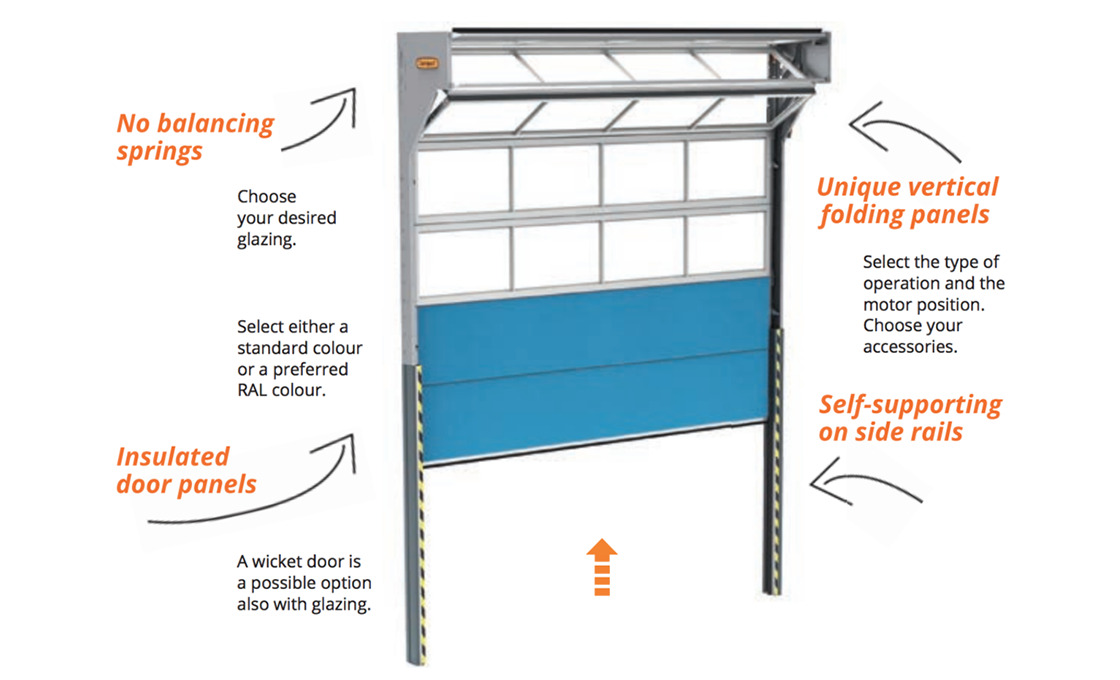
Rust proof sectional doors are engineered for environments where standard steel doors would quickly deteriorate — coastal areas within 1,500 meters of saltwater, ports and shipyards, food processing plants, pharmaceutical clean rooms, chemical facilities, and swimming pool enclosures. These doors use corrosion-resistant panel materials (aluminum, stainless steel, or galvanized steel with marine-grade coating) and stainless steel hardware to withstand salt spray, humidity, and chemical exposure.
RAX manufactures rust proof sectional doors with 40–50 mm PU foam insulated panels, available in aluminum (naturally rust-proof), stainless steel SS304/SS316 (highest corrosion resistance), or galvanized steel with marine-grade powder coating (cost-effective solution). All hardware — tracks, hinges, rollers, springs, and cables — uses SS304 or SS316 stainless steel rated for 1,000–3,000 hours NSS salt spray testing per ASTM B117 or ISO 9227. EPDM perimeter seals prevent moisture and salt ingress into the panel core.
Rust proof doors are essential for any facility where corrosion would compromise door function, safety, or appearance. While they carry a 30–80% premium over standard sectional doors, they significantly reduce maintenance costs and replacement frequency, offering better total cost of ownership over 15–20 years in corrosive environments.
Aluminum: naturally rust-proof, lightweight, ideal for coastal residential. Stainless Steel SS304/SS316: highest corrosion resistance for industrial settings. Galvanized Steel + Marine Powder Coating: cost-effective solution with adequate protection for moderate coastal exposure.
All tracks, hinges, rollers, springs, and cables use SS304 or SS316 stainless steel. SS316 offers superior pitting resistance (PREN >24) for severe marine environments. Hardware rated for 1,000–3,000 hours NSS salt spray testing.
Hot-dip galvanized substrate + electrostatic polyester powder coating. Marine-grade powdercoat specifically formulated for environments within 1,500 meters of saltwater. Anodized aluminum option for enhanced oxide layer protection.
Full-perimeter EPDM rubber seals prevent moisture and salt spray ingress into the panel core. Seals rated for -40°C to +120°C operating temperature. Critical for maintaining insulation performance and preventing internal corrosion.
Sealed housings on moving parts prevent salt accumulation inside mechanisms. Nylon brush seals on track edges reduce salt ingress. Self-cleaning geometry minimizes maintenance frequency in marine environments.
All components tested per ASTM B117 or ISO 9227. Hardware rated 1,000+ hours NSS for coastal applications; 3,000 hours NSS for severe marine (C5-M per ISO 12944-2). Third-party test certificates provided with shipment.
| Product | Rust Proof Sectional Door (also: Corrosion Resistant Sectional Door · Marine Grade Sectional Door · Stainless Steel Sectional Door) |
| Category | Sectional Doors |
| Panel material options | Aluminum (naturally rust-proof) / Stainless Steel SS304/SS316 / Galvanized Steel + Marine Powder Coating |
| Panel thickness | 40 mm or 50 mm PU foam core |
| Steel skin thickness | 0.326–0.5 mm (galvanized); 0.6 mm (aluminum) |
| Hardware material | SS304 or SS316 stainless steel (tracks, hinges, rollers, springs, cables) |
| Salt spray rating | 1,000+ hours NSS (coastal); 3,000 hours NSS (severe marine C5-M) |
| Coating system | Hot-dip galvanized + electrostatic polyester powder coating / Anodized aluminum |
| Seals | EPDM perimeter seals (-40°C to +120°C) |
| Corrosion standards | ASTM B117 / ISO 9227 (salt spray); ISO 12944-2 (corrosivity classification C1–C5) |
| PREN (pitting resistance) | >24 for SS316 hardware |
| Wind resistance | Up to 700 N/m² (Class 3 EN 12424) |
| Certification | CE EN 13241 / EN 12453 (held); ISO 9001:2015; SGS material reports |
| Order | Custom engineered to your size and corrosion environment specification |
Buildings within 1,500 meters of saltwater face constant salt spray and humidity. Standard steel doors may show rust within 18 months. Aluminum or marine-grade coated doors resist corrosion for 15–20 years with minimal maintenance (monthly fresh water rinse).
Severe marine environments (C5-M per ISO 12944) require 3,000-hour NSS rated components. Stainless steel SS316 hardware with PREN >24 resists pitting corrosion from saltwater exposure. Essential for cargo ports, naval facilities, and offshore oil platforms.
Stainless steel SS304/SS316 panels meet hygiene standards for food-grade environments. Resistant to caustic cleaning chemicals, high-pressure washdown, and temperature fluctuations. Easy to clean and maintain.
Stainless steel construction with EPDM seals prevents contamination ingress. Smooth, non-porous surface resists bacterial growth. Compatible with clean room classification requirements (ISO 14644).
Resistant to acidic and alkaline chemical exposure. Stainless steel or specialized coating systems protect against chemical splashes and vapor corrosion. Critical for safety in hazardous environments.
Chlorine vapor and constant humidity accelerate corrosion of standard steel. Aluminum or stainless steel doors resist chemical corrosion. EPDM seals prevent moisture ingress into panel core.
| Feature | Rust Proof Door | Standard Door |
|---|---|---|
| Panel material | Aluminum / SS304/SS316 / Galvanized + marine coating | Cold-rolled steel + standard coating |
| Hardware | SS304/SS316 stainless steel | Galvanized steel |
| Salt spray rating | 1,000–3,000 hours NSS | 200–500 hours NSS |
| Suitable environment | Coastal, chemical, food-grade, marine | General residential/commercial |
| Maintenance frequency | Low (monthly fresh water rinse) | Moderate (quarterly inspection) |
| Expected lifespan (coastal) | 15–20 years | 5–10 years |
| Cost premium | 30–80% over standard | Baseline price |
| Total cost of ownership | Lower over 15–20 years in corrosive environments | Higher due to replacement frequency |
RAX supports full private-label production of the Rust Proof Sectional Door: custom panel material (aluminum/SS304/SS316), RAL color matching, operator matching, packaging printing and installation-manual translation (EN/ES/FR/AR/RU). Start with an OEM sample and scale to container-load branded production. Custom molds and tooling records are archived for up to 5 years — no extra tooling fee on repeat orders, all under strict NDA.
Standard salt spray (fog) testing methods. Uses 5% NaCl solution at 35°C ±2°C. Test durations from 24 hours (basic screening) to 3,000+ hours (heavy-duty verification). Records “time to first rust” and “percentage of rusted area.”
Corrosivity classification for steel structures. Defines categories C1 (very low) to C5-M (very high, marine). C5-M requires 3,000-hour NSS rated components for coastal and offshore applications.
Core CE product standard for industrial, commercial, and garage doors. Requires Declaration of Performance (DoP) under CPR 305/2011. Defines performance characteristics including mechanical strength and durability.
Pitting Resistance Equivalent Number evaluates stainless steel resistance to localized corrosion. PREN >24 required for SS316 in severe marine environments. Calculated from chromium, molybdenum, and nitrogen content.
Mandatory for export to EU/UK markets. Indicates compliance with EN 13241 and CPR 305/2011. RAX provides CE technical file and Declaration of Performance with every shipment.
Aluminum is naturally rust-proof and lightweight, making it the top choice for coastal residential. Stainless steel SS316 offers the highest corrosion resistance for industrial settings. For budget-conscious buyers, galvanized steel with marine-grade powder coating provides adequate protection at lower cost. For areas within 1,500 meters of saltwater, avoid standard steel panels.
For coastal installations, look for hardware rated at 1,000+ hours NSS (Neutral Salt Spray) per ASTM B117 or ISO 9227. For severe marine environments (ports, shipyards, offshore), specify 3,000-hour NSS rated components meeting C5-M marine-grade classification per ISO 12944-2. Request third-party test certificates, not just manufacturer claims.
Coastal upgrade packs typically include marine-grade powder-coated hardware, SS316 cables, and nylon brush seals. However, if the base panels are standard steel, upgrading hardware alone provides limited protection. For areas within 1,500 meters of saltwater, consider aluminum or stainless steel panels from the start. Upgrading panels is not possible after manufacturing.
Rust-proof doors carry a premium of approximately 30–80% over standard sectional doors, depending on material choice. However, in corrosive environments, they significantly reduce maintenance costs and replacement frequency. Standard steel doors may need replacement in 5–10 years in coastal areas; rust-proof doors last 15–20 years, offering better total cost of ownership.
Regular washing with fresh water to remove salt deposits is essential (monthly for severe marine, quarterly for moderate coastal). Moving parts such as rollers and springs should be lubricated annually. Self-cleaning designs and sealed housings reduce maintenance frequency. Avoid abrasive cleaners that can damage protective coatings.
No — RAX is a pure manufacturer. Doors ship with English installation manuals, wiring diagrams, and remote support. We recommend using a qualified local installer who can verify structural capacity and proper sealing of the frame to prevent water ingress.
Standard configurations: 12–20 days. Custom first order: 20–35 days. Repeat orders: 15–20 days. Warranty: panels 10 years, automation components 5 years. Warranty replacement parts shipped via DHL/FedEx in 5–7 days.
Send your opening size, environment type (coastal distance from water, chemical exposure, humidity level), and preferred panel material — we reply with a specification, lead time, and quote.