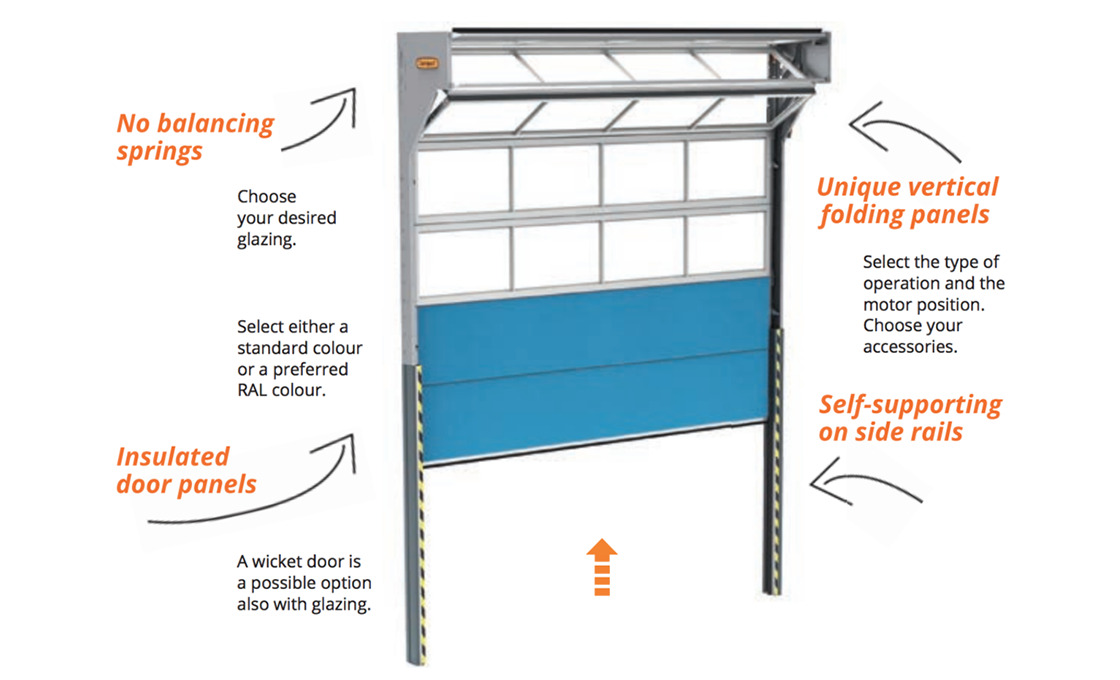
Finger safe sectional doors are engineered with specialized panel joints and sealing systems that eliminate pinch points between door sections. Unlike standard sectional doors where fingers can be caught between hinged panels during operation, finger safe doors use a 3-layer sandwich panel design (steel + PU foam + steel) with ship-lap joints that prevent access to the hinge area. This design is mandatory for schools, childcare facilities, public buildings, and any environment where children or the public interact with the door.
RAX manufactures finger safe sectional doors with 40–80 mm thick panels featuring ship-lap joint design that overlaps panel edges to block finger access. Triple safety systems include pressure-sensitive edges (stop door on contact), infrared light curtains (detect objects in door path), and torque monitoring (reverses door on resistance). All doors comply with EN 12604 (mechanical safety requirements) and EN 12978 (safety devices for powered doors).
Finger safe doors are essential for schools, kindergartens, hospitals, shopping centers, sports facilities, and residential garages where children are present. The additional safety features add minimal cost compared to the liability reduction and peace of mind they provide.
3-layer sandwich panel (steel + PU foam + steel) with ship-lap joint design overlaps panel edges to block finger access to hinge area. Panel thickness 40–80 mm. Eliminates pinch points between sections during door operation.
Bottom edge and vertical edges equipped with pressure-sensitive safety strips. Door stops immediately when contact is detected. Prevents injury if person or object is in door path during closing.
Infrared beam array across door opening detects objects in door path. Door reverses before contact occurs. Non-contact safety system complements pressure-sensitive edges for comprehensive protection.
Motor monitors door movement resistance. If abnormal resistance is detected (person/object blocking door), door automatically reverses. Prevents crushing injuries and property damage.
Mechanical safety requirements for industrial, commercial, and garage doors. Specifies design requirements to prevent injury from moving parts. Finger safe design mandatory for public access doors in EU.
Safety devices for powered doors. Specifies requirements for safety edges, light curtains, and control systems. Ensures reliable operation of safety devices throughout door service life.
| Product | Finger Safe Sectional Door (also: Safe Edge Sectional Door · Anti-Pinch Sectional Door) |
| Category | Sectional Doors |
| Panel construction | 3-layer sandwich (steel + PU foam + steel) with ship-lap joints |
| Panel thickness | 40 mm / 50 mm / 80 mm options |
| Joint design | Ship-lap overlap blocks finger access to hinge area |
| Safety edges | Pressure-sensitive bottom and vertical edges |
| Light curtains | Infrared beam array across door opening |
| Torque monitoring | Motor detects abnormal resistance, auto-reverses |
| Safety standards | EN 12604 (mechanical safety) + EN 12978 (safety devices) |
| Insulation | U-value approximately 0.5 W/(m²·K) (40–50 mm panels) |
| Wind resistance | Up to 700 N/m² (Class 3 EN 12424) |
| Certification | CE EN 13241 / EN 12453 (held); ISO 9001:2015; SGS material reports |
| Order | Custom engineered to your opening size and safety requirements |
Children are naturally curious and may place hands near moving doors. Finger safe design eliminates pinch points. Mandatory for educational facilities in many EU countries. Protects against serious hand injuries.
High-traffic public areas with vulnerable populations. Finger safe doors protect patients, visitors, and staff. Pressure-sensitive edges prevent injury to wheelchair users and mobility-impaired persons.
Public access doors require comprehensive safety systems. Light curtains detect shoppers in door path. Torque monitoring prevents crushing injuries. Reduces liability and insurance costs.
Gymnasiums and sports halls with frequent door use. Children and athletes may not pay attention to moving doors. Finger safe design provides passive protection without requiring user awareness.
Families with young children benefit from finger safe design. Children may play near garage doors. Ship-lap joints and safety edges provide peace of mind for homeowners.
Government buildings, libraries, community centers with public access. Finger safe doors meet accessibility requirements and protect all users regardless of age or ability.
| Feature | Finger Safe Door | Standard Door |
|---|---|---|
| Panel joints | Ship-lap overlap blocks finger access | Standard hinge joints (pinch points present) |
| Safety edges | Pressure-sensitive (standard) | Optional |
| Light curtains | Infrared array (standard) | Optional |
| Torque monitoring | Auto-reverse on resistance (standard) | Basic force limiting only |
| EN 12604 compliance | Full compliance (mandatory for public access) | Basic compliance |
| EN 12978 compliance | Full safety device compliance | Basic compliance |
| Cost premium | 5–15% over standard | Baseline price |
| Best for | Schools, hospitals, public buildings, homes with children | Industrial facilities, adult-only environments |
RAX supports full private-label production of the Finger Safe Sectional Door: custom panel thickness (40/50/80 mm), RAL color matching, operator matching, packaging printing and installation-manual translation (EN/ES/FR/AR/RU). Start with an OEM sample and scale to container-load branded production. Custom molds and tooling records are archived for up to 5 years — no extra tooling fee on repeat orders, all under strict NDA.
Mechanical safety requirements for industrial, commercial, and garage doors. Specifies design requirements to prevent injury from moving parts. Finger safe panel joints mandatory for public access doors in EU.
Safety devices for powered doors. Specifies requirements for safety edges, light curtains, and control systems. Ensures reliable operation of safety devices throughout door service life.
Core CE product standard for industrial, commercial, and garage doors. Covers both manual and powered doors. Requires Declaration of Performance (DoP) under CPR 305/2011.
Mandatory for export to EU/UK markets. Indicates compliance with EN 13241 and CPR 305/2011. RAX provides CE technical file and Declaration of Performance with every shipment.
Finger safe doors use ship-lap panel joints that overlap panel edges to block finger access to the hinge area. This eliminates pinch points between door sections during operation. Additional safety features include pressure-sensitive edges, infrared light curtains, and torque monitoring.
Schools, kindergartens, hospitals, shopping centers, sports facilities, and public buildings. Mandatory for public access doors in many EU countries per EN 12604. Recommended for residential garages with children.
Typically 5–15% over standard sectional doors. The additional cost provides significant liability reduction and peace of mind. For public buildings, the cost is negligible compared to potential injury claims.
Yes. Finger safe doors use the same 40–80 mm PU foam insulated panels as standard sectional doors. U-value is approximately 0.5 W/(m²·K). The ship-lap joint design does not compromise thermal performance.
EN 12604 (mechanical safety requirements) and EN 12978 (safety devices for powered doors). Finger safe panel joints mandatory for public access doors. Pressure edges and light curtains required for powered doors.
No — RAX is a pure manufacturer. Doors ship with English installation manuals, wiring diagrams, and remote support. We recommend using a qualified local installer who can verify proper safety device installation and testing.
Standard configurations: 12–20 days. Custom first order: 20–35 days. Repeat orders: 15–20 days. Warranty: panels 10 years, automation components 5 years. Warranty replacement parts shipped via DHL/FedEx in 5–7 days.
Send your opening size, application type (school/hospital/public/residential), and safety requirements — we reply with a specification, lead time, and quote.