








Two quotes sit on your desk for the same loading bay. One supplier prices a wide sliding leaf that parks beside the opening. The other insists a hinged door handles the same traffic for less. Both point at the identical structural opening, and both claim their carrier suits your forklift schedule. Only one of them is right for your floor, and neither quote sheet says which.
We build sliding and hinged industrial doors on the same factory floor, and our inspection bench records speed, noise and insulation resistance for both lines. Nothing ships without those records. A hinge and a track set up two different load paths, and every other difference follows from that one joint. We separate the two carriers the same way for every buyer, by motion first and floor conditions second.
One Hinge Changes Everything Else
Every difference between the two doors starts at a single joint. A regular industrial door turns on hinges, so its leaf sweeps an arc around a fixed vertical axis. An industrial sliding door translates along a straight track instead, and its travel equals the leaf width plus a buffer at each end. Picture a compass drawing a circle beside a drawer sliding out of a cabinet. The compass needs clear floor all around it, while the drawer only needs the run of its slot.
The names themselves tell you the motion. Sliding carriers roll a leaf horizontally on wheels or rollers until it parks beside the opening, top-hung from a beam or bottom-rolling in a channel. Hinged carriers, which most plants still call regular doors, swing a leaf on barrel hinges mounted in the side frame. Everything else in this comparison is a consequence of those two motions.
That single joint decides almost everything else. Floor space, load path, sealing method and opening speed all inherit their character from it. Guides written for warehouse doors in different markets reach the same starting point, which is why serious comparisons begin with the motion rather than the spec sheet. Sealing, cost and maintenance all bend the same way once you fix the motion. The gap between these doors is one hinge, not twenty parameters.
Load direction is the first inheritance. A hinged leaf hangs its whole weight on the frame, which is why hinge wear shows up as sag after years of service. A sliding leaf hands its weight to rollers running in a track, so the critical structure moves above the opening or into the floor. Your wall and header carry the burden instead of the jamb alone.
Structure follows the load, and the structure is where budgets differ early. A sliding leaf usually demands a level header or support steel above the opening, plus a level parking run beside it. A hinged leaf pushes its demands into a heavy frame and reinforced jambs instead. Neither escape is free, but the bills land in different trades on your project. Budget conversations go smoother when the structural asks arrive with the quote rather than after it.
Space follows the same logic. The arc of a swinging leaf must stay clear for the entire sweep, which claims staging room in front of the opening. A sliding leaf parks parallel to the wall, so the opening itself is the only space it borrows. A bi-parting pair shortens the stroke again, because each half only travels its own width.

Speed inherits the motion too. A sliding leaf clears the traffic line the moment it starts moving, while a hinged leaf still blocks part of the opening mid-sweep. Drivers judge that partial blockage on every pass, and automated systems judge it on every cycle. The straight track turns the opening into a clean on-or-off state, which is what traffic planners actually want.
Sealing inherits the motion as well, because a compression gasket only works where the leaf presses shut against a frame. A sliding leaf lives on continuous contact along its track line, trading a little tightness for a motion that never blocks the opening. Neither seal wins in the abstract; each one fits a different priority.
Before comparing the two on a spec sheet, it helps to know what makes a sliding leaf industrial rather than a domestic slider. Track, rollers and skins on an industrial sliding door are built to duty levels a domestic slider never sees. what makes a sliding leaf industrial covers those duty levels part by part.
One warning belongs here because we see the failure often. A domestic-grade slider on a warehouse opening looks identical in photos and gives up within months, because its track, bearings and skin were never built for that duty. The same applies to a hollow interior door asked to serve a plant opening. Duty class comes before door type, and the comparison only works between doors of the same class.
Seven Checks That Separate Them
Seven checks cover the practical gap between the carriers, and each one reads as a criterion rather than a feature list. Grading frameworks used across industrial door markets separate residential, commercial and industrial duty along exactly these lines, so we arranged the criteria into the table below. Grade your own opening row by row and the fitting carrier usually announces itself before the last row.
| Check | Industrial Sliding Door | Regular Hinged Door |
|---|---|---|
| Movement and floor space | Slides parallel to the wall, travel equals leaf width plus buffer | Sweeps an arc that needs clear floor across the full swing |
| Load path and structure | Rollers carry the leaf into an overhead beam or a floor track | Hinges carry the entire leaf weight on the door frame |
| Sealing method | Brush or rubber seals keep continuous contact along the track line | Perimeter gaskets compress tight when the leaf closes |
| Traffic frequency fit | Suits frequent forklift and vehicle cycles through wide openings | Suits occasional pedestrian cycles through standard openings |
| Safety components | Anti-derailment blocks, track guards and leading-edge finger protection | Hinge guards, controlled closing and panic hardware where required |
| Escape route compliance | Rarely acceptable on a designated escape route | Fits designated exits as a side-hinged leaf |
| Lifetime maintenance focus | Track cleanliness, roller wear and anti-derailment checks | Hinge sag, frame deformation and periodic realignment |
Materials overlap more than most buyers expect, which is why the rows focus on carriers rather than skins. Leaf skins for either type run from 0.4 to 1.5 mm galvanized steel, with aluminium 6063-T5 and stainless SS304 or SS316 over a PU-insulated core. Powder coat over hot-dip galvanizing, anodizing or a custom RAL color finishes both carriers the same way. Same skins, different carriers, which is exactly why the comparison turns on motion.
Coatings deserve a sentence of their own because corrosion shortens industrial door life quietly. Hot-dip galvanizing under a powder coat handles washdown areas and humid plants, while anodizing suits aluminium leaves near coastlines. A custom RAL color is not vanity on a plant, since color codes door functions for traffic. None of these finishes changes the carrier decision; they change how long the carrier lasts.
The table also explains why mixing carriers on one site is normal. Many plants run sliding leaves on warehouse openings and hinged leaves on personnel and controlled doors, because duty differs by opening rather than by building. A single carrier across every opening usually means somebody matched the building to a catalogue instead of the reverse.
Read the table with the building in your head, not with a catalogue open. Walk each opening in person and note what actually passes through it, what parks nearby and what stands in the way of an arc. Ten minutes of walking answers more rows than ten pages of brochure. The rows you cannot answer on the walk are the ones to put in front of your supplier, with the opening width attached.
The traffic row separates light and heavy duty more sharply than any other line. A hinged leaf swinging on hinges was never meant to cycle like a machine, and its hinges remind you of that as volumes rise. A sliding carrier treats every pass as a straight-line job, which is exactly what rollers and tracks are built to repeat. Grade your daily traffic honestly before anything else on the list.
Safety components look similar on paper and behave differently in motion. A swinging leaf guards its hinge line and its closing edge, while a sliding leaf guards the whole track run and the leading edge that enters the opening. Anti-derailment blocks matter because a heavy panel that leaves its track is a stopped production line at best. Ask any bidder to itemize these parts rather than fold them into a package price. Cheap packages usually hide exactly these parts.
Two rows deserve a second read before you move on. Escape-route compliance is a legal line rather than a preference, and the safety row changes shape once a leaf moves horizontally instead of swinging. Commissioning is the worst possible time to find a misgraded row.
Five Signals That Point to Sliding
In our practice, five working conditions keep tipping the decision toward a sliding leaf. Each signal below comes from orders and site feedback rather than from theory, and a single strong signal is usually enough on its own. Site conditions, not catalogue superlatives, supply the evidence. Measure each one against your own openings before the quotes decide for you.
Openings Wider Than a Swing Arc Allows
Width is the most common trigger. A leaf wide enough to cover a loading bay cannot swing without claiming an apron of clear floor roughly as deep as the leaf itself. Sliding halves solve the geometry by splitting the opening, so each panel only travels its own width. Wide warehouse and logistics openings default to sliding carriers in our quotes for this reason. Measure the opening, then measure the arc the same leaf would need, and the comparison usually ends itself.
Walls or Racking Along the Travel Path
A sliding leaf needs somewhere to park. The run of wall beside the opening must stay clear for the leaf width plus buffer, and racking, ducts or pallet stacks shrink that run fast. A genuinely free travel path turns dead wall into working clearance. A blocked run turns the same track into a daily collision course instead. Walk the wall with a tape before trusting any layout drawing.
Frequent Forklift Traffic Through the Opening
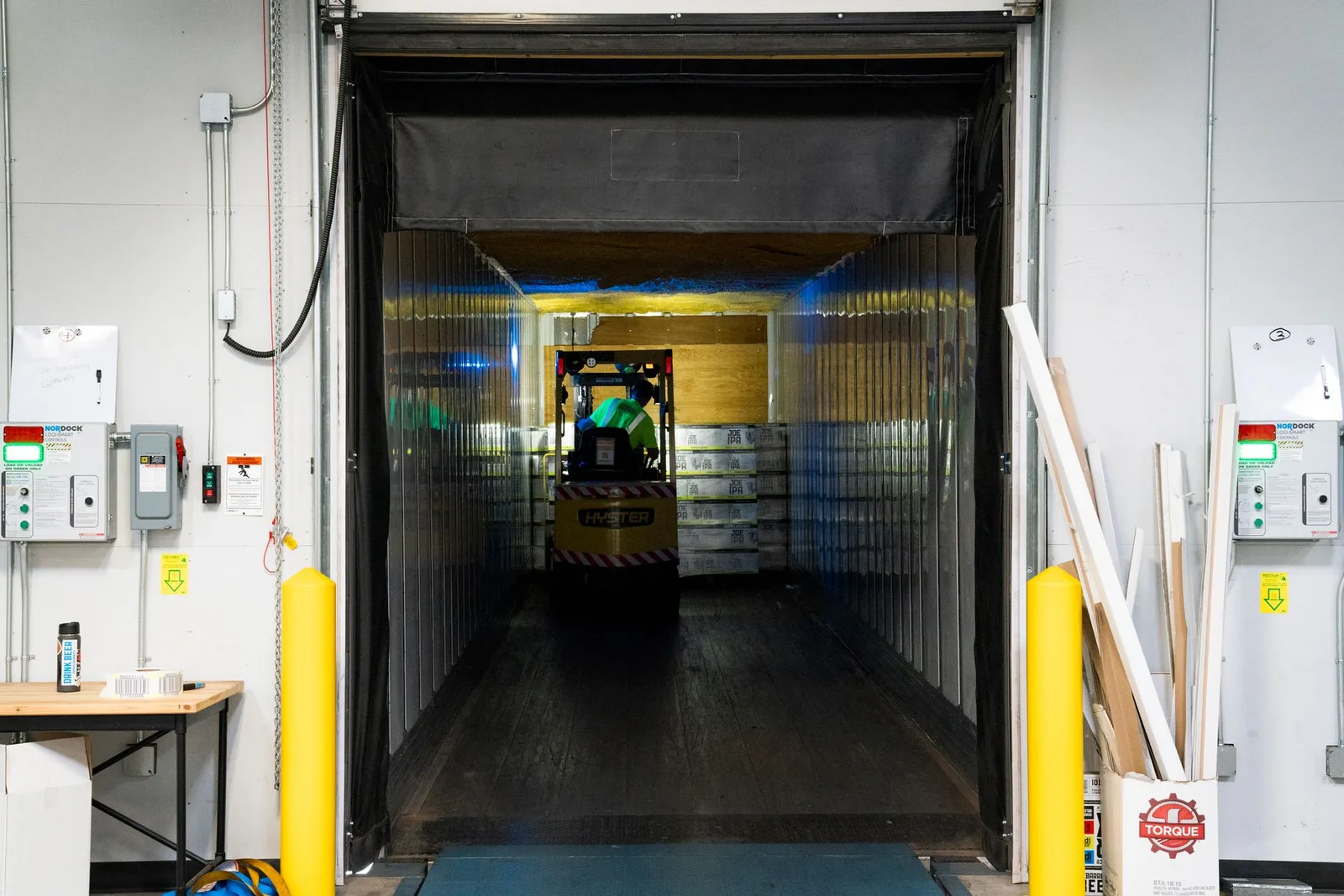
Picture a cold-store anteroom where pallet trucks cross every few minutes. A swinging leaf blocks part of the opening mid-sweep and forces every driver to slow down and judge the arc. A sliding leaf clears the line the moment it starts to move, so traffic keeps its rhythm. Drivers learn the arc of a swinging leaf and slow before it, and that learned hesitation costs more than the door. High-frequency crossings are where the sliding carrier repays its heavier initial hardware fastest.
No Arc Clearance in Front of the Opening
Some openings have no room in front of them at all. Dock faces, narrow yards and interior corridors leave no arc for a swinging leaf without swallowing staging space. A sliding leaf needs depth nowhere, only length beside the opening. If staging pallets already crowd the apron, a swinging leaf will make the crowding permanent. On constrained sites we quote sliding first for this reason, before traffic volume even enters the conversation.
Motorized Cycling at a High Tempo
Powered cycling changes the wear conversation. A hinged leaf on a swing operator works its hinges and frame on every stroke, and the mechanism must reverse a heavy arc each time. A sliding operator drives the leaf along a straight line, which pairs naturally with automated warehouses and repeat duty. Automation amplifies whatever motion you install, including its wear points. Where your operation runs on a motorized open-close rhythm, the sliding carrier fits the duty better.
Any two of the five signals together make the case for an industrial sliding door overwhelming in our experience. One signal alone invites a closer look at the remaining rows of the comparison table. Three or more mean the argument is over before price enters it.
Three Signals That Keep the Swing
The swing door keeps its place for three reasons in our practice, and one of them is not negotiable. Where any of the three applies, we stop steering buyers toward sliding no matter what the traffic analysis says. The order matters, because a fire exit can veto everything else on the page.
Occasional Foot Traffic Between Rooms
Personnel doors between offices and the plant floor cycle a handful of times a day. A hinged leaf costs little, closes positively behind people and needs no track to maintain. Nobody benefits from an industrial sliding carrier on a door that size, and the swing arc costs nothing in a quiet corridor. The swing arc also gives people a door that behaves like every other interior door in the building. Reserve the industrial budget for the openings that actually earn it.
When Airtightness Matters More Than Speed
Sealing behavior differs by motion, and the difference favors the swing where air control dominates. A hinged leaf compresses perimeter gaskets as it shuts, so the seal tightens with closing force. A sliding leaf relies on continuous brush or rubber contact along its track line, which performs well but cannot match a squeezed gasket. Food plants and cleanrooms that prioritize containment over traffic speed keep swing carriers on their controlled openings for this reason. Ask to see seal details in section drawings, not in marketing pages.
The Door Doubles as a Fire Exit
Escape routes override everything else on this page. OSHA’s exit-route door rules in 1910.36(e) require a side-hinged door wherever a room connects to an exit route. The same regulation expects it to open from the inside without a key, a tool or special knowledge. A sliding leaf can fail exactly when it matters most, through track debris or a panel off its rollers, which is why we never treat one as an escape leaf.

The table compresses the trade into working conditions you can name from your own floor plan. Where a row matches your site, treat it as the answer until a stronger signal overrides it. An opening that matches two rows takes the row with the harder constraint. Run the table twice, once for each opening on your plan. Signals beat general rules because your traffic, not the catalogue, decides the duty.
| Working Condition | Better Fit | Why It Wins |
|---|---|---|
| Wide forklift crossing | Sliding leaf | The opening clears completely on every pass |
| Office to plant personnel door | Hinged leaf | Low cycles need simple, positive-closing hardware |
| Cold store anteroom | Sliding leaf | Wide panels clear the line without intruding arcs |
| Designated fire exit | Side-hinged door | 1910.36(e) requires the side-hinged type |
Still Deciding Between Sliding and Swinging for Your Floor?
Send your aisle widths, traffic patterns, and clearance limits, and we will compare both options against each opening on your plan.
Cost and Maintenance Over the Years
Up-front cost and lifetime cost point in opposite directions between the two carriers. An industrial sliding door spends more at the start on track, header hardware and rollers, plus the structural preparation to carry them. A hinged leaf spends less on hardware but borrows floor space every day it swings. The quote only ever shows the first column of that trade. Neither figure stands still, so the honest comparison runs across years of service rather than across quotes.
| Cost Item | Industrial Sliding Door | Regular Hinged Door |
|---|---|---|
| Initial hardware | Costs more, with track, header beam, rollers and optional motor | Costs less, with hinges and a frame |
| Structural preparation | Header capacity or a floor channel comes first | A reinforced frame usually suffices |
| Wear points | Rollers and track surfaces | Hinges and frame alignment |
| Typical failure mode | Dust packing the track or a panel off its rollers | The leaf sagging as hinge load deforms the frame |
| Cost spread over life | Heavier up front, thinner service bills on busy openings | Lighter up front, periodic hinge and frame correction |
Our service records split the failure modes cleanly. Sliding failures concentrate along the track line, where packed dust, worn rollers and the occasional panel off its line account for most callouts. Hinged failures concentrate at the frame, where years of hinge load slowly deform the alignment until the leaf sags. Maintenance budgets should follow that split, with track cleaning on one side and periodic hinge realignment on the other.
Downtime belongs in the same ledger even though no quote line carries it. A jammed track stops one opening, while a sagging hinge stops one leaf and the traffic behind it. Neither failure is catastrophic if wear items are inspected on schedule. Both get expensive when nobody owns the inspection, so put a name next to each line.
Spare parts planning follows the same split between the carriers. A sliding door keeps rollers, brush seals and track liners on its critical list, and most of these swap out without touching the structure. A hinged door keeps hinge sets and frame shims on its list instead. Either way, the parts that wear fastest are also the parts your supplier should hold drawings for. Ask the supplier to list the wear parts with the quote.
Warranty terms reward buyers who plan around the wear points. We back both carriers with a two-year door warranty, and the claims we see almost always trace back to the items in the table. Keep the inspection records, because they shorten every warranty conversation that follows.
Hardware wear deserves the same planning. We cover locking hardware for either type in a dedicated walkthrough, since latches and handles fail by duty class rather than by motion. Put them on the same inspection interval as the carrier wear points and the door stays predictable.
Questions to Ask Before You Commit
Answers matter less than the questions asked at the right time. Two mistakes and one checklist cover most of what goes wrong between a signed quote and a working door. Both mistakes below came off real projects, and both were cheap to prevent. Run them before the purchase order, not after.
Two Mistakes That Show Up Later
The first mistake treats the swing arc as free floor space, and staging racks or pallet queues creep into it within months. The leaf then sweeps into stored goods, or worse, into a person. The second mistake ignores the structure around the opening, where a top-hung track needs real header capacity and a parking run needs clear wall. Header capacity is a structural question, so involve whoever signed off the building frame. Both cost less to fix on paper than in steel.
A Checklist to Hand Your Supplier
Hand the list to whichever supplier wins your trust and ask for written answers. Vague replies to any line are information too, because they show where the supplier stops knowing. Keep the completed sheet with the project file, since it settles disputes later.
- Clear opening width and height, plus the free wall run needed to park the leaf
- Headroom and header capacity for a top-hung track, or floor condition for a bottom channel
- A traffic log covering what passes through, how often, and whether pedestrians share the line
- Every designated escape route on the plan, marked before the carrier is chosen
- Factory inspection records covering speed, noise and insulation resistance
- Delivery scope including installation manual, CAD drawings and wiring diagrams
Suppliers who answer the list in writing have done this before. We build large industrial doors from a single unit with no minimum order, so ask for custom sizes even when the opening is awkward. Our industrial sliding doors ship with an installation manual, CAD drawings and wiring diagrams as standard, and the drawings stay on file for five years. Custom here means measured, engineered and archived, not improvised.
Print the list twice, once for each supplier on your desk. The selection checks that follow in our dedicated guide cover the same ground in more depth. Bring the completed sheet to any follow-up call and the conversation gets shorter. Work through it with your floor plan open and the carrier decision closes itself. Two written answers side by side end most debates before they start.
Frequently Asked Questions
Are industrial sliding doors more expensive than regular doors?
Usually at the start, because track, header hardware and rollers cost more than hinges and a frame. Across years of frequent traffic, the gap narrows as hinge wear disappears and the opening clears faster.
Can a sliding door be used as a fire exit?
Not on a designated escape route. OSHA requires a side-hinged door wherever a room connects to an exit route, and it must open from the inside without a key or tool.
Which door seals better, sliding or hinged?
A hinged door compresses gaskets around its full perimeter, so it seals tighter. A sliding door relies on continuous brush or rubber contact along the track, which works well but cannot squeeze shut.
Do sliding doors need a floor track?
Not always. Bottom-rolling designs run in a floor channel, while top-hung designs carry the leaf from an overhead beam and keep the floor clear apart from a shallow guide slot.
What daily traffic justifies a sliding door?
Frequent forklift or vehicle crossings through a wide opening justify it first. If a swinging leaf blocks part of the opening on every pass, your traffic pays for that arc all day.


