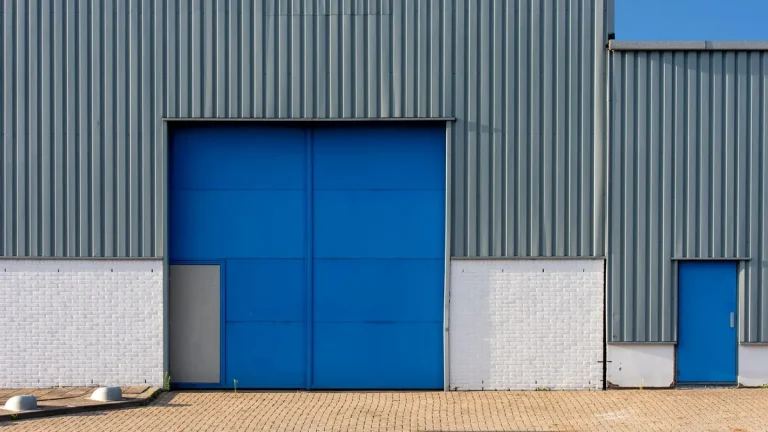







Somewhere a shift starts with a crank. The first person on site wrestles a steel curtain up by hand while a truck idles at the dock, and the last one out hauls it back down. Repeat that across forty openings a day and the effort stops being a nuisance and becomes a roster line. That routine is the quiet reason electric roller shutters keep replacing chain and crank at warehouses, plant entrances, and loading bays.
Our case for the motor is narrower than a brochure’s. Every powered shutter that leaves our factory ships with an inspection report listing four measured lines: opening speed, noise, insulation resistance, and appearance. The first two lines are what a powered upgrade is actually bought for, so speed and noise anchor everything below.
Where Manual Operation Costs You Every Day
A hand-cranked curtain on a wide opening is not a quick job. Slats weigh several kilograms per metre, guides add friction, and a full raise on a tall industrial door eats minutes, not seconds. A motorized curtain clears the same opening in 10 to 15 seconds at standard sizes, and larger doors run 4 to 6 seconds per metre of travel. Over a busy day the gap compounds into queued vehicles and idle staff.
The second cost is the door that never closes. Manual openings get propped open on busy days because shutting them between every forklift pass is nobody’s favorite job. An open industrial door invites dust, pests, and the weather straight into the workspace, and the heating or cooling bill absorbs it.
The third cost is physical. Pulling a heavy curtain several times a shift is exactly the kind of repeated strain that ends in complaints and lost days. A shutter that suddenly feels heavier is a machine telling you its balance is gone; a motor removes that daily fight from the job description entirely.
Noise follows the same ledger. Chain drives and hand cranks rattle against their guides on every cycle, and a curtain dropped the last stretch bangs hard enough to hear across the yard. A motor lowers the curtain on a controlled ramp and runs inside the barrel, so the whole cycle gets quieter, not just faster. That difference is one of the four measured lines on our inspection report, which means you can hold the delivery against the promise instead of arguing about it.

The Control Options Worth Specifying Up Front
Operation is a specification decision, not an afterthought. Powered curtains accept three control families, and the right one depends on how many people move through the building. Choose it during ordering, because adding it after installation means new wiring and new hardware.
| Control family | How it works | Best fit |
|---|---|---|
| Wall switch | Hard-wired rocker or key switch at the opening | Single bays with one trained operator |
| Radio remote | Receiver in the headbox, paired handsets | Yard access, drivers who stay in cabs |
| Group controller | App, timer, or RS485 link to many doors | Rows of industrial doors run as one |
Group control is the industrial advantage. Our door operators ship with WiFi, Bluetooth, and RS485 options in IP65 enclosures, so one panel or one PLC line can run a whole row of industrial doors on schedule. Access control plugs into the same board, which is why a motorized roller shutter doors order should always name its control family in writing.
Safety Limits That Come as Standard
A powered curtain carries more stored energy than any manual one, and European rules write the numbers down. EN 12453 caps closing forces at about 400 N for crushing and 1,400 N for impact, a reading documented in the UK safety regulator’s bulletin on the standard. Those limits turn safety from a sales adjective into a line on a purchase document.
The hardware behind the limits comes in layers. Current sensing watches the motor’s amperage and reverses the curtain on a spike. One installer’s guide is honest that it ships as an upgrade option on some motors rather than a given. Photocells beam an infrared line across the opening and stop the curtain before contact. Soft-start ramps ease the first and last degrees of travel so slats and gearbox age slower.
Compliance is also paperwork. Our powered doors ship with CE EN 13241 and EN 12453 documentation, and the buyer’s responsibility begins at specification, not at delivery. For industrial doors the force limits belong on the purchase document as a named line, because a shutter ordered without the right safety options cannot be retrofitted into compliance cheaply.

Insulation and the Cost of a Door Left Open
An open doorway is a heat exchanger. Warm air leaves through the top, cold air enters through the bottom, and the HVAC plant pays for every minute of it. Manual doors stay open longer because closing them costs effort; a powered curtain closes in seconds after each vehicle or person passes, so the opening time actually shrinks.
The curtain does quiet work too. Our slats roll in galvanized steel or aluminium from 0.8 to 1.5 mm thick, and insulated profiles add a foam core that slows heat transfer through the closed curtain. On our inspection report the insulation resistance line backs that spec with a measured number you can check against the delivery. For a full comparison of curtain build options, the insulated versus non-insulated guide takes that axis further than this one needs to.
Security After the Last Shift
A manual curtain left half-closed is an invitation. A powered one locks itself: an auto-lock engages the moment the motor stops, so the closed curtain cannot be lifted by hand from outside. Closing stops being a two-person ritual at closing time and becomes the last press of a button.
The same board accepts access control. Keypads, badge readers, and timers decide which door opens for whom and when, replacing the padlock-and-chain routine with something that leaves a record. For facilities audited after hours, that record is part of the security case.
The curtain itself keeps earning overnight. A closed face of steel or aluminium slats is a physical barrier that resists prying far better than glazing or a loose curtain left unlocked. Would-be intruders read a sealed, locked front before they try anything. Between the auto-lock, the access log, and the barrier, the last shift ends the same way every night regardless of who locked up.
Still Cranking Doors by Hand Every Shift?
Share your opening sizes, curtain weights, and daily cycle counts, and our engineers will match motor, controls, and curtain to each doorway before you commit the budget.
When Powered Operation Is Worth It
An honest buying guide has to grant that manual still wins sometimes. The decision compresses into three field checks:
- Count the cycles. A storage room opened twice a day rarely justifies a motor; a dock cycling dozens of times cannot justify anything else.
- Weigh the curtain. Light curtains on narrow openings stay manageable; wide, heavy ones fight every raise.
- Count the operators. One trained hand can live with a chain; shared doors and night shifts should never depend on muscle.
Score two or more on the electric side and the motor pays for itself in time and saved backs. That rule of thumb comes from our own order book, and it is shop-floor judgment rather than a law of physics. The full machine-by-machine comparison lives in the guide to manual vs motorized rolling shutters.

Matching the Shutter to Your Opening
Motor sizing is arithmetic, not guesswork. Published torque bands cluster between 10 and 60 Nm for standard curtains and climb to around 120 Nm for wide or heavy ones. Undersizing is the expensive mistake: a motor run at its ceiling all day overheats and ages early, so reputable guidance says increase power rather than limit it.
Industrial spans raise the stakes. Our roller shutter slats roll in galvanized steel or aluminium from 0.8 to 1.5 mm thick, on industrial doors up to 12,000 mm wide. At that span, winding geometry and wind load matter as much as weight. Before ordering any electric roller shutters, check the six items that decide fit: opening dimensions, mounting space, curtain weight, motor capacity, control type, and access to power. The mechanics behind those numbers are explained in the guide to how electric roller shutters work.
What Installation and Upkeep Ask of You
Electric operation adds one trade manual doors never need: a qualified electrician for the fixed wiring. Budget the circuit, the isolation point, and the commissioning visit as part of the purchase, because they are not optional extras in any jurisdiction that inspects its installations.
After that, upkeep is lighter than the motor suggests. The drive unit is fully enclosed against dust and weather, and routine preventative service keeps it there. Put the motor, controls, and safety sensors on the same maintenance schedule as the curtain and the guides, and the system asks little else.
The site work itself, from survey to torque settings to acceptance tests, is an installer’s sequence rather than a buyer’s task. Our guide to electric roller shutter installation walks that procedure step by step, so you know what a competent crew will do to your building and when to sign off.

Questions to Settle Before You Commit
Three questions settle most purchases for industrial doors. Who opens the door, and would you trust them with a chain at 6 a.m.? How many times does it move on a normal day? How wide and heavy is the curtain? Answers in favor of the motor make the upgrade self-funding in saved minutes.
Then ask for the paperwork. Compliance documents, the inspection report, and the warranty terms should arrive with the door, not after you chase them. The UK regulator’s guidance on purchaser duties for work equipment is blunt about the buyer’s share of that responsibility.
One path remains for existing buildings: an old manual curtain can often take a motor, if the slats, barrel, guides, and power supply check out. Whether to retrofit or replace is a decision with its own guide, and the two options deserve that separate look before you commit either budget.
Frequently Asked Questions
Are electric roller shutters worth it for a small shop?
Frequency decides. A light curtain opened a few times a day works fine by hand; doors cycled every hour pay the motor back within a busy trading week.
What happens to an electric roller shutter in a power cut?
The brake holds the curtain exactly where it stopped. A manual override eyelet with a hand crank, or a motor with an emergency release, restores movement until the supply returns.
How much electricity does an electric roller shutter use?
A typical tubular motor draws about 150 W while running, and it runs for only a few seconds per cycle. Even doors cycled dozens of times a day add a small line to the bill.
Can a manual roller shutter be converted to electric?
Often, yes: the motor replaces the manual drive inside the barrel. Curtain condition, guides, weight, and power supply decide feasibility, and the retrofit guide walks that assessment.
How long does the motor on an electric roller shutter last?
Gears and brake parts are built for roughly 20 years of service with scheduled care. Our operators carry a 3-year warranty, and regular checks keep the mechanics healthy well past it.
Do electric roller shutters need a lot of maintenance?
Less than you would expect. The motor is fully enclosed against dust and weather; keep guides clean and put the motor, controls, and sensors on the routine service schedule.