








Two words on a quotation decide how a steel door panel will look and hold up years down the road: color-coated or laminated. Neither term names a coating system, a film type, or a primer, so the choice between laminated vs pre-painted steel doors gets made on price and a color swatch. The two surfaces fail differently, and the wrong one for your building shows up within a few service years.
We manufacture our own door panels, so this comparison gets settled at the roll former and the press rather than in a catalog. Incoming coil is checked at goods-in, and every door leaves the line with a signed inspection report. The finish you approve stays traceable to the panel that arrives.
What Each Finish Actually Is
Both routes start from the same substrate: steel coil, typically galvanized or zinc-aluminum coated, delivered to the line in rolls. What changes is how the surface gets there. Pre-painted steel is coil-coated: liquid paint goes on and cures at high temperature before the sheet is ever cut. ASTM A755/A755M describes the systems as a primer coat covered by top coats such as polyester or fluoropolymer.
Laminated metal takes the physical route. A factory-bonded film of PVC, PET, or PP is pressed onto the metal under heat and pressure. Published comparisons put the film at roughly 100 to 200 µm, against about 10 to 150 µm for most liquid paint systems. When the decision is framed as laminated vs pre-painted steel doors, one route buys a bonded film and the other buys a paint system.
Underneath either surface, the base metal does the structural work. The metallic layer beneath the finish, zinc or aluminum-zinc, sacrifices itself first when corrosion takes hold. Our guide to roller shutter slat materials covers how the substrate metals compare for industrial doors, so this page stays on the finish itself. Get the substrate right first, because no finish repairs a weak base.

How Each Surface Ages in Service
A painted panel usually tells you it is aging. Ultraviolet light breaks the resin down, gloss drops, and the surface chalks before the color finally drifts. Commonly published service bands for outdoor topcoats run about 5 to 8 years for standard polyester in clean air, and 20 to 25 years for PVDF. The mid grades, silicone-modified and high-durability polyester, land between those poles at 10 to 15 years.
Those bands are starting ranges, not warranties, and the environment sets how fast a panel burns through them. ISO 12944-2 sorts exposure sites into corrosivity categories, from dry indoor air up to coastal and industrial atmospheres, and that classification drives which protective system belongs on the steel. A warehouse bay inland and a loading dock on the coast are different specification problems.
Scratches and cut edges are where panel corrosion starts first, whichever finish you specify. A film seals the face completely, but once a deep scratch cuts through, rust creeps under the film where you cannot sand it out. Paint gives way to chalking first, yet a scratch through paint can be cleaned, primed, and touched up.
Film behaves differently. PVC film suits ambient temperatures, while PET and PP films carry better heat resistance, and UV exposure eventually yellows or dulls the cheaper films. The failure you will see first, though, is mechanical: grit, straps, and forklift contact cut the film, and the wound collects corrosion instead of weathering gracefully.

Planning maintenance around the right failure mode saves money. A painted panel gets an inspection for chalk and gloss, and a touch-up cycle before the substrate shows through. A film panel gets an inspection for cuts and impacts instead, with swaps planned for the few panels that take real damage.
Forming, Edges, and Fabrication Behavior
Door panels are not flat sheets for long. They get ribbed for stiffness, embossed for texture, bent into edge profiles, and roll-formed into slats on industrial doors of every size. A finish that cannot follow the metal will show it.
Three fabrication questions separate the routes:
- Deep draws and tight bends: the bonded film stretches with the metal, while paint films can micro-crack and start hidden corrosion.
- Embossing and texture: film takes patterns cleanly, and paint depends on the elasticity of the liquid system used.
- Cut edges: whatever the finish, edges rely on the substrate’s metallic coating or an edge seal to stay ahead of rust.
Repairability closes the fabrication argument. A scratched paint film can be sanded, primed, and touched up on site with a matching repair kit. A damaged film cannot be spot-repaired invisibly, so a panel that lives around forklift traffic needs either sacrificial logic or a film grade specified for impact.
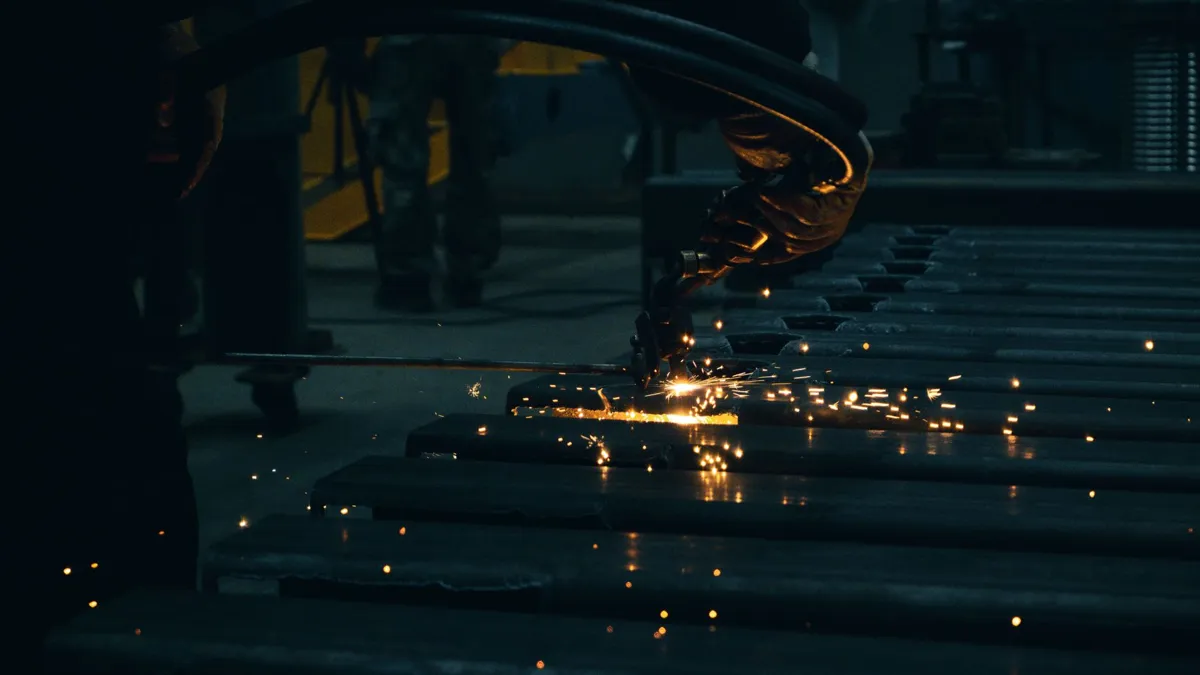
In our production, edge handling is decided at quoting rather than on the shop floor. Sheared edges on pre-painted coil keep the metallic coating intact when the blade is sharp and the settings are right. Deep-ribbed film panels get their cut edges sealed before assembly. Neither step costs much; skipping both is how premature rust starts.
Cost, Lifespan, and Ownership Math
The most misunderstood layer on a pre-painted panel is the one you cannot see. The primer under the topcoat carries roughly 80 percent of the system’s corrosion protection, according to coil-coating engineers. Judging a panel by topcoat color alone therefore misses where the rust fight actually lives. That is why two quotes in the same color can behave differently within the same year.
What the Panel Comparison Shows
The table condenses the decision into the criteria that actually move door projects. Read it as starting points for a specification conversation rather than a verdict, because the environment row overrides the rest. Both routes are mature; the difference is which failure mode you prefer to manage.
| Criterion | Laminated panel | Pre-painted panel |
|---|---|---|
| Surface build | Bonded PVC, PET, or PP film, roughly 100–200 µm | Primer plus liquid topcoat, roughly 10–150 µm |
| Forming | Stretches with deep draws and embossing | Micro-cracks possible on tight bends and deep ribs |
| Aging | UV dulling or yellowing on cheaper films; impact wounds | Chalking and fading on a published timeline by resin |
| Repair | No invisible spot repair; panel or skin swap | Sand, prime, and touch up on site |
| Best fit | High-traffic interiors, wash-down and impact bays | Sheltered exteriors and standard warehouse openings |
| Cost posture | Higher initial material cost, lower surface maintenance | Lower initial cost, touch-up and repaint over the years |
None of that changes the arithmetic of a standard bay. Most openings live sheltered lives where a mid-grade pre-painted system with a sound primer meets the building’s expectations. The choice between laminated vs pre-painted steel doors only turns expensive when the bay itself is abusive. Match the finish to the duty, and both routes stay economical.
Which Finish Belongs on Your Doors?
Tell us the opening size, the site environment, and the duty the bay sees, and we will quote the panel finish that fits, including stainless for the harshest bays.
Which Environments Favor Which Finish
The door’s job, not the brochure, decides the finish. That is the short version of the laminated vs pre-painted steel doors question, and it holds across the industrial doors we quote each week. Three site patterns cover most cases.
Where Laminated Panels Earn Their Premium
Busy interior bays punish surfaces. Impactable openings, wash-down zones in food plants, and doors that take trolley contact every shift all favor a bonded film. The thicker layer absorbs the scuffs a paint film would record permanently. In our experience, film-faced panels hold their appearance longest exactly where traffic and cleaning never stop.
Film also wins the appearance argument where owners want wood grains, stone textures, or metallic finishes, which liquid paint cannot match without custom work. Interior office-adjacent bays and customer-facing facades live in that territory. The trade-off stays the same: the premium is real, and so is the film’s inability to hide a deep wound.
Where Pre-Painted Steel Stays the Default
Standard warehouse openings with light-to-moderate cycling remain pre-painted country. The surface sees weather and occasional scuffs, the mid-grade systems reach their published service bands comfortably, and repaint or touch-up stays cheap. In our practice, coastal specifications move up the topcoat ladder, typically to PVDF, before film enters the conversation.

Cut-edge discipline belongs in both columns. Whatever the finish, ask how the fabricator handles sheared edges, punched holes, and fastener penetrations, because that is where the substrate’s metallic coating earns its keep. A well-handled edge on a mid-grade system beats a premium film over a careless cut. If the open question is whether the door leaf should be aluminum at all, our comparison of aluminum versus steel doors settles that axis separately.
How to Verify the Finish Before You Commit
Verification starts with three lines in writing. First, the system: for pre-painted panels, the primer plus topcoat family, named rather than summarized as color-coated. Second, for laminated panels, the film type and its thickness. Third, the substrate’s metallic coating and how cut edges will be handled. A supplier of industrial doors who states all three has nothing to hide.
Then put the check where it cannot drift. Ask for a batch sample of the actual coil or panel, not a brochure chip, and keep it beside the order. Every door we ship travels with a signed inspection report, so the specification you approved has a paper trail at delivery. If you are still weighing overall build quality, our guide to judging industrial doors by price per kilo handles that axis separately.
That is what turns laminated vs pre-painted steel doors from two vague words into a specification you can hold. Name the system, name the film or the paint family, and keep the batch sample. The debate ends at the loading dock, where the panel either matches the paperwork or does not.
Frequently Asked Questions
These six questions cover what buyers ask about finishes on industrial doors most often, from aging to the paperwork.
In the laminated vs pre-painted steel doors decision, which finish lasts longer?
Neither wins unconditionally. Painted panels chalk on a published timeline that depends on the resin grade, while films resist weathering but fail mechanically at scratches. The environment and the duty decide.
How thick is a laminated film compared with paint?
Published manufacturer comparisons put bonded films at roughly 100 to 200 µm and most liquid paint systems at about 10 to 150 µm. The film is the thicker, more uniform layer.
Can you repaint or repair a laminated steel panel?
A damaged film cannot be spot-repaired invisibly; the panel skin usually gets swapped. Scratches in paint can be sanded, primed, and touched up on site with a repair kit.
Does the primer matter as much as the topcoat?
More. Coil-coating engineers attribute roughly 80 percent of a system’s corrosion protection to the primer, so a cheap primer under a premium color is a false economy.
Which finish suits a coastal or high-chloride site?
Move up the topcoat ladder first, typically to PVDF, and confirm cut-edge handling in writing; in harsh marine exposure a stainless industrial door removes the coating question entirely.
What paperwork should come with the panels?
The named coating system or film type, the substrate and its metallic coating, and a signed inspection report at delivery, with CE EN 13241 evidence for the complete door.


