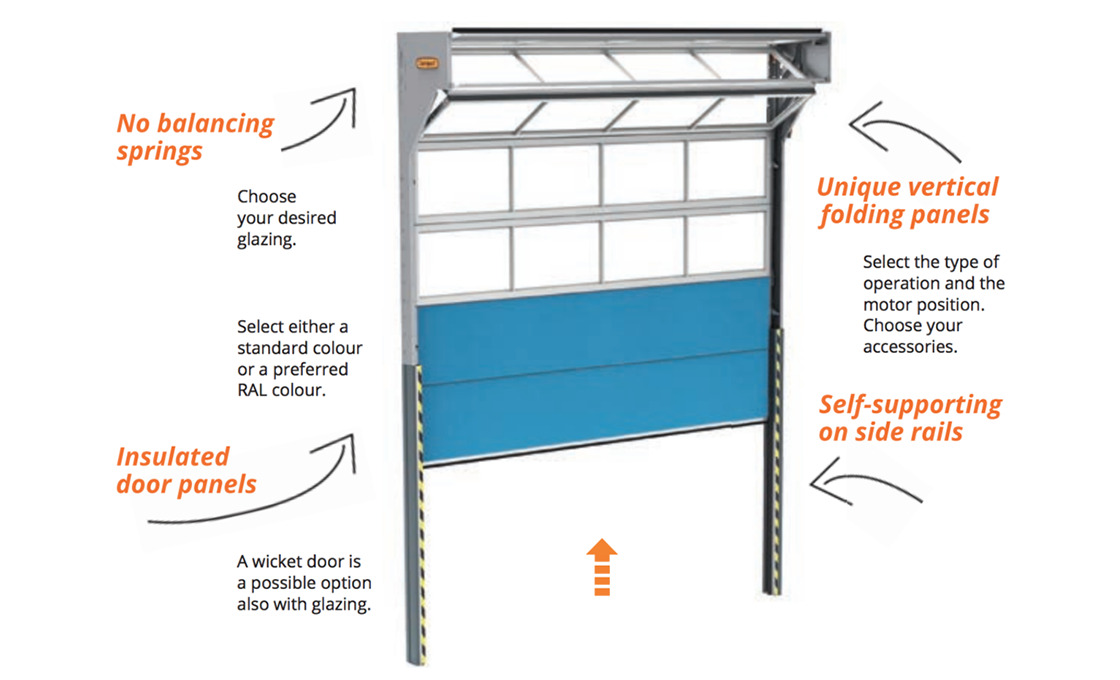
The Vertical Lift Sectional Door is engineered for openings with generous headroom where maximum clear height is critical — aircraft hangars, fire stations, heavy-equipment workshops and tall logistics bays. Unlike a standard-lift door that turns horizontal beneath the ceiling, a vertical-lift door’s panels rise straight up on extended vertical tracks with no horizontal run, preserving the full opening height for tall vehicles and equipment.
RAX manufactures vertical-lift sectional doors to any opening size (custom engineered to your specification), using 40–50 mm PU foam insulated panels with galvanized steel skins (0.4–1.5 mm) and high-cycle torsion springs validated in our 100,000-cycle fatigue lab. The vertical track system uses 2.0 mm formed steel channel (industry benchmark from CN-export listings, ecer.com) with nylon PA66 rollers for quiet, low-friction travel. Wind resistance is classified per EN 12424/12444 (Class 0–5).
RAX-company facts on this page are from the approved brand brief. Industry benchmark values are attributed to their sources (Hörmann via renrendoc.com; CN-export listings via ecer.com; EN standard scopes via antpedia.com / baijiahao). RAX product-specific test data (U-value, wind class, fire rating) is confirmed per project.
Custom width × height, RAL color and configuration. Large industrial doors from prototype to container-load, full flexibility on order quantity.
Validated against a 100,000-cycle fatigue testing protocol in our in-house lab.
ISO 9001:2015 and CE to EN 13241 / EN 12453, with SGS material reports.
English manual + wiring diagrams; operators pre-set before dispatch.
| Product | Vertical Lift Sectional Door (also: Vertical Lift Industrial Door · Full-Height Sectional Door) |
| Category | Sectional Doors |
| Lift type | Vertical lift — panels rise vertically on extended tracks with no horizontal ceiling run |
| Panel thickness | 40–50 mm PU foam (RAX capability). Benchmark: 40–42 mm typical industrial |
| Steel skin | Galvanized steel 0.4–1.5 mm |
| Track | Extended vertical steel channel (2.0 mm benchmark, CN-export ecer.com); nylon PA66 rollers |
| Size range | Custom — vertical lift suits tall openings (hangars, fire stations). Confirm max height with engineers |
| Headroom required | Full door height + mechanism clearance above lintel (no ceiling track run) |
| Torsion spring | High-cycle; 100,000-cycle fatigue validated. Benchmark: 30,000 cycles (CN-export) |
| Wind resistance | EN 12424/12444 Class 0–5. Benchmark: 450 N/m² ≈ Class 3 (ecer.com) |
| Power | AC 220–240 V / 380 V, 50/60 Hz. Shaft-mounted or chain-drive operator |
| Safety | Anti-drop brake, finger-safe joints (EN 12453/12604), photo-eye, bottom air-bag |
| Certification | CE EN 13241 / EN 12453 (held); ISO 9001:2015; SGS reports |
| Order | Custom engineered to your size and specification |
Vertical lift requires headroom equal to the full door height plus approx. 300–500 mm for the mechanism above the lintel. Confirm your building’s clear internal height before specifying.
For hangars and fire stations, 40–50 mm PU panels provide thermal and acoustic insulation. Specify RAL color and surface profile (flat/ribbed) for visual consistency with the building envelope.
Large vertical-lift doors face significant wind load. Specify your site’s design wind pressure; we classify per EN 12424 (Class 0–5) and reinforce tracks/panels accordingly.
Choose shaft-mounted or chain-drive operator. For fire-station or rapid-response use, specify high-speed operation with VFD control. WiFi/RS485 remote and radar sensing available.
RAX supports full private-label production of the Vertical Lift Sectional Door: custom RAL panel colors, operator matching, packaging printing and installation-manual translation (EN/ES/FR/AR/RU). Start with an OEM sample and scale to container-load branded production. Custom molds, Tooling records are archived for up to 5 years — no extra tooling fee on repeat orders, all under strict NDA.
Product standard for industrial doors — CE marking basis. Covers structural strength, operating forces, durability, thermal and wind performance.
Wind load classification (Class 0–5) and test method. Critical for large vertical-lift doors exposed to wind. Class 5 = >1000 Pa by special agreement.
Mechanical safety (tracks, springs, anti-drop) and power-operated safety (force limits, entrapment protection).
A standard-lift door turns horizontal after the vertical rise and parks beneath the ceiling. A vertical-lift door’s panels continue rising vertically on extended tracks with no horizontal run — preserving full ceiling clearance. Vertical lift requires headroom equal to the full door height plus mechanism space.
Approximately the full door height plus 300–500 mm above the lintel for the spring shaft and track hardware. This makes vertical lift ideal for buildings with tall internal clearance (hangars, fire stations) but unsuitable for low-ceiling structures.
RAX produces to any feasible engineering size (custom engineered to your specification). Industrial vertical-lift doors commonly exceed W8000 × H6000 mm. Share your opening dimensions and our engineers confirm the maximum span with technical drawings.
Depends on your site exposure and local code. EN 12424 classifies Class 0–5; a CN-export benchmark lists 450 N/m² (approx. Class 3). For coastal or high-wind sites, Class 4–5 may be required. RAX confirms the class per project.
No — RAX is a pure manufacturer. Orders ship with English manual, wiring diagrams and pre-set operators. Remote technical support available during installation.
Door body 2 years, operator/motor 3 years (servo 5 years). Free spare parts within warranty, DHL/FedEx 5–7 days. Lead time: standard container 12–20 days; custom first order 20–35 days.
Or email info@raxdoor.com
Send your opening size and duty requirements — we reply with a proposal and lead time.