- Choosing the Right Stainless Grade for Kick Plates
- Why Cleanroom Traffic Demands Heavy Duty Protection
- How Chloride Disinfectants Attack Type 304 Steel
- Matching Surface Finish to Your Cleanroom Class
- What Molybdenum Changes in Type 316 and 316L
- Why Flush Mounting and Welded Seams Beat Fixings
- What the 316L Price Premium Actually Buys
- Where Each Grade Fits in Your Facility
- Frequently Asked Questions
Choosing the Right Stainless Grade for Kick Plates
Type 316L is the right specification for cleanroom door kick plates in zones cleaned with chloride-based sporicidal agents, while type 304 suits areas limited to neutral detergents. The deciding factor is molybdenum, the alloy addition that shields the passive film on cleanroom door systems from chloride attack. The sections below put numbers on that decision, covering chloride thresholds, the pitting mechanism, surface finish, mounting details, and the price premium that 316L carries.
Why Cleanroom Traffic Demands Heavy Duty Protection
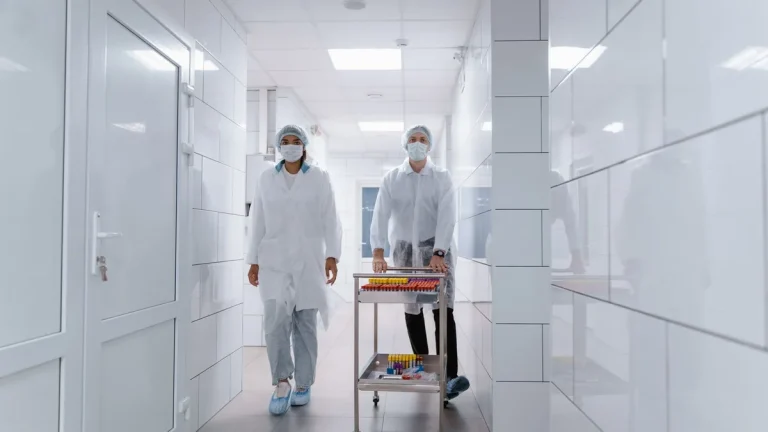
Material transfer carts and loaded trolleys strike the lower part of a door leaf all day long in a working facility. A single deep puncture through the door skin exposes the insulation core and can ruin the entire panel assembly. A kick plate exists to absorb that damage instead of the door, so its mechanical specification matters as much as its metallurgy.
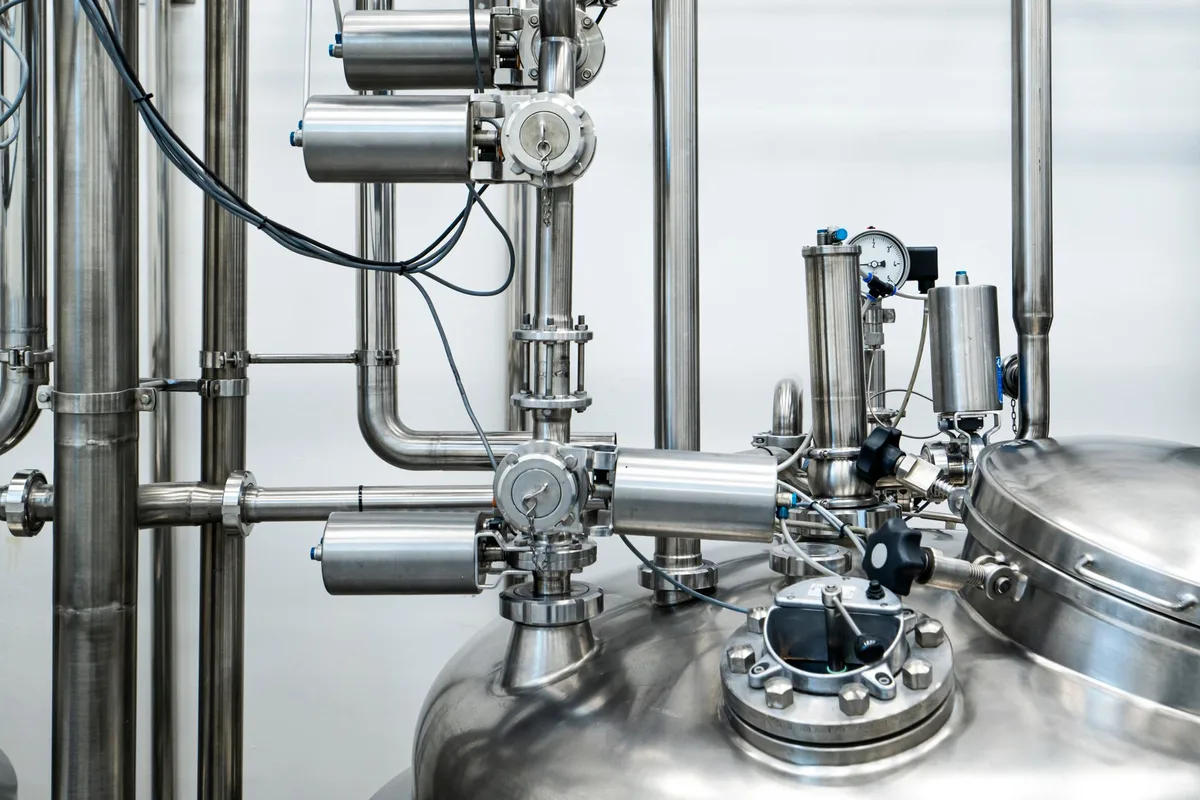
When sizing the plate, treat the door as part of the material flow, not as an architectural afterthought. Our preventative maintenance checklist recommends inspecting the lower leaf zone at every service interval, because early dents are cheaper to correct than punctured panels. The following baseline specification holds up under typical hospital and pharmaceutical cart traffic:
- Loaded stainless transfer carts commonly exceed 300 kilograms, so the plate must be thick enough to spread the impact rather than dent on the first glancing blow.
- Specify a plate thickness of at least 1.5 millimeters, which corresponds to 16-gauge sheet, for doors on active material routes.
- Extend the plate to a minimum height of 400 millimeters so it covers the bumper height of standard carts and pallet jacks.
- Back the plate with a high-density door core so impact energy disperses into the leaf instead of deforming the airtight perimeter gasket.
How Chloride Disinfectants Attack Type 304 Steel
Type 304 is the everyday workhorse of stainless steel, built on roughly eighteen percent chromium and eight percent nickel. The chromium reacts with oxygen in air and moisture to form an invisible passive oxide film that self-repairs when lightly scratched. In a dry corridor cleaned with neutral detergent, that film keeps the surface bright for the life of the door.
Sporicidal cleaning breaks this balance. Sodium hypochlorite bleach and other chlorine-releasing disinfectants flood the surface with chloride ions, which penetrate the passive film and form soluble metal chlorides at localized weak points. Each penetration site grows into a pit, and the pit concentrates both chemical attack and mechanical stress. Corrosion engineers at AMPP, the association formed from NACE International, rank pitting and crevice attack as the two failure modes most sensitive to chloride concentration, because both are hard to spot during routine inspection.
Crevice corrosion makes the door hardware worse than a flat coupon. Under deposits, gasket lines, and the gap at a plate edge, oxygen access is restricted, so the trapped liquid turns acidic and chloride-rich. That microenvironment keeps dissolving metal even after the floor has been rinsed and dried. A face-fixed kick plate creates exactly these shielded zones along its perimeter.
The failure timeline is measured in months, not years. Field experience with chloride-bearing disinfectants shows rust spotting and pitting on 304 hardware within months of exposure, long before its structural life is over. The arithmetic explains why: type 304 begins pitting at roughly 200 to 500 ppm of chloride, while working solutions of chlorine-based disinfectants commonly run between 1,500 and 3,000 ppm. Evaporation at the lower door zone concentrates the residue further between wipe-down cycles. Before fixing a disinfectant rotation, review your door cleaning validation and disinfectant compatibility plan so the hardware alloy and the chemical regime are matched from the start.
Pitting damage is also expensive to reverse. Once chloride pits form, the standard remedy is mechanical refinishing followed by chemical passivation, and the door is out of service while it happens. A correctly specified alloy avoids that maintenance cycle entirely.
Matching Surface Finish to Your Cleanroom Class
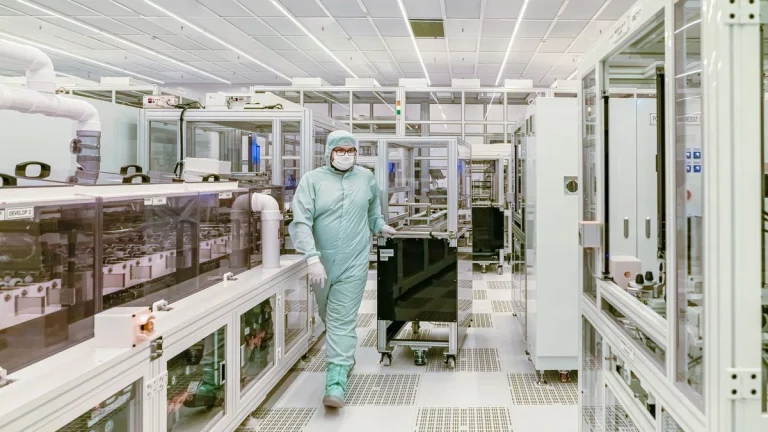
Corrosion resistance alone does not make a surface cleanable. Every mechanically polished plate carries microscopic peaks and abrasive scratches where spores and organic residues lodge. The rougher the surface, the harder the sanitation team must work to hold the room within its ISO 14644-1 cleanliness class. Particles released from the door leaf re-enter the air stream with every door swing.
Electropolishing removes those defects rather than covering them. It is an electrochemical treatment, not an abrasive one. The process works in three stages:
- Technicians submerge the finished plate in a heated acidic electrolyte bath.
- A controlled electrical current dissolves the microscopic peaks of the surface preferentially.
- The result is a passivated finish with a Roughness Average (Ra) typically below 0.4 micrometers, with no embedded abrasive to trap residue.
For Grade A and Grade B aseptic areas, specify electropolished hardware on every surface that wipe-down crews touch. The smoother the plate, the shorter the contact time needed per cycle. Shorter cycles also mean a lower risk of a failed swab test. That margin matters most in rooms audited to the strictest classes.
What Molybdenum Changes in Type 316 and 316L
Molybdenum is the alloying element that separates a chemical-grade plate from a general-purpose one. Added at two to three percent, it stabilizes the passive film so chloride ions can no longer break it down at weak points. The table below summarizes how the two grades differ in composition and behavior:
| Alloying Element | Type 304 | Type 316 / 316L | Role in Kick Plate Performance |
|---|---|---|---|
| Chromium | 18% | Typically 16 to 18% | Builds the self-repairing passive oxide film |
| Nickel | 8% | Typically 10 to 14% | Stabilizes the structure and improves ductility |
| Molybdenum | None | 2 to 3% | Blocks chloride penetration and pitting corrosion |
| Carbon | Up to 0.08% | Up to 0.03% in the L grade | Prevents carbide precipitation during welding |
Engineers compress this chemistry into a single figure, the Pitting Resistance Equivalent Number (PREN). It is calculated as the chromium percentage plus 3.3 times the molybdenum percentage plus 16 times the nitrogen percentage. On typical compositions, type 304 scores about 18 to 20, while type 316 scores about 23 to 26, and the gap is driven almost entirely by molybdenum. A higher PREN correlates with resistance to pit initiation, which makes it a more honest selection tool than the phrase “better corrosion resistance” on a datasheet.
Do not upgrade to 316 for strength. Tensile strength, yield, and elongation are nearly identical across the two grades, so a thicker 304 plate beats a thinner 316 plate on impact at lower cost. The only engineering reason to pay for molybdenum is the chloride chemistry described above.
The L designation deserves attention on any welded assembly. When carbon-rich steel passes through welding temperatures in the 450 to 850 degree Celsius range, chromium carbides precipitate at the grain boundaries and leave those zones starved of chromium. The sensitized weld line then corrodes first, even when the surrounding plate performs well. Low-carbon 316L, capped at 0.03 percent carbon, removes that failure path, which is why it is the default grade for welded cleanroom hardware.
Specifiers often ask whether plain 316 without the L suffix is acceptable. It resists chloride pitting equally well in the base metal. Any welded plate, however, carries the sensitization risk described above, so the L grade remains the safer call for hardware that leaves the factory welded.
Why Flush Mounting and Welded Seams Beat Fixings
Bolting a plate onto the face of the door creates a horizontal ledge along its top edge. Airborne dust and shed skin cells settle on that ledge during every idle hour, and gravity guarantees the deposit. A ledge only a millimeter proud of the surface can hold a measurable microbial load within weeks. Wipe-down crews cannot fully reach the crevice where plate meets door skin, and that same crevice is where crevice corrosion starts.
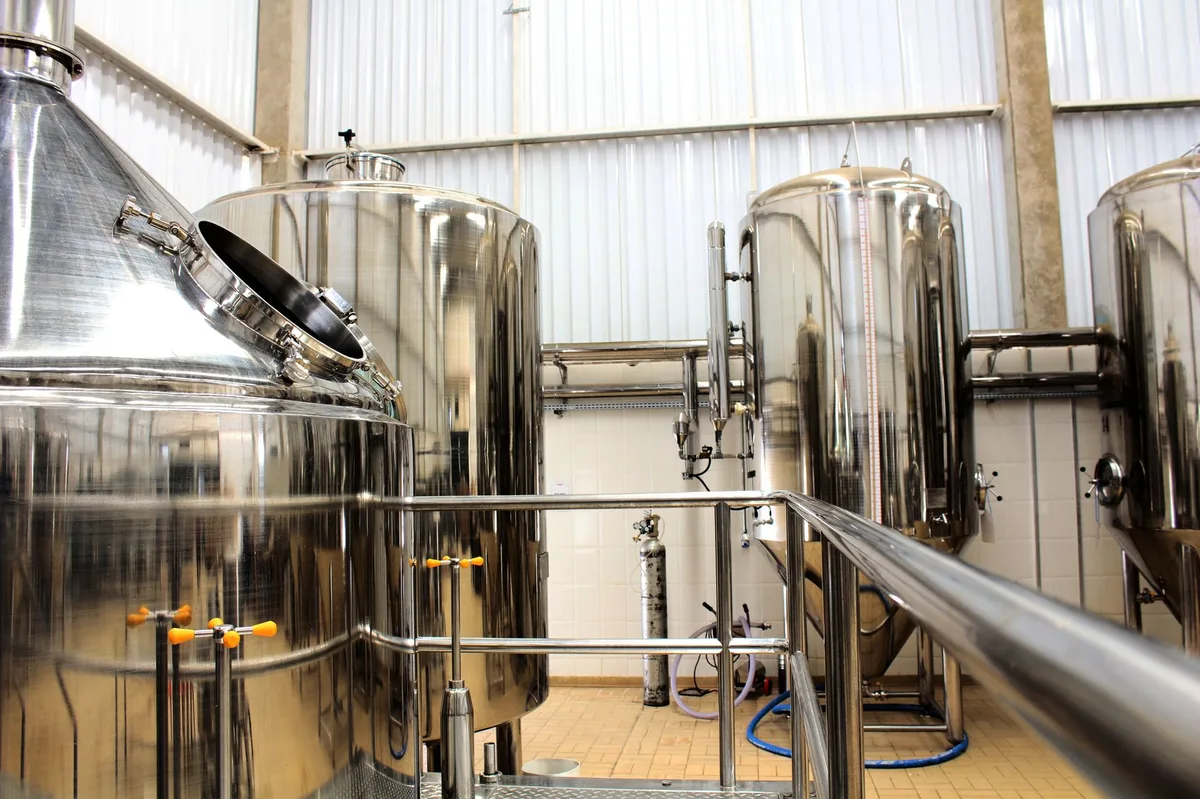
The engineering answer is to recess the lower section of the door core during fabrication, so the plate sits level with the surrounding skin. A flush profile leaves no step to collect soil and presents a single continuous plane to the mop. This is the same principle behind our flush cleanroom door design standards, where every fitting on the leaf is either recessed or bonded into the panel. Any plate that stands proud of the door face should be treated as a design concession, not a feature.
Attachment decides whether disinfectant can reach the door core. Screws punch through the skin and leave gaps around every fastener. Double-sided tape and liquid adhesives create a hidden channel at the plate edges, and capillary action pulls liquid disinfectant into that channel during every wet cycle. The trapped liquid then stagnates in the dark, warm gap where microbial growth is fastest. Hygienic design guidance published by the 3-A Sanitary Standards organization applies the same logic to food equipment: eliminate the crevice, not just the visible soil.
| Attachment Method | Crevice Created | Suitability for GMP Zones |
|---|---|---|
| Mechanical screws | Gap around every fastener plus the recessed head | Not suitable |
| Double-sided VHB tape | Hidden channel along all plate edges | Not suitable |
| Liquid adhesive bonding | Uncontrolled bond line that can trap solvent and liquid | Not suitable |
| Continuous laser weld | None, the perimeter is fused metal | Suitable |
A continuous weld around the plate perimeter fuses the plate to the door skin into one metal body. There is no gap to wick liquid, no fastener heads to decontaminate, and no adhesive to age. For pharmaceutical and sterile manufacturing doors, welded attachment should be treated as the baseline requirement rather than an upgrade. Weld quality matters as much as weld type, because a stitch weld leaves the same gaps as tape. Insist on a continuous seam that has been inspected along its full length before the door leaves the factory.
What the 316L Price Premium Actually Buys
Procurement teams hesitate at the 316L line item, so put the premium in perspective. At the mill, 316L typically runs 20 to 30 percent more per kilogram than 304, depending on market conditions and form. Material, however, is only one share of a finished welded plate assembly, so when the premium is amortized across fabrication, polishing, and fitting, the difference on the door line item usually lands in the range of 5 to 10 percent. Ask any bidder to state the alloy grade per door so a silent substitution cannot erase the difference.
Now set that premium against the cost of the wrong grade. Refinishing pitted plates means mechanical polishing, chemical passivation, and door downtime, and the cycle repeats as long as the chemistry stays in rotation. Add a failed swab test or a cleaning validation finding, and the saved premium is gone several times over. In a corrosive regime, the cheaper alloy is the expensive one.
The reverse also holds, and honest specifiers say so. A 316L plate earns its premium wherever hypochlorite or peracetic acid appears in the rotation, and it wastes budget in a detergent-only corridor where 304 delivers the same service life. Over-specifying an entire facility on one grade is a procurement convenience, not an engineering decision.
Where Each Grade Fits in Your Facility
Alloy selection becomes simple once the door is sorted by the chemistry and moisture it will actually face. The verdicts below can be lifted straight into a specification. Match the plate to the zone using these rules:

- Type 304 is best for technical corridors, airlocks, and support rooms where total chloride exposure stays below roughly 200 ppm and cleaning uses neutral detergents or quaternary ammonium products, and it is not for any zone whose rotation includes chlorine-based sporicidal agents.
- Type 316L is best for pharmaceutical aseptic suites, sterile packaging areas, and any zone using hypochlorite, peracetic acid, or vaporized hydrogen peroxide cycles, because its PREN of about 23 to 26, against 18 to 20 for 304, survives the chemistry that pits 304 within months.
- Electropolished 316L with welded, flush-mounted plates is best for food and pharmaceutical wet areas subject to daily washdown, and it is not worth the premium in dry, mildly cleaned rooms where 304 meets the same duty at lower cost.
If one facility mixes these zones, specify the alloy door by door rather than standardizing the whole project on a single grade. Document the alloy choice per door in the line schedule so contractors cannot substitute a lower grade at procurement. That single line of paperwork is what turns this comparison into an enforceable specification.
Frequently Asked Questions
Why does 304 stainless steel rust in cleanrooms?
Type 304 contains no molybdenum, so its passive chromium oxide film is vulnerable to chloride ions. Chlorine-releasing disinfectants and vaporized hydrogen peroxide break the film down at weak points, producing pitting and the reddish-brown rouging dust that contaminates the air stream.
How much chloride can type 304 tolerate before pitting?
Published selection guides put the pitting threshold for 304 at roughly 200 to 500 ppm of chloride, while 316L holds to about 1,000 to 2,000 ppm. Working solutions of chlorine-based disinfectants commonly exceed 1,500 ppm, which is why 304 fails in sporicidal zones.
How much more does 316L cost than 304?
Raw 316L typically carries a 20 to 30 percent premium per kilogram at the mill. Amortized across a finished welded and polished door, the difference usually lands between 5 and 10 percent of the line item, far less than one refinishing cycle on pitted plates.
What is a flush-mounted cleanroom kick plate?
A flush-mounted plate is recessed into the door leaf during factory fabrication so its surface sits level with the surrounding skin. This removes the horizontal ledge that a face-fixed plate would otherwise present to settling dust and microbes.
Can you glue or tape a kick plate to a pharmaceutical door?
No. Adhesives and tapes leave a hidden channel at the plate edge, and liquid disinfectant wicks into it during every wet cycle. The trapped liquid stagnates and supports microbial growth, so continuous welded attachment is the baseline for GMP zones.
What does an electropolished finish actually do?
Electropolishing dissolves the microscopic peaks of the surface in an acidic electrolyte bath, producing a finish with a Roughness Average typically below 0.4 micrometers. With no abrasive scratches left behind, spores and residues have nowhere to lodge and wipe-down cycles get shorter.
Every door in this guide is built in-house at RAX Door Technology, a source factory operating in Renqiu, Hebei since 1999 and shipping to more than 70 countries. We fabricate custom 304 and 316L cleanroom doors with flush kick plate integration, PLC interlock control, and export-grade packing for overseas projects. If you are weighing alloy grades for an upcoming build, send our engineering team your door schedule and disinfectant list. We will return a quotation with drawings and a full submittal package.