
A commercial building asks more of its garage doors than any other opening. Loading docks run forklifts through them all shift, security systems count on them after hours, and the energy budget leaks or holds at every panel joint. Facilities managers do not pick favorites the way homeowners do; they keep the door that passes three audits at once. Traffic, security, and the heating bill — and in commercial buildings the door that keeps passing all three is usually a steel sectional garage door.
The popularity is not fashion. A sectional garage door solves all three in one assembly. Rigid steel panels bring strength and security; a ceiling track replaces the swing arc; an insulated core turns the opening into a wall when closed. Each reason is worth a number and a mechanism, and the article takes them apart one by one. RAX builds its sectional line as 20 configurable products under one quality system, and every unit passes factory acceptance checks before it ships.
Installing the door rather than choosing it? The professional installation checklist covers the whole sequence from opening verification to EN 12453 handover.
The Reasons at a Glance
The five reasons, each with what it does and who feels it, fit in one table. The sections after it give the mechanics and the numbers behind each row.
| Reason | What it does | Who feels it |
|---|---|---|
| Strength under traffic | Steel panels and rated springs absorb industrial use | Dock crews and maintenance budgets |
| Vertical operation | Door travels the ceiling, not the floor or the aisle | Layout planners and forklift drivers |
| Insulation | Polyurethane core seals the thermal boundary | Energy bills and temperature-sensitive stock |
| Security | A steel barrier that does not yield to hand tools | Insurance assessors and night security |
| Fit everywhere | Standard to oversized openings, styled or plain | Architects and facility engineers |
Strength Under Daily Industrial Traffic
Strength is the first reason sectional garage doors get specified, and the one every buyer checks. A sectional door is a sandwich of steel faces around a core, and the steel carries the load. Forklift glancing blows, wind on an exterior wall, panels flexing along a track thousands of times a year — the faces take all of it. The hardware is rated for that life: RAX torsion springs are specified for at least 30,000 cycles. That is a busy dock door over years of shifts, not weeks.

Compare the alternatives and the reason sharpens. Fabric curtains flex beautifully but cut; aluminum panels resist rust but cost more for the same rigidity. Steel sectional doors hold the middle that industry lives in: strong enough for exterior duty, repairable panel by panel, and priced for a whole dock face.
Vertical Operation and Headroom Savings
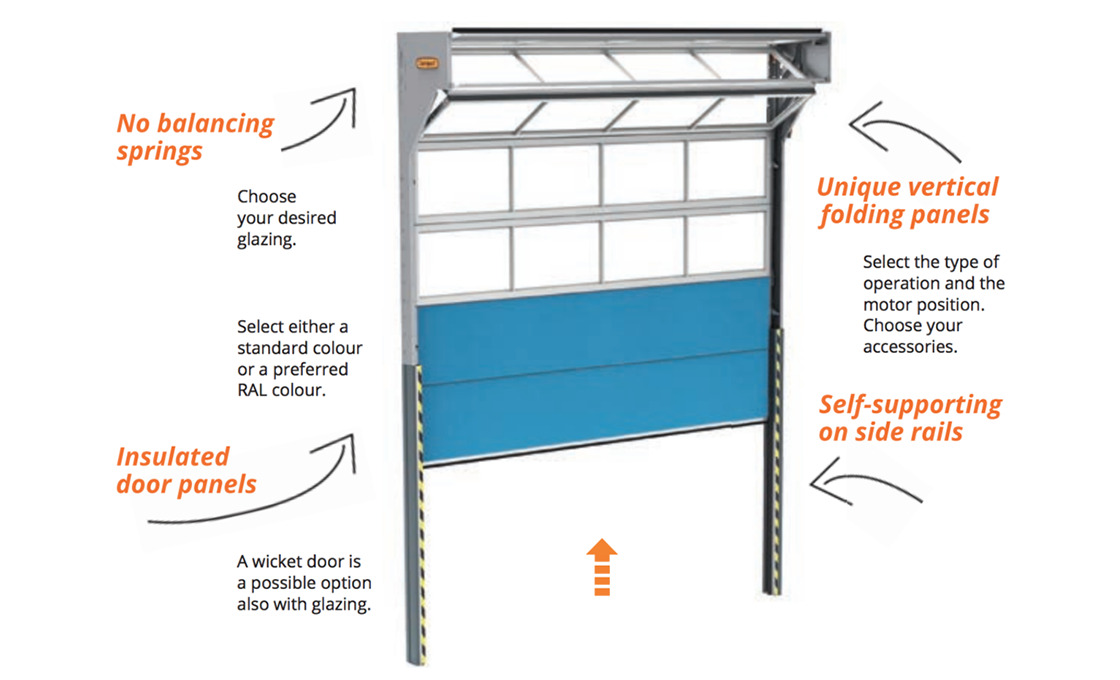
The second reason is geometry. A sectional garage door breaks into horizontal panels that ride curved tracks from vertical to horizontal, parking flat against the ceiling. Nothing swings into the aisle, nothing coils into a bulky drum over the opening, and the interior wall on either side stays free for racking, staging, or personnel doors.
In a working building that geometry converts directly into usable space. The approach lane can be tighter than any swing door allows, and forklift paths run straight. The headroom question becomes a specification detail: standard-lift, low-headroom, or vertical-lift tracks match the building you have. Rolling steel doors need the coil; sectional doors need only the ceiling.
Insulation and Energy Performance Numbers
The third reason is the thermal boundary. A sectional panel is not sheet steel; it is a 40 to 50 millimeter polyurethane foam sandwich, and RAX panels carry a U value of 0.33 W/m²K. That figure puts the closed door in the same conversation as the wall beside it. For a conditioned warehouse, a cold chain staging hall, or a workshop sharing air with an office, that number is the difference between a doorway and a hole.
Sectional garage doors also seal on all four edges: a bottom seal conforming to the floor, side seals in the tracks, and panel joints that close as the door seats. The insulation value survives the perimeter. This is where sectional garage doors beat rolling steel outright. A coil curtain cannot carry a thick insulated core, and a slat curtain cannot seal like a seated panel.
Security for Goods and Equipment
The fourth reason works nights. A closed sectional door is a steel wall. Panels resist prying, the track hardware sits inside the building, and powered versions add locks and monitoring to the same controller. For facilities that store inventory, tools, or vehicles behind their garage openings, the door is the perimeter after the lights go out.
Security math is threat-dependent, as always. An interior partition between two controlled halls needs less cut resistance than an exterior dock face; a yard-facing door in a rough neighborhood needs more than both. The steel sectional door scales across that range by panel gauge and hardware, which is why it serves the security conversation from light duty to hardened.
Panel Steel and Corrosion Protection
Underneath all five reasons sits the material spec, and it is where coatings earn their line in the purchase order. Bare steel rusts, so commercial door panels ship protected. Galvanized zinc coating is the baseline. The upgrade is aluminium-zinc coated steel, roughly 55 percent aluminium and 45 percent zinc, known widely as aluzinc, holding corrosion resistance longer for a modest premium. Where the budget or the coast allows, pure aluminium panels trade some rigidity for natural rust immunity in salt air.
One honest note: coating choice is a specification decision to write into the order, not a feature to assume. Galvanized, aluzinc, or aluminium — each has a corrosion band and a price band, and the right answer depends on the wall the door sits in. Ask the manufacturer which coating a given panel ships with, and put the answer in writing with the material certificate.
Where Sectional Doors Fit Best
The five reasons land differently by application, and the fit map is short enough to walk through.
Loading Docks and Logistics Hubs
Dock doors take the heaviest traffic and the most abuse, and sectional doors answer with panel-level repair, rated springs, and the tight approach lane that vertical operation allows. A damaged panel swaps without dismantling the door, which is how a dock stays in service through its own accidents.

Warehouses and Conditioned Spaces
Where the building pays to heat or cool, the U value does its work. Panels at 0.33 W/m²K turn the door inventory into part of the insulation plan, not an exception to it. Cold staging halls and food-adjacent logistics benefit most, because every degree the door holds is stock life.
Oversized and Special Openings
Sectional construction scales in a way swing and coil doors do not. Wide equipment bays, tall truck doors, and glazed-panel versions needing daylight all come off the same track logic. Single custom sizes are a normal order at RAX — no minimum quantity — so the odd opening is not a special project.

Sectional vs Rolling Steel Doors
The honest comparison closes the loop, because rolling steel doors are the other serious commercial option. The trade is headroom against insulation. A rolling door coils into a compact drum that fits low-ceiling buildings; a steel sectional needs ceiling track but pays it back with an insulated core and a four-edge seal. The short table is the whole decision.
| Priorities | Better pick |
|---|---|
| Low headroom, tight budget, no climate control | Rolling steel |
| Insulation, large spans, panel-level repair | Steel sectional |
| High security on both counts | Either, by gauge and hardware |
For the wider door-type map, the door type comparison covers the full family. The garage door opener guide handles the machine, and the high speed door type guide covers the fast-traffic end of the family.
Frequently Asked Questions About Sectional Garage Doors
How long do the springs last?
RAX torsion springs are rated for at least 30,000 cycles — years of dock-pace traffic. Warranty runs 2, 3, and 5 years by component.
Are sectional doors insulated?
Yes: 40 to 50 mm polyurethane cores with a U value of 0.33 W/m²K, sealing on all four edges of the opening.
Sectional or rolling steel?
Rolling steel for low headroom and budget builds; sectional for insulation, wide spans, and panel-by-panel repair.
Do the panels use aluzinc coating?
Coating is a specification choice — galvanized baseline, aluzinc upgrade for longer corrosion resistance. Confirm the spec in writing when ordering.
What the Popularity Comes Down To
Strip the brochure language and the popularity is one sentence: the steel sectional is the commercial opening that solves traffic, security, and energy in one maintainable assembly. Panels swap, springs are rated, insulation is a number on a drawing. The system scales from one warehouse opening to a full dock face, which is why specifiers keep writing it in. The RAX sectional door range covers that span with single-door orders accepted and sampling in 7 to 15 days.