A PVC high-speed door is the workhorse of the high-speed category: a flexible curtain on a servo drive that opens at 0.8 to 2.5 m/s, built for openings that cycle constantly but do not need the wind rating of a rigid door. At RAX we build these doors for cold storage, food plants, and distribution centers, and the same three questions come up in every spec meeting: what does it actually do, what does it give you, and where does it belong. This page is the answer, grounded in the physics of the opening rather than marketing claims.
In this article
What Is a PVC High Speed Door?
A PVC high-speed door uses a flexible PVC curtain that rolls vertically around a drum above the opening, driven by a servo motor. The curtain is light, which is the whole point — a lighter door accelerates faster and stops more gently. Compared to a rigid high-speed door, the PVC version trades wind resistance for lower cost and faster cycling on interior openings. That trade-off is what decides where it fits, and where it does not.
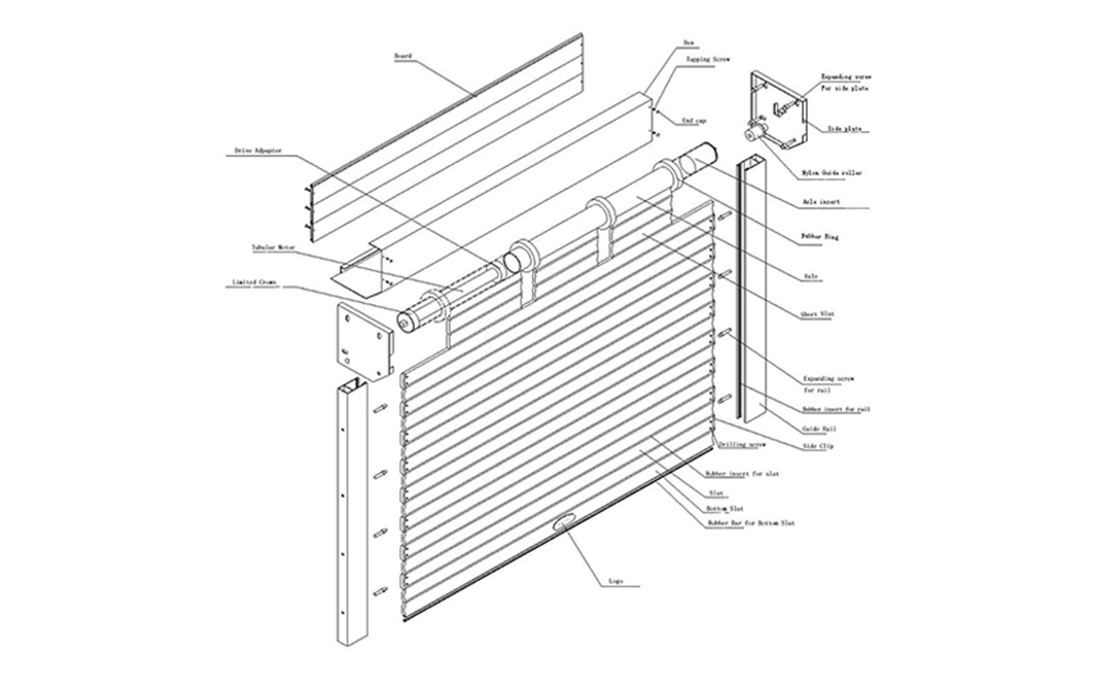
The frame is not an afterthought. RAX builds the side columns and drive housing from galvanized steel, with 6063-T5 aluminum available for door panels. The PVC curtain itself carries no rigid slats, which is why it survives the constant flexing of a high-cycle opening.
PVC High Speed Door Features
Servo Drive
A servo motor reaches 0.8 to 2.5 m/s and still brakes gently, cycle after cycle. That is what separates a high-speed door from a fast-looking standard roller shutter, and it is why RAX backs its servo motors with a 5-year warranty.
The closed control loop is what makes the speed usable. A servo drive reads an encoder continuously, so the controller always knows where the curtain is and how fast it is moving. The door decelerates into the fully open position instead of slamming into a mechanical stop. Those soft landings are what protect the drum, the curtain, and the mounting hardware across years of cycling. A fixed-speed motor brakes on a timer, and every stop is a small impact that adds up.
There is an energy side to it as well. A servo draws current while accelerating and recovers braking energy on deceleration instead of burning it off, and it draws essentially nothing while the door holds closed. On a door running two hundred cycles a day, that difference compounds into the operating cost.
Flexible PVC Curtain
The curtain flexes instead of folding, so it survives constant cycling. A transparent vision panel is available at forklift height so operators can see traffic on the other side before the door opens.
Curtain grade is specified by thickness: 0.8 mm for light interior duty, 1.2 mm as the general-purpose grade, and 2.0 mm where traffic and impact are heavier. A typical clear curtain material runs about Shore A 80 in hardness and transmits roughly 85 percent of light, which is what keeps a vision panel genuinely usable rather than decorative. For freezer openings, low-temperature grades stay flexible down to around -40°C instead of stiffening and cracking at the bottom bar.
On wider openings, horizontal wind bars carry the wind load across the curtain span. They release from the guides under impact and re-seat on the next cycle, so a forklift clip stays a near-miss instead of becoming a service call and a parts order.
Layered Safety
A light curtain or photo eye across the opening stops the door before contact. A reversing safety edge along the bottom senses an obstruction under a closing door, and a breakaway system lets the curtain release and re-feed itself after an accidental impact instead of jamming. A compliant door follows a safety standard such as EN 12453.
The requirements are written down and testable. Under EN 12453, the dynamic force a vertical-moving door may exert where a person could be reached is capped at 400 N, measured with calibrated instruments per the test procedure in EN 12445. Any automatically activated door requires supplementary protective devices, and those devices themselves fall under EN 12978. That is the difference between a door with safety listed on the spec sheet and one with safety measured on a test report.
The choice between devices matters. A single photo eye can miss anything below its beam; a light curtain scans the height of the opening beam by beam and stops the door at any obstruction. Wireless safety edges put a ribbon switch inside the bottom bar with a radio link to the controller, which removes the coiled cord whose flexing is a classic failure point on high-cycle doors. After an impact, the breakaway bottom bar releases from the guides and re-feeds on the next cycle — typically back in service in under a minute without tools.
Never bypass safety devices to keep the door running. A disabled light curtain or safety edge creates a serious injury risk and voids CE compliance. Schedule immediate repair instead.
Configurable Control
Acceleration, deceleration, and hold-open time can be tuned to the traffic, and the controller logs cycle counts and fault codes. Self-monitoring diagnostics stop the door and request service if the safety system itself fails.
Frequency-controlled drives make the speeds programmable rather than fixed. Many operators open faster than they close, and both profiles are set to the traffic the opening actually sees. The cycle counter is the maintenance clock: interval service gets scheduled on cycles run rather than calendar dates, and the count reads straight off the controller display.
Diagnostics are specific rather than a generic fault lamp. Fault codes point to the disturbed input or the safety edge, which turns a service visit into a part swap instead of a hunt. Self-monitoring is the deeper layer: the controller exercises the safety edge on every closing cycle, and a light curtain runs continuous self-diagnostics, so a failed device stops the door and asks for service instead of silently going blind.
Made-to-Size, No MOQ
The door is built to the opening, not picked from stock. Large industrial doors can be ordered one unit at a time, with no minimum order quantity.
Made-to-order sizing is part of how the industry defines this door class in the first place. Flexible-curtain doors are commonly built to openings up to around 9 × 6 m in standard constructions, with every dimension specified per project rather than picked from a stock list:
- Opening width and height, built to the structural opening
- Curtain grade and vision panel placement
- Frame material and corrosion protection
- Activation method — radar, induction loop, pull switch, or remote
- Safety package — photo eye, light curtain, wireless safety edge
A stock-size door forces the opening to fit the door; the project-built version arrives as a complete kit for the opening you actually have.
Benefits of a PVC High Speed Door
Energy and Temperature Control
On a freezer or a conditioned room, less open time means less warm air in, so the compressor runs less and the temperature stays steadier around the product. The speed is the energy feature — the door saves energy by being closed most of the time, not by insulating.
The physics are unambiguous. Air moves through an open doorway at roughly one meter per second, and in a cold store the exchange is buoyancy-driven: warm humid air enters at the top while cold dense air exits at the bottom. Under the ASHRAE infiltration model, door traffic in a high-cycle freezer can account for 30 to 60 percent of the total refrigeration load — often more than the walls or the product themselves. Cutting open time in half cuts the infiltration load roughly in half, and a door that clears and closes in 3 seconds instead of 15 reduces infiltration by around 80 percent.
The effect is documented, not theoretical. At a large food production and distribution facility in the Chicago area, retrofitting high-speed doors cut energy consumption by about 40 percent. Refrigeration runtime dropped as well, which extends compressor life on top of the direct savings.

According to the ASHRAE infiltration model, door traffic in a high-cycle freezer can account for 30-60% of total refrigeration load — often more than the walls or the product themselves. Energy codes like IECC and ASHRAE 90.1 now set explicit air-leakage limits for high-speed doors.
Hygiene and Contamination Control
In a food plant or cleanroom, a faster close means less time for dust, insects, or unfiltered air to cross the opening. PVC curtain surfaces and stainless hardware keep the door from becoming a contamination surface itself.
The regulator’s angle is pests. FDA’s food CGMP rule (21 CFR 110.20) requires effective exclusion of pests from food areas and self-closing doors where they are specified. FDA warning letters have cited door gaps as small as half an inch, with the live insects found inside to prove the point. A two-second close plus tight perimeter seals is the cheapest pest-control equipment in the building.
For washdown areas the specification is concrete. Components exposed to cleaning carry IP69K ratings, which means dust-tight plus survival of 80–100 bar water jets at 80°C. One caution worth carrying into the purchase order: specify IP69K where the cleaning process actually demands it, not as a default, because repeated chemical washdown degrades seals over time and the rating is a starting point, not a lifetime guarantee. In positive-pressure rooms, clean air pushes outward through the brief opening, and the fast close re-establishes setpoint before the pressure cascade collapses.
FDA warning letters have cited door gaps as small as half an inch, with live insects found inside food processing areas. A two-second close plus tight perimeter seals is the cheapest pest-control equipment in the building — but only if maintained.
Throughput
In a busy distribution center, a door that keeps up with forklift traffic stops being a bottleneck. A high-speed door is built for constant cycling, so operators spend less time waiting at the opening.
The traffic counts behind that are well mapped. Industry cycle ratings treat 20–50 cycles a day as low frequency, 50–200 as medium, and 200+ as high — the territory of distribution hubs, busy docks, and multi-shift cold storage. A 24/7 cold facility can push a single door past 1,000 cycles a day, and the door class is designed around a floor of 100 cycles a day.
Speed is the other half of the equation. A standard sectional or rolling door opens at roughly 0.15 to 0.3 m/s; the high-speed class starts around 0.8 m/s. As an illustrative sum rather than a sourced study: an opening cycling 300 times a shift and saving about 12 seconds per pass returns a full hour of accumulated forklift waiting per shift. The subtler loss is behavioral — slow doors train crews to prop them open, which quietly deletes the climate control the wall was built to provide.
Lower Total Cost on the Right Opening
A PVC high-speed door is a bigger investment than a standard shutter, but on an opening that cycles constantly it pays for itself through energy savings and throughput. The key word is “right opening” — on a low-traffic door the extra speed goes unused.
The price gap should be stated plainly. Installed, a basic industrial roller shutter commonly runs a quarter to a half of what a high-speed door costs for the same opening, and purpose-built food or freezer doors sit higher still. Distributors quote paybacks in the 18-to-36-month range on high-utilization openings — treat those as vendor claims, but the direction holds, because the savings scale with cycle count.
What the payback math usually omits is survivability. A flexible curtain that re-feeds after impact and a drive with no cycle-limited torsion spring change the repair profile of a frequently-hit opening; downtime, not purchase price, is where door budgets actually die. The honest caveats cut the other way too: high-speed doors reward being on a maintenance program, and a low-traffic dock with no climate or contamination concern is simply the wrong opening for one.
When comparing quotes, ask for the cycle rating and spring warranty, not just the door price. A door rated for 200+ cycles/day with a 5-year servo warranty will outlast a cheaper unit by years — and the downtime savings alone justify the difference.
Where PVC High Speed Doors Are Used
Logistics and Distribution Centers
Interior openings between warehouse zones and dock-facing corridors, where forklift traffic is constant and speed is the priority.
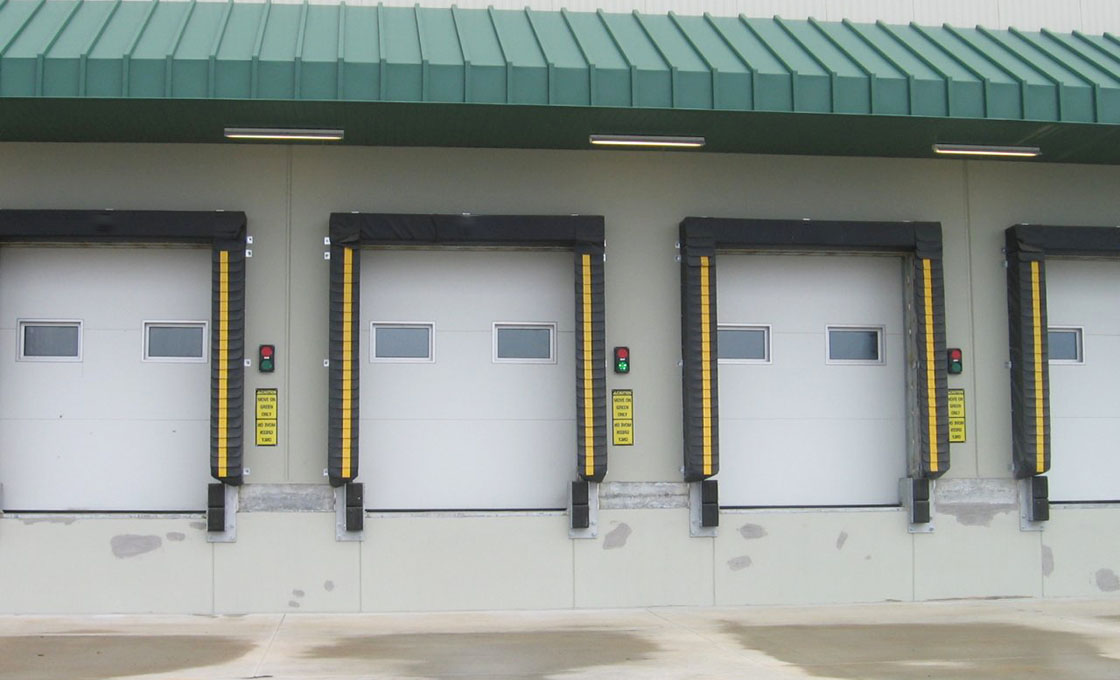
The geometry is standard. A dock door opening is typically 9 ft wide by 10 ft high to match a standard trailer, and a distribution center runs a mix: a slower insulated exterior door paired with a high-speed interior door as a vestibule, or high-speed doors alone as area separation between temperature zones. Selection follows the traffic count — the industry crossover where a high-speed door beats a slow insulated door on energy alone sits around 55 openings a day, and the case is fully realized by about 75.
Food and Beverage Processing
Production-room doorways and washdown areas where hygiene matters and the door has to close fast against temperature and contamination.
The compliance layer is explicit. FDA’s food CGMP rule requires that doors not open directly into areas where food is exposed to airborne contamination unless protection is in place — double doors or positive air pressure — and the same rule mandates pest exclusion from food areas. A two-to-three-second close is a narrow window for a flying insect, and tight perimeter seals close the half-inch gap that warning letters get written about.
For washdown zones the hardware is stainless. Stainless tracks, covers, and hardware with smooth, sealed surfaces leave no crevice for product buildup. Curtain grades are chosen to survive repeated cleaning with the plant’s actual chemicals rather than a generic “food-safe” label. The same door does the temperature work between zones: at a chilled-room boundary, the fast close limits air exchange across the line every single pass.
Cleanrooms and Pharmaceutical Facilities
Pass-through openings where a fast close preserves positive pressure, using washable PVC and stainless tracks. For these, see the cleanroom door range.
The mechanism is pressure, and the numbers are small. Adjacent rooms of different cleanliness classes are held 10 to 15 Pa apart so air always flows from cleaner to less clean, and every door opening is a temporary breach of that cascade. Airlocks with interlocked doors — the two doors never open at the same time, as EU GMP Annex 1 requires for higher-grade zones — are how the cascade survives daily traffic.
Materials follow the cleaning regime. Surfaces are non-porous and wipeable, typically stainless or coated, with sealed or coved joints that leave nowhere for particles to gather. Where vaporized hydrogen peroxide sterilization is used, door materials are specified to survive hundreds of VHP cycles without degrading or shedding.

Cold Storage
Freezer and cold-room openings with anti-icing and insulated curtain options, where the door’s job is to keep cold air on the cold side. For these, see the cold room door range.
The temperature bands set the problem. Chillers run at 2–4°C, frozen distribution at -18°C and below, and deep-frozen storage down to -35°C. In a high-traffic freezer, door infiltration can carry 30 to 60 percent of the refrigeration load, and the moisture in that air becomes frost on coils, walls, and the floor around the opening — a safety problem before it is even an energy problem.
Anti-icing is engineered, not hoped for. Frame and guide heating keeps seals from freezing to the frame; insulated or double-curtain designs trap a dead-air layer that stays above dew point; full-perimeter seals in low-temperature vinyl close the remaining gaps. Freezer doors in this class run at the top of the speed range — around 2 to 2.5 m/s open — because in a freezer, open time is the whole specification.
How to Choose the Right Type
Three answers decide the specification: how often the opening cycles, what environment it sits in, and whether it faces exterior wind. A high-cycle interior opening in a food plant points to a PVC high-speed door; an exterior dock facing weather points to a rigid door.
| Factor | PVC high-speed door | Rigid high-speed door |
|---|---|---|
| Curtain | Flexible PVC | Interlocking metal panels |
| Opening speed | 0.8-2.5 m/s | Up to 2.5 m/s |
| Wind resistance | Low to moderate | Class 5 (Beaufort 12) |
| Cost | Lower | Higher |
| Best for | Interior, high-cycle, washdown | Exterior, wind, security |
If you are ordering rather than specifying, the checks that matter — curtain grade, drive warranty, safety documentation, and cycle rating — are listed in the buying guide. To see what happens inside the mechanism, read how a high-speed door works.
Maintenance and Service Life
A PVC high-speed door is a production tool, and its service life follows the duty cycle and the maintenance. The curtain is a wear part — it flexes on every cycle — and the controller’s cycle count tells you when it is approaching replacement before it fails mid-shift.
The warranty tells you what the manufacturer actually stands behind. A 2-year door warranty, 3-year motor warranty, and 5-year servo motor warranty, with warranty spare parts shipped within 5 to 7 days, is a workable baseline for a door that runs constantly. So is a manufacturer whose in-house fatigue test lab is capable of testing up to 100,000 cycles. Combined with CE marking to EN 13241 and an ISO 9001:2015 quality system, that is a different supplier from one who ships on a spec sheet alone.
Get a PVC high-speed door built to your opening
RAX manufactures PVC high-speed doors to your opening dimensions, cycle rate, and environment — one door or a full container, with no MOQ. Send your opening dimensions and cycle rate for a specification and lead time.
FAQ
How fast does a PVC high-speed door open?
A PVC high-speed door opens at 0.8 to 2.5 m/s, driven by a servo motor. Most interior logistics openings run comfortably at the low end; freezer and high-cycle dock openings justify the top of the range.
What is the difference between a PVC and a rigid high-speed door?
A PVC high-speed door uses a flexible curtain and is lighter and lower-cost, best for interior openings. A rigid door uses interlocking panels and handles wind up to Class 5, so it is the choice for exterior walls and loading docks.
Can a PVC high-speed door be used in a freezer?
Yes, with anti-icing seals and an insulated or low-temperature curtain. The door’s job is to close fast and keep cold air on the cold side, which is why cold storage doors add anti-icing and insulation features a plain interior door does not need.
Is there a minimum order quantity for a PVC high-speed door?
Not with every manufacturer. RAX builds large industrial doors one unit at a time with no MOQ, so a single custom door is treated the same as a full container.
Conclusion
A PVC high-speed door is not a luxury upgrade — it is the right tool for the right opening. When you have high-cycle traffic, temperature control, or contamination concerns, the speed and seal of a flexible curtain pay for themselves in energy savings and throughput. When you have low traffic and security needs, a roller shutter does the job at lower cost.
The decision comes down to one question: how many times a day does the opening cycle, and what happens if it stays open too long? If the answer is “a lot” and “something expensive,” you need a high-speed door. If the answer is “not often” and “nothing critical,” a shutter is fine.
Specifying one comes down to two numbers: how many times a day the opening cycles, and what it costs you every second it stays open. Match the door to those numbers, and the choice makes itself. If you want a second opinion on a spec you have drawn up, that is the kind of question RAX answers every day.