At Raxdoors, our engineering team has seen countless modular cleanrooms fail prematurely due to poorly specified framing materials. When you are engineering a highly controlled sterile environment, the architectural backbone of your facility dictates its long-term operational viability. Choosing strategically between aluminum vs stainless steel cleanroom profiles is practically never just about the initial procurement budget. It requires a deep understanding of metallurgical properties and expected daily operational abuse.
After successfully outfitting hundreds of highly critical manufacturing facilities worldwide, we know the raw reality of the field. The wrong profile choice can easily lead to catastrophic biological contamination or heavily ballooning structural support costs over time. Whether you are actively dealing with aggressively caustic sterilization protocols or extremely tight rapid construction timelines, understanding the actual mechanical realities of these two industrial metals is absolutely paramount.
We deliberately built this incredibly comprehensive engineering comparison to help you make a truly airtight material decision for your next cleanroom project. We will systematically analyze critical structural load capacities, deep chemical resistance profiles, and long-term financial lifecycle implications. Let our veteran manufacturing experience guide you through the intricate nuances of proper cleanroom profile specification.
Structural Integrity and Modular Weight
Weight and Structural Support
At our engineering team, our engineering team evaluates structural dead loads heavily. The fundamental difference between these materials lies directly in their core mass. Stainless steel possesses immense structural strength for industrial load-bearing. However, it inherently comes with a severe structural weight penalty.
When specifying stainless steel cleanroom profiles, facility managers must account for heavily reinforced structural support ceilings. The dead load of a massive stainless steel grid can rapidly overwhelm standard commercial roof trusses. To avoid structural failure, we often mandate supplementary I-beams. Our team always analyzes the existing load-bearing capacity before recommending solid steel.
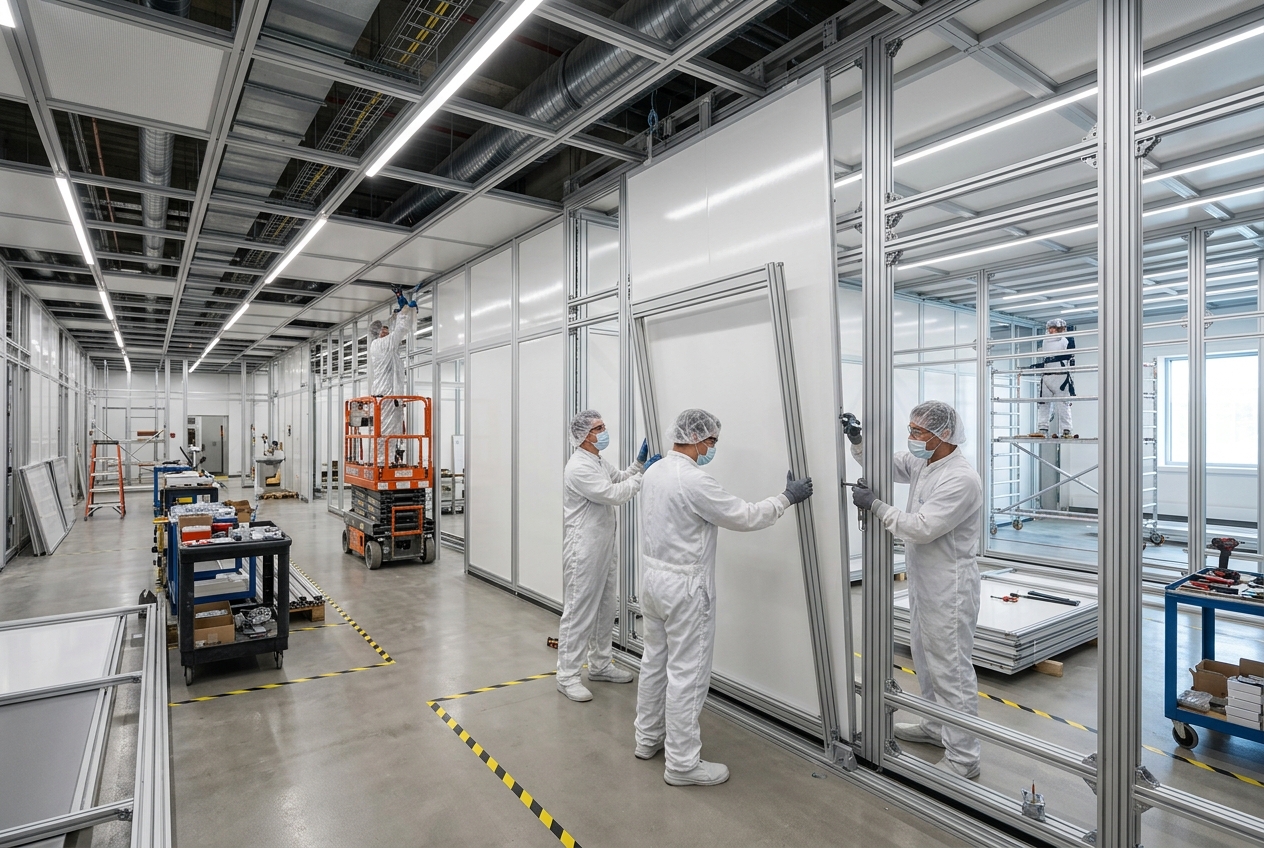
Conversely, aluminum framing provides an absolutely exceptional strength-to-weight ratio. The lightweight nature of extruded aluminum profiles fundamentally changes the structural engineering math. You achieve the required system rigidity without demanding supplementary structural steel above the cleanroom envelope. This directly simplifies overall facility ceiling design.
Modular Installation Speed
Time is physical capital in modern industrial construction projects. The heavy weight of stainless steel drastically slows down site maneuvering and overhead installation. Hoisting massive steel beams inherently requires heavy machinery and extended union labor hours. This sheer physical bulk makes rapid structural modifications practically impossible once the frame is anchored.
Welders must execute perfect connections in place, extending timelines. Aluminum cleanroom profiles completely revolutionize the total assembly timeline. Our expert installers can manually position aluminum extrusions rapidly. This directly accelerates the modular installation speed significantly during critical path phases.
Because it is highly workable, aluminum allows for quick on-site mechanical adjustments. When project timelines are aggressive, lightweight aluminum framing frequently emerges as the most strategic structural choice. Fast deployment keeps entire mega-projects on schedule and strongly limits costly operational downtime.
Contamination Control and Cleanability
VHP Sterilization and Material Pitting
Strict biopharma manufacturing environments rely on incredibly aggressive sanitizers to maintain compliance. Standard aluminum can suffer microscopic surface pitting when exposed repeatedly to Vaporized Hydrogen Peroxide (VHP) sterilization. This localized chemical corrosion creates microscopic crevices along the extrusion. Within these unseen pores, biological contaminants can easily evade standard manual wiping protocols.
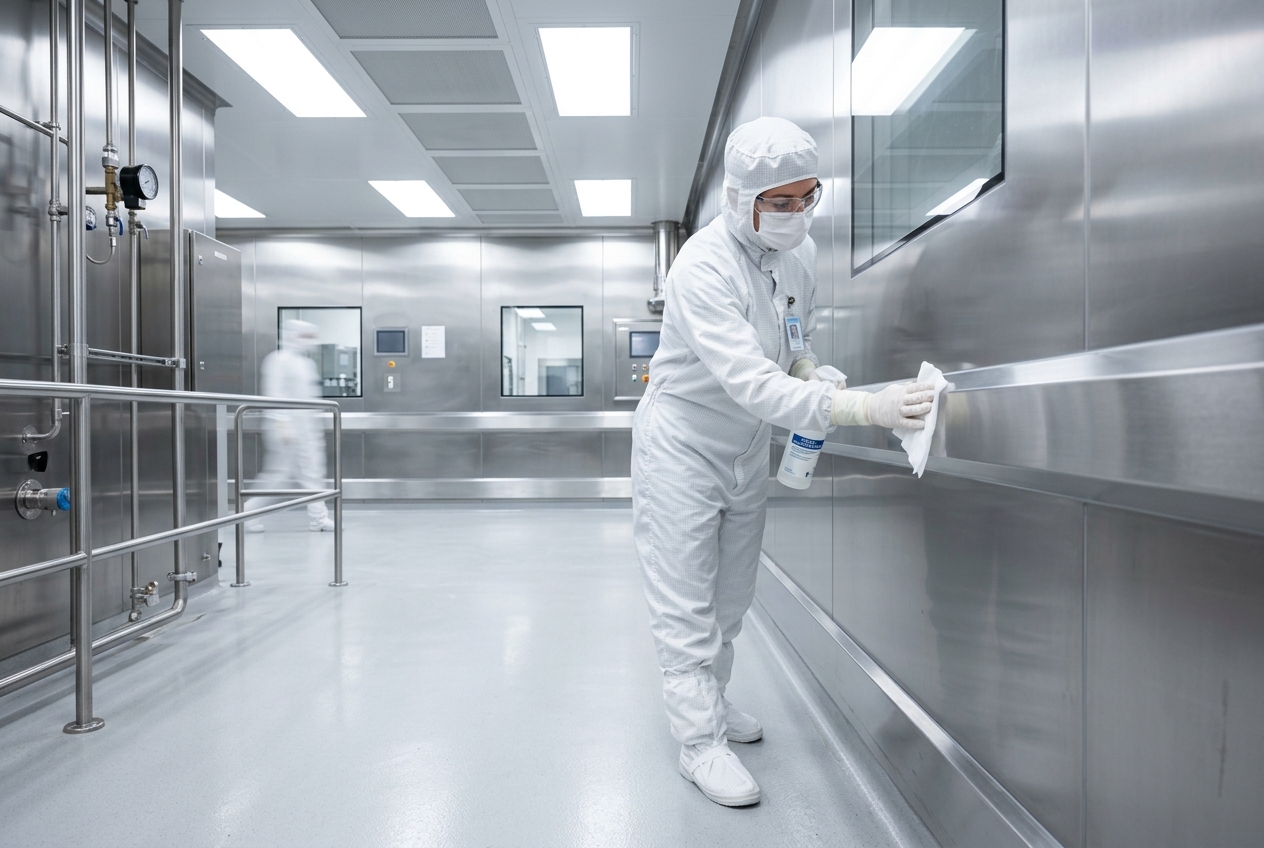
We advise extreme caution when specifying raw aluminum in any high-level bio-containment zones. Stainless steel unequivocally dominates when extreme chemical resistance is entirely mandatory. High-grade alloys like 316L seamlessly endure intensive VHP cycles without structural or surface degradation. This robust performance prevents any chemical reaction that could generate harmful metallic off-gassing.
For a deeper dive into sanitization impacts, review our insights on VHP sterilization cleanroom design. Stainless steel provides the absolute confidence required for continuous rigorous washdowns. It ensures flawless environmental testing results batch after batch.
Scratch Resistance and Bacteria Traps
Surface hardness directly dictates practical cleanability over a facility’s entire operational lifecycle. Aluminum scratches far more easily during heavy equipment move-in or routine daily maintenance operations. These fine mechanical abrasions act as insidious bacteria traps. Such microscopic traps will ultimately compromise your routine environmental monitoring results.
Even properly anodized aluminum cannot match the sheer metallurgical surface hardness of cold-rolled steel. Our engineering team at our engineering team often specifies stainless steel exclusively for heavy-traffic material corridors. Its incredibly dense metallurgical structure flawlessly resists heavy cart impacts and sharp tool abrasions.
Maintaining a perfectly smooth, unblemished wall surface is critical for preventing particulate shedding and microbial adhesion. Routine cleaning becomes significantly more effective on an unblemished metal profile. When severe mechanical abuse is anticipated, stainless steel profiles offer an impenetrable architectural barrier.
Corrosion Resistance and Durability
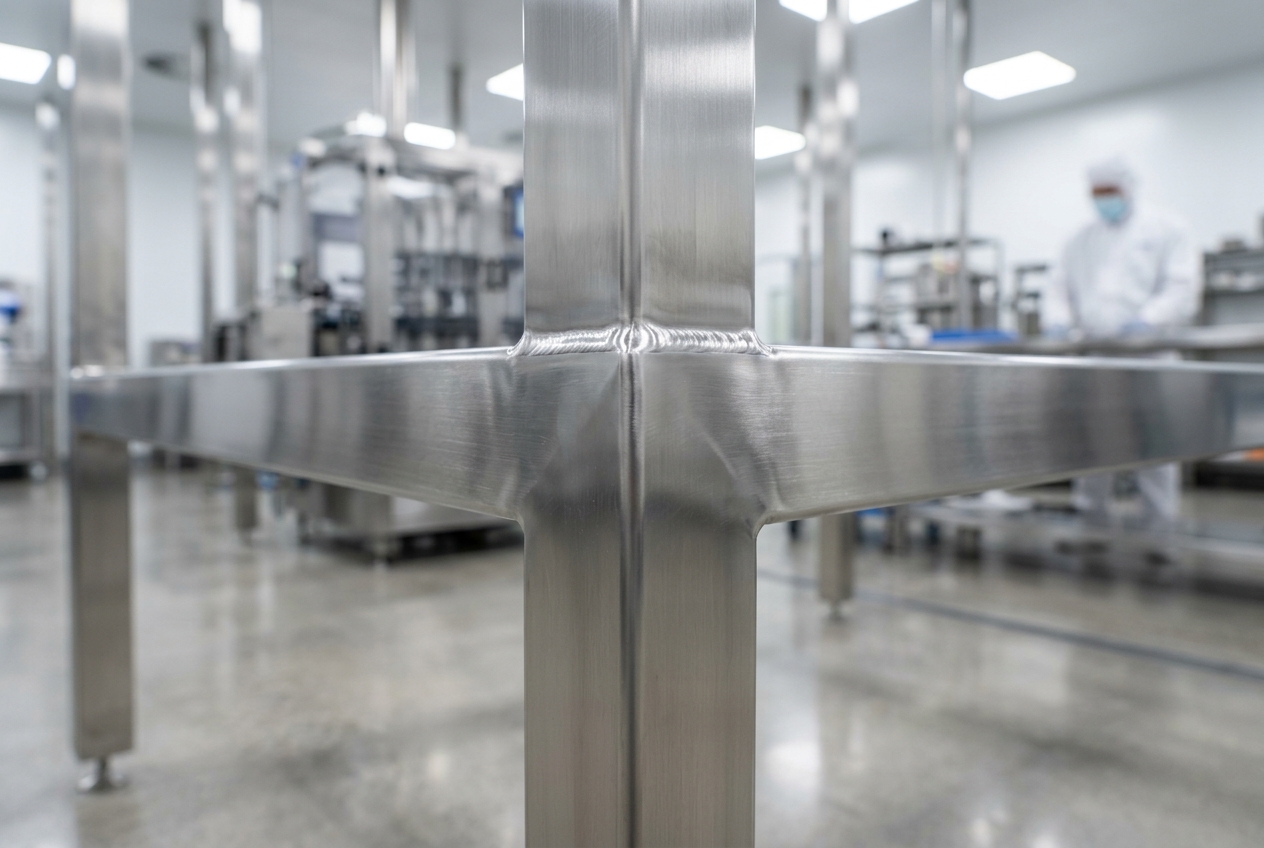
Risk of Rusting in Low-Grade Steel
A surprisingly common industry misconception is that all stainless steel is entirely immune to corrosion. Specifying low-grade metallic alloys in highly humid cleanrooms introduces a severe risk of rusting over time. If abrasive chloride-based cleaners strip the natural protective chromium oxide layer, the metal is exposed. Once exposed, even structural stainless steel will begin to oxidize and pit rapidly.
Controlling humidity and chemical exposure remains critical regardless of the steel grade chosen. Facility owners who cut financial corners on metal grades inevitably face catastrophic rouge formation. Rouge generation introduces lethal heavy metal particulates directly into the sterile manufacturing airflow. We strongly recommend scientifically verifying the exact material metallurgy prior to authorized installation.
Premium 304 or 316L stainless steel is absolutely non-negotiable for longevity in wet processing environments. Investing in certified, high-grade steel guarantees that your critical profiles remain completely pristine. It successfully eliminates the very hidden threat of systemic facility rust generation.
Aluminum Surface Treatments
Aluminum naturally forms a thin oxide layer that halts basic atmospheric corrosion instantly. However, this natural raw aluminum state is entirely unacceptable for controlled cleanroom deployments. Proper industrial anodizing fundamentally transforms the exterior profile. It effectively creates a chemically hardened, non-shedding barrier across the entire metal surface.
This electrochemical process dramatically enhances systemic durability while preserving the core lightweight advantages. Beyond standard anodizing, specialized electrostatic powder coating provides another exceptionally robust defense against chemical degradation. Powder-coated aluminum profiles offer excellent barrier resistance to standard cleaning agents and ambient facility humidity.
At our engineering team, we rigorously ensure all aluminum framing undergoes strict factory surface treatment protocols. We utilize premium thermoset powders that cure into a highly resilient protective envelope. This exacting preparation makes aluminum a highly viable option for dry, particulate-controlled environments.
Industry-Specific Application Scenarios
Need Expert Guidance on Cleanroom Framing?
Let our engineering team at our engineering team help you specify the exact profiles for your critical environment.
Pharmaceutical and Biotechnology
In the highly regulated pharmaceutical sector, microscopic contamination equals a complete and devastating batch failure. Routine structural washdowns with aggressive sporicides and continuous VHP gassing are standard daily operating procedures. Consequently, the industry heavily prefers 316L stainless steel for almost all architectural structural applications. Its non-reactive surface inherently resists chemical blinding and prevents dangerous cross-contamination.
It reliably withstands the relentless chemical onslaught specifically required by modern GMP standards. Aluminum is exceedingly rarely deployed in primary biopharma Grade A or B manufacturing zones. When designing critical drug compounding facilities, our engineering team strictly mandates stainless steel. This strategic choice is made explicitly to eliminate any potential risk of chemical pitting.
You can explore how these framing choices impact critical access points in our cleanroom door materials guide. Strict FDA and EMA regulatory compliance leaves absolutely no room for unexpected material degradation. Ensuring patient safety starts directly with robust facility architectural design.
Semiconductor and Electronics
Semiconductor fabrication plants prioritize massive architectural scale and extreme airborne particulate control above all else. These sprawling technological environments are typically very dry and do not require caustic chemical washdowns. In these massive high-tech facilities, extruded aluminum is undeniably the absolute industry standard. Its remarkable lightweight nature allows structural engineers to build massive, suspended ceiling grids efficiently.
This drastically reduces the dead weight imposed on the primary facility superstructure. Modern micro-electronics cleanrooms demand immense design flexibility for constantly shifting automated tool layouts. Aluminum profiles are engineered to integrate seamlessly with standard teardrop lighting and FFU mechanical systems.
We have successfully outfitted massive semiconductor fabrication bays globally. In those environments, the installation speed and adaptability of aluminum framing proved utterly invaluable. It dynamically delivers the perfect structural balance of reliable rigidity and rapid modular agility.
Cost Comparison and Project Budgeting
Initial Material Costs
The upfront capital expenditure between these two unique materials represents a massive financial divergence. Stainless steel is fundamentally classified as a premium industrial commodity. Consequently, it demands significantly higher raw material market pricing than standard aluminum extrusion. When outfitting massive large-scale manufacturing facilities, the initial cost of stainless steel makes large modular builds prohibitive.
This high pricing frequently completely derails preliminary facility construction budgets before ground is broken. You are also heavily paying for specialized commercial freight and exceedingly difficult manual site handling. Aluminum profiles offer exceptional architectural cost-effectiveness literally right out of the factory gate.
For a detailed financial breakdown of overall expenditures, check out our guide on modular cleanroom construction costs. By strategically utilizing engineered aluminum, specialized procurement teams can drastically reduce structural capital expenses. This effectively allows savvy project managers to reallocate crucial funds toward advanced HVAC or air filtration systems.
Long-Term Maintenance and Upkeep
Initial capital expenditure is realistically only one single facet of total facility lifecycle costs. While high-grade stainless steel is undeniably expensive initially, its routine maintenance demands are virtually zero. It will absolutely not require specialized recoating or structural patching over its operational life. Furthermore, it effortlessly survives literally decades of brutal daily mechanical and caustic chemical abuse.
In high-risk critical biopharma operations, this proven long-term reliability easily justifies the massive upfront capital investment. Aluminum panels may require specialized periodic visual inspection and potential component replacement if localized physical damage occurs. However, in highly dry electronics manufacturing spaces, its functional lifespan perfectly matches that of the overall facility itself.
Our veteran mechanical engineers at our engineering team always calculate the entire total cost of ownership over twenty distinct years. We deeply analyze operational procedures before signing off on any material procurement sheet. Matching the chosen material directly to the actual daily operational environment effectively prevents wasteful financial over-engineering.
Design Flexibility and Component Integration
Sealing Systems and Airflow Control
Maintaining exact atmospheric pressure differentials is the fundamental core function of any controlled cleanroom envelope. Aluminum extrusions are brilliantly factory engineered with highly precise, integrated receiving channels for specialized silicone gaskets. These finely engineered channels allow metallic profiles to accommodate elastomeric gaskets absolutely perfectly.
This directly achieves flawless hermetic seals with incredibly minimal manual labor on the active job site. This incredibly tight integration ensures zero systemic air leakage and highly predictable facility airflow control. Solid stainless steel frames must very often be completely custom-fabricated and hand-welded to achieve similar critical airtightness.
The notoriously rigid physical nature of stainless steel makes required field modifications during the active sealing process highly complex. We rigorously ensure all our engineering team framing systems, entirely regardless of chosen material, successfully meet strict ISO leakage tests. However, the inherently modular geometric nature of engineered aluminum simplifies the final sealing process dramatically.
Glass and Vision Panel Integration
Modern industrial cleanrooms inherently require extensive visual visibility for personnel safety and routine operational monitoring. Integrating complex flush-mounted architectural glass and robust vision panels is utterly seamless with extruded aluminum profiles. The standardized geometric slots within the advanced aluminum matrix effortlessly accept varied glass thicknesses instantly.
This brilliant modular compatibility completely eliminates the critical need for messy, custom secondary framing elements. It ultimately keeps the internal cleanroom walls totally flush and exceptionally easy to wipe down. Installing heavy-duty vision panels into solid stainless steel frames requires precise factory laser cutting.
Furthermore, it demands bulky heavy-duty mechanical retention systems that can easily harbor invisible microbial growth. The sheer physical stiffness of stainless steel means manufacturing tolerances must be absolutely flawless prior to site delivery. We have historically found that modular aluminum predictably grants field technicians the necessary mechanical flexibility.
Final Comparison Summary Table
To synthesize these highly complex engineering variables, we have meticulously compiled a quick-reference parameter table comparing both architectural materials. Our veteran team at our engineering team routinely relies on these specific structural metrics when successfully consulting on massive new facility builds. Use this definitive engineering data to securely guide your own final structural project decisions.
| Performance Parameter | Aluminum Profiles | Stainless Steel Profiles |
|---|---|---|
| Initial Material Cost | Highly cost-effective, massively budget-friendly | Premium pricing, often prohibitive for massive builds |
| Structural Weight | Exceptionally lightweight, minimal ceiling support needed | Extremely heavy, severely requires reinforced roof ceilings |
| VHP Resistance | Highly susceptible to microscopic chemical pitting over time | Complete absolute immunity to harsh chemical degradation |
| Installation Speed | Rapid modular assembly with very easy field modifications | Slow process, strictly requires heavy machinery and welding |
| Primary Industries | Semiconductor, Electronics, Aerospace, General Assembly | Pharmaceutical, Biotech, Advanced High-Level Containment |
Ultimately, your primary material choice dictates the operational safety ceiling of your entire controlled facility. At our engineering team, we fundamentally believe there is absolutely no universal winner in this debate—only the explicitly correct material engineered directly for your specific contamination control requirements. Let our extensive manufacturing expertise successfully ensure your next critical cleanroom build is structurally sound and strictly regulatory compliant.
Frequently Asked Questions
Does aluminum pit when exposed to VHP sterilization in cleanrooms?
Yes, standard aluminum can pit when repeatedly exposed to Vaporized Hydrogen Peroxide (VHP). Anodized or coated aluminum offers better resistance, but stainless steel remains superior for VHP.
Why is stainless steel preferred for pharmaceutical cleanrooms?
Pharmaceutical environments require rigorous washdowns and harsh chemical sterilization. Stainless steel (especially 316L) withstands these treatments without corroding or degrading.
How much more does stainless steel cost compared to aluminum profiles?
Stainless steel generally costs significantly more upfront than aluminum, making it a prohibitive choice for large modular builds where budget is a primary concern.
Can aluminum cleanroom framing support heavy modular structures?
Yes, aluminum profiles are strong and lightweight, allowing for structural stability without the need for the extensive reinforced structural support required by heavy stainless steel.
How do you prevent cheap stainless steel from rusting in cleanrooms?
Avoid low-grade steel by investing in 304 or 316L stainless steel. Ensure proper maintenance and avoid abrasive cleaners that can damage the protective chromium oxide layer.