







Two gates of the same weight can put the same swing gate motor through two completely different working lives. One swings a short leaf four times a day at a private home; the other hauls a four-metre leaf through a school run’s worth of cycles. The catalogue weight rating covers both. The leaf length, the solid infill and the daily cycle count appear nowhere on the box.
At our factory, every operator and control box leaves the line with a test report, and the line that decides a swing gate motor’s fate is motor temperature rise. A rating sheet says what a motor can do for one cycle. The temperature-rise line says what it can do for yours, at your cycle count. We hold our gate operators to the same duty discipline as our industrial doors, where cycle counts separate a spec sheet from a service life.
What the Ratings on a Swing Gate Motor Mean
A swing gate motor carries two ratings, and buyers who read only one of them end up with the wrong operator. Leaf weight gets all the attention because it looks like the whole story. Leaf length is the second line, and it matters just as much. A long, light leaf loads the operator as heavily as a short, heavy one, because the extra length works as a lever against the hinge.
Torque is the number underneath both ratings, and it comes from weight times lever arm. The lever arm runs from the hinge to the gate’s centre of mass, so a wide or solid leaf reaches further than its weight suggests. Size the motor to the weight and the arm, then add a margin of 20 to 30 per cent for wind, inertia and bolt-on accessories. A motor without that margin stalls, overheats and trips its protection on ordinary afternoons.
Our own operators are rated the same way they are tested, on measured leaf length and measured leaf weight rather than catalogue peaks. That is the dual-rating logic our industrial doors ship with. For the leaf side of the same question, our guide to what an automatic door opener for heavy doors must move walks the matching arithmetic. Ask a supplier for both lines and you will learn quickly whose numbers are measured.
Putting the two lines to work takes one question at the quote stage. Ask which leaf length and leaf weight the proposed model was selected on, and ask for both in writing. A supplier who measured your gate will answer in minutes. One that guessed will answer in adjectives, and adjectives are what the margin of 20 to 30 per cent is there to absorb.
The two ratings also move together when the leaf gets modified. A cladding upgrade or a privacy screen adds weight at the far end of the leaf, which grows the lever arm and the torque demand at the same time. Re-measure after any change to the leaf. An operator sized before the upgrade carries a margin that no longer exists on paper.
Wind load belongs in the same conversation. A solid leaf facing the prevailing weather acts like a sail at the worst moment of every cycle, and the datasheet figure assumes a calm one. Slatted or open infill sheds most of that load, which is one of the few free upgrades in gate design. If the driveway funnels wind between buildings, say so at the survey stage and let the margin be sized with it.
Match the Operator Type to the Pillar and Leaf
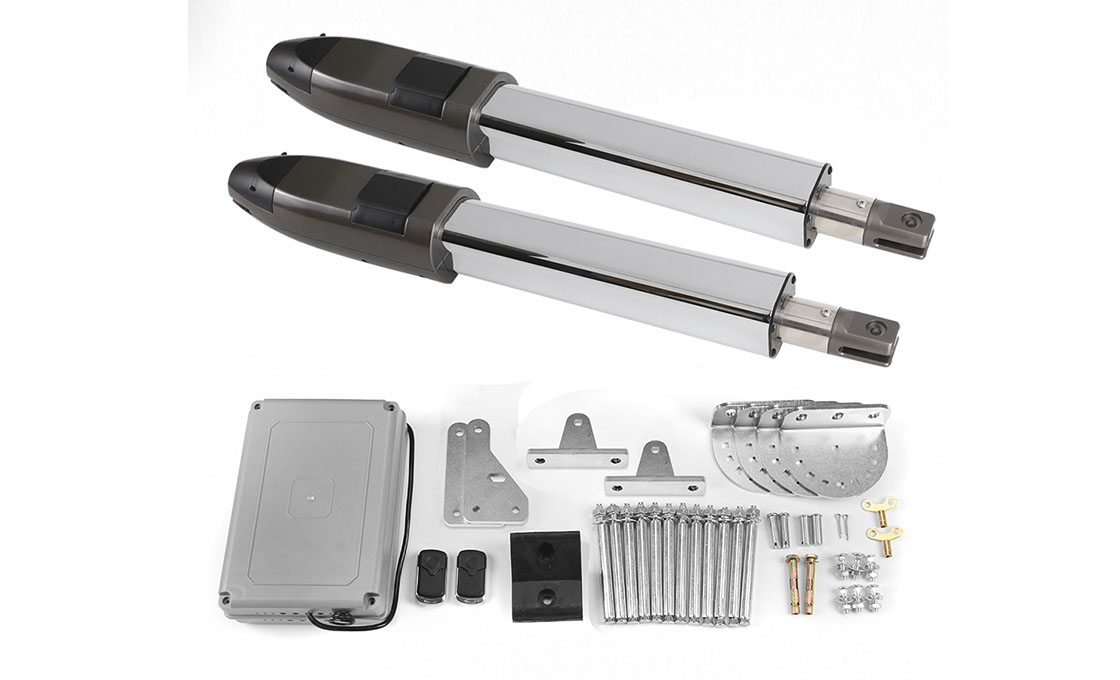
Three operator families move a swing gate, and the pillar chooses between them long before the brochure does. A linear ram bolts in a straight line between post and leaf. An articulated arm folds at a joint to reach around masonry. An underground operator hides the whole mechanism in a foundation box at the hinge. The table condenses the fit.
| Antriebstyp | Wo er passt | Trade-off |
|---|---|---|
| Linear ram | Narrow posts from 100 mm, hinges at rear or centre, leaves to 350 kg and 5 m | Cheapest; mostly inward opening only |
| Articulated arm | Wide brick or stone pillars, hinges set back up to 300 mm, leaves to about 600 kg | Visible jointed arm; cycles a little faster |
| Underground | Heritage and design-led entrances, leaves to about 900 kg, nothing visible but the hinge | Foundation box, drainage, service access |
| Double leaf | Openings past 5 m split into two shorter leaves, one motor per leaf | Sequencing board; match each leaf’s own weight |
| Retrofit pick | Sound existing gate that swings freely by hand on a narrow post or wide pillar | Underground retrofits rarely pay once digging starts |
The ram’s geometry rule is the one that sends the most motors back. A straight actuator only works when the hinges sit at the rear or centre of the post, and the post itself needs at least 100 mm of depth to mount. Hinges fixed to the front face put the correct line out of reach, and no rating on the datasheet changes that.

An articulated arm buys back the awkward cases. Its two-segment arm folds around wide piers and can compensate for hinges set up to 300 mm back from the rear pillar face. The arm stays visible when the gate is open, and the joint adds one more point to service, which most buyers accept for the fit it makes possible.
The choice also locks in the service pattern. A ram exposes its whole mechanism on the post, so a worn bearing shows itself before it fails. An articulated arm adds the joint to the inspection list. An underground box hides everything, which is why its drainage and access plan decide whether the yearly service is a checkup or an excavation.
Speed rarely decides the shortlist, but it is worth a line in the comparison. Ram actuators complete a cycle in roughly 12 to 15 seconds, and articulated arms run a little faster at 10 to 20 seconds. On a busy entrance those seconds stack into queues. On a quiet driveway they are noise, which is exactly the kind of parameter worth ignoring when the site does not care.
Underground operators trade excavation for invisibility. Each hinge needs a foundation box set level in concrete, drainage channels so water cannot pool, and a planned route for future access. Water sitting in a box is the main way these units die, so the drainage conversation belongs in the quote, not in the warranty claim.
Before any of this, measure the arc. The full leaf length sweeps through open air, and on many properties that arc meets a parked car, a garden wall or the pavement. Split a wide single leaf into a double gate and each leaf swings through a smaller radius with a lighter motor. Where no direction clears, wie ein Industrieschiebetürenantrieb funktioniert is the companion reading, because sliding is the honest answer on a steep or crowded drive. It is a habit borrowed from our industrial doors work, where a blocked opening shows up at the survey or gets paid for at the install.
Size the Duty Cycle Before the Price
Duty cycle is the share of time a motor can run before it must rest, and it is the rating that separates a quiet household from a busy entrance. A private driveway opens its gate a handful of times a day. A shared road, a depot, a school or a car park counts its cycles in dozens or hundreds. The same swing gate motor lives a different life in each place. It is the figure we ask for first on industrial doors projects, because gates deserve the same question.
The published bands make the gap concrete. Linear rams typically carry a duty cycle around 25 per cent, underground units sit at 40 to 50 per cent, and articulated arms usually land above a comparable ram. Those figures describe continuous ratings, not marketing tiers. A motor run at its limit on every cycle never gets the rest its rating assumes.
Count the worst day, not the average one. Deliveries, school runs, a contractor’s van and a family’s evening all land inside the same hour on some days, and duty ratings assume continuous work. A gate that opens forty times on a Friday afternoon needs hardware rated for forty cycles, whatever the gate weighs.
Run a residential-grade unit on an estate entrance and the failure arrives early. A motor sized on weight alone, with the cycle count ignored, can burn out in two years when it should have lasted ten. The replacement cost is only the invoice you expect; the trapped vehicles and the forced manual releases are the ones you do not.
In our practice, the duty decision gets settled by the temperature-rise line on the factory test report rather than by the duty badge on the box. Every operator we ship carries that line, measured at the cycle count the order specifies. Two motors with identical weight ratings can sit several degrees apart at the same workload, and the hotter one is the answer to a question no brochure asks.
Choose the Voltage and the Power Backbone
Voltage decides how the motor behaves long before it decides how hard it pulls. A 24V DC swing gate motor runs quietly, starts and stops softly, and takes the shock off the gate and the hinges. Its low-voltage supply also pairs naturally with a battery, so the gate still opens during an outage, and with solar charging on sites where the grid never reached.
A 230V AC motor draws straight from the mains on EU, UK and Australian supplies rated at 230V 50Hz. It buys raw power at a lower price for gates in moderate use. It starts harder and carries no backup. On US sites the household circuit is 120V 60Hz, and low-voltage operators step that down internally, so the same 24V logic applies with a transformer in the path.
Whichever voltage you pick, the control board is where the daily experience lives. Five features do most of the work:
- Soft start and soft stop, which take the surge off the leaves and hinges on every cycle.
- Adjustable limit switches, so the gate stops cleanly instead of slamming at either end.
- A photocell safety input, wired and ready, because the safety devices below depend on it.
- An auto-close timer, so the entrance never stays open because someone forgot.
- Battery backup support, which turns a power cut from a locked gate into a non-event.
Battery capacity deserves a direct question rather than a datasheet glance. Ask how many open-close cycles the backup supports at your leaf’s weight, and how the board behaves when the battery runs low. A backup that holds two cycles covers a blackout evening. One that holds twenty covers a weekend.
Mains quality rounds out the power question. A supply that dips when the compressor or the welder down the lane starts can reset a control board mid-cycle, and the gate stops wherever it happens to be. Where the supply is shared or marginal, a board with wide input tolerance and proper surge protection is worth specifying on the order. Finding it out after the second callout is the expensive version of the same lesson.
Off-grid entrances change the calculus rather than the conclusion. A solar panel and battery sized to the daily cycle count run a 24V ram or arm without a trench to the mains. Our operators ship in 24V DC builds for exactly those intensive, battery or solar sites. Underground units can run on solar too, but their standby draw and their groundworks make the pairing less common.

Safety and Control Features You Should Never Trim
A swing gate motor is not the safety system, whatever the box art implies. Photocells detect a vehicle or a person in the arc. Auto-reverse backs the leaf off on contact, and a manual release keeps the entrance usable during a power cut. Together they are the baseline, and a powered gate without them can crush a bumper, a pet or a child.
The standards frame the same demands from two directions. European force-limit rules under EN 12453 govern how hard a powered gate may push. The ASTM specification for automated vehicular gates governs how the gate itself must be built, from exposed gaps to guard requirements. Our industrial doors ship with CE paperwork for the same reason. A gate and operator that both carry their papers leave the installer far fewer judgement calls on your driveway.
Practice the manual release once with the gate closed. The mechanism that frees a dead motor is usually a keyed or levered coupling on the actuator. Operating it for the first time during a blackout is a poor way to learn. Put the release key where the household or the site log says it is, and note the step in the handover documents.
Access control has its own small print. Rolling-code remotes defeat code grabbing, and mixing remote protocols across brands leaves gaps in both reliability and security. A gate that must talk to an intercom, a keypad or a building system deserves one control philosophy, decided before the order rather than improvised after it.
Warning signs and edge protection finish the safety set on shared entrances. A moving leaf is not obvious to a visitor on foot, and the standards treat visibility as part of the design rather than an optional extra. Photocells cover the arc while the leaf moves, but a leaf that can sweep a waiting vehicle still needs the approach marked and the cycle times kept honest. It is the same discipline our industrial doors meet on loading bays, where the approach is part of the safety design.
Connected features sit on top of that base. Our guide to what smart door opener app control actually covers separates the useful additions from the gimmicks. The same rule applies to gates as to doors: the smart layer should ride on a safe, correctly sized machine.
Will Your Motor Survive Your Busiest Gate Season?
Tell us your leaf weight, leaf length and hinge geometry, and our engineers will match a swing gate operator with the factory test lines attached.
What to Check Before You Buy a Motor
Measure the Geometry, Not Just the Weight
Six numbers decide whether an operator fits your entrance, and weight is only the first. Measure the leaf weight, the leaf length, the hinge offset from the post face, the post depth, the opening angle the site allows, and the clear arc behind the leaf. Add the nearest power supply, because a trench or an electrician’s visit is part of the project budget. Photograph the pillar and the hinge from two angles while you are there, because the pictures settle more arguments between suppliers than any brochure.
Hinge geometry deserves its own line on the worksheet. Rear or centre hinges suit a linear ram, deep setbacks on wide piers point to an articulated arm, and opening angles between 90 and 120 degrees cover most residential sites. The survey-first sequence we run on industrial doors projects exists for the same reason here. A measurement taken at the pillar costs minutes, and the same measurement missed costs a second delivery.
Fix the Gate Before You Automate It
Automation magnifies whatever it is bolted to. A gate that drags, drops or sticks by hand will punish any motor. Using a motor as a cure for a gate that already needs repair is the most common way these projects go wrong. Walk the entrance and check the posts for movement, the hinges for wear, the welds and frame for cracks, and the end stops for shift. Repair first, then automate, and the motor you chose for the right reasons finally gets to be the right choice.
Pillars get judged less often than the leaf, and they fail more quietly. A post that rocks under hand pressure moves a little more under a motor that starts and stops a leaf twice a day. Hairline cracks at the base grow into a lean after a wet season. Every one of those faults is cheap to fix before the operator goes on and expensive to trace after.
Ask for the Test Lines and the Paperwork
A serious quote for a swing gate motor reads like a test sheet. It names the measured leaf weight and leaf length the model was selected on, the duty assumption behind the sizing, and the factory test lines that travel with the unit. Our wiring diagrams and English manuals ship with every order, CE covers EN 13241 and EN 12453, and the operator carries a three-year warranty. Ask every supplier for the equivalent lines, and the quotes finally become comparable.
Comparability is the quiet benefit of that request. When every quote names the same measured inputs, the differences left between quotes are real differences between machines, not between sales styles. A quote that will not name its sizing inputs has answered the question anyway. Treat the paperwork as part of the price, because the cheapest bid without it is the most expensive one to accept.
Installation, Groundworks and Life-Cycle Costs
Installation effort splits along the same lines as the hardware. A ram or articulated arm bolts to the existing structure, sets its travel stops and wiring, and finishes within a day on a prepared site. An underground operator adds the foundation box, the drainage and the conduit run. That is civil work with an excavator and a schedule, not an afternoon with a drill.
Timing matters as much as method. Ram and arm installs want the gate already sound and the cable route agreed, or the day fills with small delays that show up on the invoice. Underground installs put the decisions in the concrete, so the box position, the drainage fall and the conduit exits deserve sign-off before the pour. It is the same sign-off habit we run on industrial doors sites, where a poured mistake outlives the crew that made it.
Budgets follow the hardware, and the clearest published picture comes from the Australian retail market (AU retail, AUD). Ram kits run AU$600 to AU$1,500 with installation taking a typical project to AU$1,500 to AU$3,500. Articulated arms span AU$2,000 to AU$4,500 installed. Underground systems start near AU$4,000 and pass AU$8,000 once groundworks are counted. Local labour markets move every one of those bands, which is why the itemized quote matters more than the headline.
Life after installation is a maintenance rhythm, not an event. Test the gate and the remotes monthly, clean the hinges and the photocells quarterly, and book a professional service annually for lubrication and travel-stop checks. The industry association’s safety guidance puts trained technicians behind that work, and the cadence is the same one our industrial doors fleets follow on facility contracts. A backup battery needs replacing every three to five years, and a maintained motor typically serves ten to fifteen.
Choose the way you started: by numbers that can be checked. A swing gate motor selected on measured leaf length and weight, sized for the busiest day’s cycles, is a machine you can forget about. Ten years on, it should still be ordinary. That ordinariness is the outcome worth paying for.
Häufig gestellte Fragen
Wie dimensioniere ich einen Schwingtorantrieb für ein zweiflügliges Tor?
Use two motors, one per leaf, with a control board that sequences the opening so the leaves never collide. Match each motor to its own leaf’s weight and length, not to the combined total.
Kann ich ein bestehendes manuelles Flügeltor automatisieren?
Ja, wenn das Tor von Hand frei schwenkbar ist und die Pfosten, Scharniere sowie der Rahmen in gutem Zustand sind. Rams eignen sich für schmale Pfosten, Artikulationsarme für breite Pfeiler, während unterirdische Nachrüstungen nach Beginn der Ausgrabung selten wirtschaftlich sind.
Wie lange hält ein Schwingtorantrieb?
Eine gewartete Einheit hat typically eine Lebensdauer von zehn bis fünfzehn Jahren. Monatliche Tests, vierteljährliche Reinigungen und eine jährliche professionelle Wartung gewährleisten dies, und die Backup-Batterie muss alle drei bis fünf Jahre ersetzt werden.
What duty cycle does a swing gate motor need?
Count the busiest day’s cycles. A home opening a few times a day sits comfortably on a 25 percent ram, while shared entrances running dozens of cycles need 40 to 50 percent duty hardware.
Soll ich für einen Flügeltormotor 24 V DC oder 230 V AC wählen?
A 24V DC motor runs quieter, starts softly and keeps a battery backup alive during outages. A 230V AC unit costs less and pulls harder but starts abruptly with no backup, which matters on single-access driveways.
Why does leaf length matter as much as weight?
Length works as a lever arm against the hinge, so a long, light leaf can load the operator as heavily as a short, heavy one. If nobody measures the leaf, the motor strains on every single cycle.